Introduction
Chemical Process Simulation Software helps engineers model, analyze, optimize, and validate industrial chemical processes in a virtual environment before physical deployment. These platforms simulate thermodynamics, fluid flow, heat transfer, chemical reactions, separation processes, and plant operations to improve efficiency, reduce operational risks, and optimize production.
Modern process simulation tools are now deeply integrated into industries such as petrochemicals, oil & gas, pharmaceuticals, food processing, specialty chemicals, and energy production. As industries increasingly focus on sustainability, digital transformation, carbon reduction, and operational efficiency, simulation platforms are evolving with AI-assisted optimization, digital twins, cloud collaboration, and real-time operational analytics.
Real-world use cases include:
- Designing chemical plants and refineries
- Process optimization and debottlenecking
- Energy efficiency improvement
- Carbon capture and sustainability modeling
- Operator training and safety analysis
Key evaluation criteria buyers should consider:
- Thermodynamic modeling accuracy
- Dynamic and steady-state simulation support
- Industry-specific process libraries
- Scalability for large industrial models
- Integration with plant and SCADA systems
- Ease of model development
- Optimization and AI capabilities
- Collaboration and digital twin support
- Licensing and deployment flexibility
- Vendor ecosystem and technical support
Best for: chemical engineers, EPC firms, refinery operators, pharmaceutical manufacturers, energy companies, industrial R&D teams, and process optimization specialists.
Not ideal for: organizations needing only lightweight calculations, spreadsheet-based analysis, or basic academic-level modeling without industrial simulation requirements.
Key Trends in Chemical Process Simulation Software
- AI-assisted process optimization is improving operational efficiency and predictive analysis.
- Digital twin integration is enabling real-time plant monitoring and optimization.
- Cloud-based simulation environments are improving collaboration and remote engineering workflows.
- Sustainability and carbon capture modeling are becoming major investment priorities.
- Dynamic simulation adoption is increasing for safety analysis and operator training.
- Integration with industrial IoT and plant data systems is expanding rapidly.
- Open-source process simulation tools are gaining traction among researchers and smaller organizations.
- Advanced thermodynamic packages are improving simulation accuracy for complex systems.
- Low-code and automated flowsheet generation are simplifying engineering workflows.
- Multiphysics simulation convergence is enabling combined CFD, reaction, and process modeling.
How We Selected These Tools
The tools in this list were selected based on industrial adoption, simulation depth, scalability, and practical engineering relevance.
- Evaluated adoption across chemical, oil & gas, pharmaceutical, and energy sectors.
- Assessed thermodynamic and process modeling capabilities.
- Reviewed support for steady-state and dynamic simulation workflows.
- Considered integration with industrial and engineering ecosystems.
- Evaluated scalability for enterprise and large process models.
- Assessed optimization and AI-assisted simulation functionality.
- Reviewed usability for engineering and operational teams.
- Considered deployment flexibility including cloud and hybrid environments.
- Evaluated support quality, documentation, and training ecosystems.
- Reviewed vendor reputation and long-term market presence.
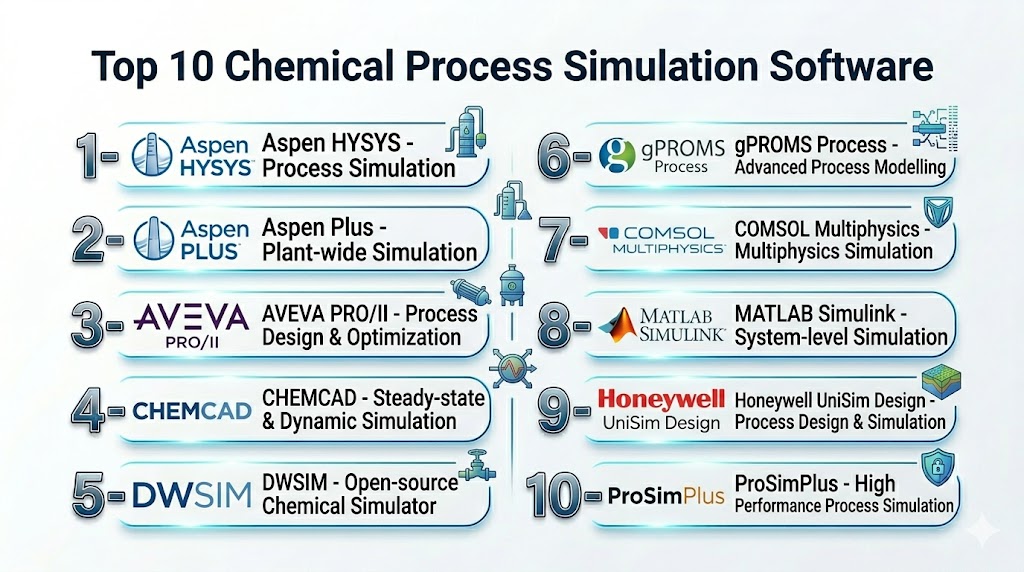
Top 10 Chemical Process Simulation Software Tools
1- Aspen Plus
Short description: Aspen Plus is one of the most widely used chemical process simulators for steady-state modeling of chemical, petrochemical, pharmaceutical, and energy systems. It supports rigorous thermodynamic analysis, process optimization, and advanced flowsheet simulation workflows for enterprise-scale industrial operations.
Key Features
- Advanced thermodynamic models
- Rigorous reactor and separation simulation
- Energy optimization tools
- Extensive chemical property databases
- Process economics support
- Carbon capture modeling
- Integration with Aspen ecosystem
Pros
- Industry-leading simulation accuracy
- Extensive thermodynamic capabilities
- Strong enterprise adoption
- Excellent scalability
Cons
- High licensing costs
- Steep learning curve
- Resource-intensive deployment
- Requires specialized expertise
Platforms / Deployment
- Windows
- Cloud / Hybrid
Security & Compliance
- RBAC
- User authentication
- Audit controls
- Enterprise-grade deployment security
Integrations & Ecosystem
Aspen Plus integrates with optimization platforms, digital twin environments, and industrial engineering systems.
- Aspen digital ecosystem
- Process optimization tools
- ERP connectivity
- Industrial data integration
- API support
Support & Community
Strong enterprise support with extensive training, certifications, and global engineering adoption.
2- Aspen HYSYS
Short description: Aspen HYSYS specializes in oil & gas, refining, and gas processing simulation workflows. It supports steady-state and dynamic simulation, making it highly valuable for operational optimization and safety analysis.
Key Features
- Dynamic and steady-state simulation
- Oil and gas process libraries
- Operator training simulation
- Process safety analysis
- Real-time plant connectivity
- Refinery optimization
- Heat and mass balance modeling
Pros
- Excellent for oil & gas operations
- Strong dynamic simulation tools
- Reliable industrial workflows
- Mature engineering ecosystem
Cons
- Expensive licensing structure
- Complex for beginners
- Best suited for hydrocarbon industries
- Heavy system requirements
Platforms / Deployment
- Windows
- Cloud / Hybrid
Security & Compliance
- RBAC
- MFA
- Audit logging
- Enterprise deployment controls
Integrations & Ecosystem
Aspen HYSYS integrates with refinery systems, plant historians, and optimization platforms.
- Aspen ecosystem
- Real-time plant data
- SCADA connectivity
- API integrations
- Process control systems
Support & Community
Large global engineering community with extensive enterprise support and educational resources.
3- CHEMCAD
Short description: CHEMCAD is a flexible process simulation platform used in chemical processing, pharmaceuticals, specialty chemicals, and academic environments. It provides both steady-state and dynamic simulation capabilities with a relatively user-friendly interface.
Key Features
- Steady-state simulation
- Dynamic process modeling
- Batch process support
- Distillation and reactor modeling
- Heat exchanger analysis
- Thermodynamic libraries
- Process optimization tools
Pros
- Easier learning curve
- Strong flexibility for SMBs
- Good balance of features and usability
- Lower cost than some enterprise competitors
Cons
- Less advanced than Aspen ecosystem
- Smaller enterprise footprint
- Limited large-scale digital twin capabilities
- UI modernization could improve
Platforms / Deployment
- Windows
- Desktop / Hybrid
Security & Compliance
- User authentication
- RBAC
- Not publicly stated for certifications
Integrations & Ecosystem
CHEMCAD supports integrations with engineering workflows and industrial process environments.
- API support
- Engineering data systems
- Spreadsheet integration
- Reporting tools
Support & Community
Strong engineering documentation and active educational usage.
4- PRO/II
Short description: PRO/II by AVEVA is a steady-state process simulator designed for refining, petrochemical, and gas processing operations. It is widely used for hydrocarbon processing and industrial plant optimization workflows.
Key Features
- Hydrocarbon process simulation
- Refinery modeling
- Rigorous thermodynamic calculations
- Heat exchanger simulation
- Distillation analysis
- Process optimization
- Industrial process libraries
Pros
- Strong refining industry support
- Reliable hydrocarbon modeling
- Mature industrial workflows
- Good scalability
Cons
- Less flexible outside refining
- Complex interface
- Enterprise pricing model
- Requires technical expertise
Platforms / Deployment
- Windows
- Hybrid
Security & Compliance
- RBAC
- User authentication
- Audit controls
- Not publicly stated for certifications
Integrations & Ecosystem
PRO/II integrates with AVEVA industrial systems and engineering environments.
- AVEVA ecosystem
- Plant engineering systems
- Industrial workflows
- Reporting integrations
Support & Community
Strong support in refinery and petrochemical industries.
5- gPROMS
Short description: gPROMS is an advanced process modeling platform known for rigorous mathematical modeling and dynamic simulation capabilities. It is commonly used in pharmaceuticals, specialty chemicals, and advanced process optimization environments.
Key Features
- Dynamic process modeling
- Advanced optimization
- Mathematical equation-based simulation
- Digital twin support
- Batch process simulation
- Process control analysis
- AI-assisted optimization workflows
Pros
- Extremely powerful modeling engine
- Excellent for advanced optimization
- Strong pharmaceutical workflows
- High simulation flexibility
Cons
- Requires advanced expertise
- Steeper learning curve
- Premium enterprise pricing
- Complex implementation
Platforms / Deployment
- Windows
- Cloud / Hybrid
Security & Compliance
- RBAC
- Authentication controls
- Audit logging
- Not publicly stated for certifications
Integrations & Ecosystem
gPROMS integrates with process control, optimization, and digital engineering systems.
- Process control integration
- API framework
- Digital twin workflows
- Enterprise analytics systems
Support & Community
Strong technical support and advanced engineering training ecosystem.
6- DWSIM
Short description: DWSIM is an open-source chemical process simulator widely used in academia, research, and smaller industrial environments. It supports steady-state simulation with extensive thermodynamic capabilities and customizable workflows.
Key Features
- Open-source simulation engine
- Thermodynamic libraries
- Distillation and reactor modeling
- CAPE-OPEN compatibility
- Dynamic simulation support
- Spreadsheet integration
- Custom scripting support
Pros
- Free and open-source
- Strong academic adoption
- Highly customizable
- Active developer community
Cons
- Less polished UI
- Limited enterprise support
- Smaller ecosystem
- Advanced workflows may require scripting
Platforms / Deployment
- Windows / Linux / macOS
- Self-hosted
Security & Compliance
- Varies / N/A
Integrations & Ecosystem
DWSIM integrates with open engineering workflows and scientific computing tools.
- CAPE-OPEN compatibility
- Spreadsheet tools
- Python integration
- Custom plugins
Support & Community
Active open-source community with strong academic participation.
7- UniSim Design
Short description: UniSim Design by Honeywell is a process simulation platform focused on oil & gas, refining, and petrochemical operations. It provides steady-state and dynamic simulation capabilities for industrial process optimization.
Key Features
- Dynamic and steady-state simulation
- Refinery and gas processing libraries
- Operator training support
- Process optimization
- Safety analysis
- Real-time operational modeling
- Heat integration analysis
Pros
- Strong hydrocarbon workflow support
- Good industrial integration
- Reliable dynamic simulation
- Mature enterprise deployment
Cons
- Enterprise-oriented pricing
- Complex onboarding
- Requires industry expertise
- Best suited for oil & gas workflows
Platforms / Deployment
- Windows
- Cloud / Hybrid
Security & Compliance
- RBAC
- MFA
- Audit controls
- Enterprise deployment security
Integrations & Ecosystem
UniSim integrates with Honeywell industrial systems and process control environments.
- Honeywell ecosystem
- Process historians
- Control systems
- API integrations
Support & Community
Strong industrial support organization and engineering consulting ecosystem.
8- ProSimPlus
Short description: ProSimPlus is a process simulation and optimization platform used in chemical, pharmaceutical, and energy industries. It supports rigorous steady-state simulation with specialized modules for process analysis and sustainability workflows.
Key Features
- Steady-state process simulation
- Energy optimization
- Distillation and separation analysis
- Reactor simulation
- Sustainability workflows
- Thermodynamic calculations
- Process optimization
Pros
- Strong European industrial presence
- Good process optimization support
- Reliable simulation accuracy
- Flexible engineering workflows
Cons
- Smaller global footprint
- Limited ecosystem compared to Aspen
- Advanced workflows require expertise
- UI can feel technical
Platforms / Deployment
- Windows
- Desktop / Hybrid
Security & Compliance
- User authentication
- RBAC
- Not publicly stated for certifications
Integrations & Ecosystem
ProSimPlus integrates with industrial engineering and process optimization systems.
- Process engineering tools
- API connectivity
- Data export systems
- Optimization platforms
Support & Community
Good technical documentation and engineering-focused support.
9- SuperPro Designer
Short description: SuperPro Designer specializes in batch and continuous process simulation for pharmaceutical, biotech, food, and specialty chemical industries. It supports process economics, scheduling, and production planning workflows.
Key Features
- Batch process simulation
- Pharmaceutical process modeling
- Production scheduling
- Cost analysis
- Resource utilization tracking
- Process economics
- Equipment sizing
Pros
- Excellent for pharma and biotech
- Strong batch process capabilities
- Useful production planning features
- Easier usability than some enterprise suites
Cons
- Less suitable for refinery workflows
- Limited advanced dynamic simulation
- Smaller enterprise ecosystem
- Visualization capabilities vary
Platforms / Deployment
- Windows
- Desktop
Security & Compliance
- User controls
- Authentication support
- Not publicly stated for certifications
Integrations & Ecosystem
SuperPro integrates with manufacturing planning and process engineering workflows.
- Manufacturing systems
- Spreadsheet integrations
- Reporting tools
- Process economics workflows
Support & Community
Strong pharmaceutical and biotech engineering adoption with good educational resources.
10- COMSOL Multiphysics
Short description: COMSOL Multiphysics is a multiphysics simulation platform used for coupled chemical, thermal, fluid, and mechanical simulations. It is widely used in advanced R&D and engineering research environments.
Key Features
- Multiphysics simulation
- CFD integration
- Reaction engineering module
- Heat and mass transfer analysis
- Custom physics modeling
- Advanced visualization
- High-performance computing support
Pros
- Extremely flexible simulation environment
- Strong multiphysics capabilities
- Excellent research platform
- Advanced customization support
Cons
- Requires specialized expertise
- Higher complexity
- Premium pricing structure
- Not focused solely on process simulation
Platforms / Deployment
- Windows / Linux / macOS
- Desktop / Hybrid
Security & Compliance
- User authentication
- RBAC
- Not publicly stated for certifications
Integrations & Ecosystem
COMSOL integrates with engineering, CFD, and scientific computing workflows.
- MATLAB integration
- CAD integrations
- API support
- Scientific computing tools
Support & Community
Strong research and engineering community with extensive technical resources.
Comparison Table
| Tool Name | Best For | Platform(s) Supported | Deployment | Standout Feature | Public Rating |
|---|---|---|---|---|---|
| Aspen Plus | Large chemical plants | Windows | Cloud, Hybrid | Industry-leading thermodynamics | N/A |
| Aspen HYSYS | Oil & gas simulation | Windows | Cloud, Hybrid | Dynamic refinery simulation | N/A |
| CHEMCAD | SMB chemical workflows | Windows | Desktop, Hybrid | Balanced usability and capability | N/A |
| PRO/II | Refining operations | Windows | Hybrid | Hydrocarbon process modeling | N/A |
| gPROMS | Advanced optimization | Windows | Cloud, Hybrid | Equation-based modeling | N/A |
| DWSIM | Open-source simulation | Windows, Linux, macOS | Self-hosted | Open-source flexibility | N/A |
| UniSim Design | Industrial hydrocarbon workflows | Windows | Cloud, Hybrid | Operator training support | N/A |
| ProSimPlus | Process optimization | Windows | Desktop, Hybrid | Sustainability-focused simulation | N/A |
| SuperPro Designer | Pharma and biotech | Windows | Desktop | Batch process simulation | N/A |
| COMSOL Multiphysics | Advanced multiphysics analysis | Windows, Linux, macOS | Desktop, Hybrid | Multiphysics simulation | N/A |
Evaluation & Scoring of Chemical Process Simulation Software
| Tool Name | Core 25% | Ease 15% | Integrations 15% | Security 10% | Performance 10% | Support 10% | Value 15% | Weighted Total |
|---|---|---|---|---|---|---|---|---|
| Aspen Plus | 10 | 7 | 10 | 8 | 9 | 9 | 6 | 8.5 |
| Aspen HYSYS | 9 | 7 | 9 | 8 | 9 | 9 | 6 | 8.2 |
| CHEMCAD | 8 | 8 | 7 | 7 | 8 | 7 | 8 | 7.8 |
| PRO/II | 8 | 7 | 8 | 7 | 8 | 8 | 7 | 7.7 |
| gPROMS | 9 | 6 | 8 | 8 | 9 | 8 | 6 | 7.9 |
| DWSIM | 7 | 7 | 6 | 5 | 7 | 6 | 10 | 7.0 |
| UniSim Design | 8 | 7 | 8 | 8 | 8 | 8 | 7 | 7.8 |
| ProSimPlus | 7 | 7 | 7 | 7 | 7 | 7 | 8 | 7.2 |
| SuperPro Designer | 7 | 8 | 6 | 6 | 7 | 7 | 8 | 7.1 |
| COMSOL Multiphysics | 9 | 6 | 8 | 7 | 9 | 8 | 6 | 7.8 |
These scores are comparative and intended to help organizations evaluate strengths across different simulation scenarios. Enterprise platforms generally score higher in scalability and integrations, while open-source or niche tools may provide better affordability and flexibility. Buyers should prioritize criteria aligned with operational complexity, industry focus, and long-term engineering goals. A higher score does not automatically mean a better fit for every organization.
Which Chemical Process Simulation Software Tool Is Right for You?
Solo / Freelancer
Independent engineers, researchers, and academic users often benefit most from flexible and affordable tools like DWSIM or CHEMCAD. These platforms provide strong simulation functionality without requiring enterprise-scale investment.
SMB
Small and mid-sized engineering firms should prioritize usability, affordability, and balanced simulation capabilities. CHEMCAD and SuperPro Designer are strong choices for organizations needing practical workflows without excessive complexity.
Mid-Market
Mid-market chemical manufacturers and EPC firms often require stronger optimization, process integration, and industrial scalability. UniSim Design and PRO/II provide solid industrial modeling support for growing operational environments.
Enterprise
Large petrochemical, refining, and pharmaceutical enterprises typically require advanced thermodynamics, dynamic simulation, digital twin support, and enterprise integration. Aspen Plus, Aspen HYSYS, and gPROMS remain leading choices for enterprise-scale deployments.
Budget vs Premium
Budget-conscious users may prefer open-source or lower-cost platforms like DWSIM, while premium enterprise platforms deliver stronger support, scalability, digital engineering integration, and advanced optimization capabilities.
Feature Depth vs Ease of Use
Highly advanced simulation environments provide deeper thermodynamic and dynamic modeling capabilities but require greater expertise and onboarding. Simpler tools may reduce training requirements while sacrificing advanced industrial functionality.
Integrations & Scalability
Organizations with large industrial operations should prioritize strong API ecosystems, digital twin support, and plant connectivity integrations. Scalability becomes increasingly important for enterprise manufacturing environments.
Security & Compliance Needs
Enterprise users should prioritize RBAC, audit controls, MFA, and centralized deployment governance. Security becomes increasingly important when integrating simulation platforms with operational plant systems and industrial IoT environments.
Frequently Asked Questions
1- What is Chemical Process Simulation Software?
Chemical Process Simulation Software helps engineers model, optimize, and analyze chemical processes digitally before implementation. These platforms simulate reactors, distillation systems, heat exchangers, fluid flow, and chemical reactions to improve operational efficiency and safety.
2- Which industries use these platforms most heavily?
Chemical manufacturing, oil & gas, refining, pharmaceuticals, biotechnology, energy production, and food processing industries are among the largest users of process simulation software.
3- What is the difference between steady-state and dynamic simulation?
Steady-state simulation models stable operating conditions, while dynamic simulation models changing process behavior over time. Dynamic simulation is especially important for operator training, safety analysis, and transient process studies.
4- Are Aspen Plus and Aspen HYSYS different?
Yes. Aspen Plus is generally more focused on chemical and specialty process industries, while Aspen HYSYS is widely used in oil & gas and refining operations.
5- Is open-source process simulation software viable?
Open-source tools like DWSIM can be highly valuable for research, education, and smaller engineering projects. However, enterprise platforms generally provide broader industrial libraries, stronger support, and deeper integration ecosystems.
6- How important are thermodynamic models?
Thermodynamic accuracy is one of the most critical aspects of process simulation because it directly affects process design, energy balances, separation calculations, and operational optimization.
7- Can these tools integrate with plant systems?
Many enterprise simulation platforms support integration with plant historians, SCADA systems, industrial IoT infrastructure, and digital twin environments for real-time optimization and monitoring workflows.
8- What are common implementation challenges?
Common challenges include model complexity, user training, integration with operational systems, licensing costs, and hardware requirements for large simulation environments.
9- Are AI features becoming common in process simulation?
Yes. AI-assisted optimization, automated flowsheet generation, predictive analytics, and machine-learning-driven process improvements are increasingly being integrated into modern simulation environments.
10- What should buyers prioritize when selecting a platform?
Organizations should prioritize thermodynamic accuracy, industry-specific workflows, scalability, integration capabilities, usability, support quality, and long-term operational fit rather than focusing only on licensing costs.
Conclusion
Chemical Process Simulation Software has become a foundational technology for modern chemical engineering, industrial optimization, and digital manufacturing operations. Today’s platforms combine advanced thermodynamics, dynamic simulation, AI-assisted optimization, digital twins, and industrial integration capabilities to improve operational efficiency, safety, and sustainability across complex process industries. The right solution depends heavily on industry focus, simulation depth requirements, technical expertise, and operational scale. Some organizations may prioritize affordability and ease of use, while enterprise operators often require advanced optimization, real-time plant integration, and large-scale simulation accuracy. Open-source tools continue gaining popularity for research and smaller engineering environments, whereas enterprise platforms dominate large industrial deployments. Instead of choosing solely based on market popularity, organizations should shortlist a few platforms aligned with their operational workflows, test simulation accuracy and integration capabilities, validate scalability requirements, and conduct pilot projects before making a long-term investment decision.

Chemical process simulation software is increasingly being used beyond process design to support sustainability and operational decision-making throughout the plant lifecycle. By combining simulation models with real production data, organizations can evaluate energy consumption, emissions, and resource efficiency before implementing process changes. Including insights on digital twins, real-time model calibration, and sustainability optimization would provide readers with a broader understanding of how modern simulation platforms create value beyond traditional engineering calculations.
Process simulation becomes much more valuable when engineers treat the model as a living engineering asset rather than a calculation used only during initial design. Operating conditions, equipment performance, feed composition, and process constraints can change over time, so regularly comparing simulation assumptions with plant data can reveal where the model has drifted from reality. Versioning the model, documenting assumption changes, and validating important scenarios against historical operating results can also make engineering decisions easier to review. This is particularly useful when simulations are used for optimization or debottlenecking, because an apparently attractive result may depend heavily on assumptions that no longer reflect actual plant conditions.