Introduction
Utility Billing Software helps utility providers, municipalities, property managers, co-ops, and service operators manage billing for electricity, water, gas, waste, sewer, broadband, and other recurring utility services. These platforms automate meter reading imports, rate calculations, customer invoices, payment processing, account management, collections, reporting, and service workflows.
Utility billing is becoming more complex as organizations manage smart meters, tiered pricing, customer portals, digital payments, regulatory reporting, and multi-service billing from one system. Modern platforms help reduce manual errors, improve cash flow, simplify customer communication, and support scalable billing operations.
Real-world use cases include:
- Municipal water and sewer billing
- Electric and gas utility customer billing
- Multi-tenant property utility cost allocation
- Waste and recycling service billing
- Customer self-service payment portals
Key buyer evaluation criteria include:
- Meter data integration
- Rate structure flexibility
- Customer portal quality
- Payment processing options
- Reporting and audit trails
- Integration with accounting systems
- Multi-service billing support
- Security and access controls
- Implementation support
- Scalability for customer accounts
Best for: municipal utilities, private utility companies, electric cooperatives, property management firms, public works departments, broadband service providers, and organizations managing recurring service billing.
Not ideal for: very small teams with simple flat-rate billing, organizations that only need basic invoicing, or businesses that do not require meter-based usage tracking.
Key Trends in Utility Billing Software
- Smart meter integrations are becoming essential for automated and accurate billing.
- Customer self-service portals are now expected for payments, usage history, and support requests.
- Digital payment options are expanding across cards, ACH, wallets, and recurring payments.
- Flexible rate engines are increasingly important for tiered, seasonal, and usage-based billing.
- Cloud deployment is becoming the preferred model for smaller and mid-sized utilities.
- Mobile field service integrations are improving meter reading and service order workflows.
- Automated delinquency management is helping reduce manual collections effort.
- Utility analytics dashboards are improving revenue visibility and operational planning.
- Integration with GIS, asset management, and accounting tools is becoming more common.
- Cybersecurity and role-based access controls are now major buying priorities.
How We Selected These Tools
The platforms in this list were selected using a practical utility operations-focused evaluation methodology:
- Market adoption and utility industry recognition
- Billing engine flexibility
- Meter data and smart meter compatibility
- Customer portal and payment capabilities
- Reporting and audit readiness
- Integration ecosystem maturity
- Support for municipal and private utilities
- Ease of implementation and administration
- Security and governance features
- Fit across small utilities, mid-market providers, and enterprise-scale operations
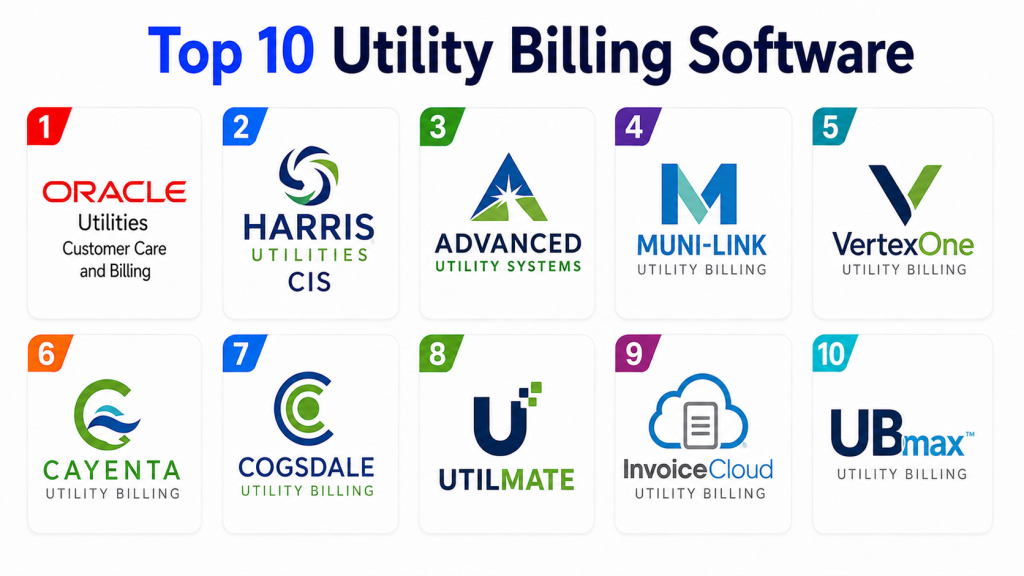
Top 10 Utility Billing Software Tools
#1 — Oracle Utilities Customer Care and Billing
Short description: Oracle Utilities Customer Care and Billing is an enterprise-grade utility billing and customer information platform built for large utilities with complex billing, customer service, and operational requirements. It supports advanced account management, rate structures, usage billing, service orders, and enterprise integrations. The platform is best suited for electric, gas, water, and multi-service utilities that need deep functionality and high scalability.
Key Features
- Enterprise customer information system
- Complex rate and tariff billing
- Customer account management
- Meter data integration
- Service order workflows
- Reporting and analytics
- Enterprise system integrations
Pros
- Strong enterprise scalability
- Deep utility-specific billing functionality
- Suitable for complex multi-service utilities
- Mature integration ecosystem
Cons
- High implementation complexity
- Premium enterprise cost
- Requires experienced administration
- Not ideal for small utilities
Platforms / Deployment
- Web
- Cloud / Hybrid
Security & Compliance
- SSO
- RBAC
- Encryption
- Audit logging
- Enterprise governance controls
Integrations & Ecosystem
Oracle Utilities Customer Care and Billing integrates with enterprise utility operations, finance, customer service, and meter data environments.
- Oracle Utilities ecosystem
- ERP systems
- Meter data management systems
- Customer portals
- Analytics platforms
- Payment systems
Support & Community
Strong enterprise support, implementation partner ecosystem, technical documentation, and professional services availability.
#2 — Tyler Technologies Munis Utility Billing
Short description: Tyler Technologies Munis Utility Billing is designed for municipalities and public sector organizations that need utility billing connected with finance, payments, citizen services, and local government operations. It supports water, sewer, refuse, and other municipal utility billing workflows. The platform is especially strong for cities and counties already using Tyler public sector software.
Key Features
- Municipal utility billing
- Customer account management
- Meter reading imports
- Payment processing workflows
- Finance system integration
- Reporting and audit trails
- Citizen self-service support
Pros
- Strong public sector fit
- Good municipal finance integration
- Useful for water, sewer, and waste billing
- Mature government software ecosystem
Cons
- Best suited for Tyler environments
- Implementation may require public sector process mapping
- Advanced customization can add complexity
- Not designed for all private utility models
Platforms / Deployment
- Web
- Cloud / Hybrid
Security & Compliance
- RBAC
- Encryption
- Audit logging
- Additional certifications not publicly stated
Integrations & Ecosystem
Tyler Munis Utility Billing connects well with local government finance, permitting, payment, and citizen service workflows.
- Tyler Munis finance
- Citizen portals
- Payment processors
- Meter reading systems
- Reporting tools
- Public sector workflows
Support & Community
Strong municipal support network, implementation services, product documentation, and public sector customer community.
#3 — Harris Computer Systems NorthStar
Short description: NorthStar is a customer information and utility billing platform built for electric, water, gas, and multi-service utilities. It supports billing, customer care, payments, meter data, service orders, and operational reporting. The platform is well suited for utilities that need robust CIS functionality without relying only on generic billing software.
Key Features
- Utility customer information system
- Multi-service billing
- Rate management
- Meter reading integration
- Customer service workflows
- Payment management
- Operational reporting
Pros
- Strong utility-specific functionality
- Suitable for mid-sized and larger utilities
- Supports multiple service types
- Good customer care workflows
Cons
- Implementation can be resource intensive
- Interface may require training
- Pricing varies by utility size
- Advanced integrations may require vendor support
Platforms / Deployment
- Web / Windows
- Cloud / Hybrid
Security & Compliance
- RBAC
- Encryption
- Audit logs
- Additional certifications not publicly stated
Integrations & Ecosystem
NorthStar integrates with utility operations, meter reading, payment, and reporting systems.
- Meter data systems
- Payment processors
- Customer portals
- Accounting systems
- Service order systems
- Reporting tools
Support & Community
Established utility support services, onboarding assistance, and technical implementation resources.
#4 — Advanced Utility Systems CIS Infinity
Short description: CIS Infinity by Advanced Utility Systems is a customer information and utility billing solution focused on municipalities, water utilities, electric utilities, and multi-service providers. It supports billing automation, customer service, service orders, meter management, and analytics. It is a strong fit for utilities seeking a dedicated CIS platform with broad operational capabilities.
Key Features
- Utility billing automation
- Customer information management
- Meter management
- Service order tracking
- Payment workflows
- Reporting dashboards
- Multi-utility support
Pros
- Strong CIS functionality
- Good fit for municipal and utility providers
- Supports operational workflows beyond billing
- Useful reporting and customer management tools
Cons
- May require detailed implementation planning
- Learning curve for new administrators
- Some integrations may require customization
- Pricing not publicly stated
Platforms / Deployment
- Web / Windows
- Cloud / Hybrid
Security & Compliance
- RBAC
- Encryption
- Audit logging
- Additional certifications not publicly stated
Integrations & Ecosystem
CIS Infinity connects with utility meter data, customer portals, payment platforms, and enterprise reporting systems.
- Meter reading tools
- Payment processors
- Customer portals
- Accounting systems
- GIS systems
- Reporting platforms
Support & Community
Strong utility-focused implementation support, customer training, documentation, and ongoing technical assistance.
#5 — MuniBilling
Short description: MuniBilling is a cloud-based utility billing platform built for municipalities, water districts, sewer providers, and local utility operations. It focuses on simplifying billing, customer management, meter imports, payment processing, and reporting. The platform is often a practical option for smaller and mid-sized utilities that want modern cloud billing without enterprise complexity.
Key Features
- Cloud utility billing
- Meter reading imports
- Customer portal
- Online payments
- Work order support
- Reporting tools
- Multi-service billing
Pros
- Easy cloud deployment
- Good fit for smaller municipalities
- Practical customer portal features
- Faster implementation than many enterprise systems
Cons
- Less suited for very large utilities
- Advanced enterprise customization may be limited
- Complex tariff structures may require review
- Integration depth varies by system
Platforms / Deployment
- Web
- Cloud
Security & Compliance
- Encryption
- Role-based access
- Additional certifications not publicly stated
Integrations & Ecosystem
MuniBilling integrates with payment processors, accounting systems, meter reading tools, and local government workflows.
- Payment processing
- Meter reading imports
- Accounting integrations
- Customer portals
- Reporting exports
- Work order tools
Support & Community
Good onboarding support for municipal customers with practical documentation and service assistance.
#6 — UtilAbility
Short description: UtilAbility is a utility billing software platform designed for small to mid-sized utilities, municipalities, and submetering providers. It supports meter readings, recurring billing, account management, payments, and customer communication. The platform is a practical choice for teams that need focused billing functionality without large enterprise overhead.
Key Features
- Utility account management
- Meter reading support
- Recurring billing
- Rate management
- Payment tracking
- Customer statements
- Reporting tools
Pros
- Good fit for smaller utilities
- Focused utility billing workflows
- Practical rate and meter management
- Easier to manage than complex CIS platforms
Cons
- Less suitable for large enterprise utilities
- Interface may feel traditional
- Limited advanced analytics
- Integration ecosystem may be narrower
Platforms / Deployment
- Windows
- Self-hosted / Cloud options may vary
Security & Compliance
- User access controls
- Additional security details not publicly stated
Integrations & Ecosystem
UtilAbility supports core utility billing workflows and connects with common operational tools depending on deployment needs.
- Meter reading imports
- Payment processing
- Accounting exports
- Customer statements
- Reporting exports
- Data import tools
Support & Community
Support availability varies by plan and deployment. Documentation and vendor support are typically important for setup.
#7 — CUSI Utility Billing
Short description: CUSI Utility Billing is designed for municipal utilities, rural water districts, and utility providers needing billing, customer information, payments, and meter reading support. It is commonly used by smaller and mid-sized organizations that need dependable utility billing workflows. The platform focuses on core billing accuracy and administrative efficiency.
Key Features
- Utility billing management
- Customer information tracking
- Meter reading imports
- Payment posting
- Rate setup
- Delinquency management
- Reporting tools
Pros
- Practical utility billing focus
- Good for small and mid-sized providers
- Supports common municipal workflows
- Reliable core billing functions
Cons
- May lack advanced enterprise analytics
- UI may require training
- Integration depth varies
- Not ideal for highly complex utilities
Platforms / Deployment
- Windows / Web options may vary
- Cloud / Self-hosted options may vary
Security & Compliance
- User permissions
- Additional certifications not publicly stated
Integrations & Ecosystem
CUSI supports integrations and exports for billing, payments, reporting, and meter reading operations.
- Meter reading systems
- Payment processors
- Accounting exports
- Customer portals
- Reporting tools
- Data imports
Support & Community
Vendor support and onboarding assistance are available, with practical resources for municipal utility teams.
#8 — El Dorado Utility Billing
Short description: El Dorado Utility Billing is a utility billing solution for municipalities, water districts, sewer providers, and local service organizations. It supports customer accounts, service billing, meter readings, payment handling, and reporting. The platform is often selected by smaller public sector teams needing straightforward utility billing management.
Key Features
- Customer account billing
- Meter reading management
- Rate calculation
- Payment tracking
- Delinquency workflows
- Reporting
- Service history management
Pros
- Good fit for smaller utilities
- Straightforward billing workflows
- Supports public sector utility needs
- Practical reporting functions
Cons
- Limited advanced automation
- Smaller ecosystem than enterprise vendors
- May require manual configuration
- Advanced integrations may be limited
Platforms / Deployment
- Windows
- Self-hosted / Cloud options may vary
Security & Compliance
- User access controls
- Additional certifications not publicly stated
Integrations & Ecosystem
El Dorado supports standard utility billing data flows, payment tracking, and operational reporting.
- Meter reading imports
- Accounting exports
- Payment tracking
- Customer data exports
- Reporting tools
- Statement generation
Support & Community
Support is typically vendor-led with implementation guidance and user assistance for municipal billing teams.
#9 — QuikWater
Short description: QuikWater is utility billing software designed mainly for water districts, rural utilities, municipalities, and small service providers. It focuses on meter readings, billing statements, payment records, customer accounts, and practical administrative workflows. The platform is best suited for teams that need focused billing software rather than a large enterprise CIS.
Key Features
- Water utility billing
- Meter reading management
- Customer account tracking
- Payment posting
- Billing statement generation
- Reporting
- Delinquency tracking
Pros
- Strong fit for water utilities
- Practical for smaller teams
- Focused billing workflows
- Easier than large enterprise systems
Cons
- Limited multi-utility enterprise depth
- Advanced integrations may be limited
- Interface may feel basic
- Less suited for complex service models
Platforms / Deployment
- Windows
- Self-hosted / Cloud options may vary
Security & Compliance
- User permissions
- Additional certifications not publicly stated
Integrations & Ecosystem
QuikWater supports common water utility billing operations and related administrative data workflows.
- Meter reading imports
- Payment tracking
- Statement printing
- Accounting exports
- Reporting exports
- Customer account data
Support & Community
Support is generally vendor-provided, with practical assistance for small utility billing teams.
#10 — Caselle Utility Management
Short description: Caselle Utility Management is part of a broader local government software suite, supporting utility billing, customer accounts, payments, and municipal finance workflows. It is well suited for cities, towns, and public agencies that want utility billing connected to accounting and government administration.
Key Features
- Municipal utility billing
- Customer account management
- Meter reading support
- Payment processing
- Finance integration
- Reporting
- Delinquency tracking
Pros
- Strong fit for municipalities
- Good connection with government finance workflows
- Practical utility billing features
- Useful for public sector administration
Cons
- Best suited for Caselle ecosystem users
- May not fit private enterprise utilities
- Advanced customization may vary
- Implementation planning is needed
Platforms / Deployment
- Web / Windows
- Cloud / Self-hosted options may vary
Security & Compliance
- Role-based permissions
- Encryption details not publicly stated
- Additional certifications not publicly stated
Integrations & Ecosystem
Caselle integrates utility billing with public sector financial and administrative workflows.
- Caselle finance tools
- Meter reading systems
- Payment processors
- Reporting tools
- Customer account systems
- Public sector workflows
Support & Community
Good municipal support, onboarding assistance, documentation, and public sector software expertise.
Comparison Table
| Tool Name | Best For | Platform(s) Supported | Deployment | Standout Feature | Public Rating |
|---|---|---|---|---|---|
| Oracle Utilities Customer Care and Billing | Large enterprise utilities | Web | Cloud, Hybrid | Enterprise CIS scalability | N/A |
| Tyler Technologies Munis Utility Billing | Municipal utilities | Web | Cloud, Hybrid | Public sector finance integration | N/A |
| Harris NorthStar | Multi-service utilities | Web, Windows | Cloud, Hybrid | Utility customer information system | N/A |
| Advanced Utility Systems CIS Infinity | Municipal and utility providers | Web, Windows | Cloud, Hybrid | Full utility CIS workflows | N/A |
| MuniBilling | Small and mid-sized municipalities | Web | Cloud | Simple cloud utility billing | N/A |
| UtilAbility | Small to mid-sized utilities | Windows | Varies / N/A | Focused billing workflows | N/A |
| CUSI Utility Billing | Rural and municipal utilities | Web, Windows | Varies / N/A | Practical municipal billing | N/A |
| El Dorado Utility Billing | Small public utilities | Windows | Varies / N/A | Straightforward billing management | N/A |
| QuikWater | Water districts | Windows | Varies / N/A | Water utility billing simplicity | N/A |
| Caselle Utility Management | Local governments | Web, Windows | Varies / N/A | Finance and utility connection | N/A |
Evaluation & Scoring of Utility Billing Software
| Tool Name | Core 25% | Ease 15% | Integrations 15% | Security 10% | Performance 10% | Support 10% | Value 15% | Weighted Total |
|---|---|---|---|---|---|---|---|---|
| Oracle Utilities Customer Care and Billing | 9.5 | 7.0 | 9.4 | 9.0 | 9.2 | 8.8 | 7.1 | 8.6 |
| Tyler Technologies Munis Utility Billing | 8.8 | 7.8 | 8.7 | 8.3 | 8.5 | 8.6 | 7.8 | 8.3 |
| Harris NorthStar | 8.9 | 7.6 | 8.4 | 8.0 | 8.6 | 8.4 | 7.7 | 8.2 |
| Advanced Utility Systems CIS Infinity | 8.8 | 7.7 | 8.3 | 8.0 | 8.5 | 8.4 | 7.8 | 8.2 |
| MuniBilling | 8.0 | 8.8 | 7.6 | 7.5 | 8.0 | 8.1 | 8.7 | 8.1 |
| UtilAbility | 7.7 | 8.1 | 6.9 | 6.8 | 7.8 | 7.5 | 8.4 | 7.7 |
| CUSI Utility Billing | 7.8 | 8.0 | 7.0 | 6.9 | 7.9 | 7.6 | 8.3 | 7.8 |
| El Dorado Utility Billing | 7.4 | 8.2 | 6.7 | 6.6 | 7.5 | 7.3 | 8.5 | 7.6 |
| QuikWater | 7.3 | 8.3 | 6.5 | 6.5 | 7.5 | 7.2 | 8.6 | 7.6 |
| Caselle Utility Management | 8.0 | 7.9 | 7.8 | 7.4 | 8.0 | 8.0 | 8.0 | 7.9 |
These scores are comparative and should be interpreted based on organization size, utility complexity, billing volume, and integration needs. Large enterprise platforms score higher in scalability and integrations but require more implementation effort. Smaller utility billing tools may offer better value and usability for municipalities or districts with straightforward workflows.
Which Utility Billing Software Is Right for You?
Solo / Freelancer
Independent utility consultants and small billing service providers may prefer lightweight tools such as UtilAbility, QuikWater, or El Dorado Utility Billing. These platforms are easier to manage when the billing environment is focused and customer volume is limited.
SMB
Small municipalities, rural water districts, and local service providers should prioritize ease of use, fast setup, and practical billing workflows. MuniBilling, CUSI Utility Billing, and Caselle Utility Management are strong options for smaller teams that need reliable billing and reporting without enterprise complexity.
Mid-Market
Mid-sized utilities need stronger meter integration, customer service workflows, payment automation, and reporting. Harris NorthStar and Advanced Utility Systems CIS Infinity are strong fits for organizations with growing service complexity and multi-utility billing needs.
Enterprise
Large electric, gas, water, and multi-service utilities should prioritize scalability, advanced rate engines, enterprise integrations, and governance controls. Oracle Utilities Customer Care and Billing is a strong fit for complex enterprise operations, while Tyler and Harris can also serve larger public sector and utility environments.
Budget vs Premium
Budget-focused buyers should avoid overbuying complex CIS platforms if their needs are limited to meter readings, customer accounts, and monthly billing. Premium solutions are better suited for organizations requiring advanced rates, integrations, customer care, audit workflows, and large-scale account management.
Feature Depth vs Ease of Use
Smaller tools are usually easier to learn but may have fewer advanced features. Enterprise tools offer deeper functionality but require more setup, training, and process design. Buyers should match software complexity to their internal team capacity.
Integrations & Scalability
Utilities with smart meters, payment portals, GIS systems, ERP tools, and customer service workflows should prioritize platforms with mature APIs and proven integration support. Large utilities should also validate data migration and system performance before full deployment.
Security & Compliance Needs
Utilities manage sensitive customer, billing, payment, and service data, so security should be a core buying factor. Prioritize role-based access, encryption, audit trails, payment security workflows, and strong user permission controls.
Frequently Asked Questions FAQs
1. What is Utility Billing Software?
Utility Billing Software helps organizations manage customer accounts, meter readings, rate calculations, invoices, payments, collections, and reporting for utility services. It is commonly used by water, sewer, electric, gas, waste, broadband, and municipal service providers.
2. Who uses Utility Billing Software?
Municipalities, public utilities, electric co-ops, water districts, private utility companies, property managers, and service providers use these platforms. The software helps automate recurring billing and improves customer account management.
3. What features are most important in Utility Billing Software?
Important features include meter reading imports, flexible rate management, customer portals, online payments, delinquency tracking, reporting, audit trails, and accounting integrations. Larger utilities should also prioritize CIS capabilities and service order workflows.
4. Can Utility Billing Software support smart meters?
Many modern platforms support smart meter data imports or integrations with meter data management systems. Buyers should confirm compatibility with their specific meters, data formats, and reading workflows before selecting a platform.
5. Is cloud deployment better than self-hosted utility billing?
Cloud deployment is easier to maintain and often improves remote access, updates, and scalability. Self-hosted or hybrid models may still be preferred by organizations with strict internal IT controls, legacy systems, or specific data governance requirements.
6. How difficult is implementation?
Implementation depends on customer count, rate structure complexity, data migration needs, integrations, and staff readiness. Small utilities can often deploy faster, while enterprise CIS implementations require detailed planning, testing, and training.
7. What common mistakes should buyers avoid?
Common mistakes include underestimating rate complexity, ignoring data migration quality, overlooking customer portal needs, and failing to validate payment integrations. Buyers should also avoid selecting software that cannot scale with future service expansion.
8. Can these platforms integrate with accounting software?
Yes. Many utility billing platforms integrate with accounting, ERP, finance, and payment systems. Municipal utilities should pay special attention to finance integration because billing data often connects directly to government accounting workflows.
9. How do these tools improve customer experience?
They improve customer experience through online payment portals, usage history, automated notifications, accurate billing, faster service requests, and self-service account access. This reduces calls to billing departments and improves transparency.
10. What alternatives exist for very small utilities?
Very small utilities may use accounting software, spreadsheets, or simple invoicing tools if billing is flat-rate and customer volume is low. However, once meter-based billing, delinquency management, and reporting requirements grow, dedicated utility billing software becomes more practical.
Conclusion
Utility Billing Software is essential for organizations that need accurate meter-based billing, customer account management, payment processing, reporting, and service workflow control. The best platform depends on utility size, service complexity, rate structures, integration needs, and internal technical capacity. Small utilities may benefit from simpler tools like MuniBilling, QuikWater, or CUSI Utility Billing, while mid-sized providers may need stronger CIS functionality from Harris NorthStar or Advanced Utility Systems CIS Infinity. Large enterprise utilities should prioritize scalability, advanced billing engines, security, and integration depth with platforms like Oracle Utilities Customer Care and Billing. To choose wisely, shortlist two or three tools, test billing scenarios with real rate structures, validate integrations and security controls, and run a pilot before full deployment.

Very informative and well-structured blog on utility billing software. The comparison of features, pros, and cons is clear and practical, making it helpful for understanding different billing and utility management solutions.
Great overview of utility billing software—this article clearly explains how these platforms simplify billing processes, customer management, and payment tracking for utility providers.
Utility billing software should be evaluated not only for billing accuracy but also for its ability to adapt to changing pricing models and customer expectations. As utilities introduce dynamic tariffs, prepaid services, renewable energy credits, and flexible payment options, billing platforms must remain configurable without requiring major system changes. Including insights on configurable rate engines, customer communication tools, revenue assurance, dispute management, and scalability for future regulatory changes would provide readers with a more practical framework for selecting a long-term utility billing solution.