Introduction
Data migration tools help organizations move data between systems, databases, cloud platforms, and applications efficiently and securely. Whether it’s shifting from on-premise infrastructure to the cloud, consolidating systems after a merger, or upgrading legacy databases, these tools simplify complex data transfer processes while minimizing downtime and data loss.
As businesses become increasingly data-driven, seamless migration is critical for maintaining operations, ensuring data integrity, and enabling analytics. Modern data migration tools go beyond simple transfers by offering real-time synchronization, transformation capabilities, automation, and monitoring, making them essential for digital transformation initiatives.
Real-world use cases:
- Migrating databases to cloud platforms
- Consolidating data from multiple systems
- Real-time data replication and synchronization
- Upgrading legacy data infrastructure
- Supporting analytics and data warehousing projects
What buyers should evaluate:
- Supported data sources and destinations
- Real-time vs batch migration capabilities
- Data transformation and ETL features
- Ease of use and setup
- Performance and scalability
- Security and compliance features
- Monitoring and error handling
- Integration with cloud platforms
- Pricing and licensing
Best for: Data engineers, IT teams, enterprises, and organizations managing large-scale data migrations or cloud transitions.
Not ideal for: Small projects with minimal data movement or teams without structured data management needs.
Key Trends in Data Migration Tools
- Rise of cloud-native migration tools for modern architectures
- Real-time data replication becoming a standard feature
- Automation and low-code interfaces improving usability
- Integration with data warehouses and analytics platforms
- Increased focus on data governance and compliance
- Hybrid and multi-cloud data migration strategies
- AI-assisted data mapping and transformation
- Scalable architectures for big data workloads
- Improved monitoring and error handling tools
- Cost optimization and performance tuning features
How We Selected These Tools (Methodology)
- Evaluated industry adoption and credibility
- Assessed data migration and transformation capabilities
- Reviewed performance and scalability features
- Analyzed integration with cloud and enterprise systems
- Considered ease of use and learning curve
- Evaluated security and compliance capabilities
- Reviewed monitoring and automation features
- Compared pricing models and overall value
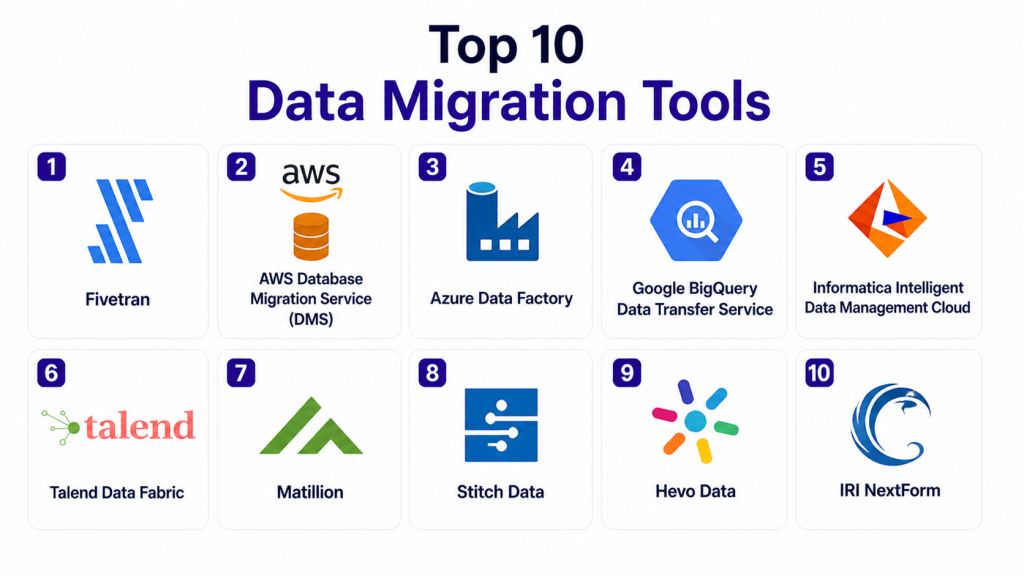
Top 10 Data Migration Tools
#1 — Fivetran
Short description:
Fivetran is a fully managed data pipeline tool that automates data migration and synchronization between various sources and destinations.
Key Features
- Automated data pipelines
- Real-time data synchronization
- Pre-built connectors
- Schema management
- Cloud-native architecture
Pros
- Easy to use
- Strong automation
- Reliable performance
Cons
- Pricing can be high
- Limited customization
- Dependency on connectors
Platforms / Deployment
Cloud
Security & Compliance
Encryption, RBAC
Integrations & Ecosystem
Supports multiple data platforms.
- Data warehouses
- SaaS applications
Support & Community
Strong enterprise support.
#2 — AWS Database Migration Service (DMS)
Short description:
AWS DMS helps migrate databases to AWS with minimal downtime, supporting both homogeneous and heterogeneous migrations.
Key Features
- Continuous data replication
- Minimal downtime migration
- Supports multiple database engines
- Monitoring tools
- Integration with AWS services
Pros
- Reliable
- Scalable
- Flexible
Cons
- AWS dependency
- Complex configuration
- Requires expertise
Platforms / Deployment
Cloud
Security & Compliance
Encryption, access control
Integrations & Ecosystem
Works within AWS ecosystem.
- AWS databases
- Cloud services
Support & Community
Strong documentation and support.
#3 — Azure Data Factory
Short description:
Azure Data Factory is a cloud-based data integration service for building, scheduling, and orchestrating data workflows.
Key Features
- ETL and ELT support
- Data pipeline orchestration
- Integration with Azure services
- Visual interface
- Data transformation
Pros
- Easy to use
- Strong cloud integration
- Scalable
Cons
- Azure-centric
- Learning curve
- Cost management
Platforms / Deployment
Cloud
Security & Compliance
Encryption, access control
Integrations & Ecosystem
Deep Azure integration.
- Azure services
- Data warehouses
Support & Community
Strong enterprise support.
#4 — Google BigQuery Data Transfer Service
Short description:
This tool enables automated data transfer into BigQuery from various sources, simplifying analytics workflows.
Key Features
- Automated data ingestion
- Scheduled transfers
- Integration with BigQuery
- Managed service
- Data synchronization
Pros
- Easy setup
- Reliable
- Strong analytics integration
Cons
- Limited customization
- Google Cloud dependency
- Limited ETL features
Platforms / Deployment
Cloud
Security & Compliance
Encryption
Integrations & Ecosystem
Works within Google ecosystem.
- BigQuery
- Google Cloud
Support & Community
Good support and documentation.
#5 — Informatica Intelligent Data Management Cloud
Short description:
Informatica provides enterprise-grade data migration and integration capabilities with advanced data governance features.
Key Features
- Data integration
- ETL/ELT support
- Data governance
- Cloud and hybrid support
- Automation tools
Pros
- Enterprise-ready
- Comprehensive features
- Strong governance
Cons
- Complex setup
- High cost
- Learning curve
Platforms / Deployment
Cloud / Hybrid
Security & Compliance
Encryption, compliance support
Integrations & Ecosystem
Supports enterprise ecosystems.
- Databases
- Cloud platforms
Support & Community
Strong enterprise support.
#6 — Talend Data Fabric
Short description:
Talend provides data integration and migration solutions with a focus on data quality and governance.
Key Features
- Data integration
- Data quality tools
- ETL pipelines
- Cloud and hybrid support
- Automation
Pros
- Strong data quality features
- Flexible
- Open-source options
Cons
- Complex interface
- Performance issues
- Learning curve
Platforms / Deployment
Cloud / Hybrid
Security & Compliance
Encryption
Integrations & Ecosystem
Supports multiple systems.
- Databases
- SaaS platforms
Support & Community
Active community and support.
#7 — Matillion
Short description:
Matillion is a cloud-native data integration tool designed for data warehousing and transformation.
Key Features
- ETL/ELT pipelines
- Cloud-native design
- Data transformation
- Integration with warehouses
- Automation
Pros
- High performance
- Easy to use
- Scalable
Cons
- Limited on-prem support
- Pricing considerations
- Learning curve
Platforms / Deployment
Cloud
Security & Compliance
Encryption
Integrations & Ecosystem
Works with cloud data platforms.
- Snowflake
- Redshift
Support & Community
Strong support and documentation.
#8 — Stitch Data
Short description:
Stitch is a simple ETL service for migrating data from various sources into cloud data warehouses.
Key Features
- Data pipelines
- Pre-built connectors
- Automated replication
- Cloud integration
- Easy setup
Pros
- Simple to use
- Affordable
- Reliable
Cons
- Limited advanced features
- Smaller ecosystem
- Basic transformations
Platforms / Deployment
Cloud
Security & Compliance
Encryption
Integrations & Ecosystem
Supports cloud tools.
- Data warehouses
- SaaS apps
Support & Community
Good documentation and support.
#9 — Hevo Data
Short description:
Hevo Data is a no-code data pipeline platform that enables real-time data migration and transformation.
Key Features
- Real-time pipelines
- No-code interface
- Automated schema mapping
- Data transformation
- Monitoring tools
Pros
- User-friendly
- Fast setup
- Real-time capabilities
Cons
- Limited customization
- Pricing tiers
- Connector dependency
Platforms / Deployment
Cloud
Security & Compliance
Encryption
Integrations & Ecosystem
Supports modern data stacks.
- SaaS apps
- Data warehouses
Support & Community
Strong support and onboarding.
#10 — IRI NextForm
Short description:
IRI NextForm specializes in data migration and transformation across structured and unstructured data formats.
Key Features
- Data transformation
- Multi-format support
- Migration tools
- High performance
- Custom workflows
Pros
- Flexible
- High performance
- Supports complex data
Cons
- Requires expertise
- Less user-friendly
- Smaller ecosystem
Platforms / Deployment
Windows / Linux
Security & Compliance
Encryption
Integrations & Ecosystem
Works with enterprise systems.
- Databases
- File systems
Support & Community
Moderate support and documentation.
Comparison Table
| Tool Name | Best For | Platform(s) Supported | Deployment | Standout Feature | Public Rating |
|---|---|---|---|---|---|
| Fivetran | Automated pipelines | Multi-platform | Cloud | Automation | N/A |
| AWS DMS | Database migration | Multi-platform | Cloud | Continuous replication | N/A |
| Azure Data Factory | Workflow orchestration | Cloud | Cloud | Visual pipelines | N/A |
| Google Transfer | BigQuery ingestion | Cloud | Cloud | Automation | N/A |
| Informatica | Enterprise data | Multi-platform | Hybrid | Governance | N/A |
| Talend | Data quality | Multi-platform | Hybrid | ETL pipelines | N/A |
| Matillion | Data warehousing | Cloud | Cloud | ELT pipelines | N/A |
| Stitch | Simple pipelines | Cloud | Cloud | Ease of use | N/A |
| Hevo | No-code pipelines | Cloud | Cloud | Real-time | N/A |
| IRI NextForm | Complex migration | Multi-platform | Local | Multi-format support | N/A |
Evaluation & Scoring
| Tool Name | Core | Ease | Integrations | Security | Performance | Support | Value | Weighted Total |
|---|---|---|---|---|---|---|---|---|
| Fivetran | 9 | 8 | 9 | 8 | 9 | 8 | 7 | 8.4 |
| AWS DMS | 9 | 7 | 9 | 8 | 9 | 8 | 7 | 8.3 |
| Azure DF | 8 | 8 | 9 | 8 | 8 | 8 | 8 | 8.2 |
| Google DTS | 8 | 8 | 8 | 8 | 8 | 7 | 8 | 8.0 |
| Informatica | 9 | 6 | 9 | 9 | 8 | 9 | 7 | 8.2 |
| Talend | 8 | 6 | 8 | 8 | 7 | 7 | 8 | 7.7 |
| Matillion | 8 | 8 | 8 | 8 | 8 | 8 | 8 | 8.1 |
| Stitch | 7 | 9 | 7 | 8 | 7 | 7 | 9 | 7.9 |
| Hevo | 8 | 9 | 8 | 8 | 8 | 8 | 8 | 8.2 |
| IRI | 8 | 6 | 7 | 8 | 9 | 7 | 8 | 7.8 |
How to interpret scores:
These scores provide a comparative overview of how each tool performs across critical factors like functionality, usability, and integrations. A higher score indicates a more balanced and versatile solution, but it does not necessarily mean it is the best fit for every use case. Some tools excel in enterprise environments, while others prioritize simplicity or real-time capabilities. Use this evaluation as a guideline and align your decision with your specific data migration requirements, infrastructure, and scalability needs.
Which Data Migration Tool Is Right for You?
Solo / Freelancer
Stitch or Hevo are simple and easy to use.
SMB
Fivetran and Azure Data Factory provide scalability and ease.
Mid-Market
Matillion and Talend offer flexibility and performance.
Enterprise
Informatica and AWS DMS provide advanced features and governance.
Budget vs Premium
Open and lower-cost tools are good for small projects, while enterprise tools offer deeper capabilities.
Feature Depth vs Ease of Use
No-code tools are easier, while enterprise platforms provide advanced customization.
Integrations & Scalability
Choose tools aligned with your cloud and data stack.
Security & Compliance Needs
Prioritize encryption, governance, and compliance features.
Frequently Asked Questions (FAQs)
1. What is data migration?
Data migration is the process of transferring data from one system to another.
2. Why is data migration important?
It ensures data availability and supports system upgrades and cloud adoption.
3. What are types of data migration?
Database, application, storage, and cloud migration.
4. Is data migration risky?
It can be, but tools minimize risks.
5. Can migration be automated?
Yes, most tools support automation.
6. What is ETL?
Extract, Transform, Load process for data pipelines.
7. Do these tools support real-time migration?
Many tools offer real-time capabilities.
8. How do I ensure data integrity?
Use validation and monitoring features.
9. Are these tools cloud-based?
Most modern tools are cloud-native.
10. How do I choose the right tool?
Evaluate your data sources, scale, and requirements.
Conclusion
Data migration tools are essential for organizations looking to move, transform, and manage data efficiently across systems and platforms. As businesses continue to adopt cloud technologies and data-driven strategies, the ability to migrate data reliably and securely becomes a critical capability. The tools covered in this guide offer a wide range of features, from simple no-code pipelines to enterprise-grade data integration platforms with advanced governance and scalability. Selecting the right tool depends on your data volume, infrastructure, and business goals. Instead of focusing on a single best option, it is more effective to align your choice with your technical requirements and long-term strategy. The best approach is to test a few tools, validate their performance and compatibility, and then standardize on the one that best supports your data ecosystem.

Great comparison. The article presents each data migration tool in a simple and structured way, making it much easier to understand the available options and choose the right solution for specific migration projects.