Introduction
E commerce platforms are software solutions that allow businesses to create, manage, and scale online stores by handling products, payments, inventory, and customer interactions in one place. These platforms act as the foundation for selling products or services online, whether through a standalone website or across multiple channels.
With the rapid growth of digital shopping and omnichannel retail, businesses need more than just a website. Modern platforms offer integrated payment processing, marketing tools, analytics, and automation, helping brands compete in a highly dynamic online marketplace.
Real-world use cases
- Launching and managing online stores
- Selling products across multiple channels
- Managing inventory and orders
- Running promotions and marketing campaigns
- Analyzing customer behavior and sales performance
What buyers should evaluate
- Ease of store setup and customization
- Payment gateway support
- Inventory and order management
- Scalability for growth
- Integration with marketing and analytics tools
- Mobile and omnichannel support
- Security and compliance
- Pricing and transaction fees
Best for: Entrepreneurs, SMBs, retailers, and enterprises looking to sell products online.
Not ideal for: Businesses that do not require online sales or have very simple product catalogs.
Key Trends in E commerce Platforms
- AI driven personalization and recommendations
- Headless commerce architecture
- Omnichannel selling across marketplaces and social media
- Mobile first shopping experiences
- Subscription based and recurring commerce models
- Integrated marketing automation tools
- API first ecosystems for flexibility
- Real time analytics and insights
- Cloud based scalable infrastructure
- Automation of fulfillment and logistics
How We Selected These Tools
- Evaluated market adoption and global usage
- Assessed feature completeness across commerce workflows
- Considered scalability for different business sizes
- Reviewed integration with payment and marketing tools
- Analyzed ease of use and onboarding
- Evaluated customization and flexibility
- Considered pricing models and value
- Assessed vendor support and ecosystem strength
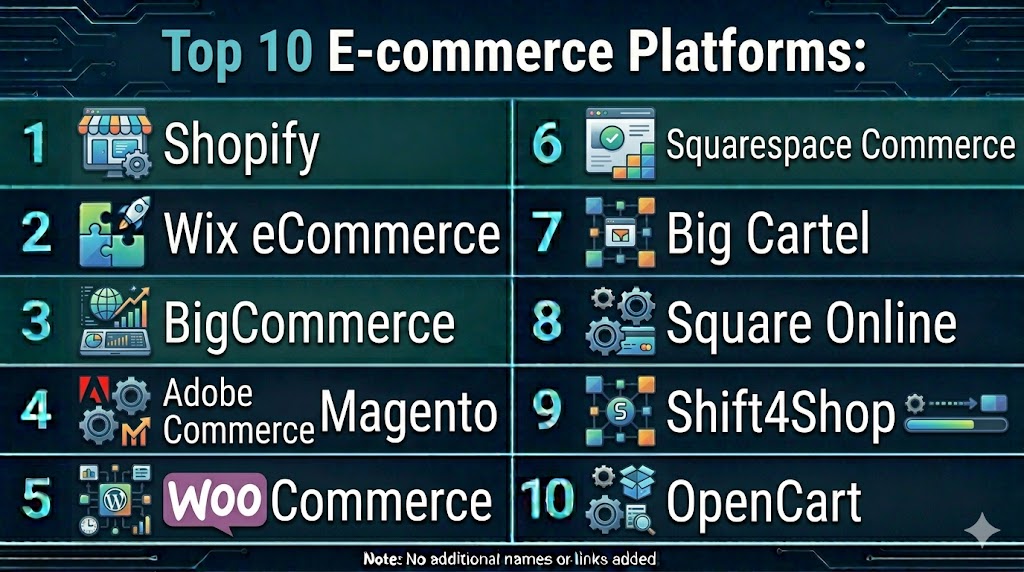
Top 10 E commerce Platforms
#1 — Shopify
Short description: Shopify is a leading cloud-based e commerce platform designed for businesses of all sizes with strong scalability and ease of use.
Key Features
- Store builder
- Payment processing
- Inventory management
- Marketing tools
- Analytics
Pros
- Easy to use
- Scalable
- Large ecosystem
Cons
- Transaction fees
- Limited customization without apps
- Pricing tiers
Platforms / Deployment
- Web Mobile
- Cloud
Security & Compliance
- Not publicly stated
Integrations & Ecosystem
Extensive ecosystem with apps and integrations.
- APIs
- Payment tools
- Marketing tools
Support & Community
Large global community
#2 — Wix eCommerce
Short description: Wix offers a simple drag and drop website builder with integrated e commerce capabilities for small businesses.
Key Features
- Website builder
- Online store
- Payment processing
- Marketing tools
- Analytics
Pros
- Easy setup
- Affordable
- Good for beginners
Cons
- Limited scalability
- Basic features
- Smaller ecosystem
Platforms / Deployment
- Web Mobile
- Cloud
Security & Compliance
- Not publicly stated
Integrations & Ecosystem
Supports integrations via apps.
- APIs
- Apps
Support & Community
Good support
#3 — BigCommerce
Short description: BigCommerce is a scalable e commerce platform with strong built-in features for growing businesses.
Key Features
- Multi-channel selling
- Inventory management
- SEO tools
- Analytics
- API support
Pros
- Strong built-in features
- Scalable
- No transaction fees
Cons
- Learning curve
- Pricing
- Limited themes
Platforms / Deployment
- Web
- Cloud
Security & Compliance
- Not publicly stated
Integrations & Ecosystem
Integrates with major tools and marketplaces.
- APIs
- Marketplaces
Support & Community
Enterprise support
#4 — Adobe Commerce Magento
Short description: Adobe Commerce is an enterprise-level e commerce platform offering advanced customization and scalability.
Key Features
- Custom store development
- Product management
- Analytics
- Marketing tools
- API support
Pros
- Highly customizable
- Scalable
- Enterprise-ready
Cons
- Complex setup
- Expensive
- Requires development resources
Platforms / Deployment
- Web
- Cloud On premise
Security & Compliance
- Not publicly stated
Integrations & Ecosystem
Strong enterprise integrations.
- APIs
- Enterprise tools
Support & Community
Large developer community
#5 — WooCommerce
Short description: WooCommerce is an open-source e commerce plugin for WordPress that allows full customization of online stores.
Key Features
- Product management
- Payment integration
- Plugins and extensions
- SEO support
- Customization
Pros
- Open-source
- Flexible
- Large community
Cons
- Requires hosting
- Maintenance required
- Plugin dependency
Platforms / Deployment
- Web
- Self hosted
Security & Compliance
- Not publicly stated
Integrations & Ecosystem
Extensive plugin ecosystem.
- APIs
- Plugins
Support & Community
Large community
#6 — Squarespace Commerce
Short description: Squarespace offers stylish website templates combined with e commerce functionality for small businesses.
Key Features
- Website builder
- Online store
- Payment processing
- Analytics
- Marketing tools
Pros
- Beautiful templates
- Easy to use
- All-in-one
Cons
- Limited customization
- Smaller ecosystem
- Scalability limits
Platforms / Deployment
- Web Mobile
- Cloud
Security & Compliance
- Not publicly stated
Integrations & Ecosystem
Supports integrations with business tools.
- APIs
- Marketing tools
Support & Community
Good support
#7 — Big Cartel
Short description: Big Cartel is a simple e commerce platform designed for artists and small sellers.
Key Features
- Store setup
- Product listing
- Payment integration
- Inventory tracking
- Analytics
Pros
- Simple
- Affordable
- Good for creatives
Cons
- Limited features
- Not scalable
- Basic analytics
Platforms / Deployment
- Web
- Cloud
Security & Compliance
- Not publicly stated
Integrations & Ecosystem
Basic integrations available.
- APIs
- Tools
Support & Community
Basic support
#8 — Square Online
Short description: Square Online provides e commerce capabilities integrated with Square POS systems.
Key Features
- Online store
- Payment processing
- Inventory sync
- Reporting
- Marketing tools
Pros
- Easy integration with POS
- Simple setup
- Affordable
Cons
- Limited customization
- Smaller ecosystem
- Basic features
Platforms / Deployment
- Web Mobile
- Cloud
Security & Compliance
- Not publicly stated
Integrations & Ecosystem
Integrates with Square ecosystem.
- APIs
- POS
Support & Community
Good support
#9 — Shift4Shop
Short description: Shift4Shop is a full-featured e commerce platform offering a wide range of built-in tools.
Key Features
- Product management
- Payment integration
- SEO tools
- Reporting
- Marketing tools
Pros
- Feature-rich
- Affordable
- Flexible
Cons
- Complex UI
- Learning curve
- Smaller ecosystem
Platforms / Deployment
- Web
- Cloud
Security & Compliance
- Not publicly stated
Integrations & Ecosystem
Supports integrations with business tools.
- APIs
- Tools
Support & Community
Good support
#10 — OpenCart
Short description: OpenCart is an open-source e commerce platform for building customizable online stores.
Key Features
- Product catalog
- Payment gateways
- Extensions
- Reporting
- Multi-store support
Pros
- Open-source
- Flexible
- Affordable
Cons
- Requires technical setup
- Limited built-in features
- Smaller ecosystem
Platforms / Deployment
- Web
- Self hosted
Security & Compliance
- Not publicly stated
Integrations & Ecosystem
Supports extensions and plugins.
- APIs
- Extensions
Support & Community
Open-source community
Comparison Table
| Tool Name | Best For | Platform Supported | Deployment | Standout Feature | Public Rating |
|---|---|---|---|---|---|
| Shopify | All sizes | Web Mobile | Cloud | Ease of use | N/A |
| Wix | Beginners | Web Mobile | Cloud | Drag and drop builder | N/A |
| BigCommerce | Growing businesses | Web | Cloud | Built-in features | N/A |
| Adobe Commerce | Enterprise | Web | Cloud On premise | Customization | N/A |
| WooCommerce | Developers | Web | Self hosted | Flexibility | N/A |
| Squarespace | Design-focused | Web Mobile | Cloud | Templates | N/A |
| Big Cartel | Small sellers | Web | Cloud | Simplicity | N/A |
| Square Online | POS users | Web Mobile | Cloud | POS integration | N/A |
| Shift4Shop | SMB | Web | Cloud | Feature-rich | N/A |
| OpenCart | Developers | Web | Self hosted | Open-source | N/A |
Evaluation & Scoring of E commerce Platforms
| Tool Name | Core | Ease | Integrations | Security | Performance | Support | Value | Weighted Total |
|---|---|---|---|---|---|---|---|---|
| Shopify | 9 | 9 | 9 | 8 | 9 | 9 | 8 | 8.8 |
| Wix | 7 | 10 | 7 | 7 | 7 | 7 | 9 | 7.9 |
| BigCommerce | 9 | 7 | 9 | 8 | 9 | 8 | 8 | 8.4 |
| Adobe Commerce | 10 | 6 | 9 | 9 | 9 | 8 | 6 | 8.3 |
| WooCommerce | 8 | 7 | 10 | 7 | 8 | 7 | 9 | 8.1 |
| Squarespace | 7 | 9 | 7 | 7 | 7 | 7 | 8 | 7.7 |
| Big Cartel | 6 | 9 | 6 | 6 | 6 | 6 | 9 | 7.0 |
| Square Online | 7 | 9 | 7 | 7 | 7 | 7 | 9 | 7.6 |
| Shift4Shop | 8 | 7 | 7 | 7 | 8 | 7 | 8 | 7.6 |
| OpenCart | 8 | 6 | 8 | 7 | 8 | 6 | 9 | 7.6 |
Scores are comparative and help evaluate platforms based on features, usability, and scalability.
Which E commerce Platform Is Right for You
Solo / Small Businesses
Wix and Big Cartel are simple and affordable.
SMB
Shopify and Square Online offer strong value.
Mid-Market
BigCommerce and WooCommerce provide flexibility.
Enterprise
Adobe Commerce is ideal.
Budget vs Premium
Big Cartel is budget-friendly, Adobe Commerce is premium.
Feature Depth vs Ease of Use
Adobe Commerce for depth, Shopify for simplicity.
Integrations & Scalability
Shopify and BigCommerce are strong options.
Security & Compliance Needs
Enterprise platforms provide stronger controls.
Frequently Asked Questions
1. What is an e commerce platform
It is software used to build and manage online stores. It handles products, payments, and customer interactions.
2. Why are these platforms important
They enable businesses to sell online efficiently. They also provide tools for growth and analytics.
3. How do these platforms work
They provide tools to create stores, manage inventory, and process payments. They also integrate with marketing tools.
4. Are these platforms suitable for small businesses
Yes, many platforms are designed for small businesses. They offer easy setup and affordable plans.
5. How much do they cost
Costs vary depending on features and scale. Some platforms offer free plans, while others are subscription-based.
6. Do they support mobile commerce
Yes, most platforms are mobile-friendly. They support responsive design and mobile apps.
7. How long does implementation take
It can take a few hours to days. It depends on customization and setup.
8. What are common mistakes
Choosing the wrong platform for scalability is common. Ignoring integrations can also cause issues.
9. Are these platforms secure
Most platforms provide secure payment processing. Security varies by provider.
10. Are there alternatives
Custom-built solutions are alternatives. However, they require more resources.
Conclusion
E commerce platforms are the backbone of modern online businesses, enabling companies to build, manage, and scale their digital storefronts efficiently. These tools bring together essential capabilities such as product management, payment processing, marketing, and analytics into a single ecosystem, making it easier to operate and grow in a competitive online market. From beginner-friendly platforms like Wix and Shopify to enterprise-grade solutions like Adobe Commerce, each platform offers unique strengths depending on business needs and technical expertise. The best choice depends on factors such as scalability, customization requirements, and budget rather than a one-size-fits-all solution. Businesses should prioritize ease of use, integration capabilities, and long-term growth potential when selecting a platform. A practical next step is to shortlist a few options, test store setups, and evaluate how well they align with your business goals and customer experience strategy.
