Introduction
Retail Category Management Tools are software platforms that help businesses organize products into strategic categories, optimize assortments, manage supplier relationships, and improve sales performance using data-driven insights. These tools treat each product category as a “mini business unit,” allowing retailers to plan, analyze, and optimize performance at a granular level.
In modern retail, category management has evolved from manual planning to AI-driven, analytics-powered decision-making, helping retailers align product mix, pricing, and promotions with customer demand.
Real-world use cases
- Assortment planning and SKU optimization
- Category performance tracking and reporting
- Supplier and procurement strategy management
- Shelf space and merchandising optimization
- Promotion and pricing strategy alignment
What buyers should evaluate
- Assortment and category planning capabilities
- Data analytics and forecasting features
- Integration with POS, ERP, and supply chain systems
- Collaboration between merchandising and procurement teams
- Scalability across multiple categories and locations
- AI-driven recommendations
- Reporting and visualization
- Ease of use and configuration
Best for: Retail chains, FMCG companies, merchandising teams, and enterprises managing large product catalogs.
Not ideal for: Small retailers with limited SKUs and simple inventory needs.
Key Trends in Retail Category Management Tools
- AI-driven assortment optimization and forecasting
- Real-time analytics for category performance
- Integration with supply chain and pricing systems
- Cloud-based category planning platforms
- Automation of category strategy workflows
- Collaboration tools for supplier and retailer alignment
- Omnichannel category management
- Demand-driven inventory planning
- Scenario simulation and predictive analytics
- Customer-centric category strategies
How We Selected These Tools
- Evaluated adoption across retail and FMCG sectors
- Assessed category planning and analytics capabilities
- Considered scalability for enterprise use
- Reviewed integration with retail ecosystems
- Analyzed usability for category managers
- Evaluated forecasting and AI capabilities
- Considered reporting and visualization tools
- Assessed overall value and flexibility
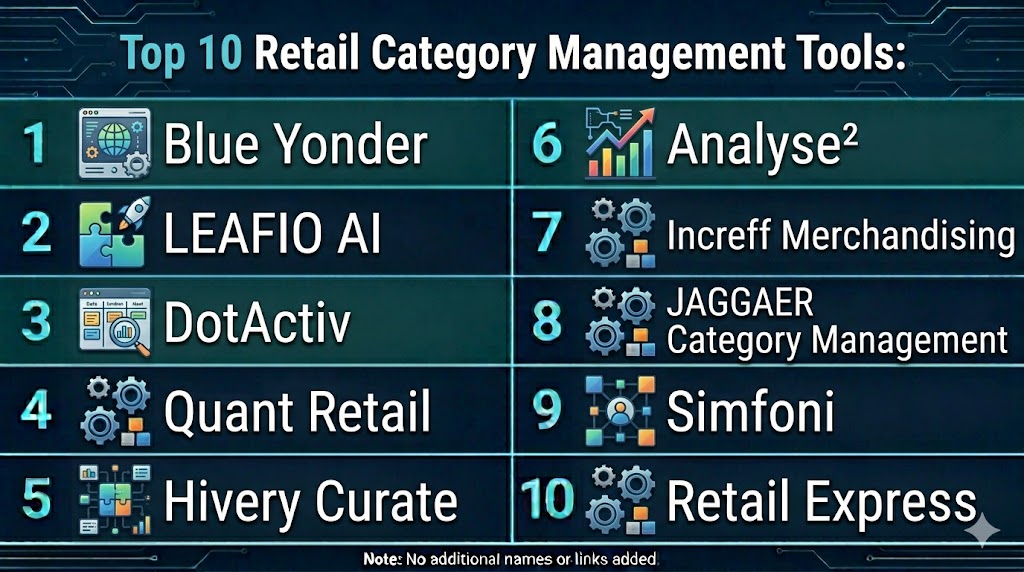
Top 10 Retail Category Management Tools
#1 — Blue Yonder
Short description: Blue Yonder provides advanced category management and supply chain solutions with strong AI-driven insights for large retailers.
Key Features
- Category planning
- Demand forecasting
- Space and assortment optimization
- Analytics dashboards
- Collaboration tools
Pros
- Strong AI capabilities
- Enterprise-ready
- Scalable
Cons
- Expensive
- Complex setup
- Requires training
Platforms / Deployment
- Web
- Cloud
Security & Compliance
- Not publicly stated
Integrations & Ecosystem
Integrates with supply chain and retail systems.
- APIs
- ERP
- Retail platforms
Support & Community
Enterprise support
#2 — LEAFIO AI
Short description: LEAFIO uses AI to automate category management, focusing on assortment optimization and demand forecasting.
Key Features
- AI assortment planning
- Demand forecasting
- Category analytics
- Inventory optimization
- Reporting
Pros
- AI-driven insights
- Scalable
- Strong forecasting
Cons
- Complex
- Expensive
- Learning curve
Platforms / Deployment
- Web
- Cloud
Security & Compliance
- Not publicly stated
Integrations & Ecosystem
Supports integration with retail systems.
- APIs
- ERP
Support & Community
Enterprise support
#3 — DotActiv
Short description: DotActiv is a mid-market category management tool combining analytics, assortment planning, and planogram capabilities.
Key Features
- Category analytics
- Assortment planning
- Floor planning
- Reporting
- Visualization
Pros
- Balanced features
- Affordable
- Easy to use
Cons
- Limited enterprise features
- Smaller ecosystem
- UI limitations
Platforms / Deployment
- Web
- Cloud
Security & Compliance
- Not publicly stated
Integrations & Ecosystem
Supports integrations with retail tools.
- APIs
- Data tools
Support & Community
Good support
#4 — Quant Retail
Short description: Quant Retail is a data-driven category management platform focused on optimizing assortment and space planning.
Key Features
- Assortment optimization
- Space planning
- Category analytics
- Reporting
- Visualization
Pros
- Strong analytics
- Scalable
- Data-driven
Cons
- Complex
- Expensive
- Learning curve
Platforms / Deployment
- Web
- Cloud
Security & Compliance
- Not publicly stated
Integrations & Ecosystem
Supports integration with enterprise systems.
- APIs
- ERP
Support & Community
Enterprise support
#5 — Hivery Curate
Short description: Hivery Curate provides AI-powered category strategy and simulation tools for retail and FMCG brands.
Key Features
- Strategy simulation
- Assortment optimization
- AI insights
- Category analytics
- Reporting
Pros
- AI-driven
- Strong simulation tools
- Scalable
Cons
- Expensive
- Complex
- Learning curve
Platforms / Deployment
- Web
- Cloud
Security & Compliance
- Not publicly stated
Integrations & Ecosystem
Supports integration with data platforms.
- APIs
- Analytics tools
Support & Community
Enterprise support
#6 — Analyse²
Short description: Analyse² provides shopper insights and category analytics to help retailers improve performance and customer engagement.
Key Features
- Shopper analytics
- Category insights
- Assortment planning
- Reporting
- Data visualization
Pros
- Strong insights
- Easy to use
- Scalable
Cons
- Limited automation
- Smaller ecosystem
- Pricing
Platforms / Deployment
- Web Mobile
- Cloud
Security & Compliance
- Not publicly stated
Integrations & Ecosystem
Supports integration via APIs.
- APIs
- Retail tools
Support & Community
Good support
#7 — Increff Merchandising
Short description: Increff focuses on category and assortment optimization for fashion and retail brands.
Key Features
- Assortment planning
- Inventory optimization
- Analytics
- Reporting
- Demand forecasting
Pros
- Strong retail focus
- Scalable
- Data-driven
Cons
- Industry-specific
- Pricing
- Limited customization
Platforms / Deployment
- Web
- Cloud
Security & Compliance
- Not publicly stated
Integrations & Ecosystem
Supports integration with retail systems.
- APIs
- ERP
Support & Community
Good support
#8 — JAGGAER Category Management
Short description: JAGGAER provides category management solutions focused on procurement and supplier optimization.
Key Features
- Spend analysis
- Supplier management
- Category strategy
- Reporting
- Automation
Pros
- Strong procurement features
- Scalable
- Enterprise-ready
Cons
- Complex
- Expensive
- Learning curve
Platforms / Deployment
- Web
- Cloud
Security & Compliance
- Not publicly stated
Integrations & Ecosystem
Integrates with procurement systems.
- APIs
- ERP
Support & Community
Enterprise support
#9 — Simfoni
Short description: Simfoni offers AI-powered category management with strong spend analytics and sourcing optimization.
Key Features
- Spend analytics
- Category planning
- AI insights
- Reporting
- Automation
Pros
- Strong analytics
- AI-driven
- Scalable
Cons
- Complex
- Pricing
- Learning curve
Platforms / Deployment
- Web Mobile
- Cloud
Security & Compliance
- Not publicly stated
Integrations & Ecosystem
Supports integration with enterprise tools.
- APIs
- Procurement systems
Support & Community
Enterprise support
#10 — Retail Express
Short description: Retail Express provides category and inventory management tools tailored for retail operations.
Key Features
- Inventory management
- Category tracking
- Reporting
- Analytics
- POS integration
Pros
- Easy to use
- Retail-focused
- Affordable
Cons
- Limited enterprise features
- Smaller ecosystem
- Basic analytics
Platforms / Deployment
- Web
- Cloud
Security & Compliance
- Not publicly stated
Integrations & Ecosystem
Supports integration with retail systems.
- APIs
- POS
Support & Community
Good support
Comparison Table
| Tool Name | Best For | Platform Supported | Deployment | Standout Feature | Public Rating |
|---|---|---|---|---|---|
| Blue Yonder | Enterprise retail | Web | Cloud | AI category planning | N/A |
| LEAFIO | AI retail | Web | Cloud | AI forecasting | N/A |
| DotActiv | Mid-market | Web | Cloud | Assortment planning | N/A |
| Quant Retail | Data-driven retail | Web | Cloud | Space optimization | N/A |
| Hivery | Strategy simulation | Web | Cloud | AI simulation | N/A |
| Analyse² | Shopper insights | Web Mobile | Cloud | Customer analytics | N/A |
| Increff | Fashion retail | Web | Cloud | Inventory optimization | N/A |
| JAGGAER | Procurement | Web | Cloud | Spend analysis | N/A |
| Simfoni | AI analytics | Web Mobile | Cloud | Spend intelligence | N/A |
| Retail Express | SMB retail | Web | Cloud | POS integration | N/A |
Evaluation & Scoring of Retail Category Management Tools
| Tool Name | Core | Ease | Integrations | Security | Performance | Support | Value | Weighted Total |
|---|---|---|---|---|---|---|---|---|
| Blue Yonder | 10 | 6 | 9 | 9 | 9 | 9 | 6 | 8.7 |
| LEAFIO | 9 | 6 | 8 | 8 | 9 | 8 | 7 | 8.2 |
| DotActiv | 8 | 8 | 7 | 7 | 8 | 7 | 8 | 7.9 |
| Quant Retail | 9 | 6 | 8 | 8 | 9 | 8 | 6 | 8.1 |
| Hivery | 9 | 6 | 8 | 8 | 9 | 8 | 6 | 8.1 |
| Analyse² | 8 | 8 | 7 | 7 | 8 | 7 | 8 | 7.9 |
| Increff | 8 | 7 | 8 | 7 | 8 | 7 | 8 | 7.8 |
| JAGGAER | 9 | 6 | 9 | 8 | 9 | 8 | 6 | 8.2 |
| Simfoni | 9 | 6 | 8 | 8 | 9 | 8 | 6 | 8.1 |
| Retail Express | 7 | 9 | 6 | 7 | 7 | 7 | 9 | 7.6 |
Scores are comparative and reflect strengths in analytics, scalability, and category optimization. Use them as a directional guide, not absolute rankings.
Which Retail Category Management Tool Is Right for You
Solo / Small Retailers
Retail Express and DotActiv are easy and cost-effective.
SMB
Analyse² and Increff provide balanced features.
Mid-Market
Quant Retail and LEAFIO offer strong optimization.
Enterprise
Blue Yonder, Hivery, and JAGGAER are ideal.
Budget vs Premium
Retail Express is budget-friendly, Blue Yonder is premium.
Feature Depth vs Ease of Use
Blue Yonder for depth, DotActiv for simplicity.
Integrations & Scalability
LEAFIO and JAGGAER are strong options.
Security & Compliance Needs
Enterprise tools provide stronger governance.
Frequently Asked Questions
1. What are retail category management tools
These tools help retailers manage product categories strategically. They improve assortment, pricing, and performance. They enhance decision-making.
2. Why is category management important
It helps optimize product mix and improve profitability. It aligns inventory with customer demand. It also improves efficiency.
3. How do these tools work
They analyze sales, demand, and supplier data. Then they provide insights and recommendations. This helps optimize categories.
4. Are these tools suitable for small retailers
Yes, some tools are designed for small businesses. Others are better suited for large enterprises.
5. What features should I look for
Look for analytics, forecasting, and integration capabilities. These are essential for effective category management.
6. How much do these tools cost
Pricing varies widely. Enterprise tools are expensive, while smaller tools are more affordable.
7. Do they integrate with retail systems
Yes, most tools integrate with POS, ERP, and supply chain systems. This improves workflow efficiency.
8. What are common mistakes
Not using data-driven insights is a common mistake. Manual planning limits effectiveness.
9. Are these tools secure
Most tools provide access control and data protection. Security varies by provider.
10. Are there alternatives
Spreadsheets and manual tools can be used. However, they lack scalability and automation.
Conclusion
Retail Category Management Tools have become essential for retailers aiming to optimize product assortment, improve profitability, and deliver better customer experiences. By transforming categories into strategic business units, these tools enable data-driven decisions across pricing, inventory, and merchandising. Modern platforms leverage AI and analytics to move beyond manual planning, allowing retailers to respond quickly to market changes and consumer demand. From simple tools like Retail Express to enterprise solutions like Blue Yonder and LEAFIO, each platform offers unique strengths based on business size and complexity. The right choice depends on your operational needs, data maturity, and scalability requirements rather than a one-size-fits-all solution. Retailers should prioritize analytics, integration, and usability when selecting a tool. A practical next step is to shortlist a few tools, run pilot implementations, and validate their impact on category performance and revenue growth.
