Introduction
Retail Pricing Optimization Tools are software platforms that help businesses analyze market data, competitor prices, demand signals, and customer behavior to determine the most profitable and competitive pricing strategy. These tools use advanced analytics and AI to automate pricing decisions and continuously adjust them based on real-time conditions.
In modern retail, pricing is no longer a static decision. With customers comparing prices instantly across channels, retailers must react quickly while balancing profitability and competitiveness. These tools enable dynamic pricing, demand forecasting, and margin optimization, turning pricing into a continuous, data-driven process rather than a manual task .
Real-world use cases
- Dynamic pricing for eCommerce and retail stores
- Competitor price monitoring and matching
- Demand-based price adjustments
- Margin optimization and revenue growth
- Promotion and discount optimization
What buyers should evaluate
- AI and predictive analytics capabilities
- Competitor price tracking and benchmarking
- Demand forecasting accuracy
- Integration with POS, ERP, and eCommerce systems
- Real-time pricing automation
- Scalability across large product catalogs
- Reporting and analytics
- Ease of configuration and control
Best for: Retail chains, eCommerce businesses, pricing analysts, and enterprises managing large product catalogs.
Not ideal for: Small retailers with static pricing strategies and limited product ranges.
Key Trends in Retail Pricing Optimization Tools
- AI-driven dynamic pricing based on demand and competition
- Real-time competitor price monitoring and adjustment
- Predictive analytics for demand forecasting
- Automation of pricing rules and workflows
- Integration with omnichannel retail systems
- Conversational AI and decision intelligence
- Personalized pricing strategies for customers
- Cloud-based pricing platforms
- Scenario simulation and A B testing
- Increased focus on pricing transparency and compliance
How We Selected These Tools
- Evaluated adoption across retail and eCommerce industries
- Assessed AI and analytics capabilities
- Considered scalability for large product catalogs
- Reviewed integration with retail systems
- Analyzed ease of use and configuration
- Evaluated real-time pricing capabilities
- Considered reporting and decision-making tools
- Assessed overall value and flexibility
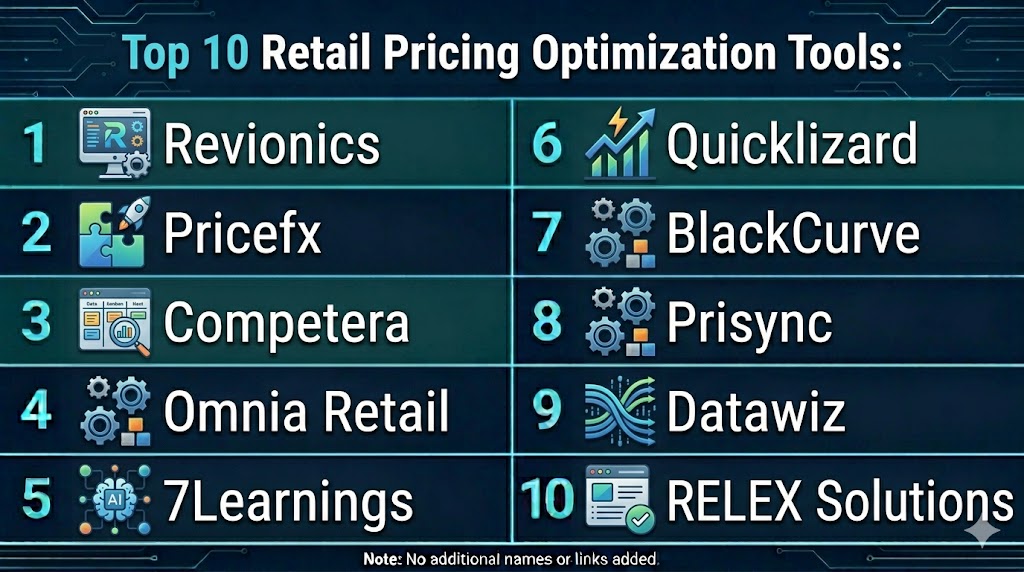
Top 10 Retail Pricing Optimization Tools
#1 — Revionics
Short description: Revionics is an enterprise-grade AI pricing platform that helps retailers optimize pricing strategies using advanced analytics and demand forecasting.
Key Features
- AI-driven price optimization
- Demand forecasting
- Category pricing strategies
- Promotion optimization
- Reporting and analytics
Pros
- Strong AI capabilities
- Enterprise-ready
- Proven scalability
Cons
- Expensive
- Complex implementation
- Requires training
Platforms / Deployment
- Web
- Cloud
Security & Compliance
- Not publicly stated
Integrations & Ecosystem
Integrates with retail and enterprise systems.
- APIs
- ERP
- Retail platforms
Support & Community
Enterprise support
#2 — Pricefx
Short description: Pricefx provides cloud-based pricing optimization with strong analytics and flexible pricing workflows.
Key Features
- Dynamic pricing
- Analytics dashboards
- Price modeling
- Workflow automation
- Reporting
Pros
- Flexible
- Scalable
- Strong analytics
Cons
- Learning curve
- Setup complexity
- Pricing
Platforms / Deployment
- Web
- Cloud
Security & Compliance
- Not publicly stated
Integrations & Ecosystem
Supports integration with enterprise tools.
- APIs
- ERP
Support & Community
Enterprise support
#3 — Competera
Short description: Competera is an AI-driven pricing platform that helps retailers optimize pricing based on demand and competitor insights.
Key Features
- AI pricing optimization
- Competitor price tracking
- Demand forecasting
- Price simulations
- Reporting
Pros
- Strong AI capabilities
- Data-driven insights
- Scalable
Cons
- Complex
- Expensive
- Learning curve
Platforms / Deployment
- Web
- Cloud
Security & Compliance
- Not publicly stated
Integrations & Ecosystem
Supports integration with retail systems.
- APIs
- Data platforms
Support & Community
Enterprise support
#4 — Omnia Retail
Short description: Omnia Retail provides dynamic pricing and competitor monitoring tools for omnichannel retailers.
Key Features
- Competitor monitoring
- Dynamic pricing automation
- Pricing rules engine
- Analytics
- Reporting
Pros
- Real-time insights
- Strong automation
- Omnichannel support
Cons
- Pricing
- Complex setup
- Learning curve
Platforms / Deployment
- Web
- Cloud
Security & Compliance
- Not publicly stated
Integrations & Ecosystem
Integrates with retail and eCommerce systems.
- APIs
- eCommerce
Support & Community
Good support
#5 — 7Learnings
Short description: 7Learnings is an AI-based pricing platform focused on predictive analytics and demand-based optimization.
Key Features
- AI price recommendations
- Demand forecasting
- Scenario simulations
- A B testing
- Analytics
Pros
- Predictive AI
- Strong forecasting
- Scalable
Cons
- Complex
- Expensive
- Requires expertise
Platforms / Deployment
- Web
- Cloud
Security & Compliance
- Not publicly stated
Integrations & Ecosystem
Supports enterprise integrations.
- APIs
- Data tools
Support & Community
Enterprise support
#6 — Quicklizard
Short description: Quicklizard offers dynamic pricing automation with real-time competitor tracking and analytics.
Key Features
- Dynamic pricing
- Competitor monitoring
- Analytics
- Reporting
- Automation
Pros
- Real-time updates
- Easy to use
- Scalable
Cons
- Limited advanced features
- Smaller ecosystem
- Pricing
Platforms / Deployment
- Web
- Cloud
Security & Compliance
- Not publicly stated
Integrations & Ecosystem
Supports integrations via APIs.
- APIs
- eCommerce
Support & Community
Good support
#7 — BlackCurve
Short description: BlackCurve provides pricing optimization with strong analytics and automation features.
Key Features
- Price optimization
- Competitor tracking
- Analytics
- Reporting
- Automation
Pros
- Easy to use
- Good analytics
- Affordable
Cons
- Limited enterprise features
- Smaller ecosystem
- Basic integrations
Platforms / Deployment
- Web
- Cloud
Security & Compliance
- Not publicly stated
Integrations & Ecosystem
Supports integrations with business tools.
- APIs
- Retail tools
Support & Community
Good support
#8 — Prisync
Short description: Prisync is a pricing intelligence tool that focuses on competitor monitoring and dynamic pricing for online stores.
Key Features
- Competitor price tracking
- Dynamic pricing
- Alerts and notifications
- Reporting
- API access
Pros
- Simple setup
- Real-time tracking
- Affordable
Cons
- Limited advanced AI
- Smaller ecosystem
- Basic analytics
Platforms / Deployment
- Web
- Cloud
Security & Compliance
- Not publicly stated
Integrations & Ecosystem
Supports integration with eCommerce tools.
- APIs
- eCommerce
Support & Community
Good support
#9 — Datawiz
Short description: Datawiz provides pricing analytics and optimization tools with strong reporting capabilities.
Key Features
- Pricing analytics
- Demand insights
- Reporting
- Forecasting
- Data visualization
Pros
- Strong analytics
- Easy to use
- Scalable
Cons
- Limited automation
- Smaller ecosystem
- Pricing
Platforms / Deployment
- Web
- Cloud
Security & Compliance
- Not publicly stated
Integrations & Ecosystem
Supports integrations via APIs.
- APIs
- Data tools
Support & Community
Good support
#10 — RELEX Solutions
Short description: RELEX provides pricing and supply chain optimization tools with strong forecasting capabilities.
Key Features
- Pricing optimization
- Demand forecasting
- Supply chain integration
- Analytics
- Reporting
Pros
- Strong forecasting
- Scalable
- Enterprise-ready
Cons
- Complex
- Expensive
- Learning curve
Platforms / Deployment
- Web
- Cloud
Security & Compliance
- Not publicly stated
Integrations & Ecosystem
Integrates with enterprise systems.
- APIs
- ERP
Support & Community
Enterprise support
Comparison Table
| Tool Name | Best For | Platform Supported | Deployment | Standout Feature | Public Rating |
|---|---|---|---|---|---|
| Revionics | Enterprise retail | Web | Cloud | AI pricing | N/A |
| Pricefx | Flexible pricing | Web | Cloud | Workflow automation | N/A |
| Competera | AI pricing | Web | Cloud | Demand forecasting | N/A |
| Omnia | Omnichannel | Web | Cloud | Real-time monitoring | N/A |
| 7Learnings | Predictive AI | Web | Cloud | AI recommendations | N/A |
| Quicklizard | SMB retail | Web | Cloud | Dynamic pricing | N/A |
| BlackCurve | SMB | Web | Cloud | Analytics | N/A |
| Prisync | eCommerce | Web | Cloud | Competitor tracking | N/A |
| Datawiz | Analytics | Web | Cloud | Data insights | N/A |
| RELEX | Enterprise | Web | Cloud | Forecasting | N/A |
Evaluation & Scoring of Retail Pricing Optimization Tools
| Tool Name | Core | Ease | Integrations | Security | Performance | Support | Value | Weighted Total |
|---|---|---|---|---|---|---|---|---|
| Revionics | 10 | 6 | 9 | 9 | 9 | 9 | 6 | 8.7 |
| Pricefx | 9 | 7 | 9 | 8 | 9 | 8 | 7 | 8.4 |
| Competera | 9 | 6 | 8 | 8 | 9 | 8 | 7 | 8.2 |
| Omnia | 9 | 7 | 8 | 8 | 8 | 8 | 7 | 8.1 |
| 7Learnings | 9 | 6 | 8 | 8 | 9 | 8 | 6 | 8.0 |
| Quicklizard | 8 | 8 | 7 | 7 | 8 | 7 | 8 | 7.9 |
| BlackCurve | 8 | 8 | 7 | 7 | 8 | 7 | 8 | 7.9 |
| Prisync | 8 | 9 | 7 | 7 | 8 | 7 | 9 | 8.0 |
| Datawiz | 8 | 8 | 7 | 7 | 8 | 7 | 8 | 7.9 |
| RELEX | 9 | 6 | 8 | 8 | 9 | 8 | 6 | 8.1 |
Scores are comparative and reflect strengths in analytics, automation, and scalability. Choose tools based on your pricing complexity and business size.
Which Retail Pricing Optimization Tool Is Right for You
Solo / Small Retailers
Prisync and BlackCurve are easy to use and affordable.
SMB
Quicklizard and Datawiz provide balanced features.
Mid-Market
Pricefx and Omnia offer strong capabilities.
Enterprise
Revionics, Competera, and RELEX are ideal.
Budget vs Premium
Prisync is budget-friendly, Revionics is premium.
Feature Depth vs Ease of Use
Competera for depth, Prisync for simplicity.
Integrations & Scalability
Pricefx and RELEX are strong options.
Security & Compliance Needs
Enterprise tools provide stronger governance.
Frequently Asked Questions
1. What are retail pricing optimization tools
These tools help businesses set optimal product prices using data and analytics. They improve profitability and competitiveness.
2. How do these tools work
They analyze demand, competitor prices, and historical data. Then they recommend or automate pricing decisions.
3. What is dynamic pricing
Dynamic pricing automatically adjusts prices based on market conditions. It uses real-time data to optimize pricing .
4. Are these tools suitable for small businesses
Yes, some tools are designed for small businesses. Others are better suited for enterprises.
5. How much do these tools cost
Pricing varies widely. Enterprise tools are expensive, while smaller tools are more affordable.
6. Do they integrate with retail systems
Yes, most tools integrate with POS, ERP, and eCommerce systems. This improves workflow efficiency.
7. How long does implementation take
Implementation can take days to weeks. It depends on system complexity.
8. What are common mistakes
Relying only on competitor pricing without considering margins is a common mistake.
9. Are these tools secure
Most tools include access control and data protection. Security varies by provider.
10. Are there alternatives
Manual pricing or spreadsheets can be used. However, they lack scalability and automation.
Conclusion
Retail Pricing Optimization Tools have become essential for modern retailers navigating highly competitive and fast-changing markets. These platforms transform pricing from a static, manual process into a dynamic, data-driven strategy powered by AI and real-time insights. By leveraging demand forecasting, competitor monitoring, and automated decision-making, businesses can balance profitability with competitiveness more effectively. From simple tools like Prisync to enterprise solutions like Revionics and RELEX, each option serves different needs depending on scale and complexity. The right choice depends on your business size, data maturity, and pricing strategy goals rather than a one-size-fits-all solution. Retailers should focus on analytics capabilities, integration, and ease of use when selecting a tool. A practical next step is to shortlist a few tools, run controlled pricing experiments, and evaluate their impact on revenue and margins before full adoption.
