Introduction
Compensation Management Tools are platforms that help organizations plan, manage, and optimize employee salaries, bonuses, incentives, and total rewards in a structured and data-driven way. Instead of relying on spreadsheets, these tools centralize compensation data, automate workflows, and ensure fair and competitive pay decisions.
As organizations grow, managing compensation becomes increasingly complex—especially with global teams, pay equity requirements, and competitive talent markets. Modern tools provide automation, benchmarking, analytics, and compliance controls, enabling HR and finance teams to make faster and more accurate compensation decisions.
Common use cases include:
- Salary planning and merit increases
- Bonus and incentive management
- Pay equity analysis and compliance
- Compensation benchmarking against market data
- Total rewards communication
What buyers should evaluate:
- Salary benchmarking and market data access
- Compensation cycle automation
- Pay equity and compliance tools
- Integration with HRIS and payroll systems
- Workflow approvals and governance
- Analytics and reporting capabilities
- Scalability across teams and geographies
- Ease of use and adoption
- Security and audit trails
Best for: HR leaders, compensation analysts, finance teams, and enterprises managing structured pay strategies.
Not ideal for: Small teams with simple salary structures that can be managed via basic HR tools.
Key Trends in Compensation Management Tools
- AI-driven compensation planning: Predictive salary recommendations
- Pay transparency and equity tools: Addressing regulatory and DEI requirements
- Real-time market benchmarking: Continuous compensation updates
- Automated compensation cycles: Faster merit and bonus planning
- Total rewards visualization: Showing full compensation packages
- Global compensation frameworks: Managing multi-country pay structures
- Integration-first platforms: Sync with HR, payroll, and finance tools
- Scenario modeling: Simulate salary and bonus changes
- Cloud-based solutions: Scalable and accessible globally
- Data-driven decision-making: Advanced analytics and reporting
How We Selected These Tools (Methodology)
- Evaluated market adoption and HR tech relevance
- Assessed compensation planning and automation capabilities
- Reviewed pay equity and benchmarking features
- Analyzed integration ecosystem (HRIS, payroll, finance tools)
- Considered ease of use and onboarding experience
- Checked security and compliance readiness
- Compared scalability across SMB to enterprise
- Reviewed analytics and reporting strength
- Ensured balanced mix of modern and enterprise tools
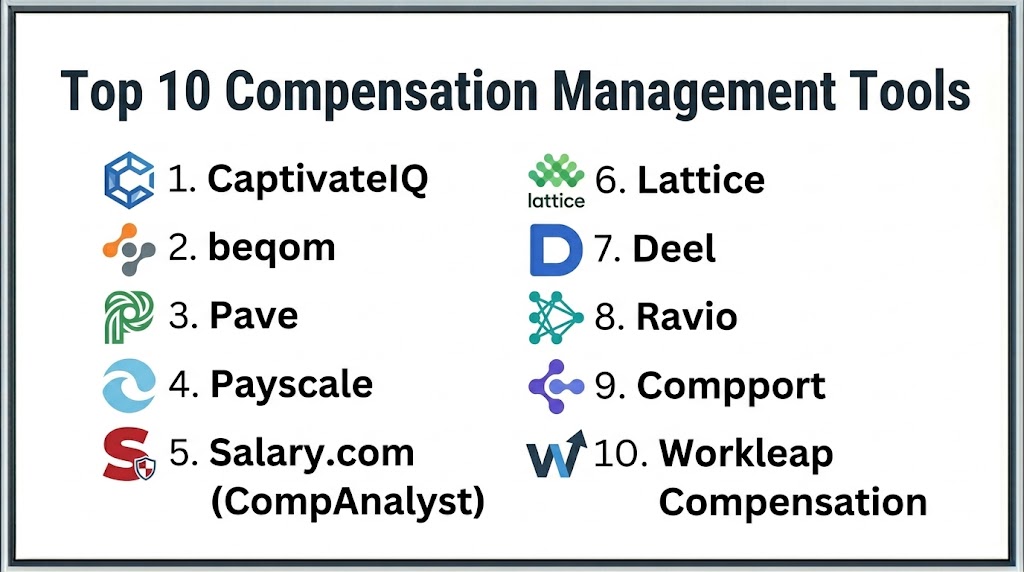
Top 10 Compensation Management Tools
#1 — CaptivateIQ
Short description: CaptivateIQ is a modern compensation platform focused on incentive compensation and commission management for sales-driven organizations.
Key Features
- Commission automation
- Incentive compensation modeling
- Real-time dashboards
- Workflow automation
- Data integrations
Pros
- Strong for sales compensation
- Flexible modeling
- Real-time insights
Cons
- Focused mainly on sales teams
- Limited HR compensation features
- Pricing varies
Platforms / Deployment
Cloud
Security & Compliance
Not publicly stated
Integrations & Ecosystem
Integrates with CRM and finance tools
- Salesforce
- Data warehouses
- APIs
Support & Community
Strong customer support
#2 — beqom
Short description: beqom is an enterprise-grade compensation platform supporting total rewards, pay equity, and global compensation strategies.
Key Features
- Salary and bonus planning
- Pay equity analysis
- Total rewards management
- Compensation modeling
- Analytics dashboards
Pros
- Enterprise-ready
- Global scalability
- Strong analytics
Cons
- Complex implementation
- Expensive
- Requires expertise
Platforms / Deployment
Cloud
Security & Compliance
Not publicly stated
Integrations & Ecosystem
Integrates with HR and ERP systems
Support & Community
Enterprise-level support
#3 — Pave
Short description: Pave provides real-time compensation benchmarking and planning tools for modern tech companies.
Key Features
- Market benchmarking
- Compensation bands
- Scenario modeling
- Real-time analytics
- Workflow automation
Pros
- Strong benchmarking data
- Modern interface
- Easy to use
Cons
- Limited enterprise depth
- Smaller ecosystem
- Pricing varies
Platforms / Deployment
Cloud
Security & Compliance
Not publicly stated
Integrations & Ecosystem
Integrates with HRIS and finance tools
Support & Community
Growing support
#4 — Payscale
Short description: Payscale is a compensation data and benchmarking platform that helps organizations align pay with market standards.
Key Features
- Salary benchmarking
- Compensation analytics
- Pay equity tools
- Reporting dashboards
- Market insights
Pros
- Strong market data
- Reliable insights
- Easy to use
Cons
- Limited workflow automation
- Pricing varies
- Less customization
Platforms / Deployment
Cloud
Security & Compliance
Not publicly stated
Integrations & Ecosystem
Integrates with HR systems
Support & Community
Strong support
#5 — Salary.com (CompAnalyst)
Short description: CompAnalyst offers compensation benchmarking and analytics with extensive salary data.
Key Features
- Salary benchmarking
- Compensation analytics
- Pay equity analysis
- Reporting dashboards
- Market data insights
Pros
- Extensive salary data
- Strong analytics
- Reliable
Cons
- Limited automation
- Pricing varies
- Learning curve
Platforms / Deployment
Cloud
Security & Compliance
Not publicly stated
Integrations & Ecosystem
Integrates with HR tools
Support & Community
Good support
#6 — Lattice
Short description: Lattice integrates compensation planning with performance management and employee engagement.
Key Features
- Compensation planning
- Performance reviews
- Pay equity insights
- Workflow automation
- Reporting dashboards
Pros
- Integrated HR platform
- Easy to use
- Strong engagement tools
Cons
- Limited advanced compensation features
- Pricing varies
- SMB-focused
Platforms / Deployment
Cloud
Security & Compliance
Not publicly stated
Integrations & Ecosystem
Integrates with HR and performance tools
Support & Community
Strong support
#7 — Deel
Short description: Deel offers global compensation and payroll solutions for distributed teams and international hiring.
Key Features
- Global salary management
- Compliance automation
- Contractor payments
- Benefits management
- Reporting dashboards
Pros
- Strong global coverage
- Easy onboarding
- Scalable
Cons
- Limited deep compensation analytics
- Pricing varies
- Smaller ecosystem
Platforms / Deployment
Cloud
Security & Compliance
Not publicly stated
Integrations & Ecosystem
Integrates with HR and finance systems
Support & Community
Strong support
#8 — Ravio
Short description: Ravio provides real-time compensation benchmarking and pay equity insights for growing companies.
Key Features
- Benchmarking data
- Pay equity analysis
- Compensation bands
- Reporting dashboards
- Analytics
Pros
- Strong benchmarking
- Modern platform
- Easy to use
Cons
- Limited enterprise features
- Smaller ecosystem
- Pricing varies
Platforms / Deployment
Cloud
Security & Compliance
Not publicly stated
Integrations & Ecosystem
Integrates with HR systems
Support & Community
Growing support
#9 — Compport
Short description: Compport focuses on total rewards management and compensation planning with strong analytics.
Key Features
- Compensation planning
- Pay equity analysis
- Total rewards management
- Workflow automation
- Reporting tools
Pros
- Flexible platform
- Strong analytics
- Scalable
Cons
- Setup complexity
- Pricing varies
- Learning curve
Platforms / Deployment
Cloud
Security & Compliance
Not publicly stated
Integrations & Ecosystem
Integrates with HR systems
Support & Community
Good support
#10 — Workleap Compensation
Short description: Workleap Compensation provides salary planning and benchmarking tools integrated with HR workflows.
Key Features
- Compensation planning
- Salary benchmarking
- Workflow automation
- Reporting dashboards
- Analytics
Pros
- Easy to use
- Affordable
- Good for SMBs
Cons
- Limited enterprise features
- Smaller ecosystem
- Basic analytics
Platforms / Deployment
Cloud
Security & Compliance
Not publicly stated
Integrations & Ecosystem
Integrates with HR platforms
Support & Community
Good support
Comparison Table
| Tool Name | Best For | Platform(s) Supported | Deployment | Standout Feature | Public Rating |
|---|---|---|---|---|---|
| CaptivateIQ | Sales teams | Web | Cloud | Incentive compensation | N/A |
| beqom | Enterprise | Web | Cloud | Total rewards | N/A |
| Pave | Startups | Web | Cloud | Benchmarking | N/A |
| Payscale | SMB/Mid | Web | Cloud | Salary data | N/A |
| Salary.com | Enterprise | Web | Cloud | Analytics | N/A |
| Lattice | SMB | Web | Cloud | HR integration | N/A |
| Deel | Global teams | Web | Cloud | Global payroll | N/A |
| Ravio | Startups | Web | Cloud | Real-time benchmarking | N/A |
| Compport | Enterprise | Web | Cloud | Total rewards | N/A |
| Workleap | SMB | Web | Cloud | Ease of use | N/A |
Evaluation & Scoring of Compensation Management Tools
| Tool | Core | Ease | Integrations | Security | Performance | Support | Value | Weighted Total |
|---|---|---|---|---|---|---|---|---|
| CaptivateIQ | 8 | 8 | 8 | 7 | 8 | 7 | 7 | 7.8 |
| beqom | 9 | 6 | 9 | 8 | 9 | 8 | 6 | 8.1 |
| Pave | 8 | 9 | 8 | 7 | 8 | 7 | 8 | 8.0 |
| Payscale | 8 | 8 | 7 | 7 | 8 | 7 | 8 | 7.8 |
| Salary.com | 8 | 7 | 7 | 7 | 8 | 7 | 7 | 7.6 |
| Lattice | 7 | 9 | 7 | 7 | 7 | 7 | 8 | 7.6 |
| Deel | 8 | 8 | 8 | 7 | 8 | 7 | 7 | 7.8 |
| Ravio | 7 | 9 | 7 | 7 | 7 | 7 | 8 | 7.6 |
| Compport | 8 | 7 | 8 | 7 | 8 | 7 | 7 | 7.7 |
| Workleap | 7 | 9 | 7 | 7 | 7 | 7 | 9 | 7.8 |
How to interpret scores:
- Higher Core = deeper compensation capabilities
- Higher Ease = faster adoption
- Higher Value = better ROI
- Enterprises should prioritize Core + Security, SMBs focus on Ease + Value
Which Compensation Management Tool Is Right for You?
Solo / Freelancer
Not required; basic HR or payroll tools are sufficient.
SMB
Workleap, Lattice, and Payscale offer ease of use and affordability.
Mid-Market
Pave, Ravio, and Compport provide better analytics and scalability.
Enterprise
beqom, Salary.com, and CaptivateIQ deliver advanced capabilities.
Budget vs Premium
- Budget: Workleap, Payscale
- Premium: beqom, CaptivateIQ
Feature Depth vs Ease of Use
- Feature-rich: beqom, Compport
- Easy-to-use: Workleap, Pave
Integrations & Scalability
Choose tools with strong HRIS and payroll integrations.
Security & Compliance Needs
Enterprises should prioritize audit trails, pay equity analysis, and compliance reporting.
Frequently Asked Questions (FAQs)
1. What is compensation management software?
It is software that helps manage salaries, bonuses, and total rewards. It centralizes compensation data and automates planning. This improves accuracy and efficiency.
2. Why is compensation management important?
It ensures fair and competitive pay. It helps retain employees and maintain compliance. It also improves transparency.
3. What features should I look for?
Look for benchmarking, analytics, automation, and integrations. Pay equity tools are also important.
4. Who should use these tools?
HR teams, finance teams, and enterprises benefit the most. Growing companies also need them.
5. Can these tools ensure pay equity?
Yes, they analyze compensation data to identify disparities. This helps maintain fairness and compliance.
6. Are these tools secure?
Most provide encryption and access controls. Security features vary by vendor.
7. Can they integrate with HR systems?
Yes, most tools integrate with HRIS and payroll systems. This ensures seamless data flow.
8. How long does implementation take?
SMB tools can be implemented quickly, while enterprise tools take longer.
9. What pricing models are used?
Subscription-based pricing is common. Costs vary based on features and scale.
10. What mistakes should be avoided?
Ignoring integrations and scalability is a common mistake. Businesses should also evaluate data accuracy.
Conclusion
Compensation Management Tools are essential for organizations aiming to create fair, competitive, and data-driven pay strategies. As businesses scale, managing compensation manually becomes inefficient and risky, especially when dealing with global teams and pay equity requirements. These tools provide automation, analytics, and benchmarking to ensure consistent and compliant compensation decisions. From SMB-friendly platforms like Workleap and Payscale to enterprise solutions like beqom and CaptivateIQ, there are options for every business size. The right choice depends on your organization’s complexity, workforce size, and integration needs. Businesses should prioritize transparency, automation, and scalability when selecting a solution. Security and compliance should also be key considerations. Instead of choosing based on popularity, organizations should evaluate how well a platform fits their workflows. Shortlisting a few tools and running pilot programs is the best approach. This ensures long-term success, better employee satisfaction, and optimized compensation strategies.

One aspect that often adds real value in compensation management tools is how easily organizations can model different pay structures. The ability to simulate changes before implementation helps ensure better decisions and smoother internal alignment.