Introduction
Subscription Billing Platforms are software solutions that help businesses automate recurring billing, manage subscriptions, and handle complex pricing models such as tiered, usage-based, or hybrid billing. These tools eliminate manual invoicing, reduce billing errors, and ensure predictable revenue streams.
As more companies adopt subscription-based business models, billing complexity increases. Managing upgrades, downgrades, renewals, proration, and global taxes manually is inefficient and risky. Modern subscription billing platforms solve this by offering automation, real-time analytics, and seamless integrations, allowing businesses to scale without operational bottlenecks.
Common use cases include:
- Managing recurring subscriptions and renewals
- Handling usage-based or metered billing
- Automating invoicing and payment collection
- Managing customer lifecycle events
- Revenue tracking and forecasting
What buyers should evaluate:
- Support for multiple pricing models
- Billing automation and workflows
- Integration with payment gateways and ERP systems
- Global tax and compliance handling
- API flexibility and extensibility
- Reporting and analytics capabilities
- Scalability and performance
- Security and compliance controls
- Ease of implementation and onboarding
Best for: SaaS companies, subscription businesses, digital services, and enterprises with recurring revenue models.
Not ideal for: Businesses with only one-time transactions or very simple billing needs.
Key Trends in Subscription Billing Platforms
- Usage-based billing adoption: Businesses are shifting toward consumption-based pricing models
- AI-driven churn prediction: Platforms help reduce customer churn with predictive insights
- Embedded payments: Seamless payment experiences within products
- Hybrid pricing models: Combining subscriptions with usage and one-time charges
- Automated tax compliance: Built-in support for global tax regulations
- API-first platforms: Easy integration with modern tech stacks
- Real-time revenue analytics: Visibility into ARR, churn, and growth
- Customer self-service portals: Customers manage subscriptions independently
- End-to-end revenue lifecycle management: Billing, payments, and accounting in one flow
- Security-first approach: Strong encryption and access controls
How We Selected These Tools (Methodology)
- Evaluated market adoption and industry presence
- Assessed subscription lifecycle management capabilities
- Reviewed billing flexibility and automation depth
- Analyzed integration ecosystem and API support
- Considered ease of use and onboarding experience
- Checked global billing and compliance capabilities
- Compared scalability across business sizes
- Reviewed customer feedback and reliability indicators
- Ensured balanced coverage across SMB and enterprise solutions
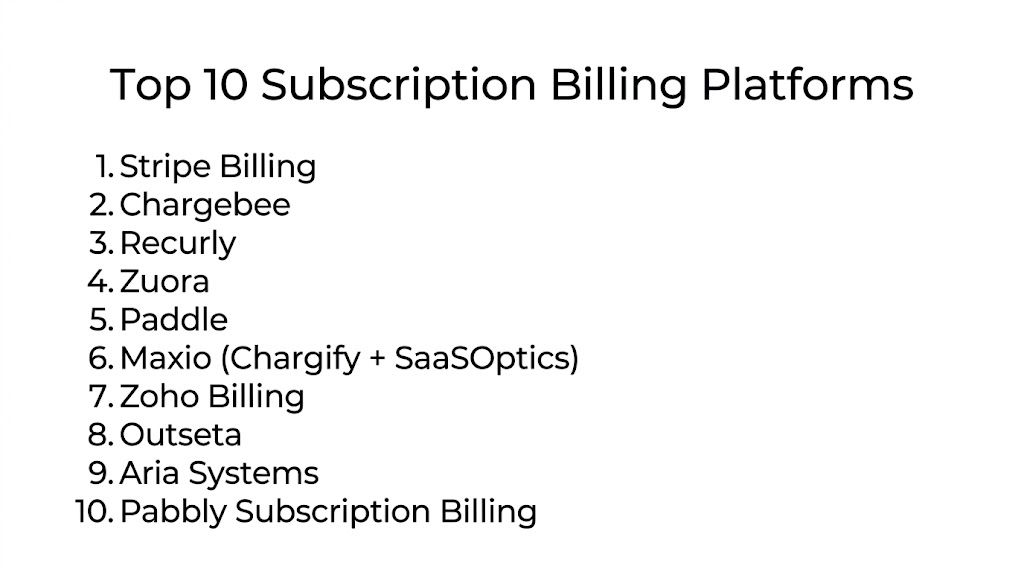
Top 10 Subscription Billing Platforms
#1 — Stripe Billing
Short description: Stripe Billing is a flexible and developer-friendly platform that supports recurring, usage-based, and hybrid billing models for businesses of all sizes.
Key Features
- Recurring and usage-based billing
- Subscription lifecycle management
- Smart retry logic for failed payments
- Global payment processing
- Revenue analytics
- API-first architecture
Pros
- Highly customizable
- Scales easily
- Strong developer ecosystem
Cons
- Requires technical expertise
- Complex for non-technical users
- Pricing can vary
Platforms / Deployment
Web, Cloud
Security & Compliance
PCI compliance, encryption
Integrations & Ecosystem
Extensive integration ecosystem across SaaS and finance tools.
- Payment gateways
- CRM systems
- Accounting tools
Support & Community
Strong documentation and global developer community.
#2 — Chargebee
Short description: Chargebee is a popular subscription management platform offering automation, analytics, and flexible billing models for SaaS businesses.
Key Features
- Subscription lifecycle automation
- Usage-based billing
- Automated invoicing
- Revenue analytics
- Multi-currency support
Pros
- Easy to scale
- Strong automation features
- Wide integration support
Cons
- Pricing complexity
- Requires configuration
- Limited customization in lower tiers
Platforms / Deployment
Web, Cloud
Security & Compliance
Encryption; certifications not publicly stated
Integrations & Ecosystem
Integrates with major SaaS tools.
- API integrations
- CRM and accounting tools
Support & Community
Good onboarding and support resources.
#3 — Recurly
Short description: Recurly specializes in subscription billing with strong tools for reducing churn and improving retention.
Key Features
- Subscription automation
- Revenue recovery tools
- Customer lifecycle management
- Multi-currency support
- Analytics dashboards
Pros
- Strong churn reduction features
- Reliable platform
- Flexible billing models
Cons
- Expensive
- Limited advanced usage billing
- Customization may require effort
Platforms / Deployment
Web, Cloud
Security & Compliance
Not publicly stated
Integrations & Ecosystem
Integrates with payment and business tools.
- Payment gateways
- CRM systems
Support & Community
Enterprise-level support available.
#4 — Zuora
Short description: Zuora is an enterprise-grade billing platform designed for complex subscription models and large-scale operations.
Key Features
- Subscription lifecycle management
- Revenue recognition
- Billing automation
- Advanced analytics
- Global compliance support
Pros
- Enterprise-ready
- Handles complex pricing
- Strong reporting
Cons
- High cost
- Complex implementation
- Requires training
Platforms / Deployment
Cloud
Security & Compliance
Encryption, RBAC; certifications not publicly stated
Integrations & Ecosystem
Integrates with ERP and finance systems.
- API support
- CRM integrations
Support & Community
Strong enterprise support.
#5 — Paddle
Short description: Paddle provides an all-in-one solution combining billing, payments, and tax compliance for SaaS businesses.
Key Features
- Subscription billing
- Payment processing
- Global tax compliance
- Fraud protection
- Revenue analytics
Pros
- All-in-one platform
- Simplifies compliance
- Easy setup
Cons
- Limited customization
- SaaS-focused
- Pricing varies
Platforms / Deployment
Cloud
Security & Compliance
Encryption, GDPR support
Integrations & Ecosystem
Built-in ecosystem for SaaS billing.
- Payment integrations
- SaaS tools
Support & Community
Responsive support and documentation.
#6 — Maxio
Short description: Maxio is built for B2B SaaS companies requiring advanced billing and revenue management capabilities.
Key Features
- Subscription billing
- Revenue recognition
- Analytics dashboards
- Customer lifecycle tracking
- Billing automation
Pros
- Strong B2B focus
- Detailed analytics
- Flexible billing
Cons
- Complex setup
- Higher pricing
- Not ideal for SMBs
Platforms / Deployment
Cloud
Security & Compliance
Not publicly stated
Integrations & Ecosystem
Integrates with SaaS finance tools.
- API integrations
- CRM systems
Support & Community
Moderate support and documentation.
#7 — Zoho Billing
Short description: Zoho Billing offers subscription management within the Zoho ecosystem, ideal for SMBs.
Key Features
- Subscription automation
- Invoice generation
- Payment tracking
- Analytics dashboards
- Multi-currency support
Pros
- Affordable
- Easy to use
- Strong ecosystem
Cons
- Limited enterprise features
- Basic reporting
- Customization limits
Platforms / Deployment
Web / iOS / Android, Cloud
Security & Compliance
Encryption, MFA; certifications not publicly stated
Integrations & Ecosystem
Part of Zoho ecosystem.
- CRM integrations
- Payment gateways
Support & Community
Strong documentation and support.
#8 — Aria Systems
Short description: Aria Systems supports complex subscription and usage-based billing for enterprise businesses.
Key Features
- Usage-based billing
- Subscription management
- Revenue analytics
- Global billing support
- Workflow automation
Pros
- Handles complex billing
- Highly scalable
- Enterprise-ready
Cons
- Complex implementation
- Expensive
- Requires expertise
Platforms / Deployment
Cloud
Security & Compliance
Not publicly stated
Integrations & Ecosystem
Integrates with enterprise systems.
- API support
- ERP integrations
Support & Community
Enterprise-level support.
#9 — BillingPlatform
Short description: BillingPlatform provides configurable billing solutions for enterprises with advanced automation and reporting.
Key Features
- Configurable billing models
- Workflow automation
- Revenue reporting
- Product catalog management
- Global support
Pros
- Highly flexible
- Scalable
- Strong reporting
Cons
- Complex setup
- Higher cost
- Requires training
Platforms / Deployment
Cloud
Security & Compliance
Not publicly stated
Integrations & Ecosystem
Integrates with finance systems.
- API integrations
- ERP tools
Support & Community
Enterprise-grade support.
#10 — Pabbly Subscription Billing
Short description: Pabbly is an affordable subscription billing solution designed for startups and small businesses.
Key Features
- Recurring billing
- Subscription management
- Payment integrations
- Automated invoicing
- Analytics tools
Pros
- Cost-effective
- Easy setup
- Good for startups
Cons
- Limited advanced features
- Smaller ecosystem
- Basic reporting
Platforms / Deployment
Web, Cloud
Security & Compliance
Not publicly stated
Integrations & Ecosystem
Supports integrations with payment tools.
- API support
- Payment gateways
Support & Community
Basic support with growing community.
Comparison Table
| Tool Name | Best For | Platform(s) Supported | Deployment | Standout Feature | Public Rating |
|---|---|---|---|---|---|
| Stripe Billing | All sizes | Web | Cloud | Flexible billing models | N/A |
| Chargebee | SaaS | Web | Cloud | Subscription automation | N/A |
| Recurly | SaaS | Web | Cloud | Churn reduction | N/A |
| Zuora | Enterprise | Web | Cloud | Complex billing | N/A |
| Paddle | SaaS | Web | Cloud | Tax compliance | N/A |
| Maxio | B2B SaaS | Web | Cloud | Revenue analytics | N/A |
| Zoho Billing | SMB | Web/Mobile | Cloud | Affordable pricing | N/A |
| Aria Systems | Enterprise | Web | Cloud | Usage-based billing | N/A |
| BillingPlatform | Enterprise | Web | Cloud | Configurable billing | N/A |
| Pabbly | SMB | Web | Cloud | Cost-effective | N/A |
Evaluation & Scoring of Subscription Billing Platforms
| Tool | Core | Ease | Integrations | Security | Performance | Support | Value | Weighted Total |
|---|---|---|---|---|---|---|---|---|
| Stripe Billing | 9 | 6 | 10 | 9 | 9 | 8 | 7 | 8.5 |
| Chargebee | 9 | 7 | 9 | 8 | 8 | 8 | 7 | 8.3 |
| Recurly | 8 | 7 | 8 | 7 | 8 | 8 | 7 | 7.8 |
| Zuora | 9 | 6 | 8 | 9 | 9 | 8 | 6 | 8.2 |
| Paddle | 8 | 8 | 7 | 8 | 8 | 8 | 8 | 8.1 |
| Maxio | 8 | 6 | 8 | 7 | 8 | 7 | 7 | 7.6 |
| Zoho Billing | 7 | 9 | 7 | 7 | 7 | 7 | 9 | 7.8 |
| Aria Systems | 9 | 5 | 8 | 8 | 9 | 8 | 6 | 7.9 |
| BillingPlatform | 9 | 5 | 8 | 8 | 9 | 8 | 6 | 7.9 |
| Pabbly | 6 | 9 | 6 | 6 | 7 | 6 | 9 | 7.1 |
Scores are comparative and highlight relative strengths. Enterprises should prioritize core features and security, while SMBs should focus on ease of use and value.
Which Subscription Billing Platform Is Right for You?
Solo / Freelancer
Choose simple and affordable tools like Pabbly or Zoho Billing.
SMB
Chargebee, Zoho Billing, and Paddle provide a balance of automation and usability.
Mid-Market
Recurly and Maxio offer scalability and advanced analytics.
Enterprise
Zuora, Stripe Billing, and Aria Systems provide deep billing capabilities.
Budget vs Premium
- Budget: Pabbly, Zoho Billing
- Premium: Stripe Billing, Zuora
Feature Depth vs Ease of Use
- Feature-rich: Stripe, Zuora
- Easy-to-use: Zoho Billing, Paddle
Integrations & Scalability
Choose API-first platforms for long-term growth.
Security & Compliance Needs
Enterprises should prioritize strong compliance and audit controls.
Frequently Asked Questions (FAQs)
1. What is a subscription billing platform?
A subscription billing platform automates recurring payments, invoicing, and subscription lifecycle management. It handles renewals, upgrades, and billing cycles efficiently. This helps businesses maintain consistent revenue streams and reduce manual effort.
2. Who should use subscription billing software?
SaaS companies, subscription businesses, and digital service providers benefit the most from these platforms. They are also useful for startups scaling their recurring revenue models. Even mid-sized companies use them to streamline operations.
3. What pricing models do these platforms support?
Most platforms support flat-rate, tiered, usage-based, and hybrid pricing models. This flexibility allows businesses to adapt pricing strategies based on customer behavior. It is essential for companies experimenting with monetization.
4. Are subscription billing platforms secure?
Yes, most platforms offer encryption, secure payment processing, and access controls. Some also support compliance frameworks for handling sensitive financial data. However, certifications may vary by provider.
5. Can these platforms handle global payments?
Many platforms support multiple currencies and international tax regulations. This enables businesses to operate globally without manual calculations. It is especially useful for SaaS companies with international users.
6. How long does implementation take?
Implementation time depends on complexity and integrations. Simple setups can take a few days, while enterprise deployments may take several weeks. Planning integrations in advance can speed up the process.
7. What integrations are important?
Important integrations include payment gateways, CRM systems, and accounting or ERP platforms. These integrations ensure smooth data flow across systems. API support is also important for customization.
8. Can I switch subscription billing platforms later?
Yes, switching is possible but requires proper planning for data migration. Businesses should ensure compatibility with existing systems before switching. Testing the new platform is recommended before full deployment.
9. What are common mistakes when choosing a platform?
Common mistakes include ignoring scalability, focusing only on price, and overlooking integration requirements. Businesses may also underestimate future billing complexity. Evaluating long-term needs is important.
10. Are subscription billing platforms suitable for startups?
Yes, many platforms offer startup-friendly plans with essential features. They allow startups to automate billing early and scale efficiently. Choosing a flexible tool helps support future growth.
Conclusion
Subscription Billing Platforms are essential for businesses that rely on recurring revenue models and need efficient billing operations. They simplify complex processes like subscription management, invoicing, and payment collection while providing real-time insights into revenue performance. From flexible platforms like Stripe Billing and Chargebee to enterprise solutions like Zuora and Aria Systems, there are options for every business size and complexity. The right choice depends on your pricing model, integration needs, and growth plans. Companies should prioritize automation, scalability, and ease of use when selecting a platform. Security and compliance should also be considered, especially for businesses operating globally. Instead of choosing based on popularity, organizations should evaluate how well a platform fits their workflows. Shortlisting a few tools and testing them in real scenarios is the best approach. This ensures long-term efficiency, better customer experience, and optimized revenue growth.
