Introduction
Reverse ETL Tools are designed to sync data from centralized data warehouses, lakes, or lakehouses back into operational systems, such as CRMs, marketing automation platforms, sales tools, and customer support systems. Unlike traditional ETL, which moves data into analytical systems, reverse ETL ensures business teams have actionable insights directly in the tools they use daily.
Reverse ETL helps organizations operationalize analytics, making data-driven actions possible across departments. It is widely used in sales, marketing, customer success, product analytics, and finance workflows.
Common use cases include:
- Syncing enriched customer data into Salesforce, HubSpot, or Zendesk
- Operationalizing predictive scores for sales or marketing campaigns
- Updating subscription and billing tools with warehouse insights
- Personalizing product or email campaigns using analytics data
- Syncing churn risk or health scores into CRM for customer success teams
- Feeding AI-driven recommendations back into operational platforms
Key evaluation criteria:
- Supported destinations (CRMs, marketing platforms, support tools)
- Real-time or batch sync support
- Ease of configuration and workflow automation
- Integration with data warehouses, lakes, and analytics platforms
- Monitoring, error handling, and observability
- Scalability and performance
- Security and compliance support
- Cloud-native and hybrid deployment options
Best for: Sales, marketing, and product teams; data teams who want to operationalize analytics without custom engineering.
Not ideal for: Organizations with no centralized data warehouse or minimal operational workflows.
Key Trends in Reverse ETL Tools
- Rise of CDP + Reverse ETL integrations
- Cloud-native platforms with serverless sync capabilities
- Real-time streaming and incremental data sync
- AI-powered recommendations and scoring pushed to operational tools
- No-code and low-code workflow interfaces
- Unified analytics-to-operations pipelines
- Increased adoption by marketing, sales, and customer success teams
- Strong focus on data privacy, compliance, and governance
- Integration with modern warehouse ecosystems (Snowflake, BigQuery, Redshift)
- Expansion of open-source and developer-friendly options
How We Selected These Tools (Methodology)
- Adoption in analytics-to-operations workflows
- Destination system support (CRM, marketing, sales, product tools)
- Ease of setup and low-code configuration
- Performance for batch and near real-time sync
- Compatibility with modern data warehouses and lakes
- Security, governance, and compliance features
- Observability, monitoring, and error handling
- Community or enterprise adoption
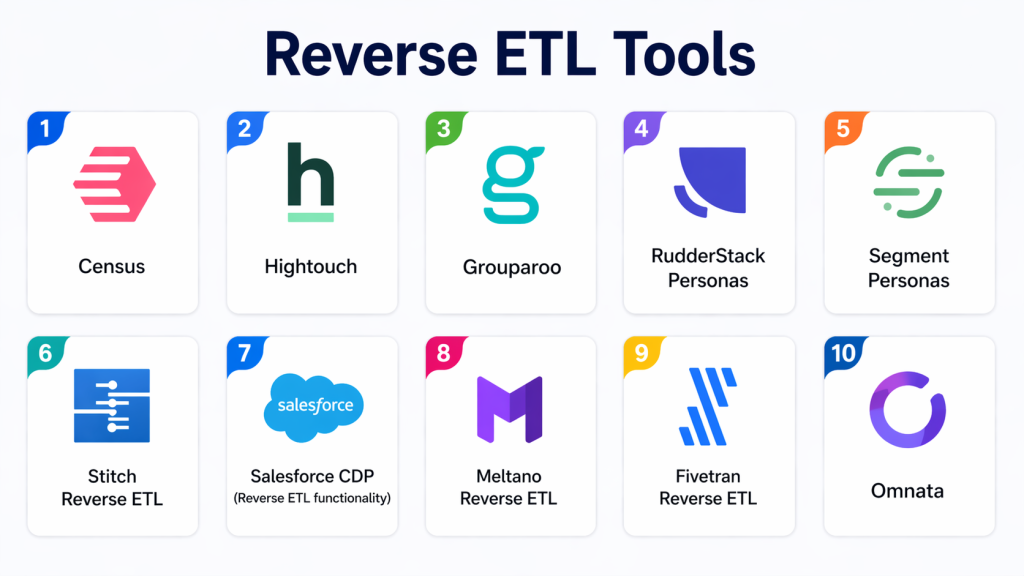
Top 10 Reverse ETL Tools
#1 — Census
A leading reverse ETL platform connecting warehouses with operational systems.
Key Features
- Bi-directional syncing
- Real-time and batch support
- Syncs to CRMs, marketing, and support tools
- Data transformation capabilities
- SQL-based configuration
Pros
- Strong warehouse integrations
- Easy-to-use, no-code interface
Cons
- Cost scales with sync volume
- Limited open-source flexibility
Platforms / Deployment
Cloud
Security & Compliance
Encryption, RBAC; Not publicly stated
Integrations & Ecosystem
- Salesforce, HubSpot, Zendesk
- Snowflake, BigQuery, Redshift
- APIs
Support & Community
Strong enterprise support
#2 — Hightouch
A modern reverse ETL tool for operationalizing analytics directly in business applications.
Key Features
- SQL-powered sync workflows
- Multi-destination support
- Real-time data updates
- Scheduling and transformation features
- No-code pipeline creation
Pros
- User-friendly interface
- Extensive destination coverage
Cons
- Enterprise features are premium
- Some latency in real-time sync
Platforms / Deployment
Cloud
Security & Compliance
Encryption, SOC 2; Not publicly stated
Integrations & Ecosystem
- CRMs, marketing tools, support systems
- Snowflake, BigQuery, Redshift
- APIs
Support & Community
Strong enterprise support
#3 — Grouparoo
An open-source reverse ETL platform for syncing warehouse data to operational tools.
Key Features
- Open-source and self-hosted options
- Multi-destination sync
- Real-time and batch workflows
- Extensible with custom transformations
- SQL and code-based configuration
Pros
- Open-source flexibility
- Developer-friendly and extensible
Cons
- Requires some engineering effort
- Smaller ecosystem than commercial platforms
Platforms / Deployment
Cloud / On-premise
Security & Compliance
Depends on deployment; Not publicly stated
Integrations & Ecosystem
- Salesforce, HubSpot, Intercom
- Snowflake, BigQuery, Redshift
- APIs
Support & Community
Growing open-source community
#4 — RudderStack Personas
A CDP platform with built-in reverse ETL capabilities for syncing warehouse data.
Key Features
- Segmenting and modeling data
- Real-time sync to operational systems
- Low-code pipeline setup
- Warehouse-native integration
- Transformation and enrichment
Pros
- CDP + Reverse ETL in one platform
- Strong real-time capabilities
Cons
- Limited to supported destinations
- Requires CDP adoption
Platforms / Deployment
Cloud
Security & Compliance
Encryption; Not publicly stated
Integrations & Ecosystem
- Salesforce, Marketo, HubSpot
- Snowflake, BigQuery, Redshift
- APIs
Support & Community
Enterprise support
#5 — Segment Personas
A customer data platform offering reverse ETL features for operational analytics.
Key Features
- Profile unification
- Real-time data sync
- Pre-built connectors to operational tools
- Audience segmentation
- AI-driven recommendations
Pros
- Strong customer data unification
- Low-code integration
Cons
- High cost for large-scale usage
- Limited warehouse integrations outside Segment
Platforms / Deployment
Cloud
Security & Compliance
Enterprise encryption; Not publicly stated
Integrations & Ecosystem
- CRM, marketing, support tools
- Data warehouses
- APIs
Support & Community
Strong Segment ecosystem
#6 — Stitch Reverse ETL
A simple platform to sync warehouse data to business applications.
Key Features
- Incremental data sync
- Pre-built connectors
- Batch-oriented pipelines
- Cloud-native design
- Monitoring and logging
Pros
- Easy to set up and use
- Affordable for SMBs
Cons
- Limited real-time support
- Fewer transformation features
Platforms / Deployment
Cloud
Security & Compliance
Encryption; Not publicly stated
Integrations & Ecosystem
- Snowflake, BigQuery, Redshift
- Salesforce, HubSpot
- APIs
Support & Community
Moderate support
#7 — Salesforce CDP (Reverse ETL functionality)
CDP platform with integrated reverse ETL capabilities.
Key Features
- Customer profile unification
- Sync enriched data to Salesforce and other CRMs
- Real-time or scheduled updates
- Audience segmentation
- Analytics-ready transformations
Pros
- Native Salesforce integration
- Strong customer insight capabilities
Cons
- Limited outside Salesforce ecosystem
- Premium pricing
Platforms / Deployment
Cloud
Security & Compliance
Enterprise security; Not publicly stated
Integrations & Ecosystem
- Salesforce apps
- Marketing automation tools
- APIs
Support & Community
Strong Salesforce support
#8 — Meltano Reverse ETL
Open-source ETL and reverse ETL platform for modern data pipelines.
Key Features
- Open-source and self-hosted
- SQL and Python pipelines
- Multi-destination support
- Batch sync workflows
- Extensible transformation layer
Pros
- Flexible open-source tool
- Developer-friendly
Cons
- Requires technical expertise
- Smaller commercial support
Platforms / Deployment
Cloud / On-premise
Security & Compliance
Depends on deployment; Not publicly stated
Integrations & Ecosystem
- Data warehouses
- CRMs and marketing tools
- APIs
Support & Community
Growing open-source community
#9 — Fivetran Reverse ETL
Cloud-native platform for operationalizing warehouse data into business apps.
Key Features
- Fully managed pipelines
- Incremental syncs
- Pre-built connectors
- Transformation support
- Cloud-native design
Pros
- Low-maintenance and reliable
- Easy for business teams
Cons
- Can be expensive at scale
- Limited on-premise support
Platforms / Deployment
Cloud
Security & Compliance
Encryption and SOC compliance; Not publicly stated
Integrations & Ecosystem
- Snowflake, BigQuery, Redshift
- Salesforce, HubSpot, Zendesk
- APIs
Support & Community
Strong enterprise support
#10 — Omnata
A reverse ETL platform focused on syncing analytics and operational data to SaaS tools.
Key Features
- SQL-based sync
- Pre-built connectors
- Batch and scheduled updates
- Transformation and enrichment
- Monitoring and alerting
Pros
- Focused on operational use cases
- Lightweight and simple
Cons
- Limited enterprise features
- Smaller ecosystem
Platforms / Deployment
Cloud
Security & Compliance
Encryption; Not publicly stated
Integrations & Ecosystem
- Salesforce, HubSpot, Intercom
- Data warehouses
- APIs
Support & Community
Moderate support
Comparison Table (Top 10)
| Tool Name | Best For | Platform(s) Supported | Deployment | Standout Feature | Public Rating |
|---|---|---|---|---|---|
| Census | Operational workflows | Multi | Cloud | Bi-directional sync | N/A |
| Hightouch | Business teams | Multi | Cloud | Real-time updates | N/A |
| Grouparoo | Open-source devs | Multi | Cloud/On-prem | Open-source flexibility | N/A |
| RudderStack Personas | CDP + Ops | Multi | Cloud | Segmentation + real-time | N/A |
| Segment Personas | Marketing teams | Multi | Cloud | Customer profile unification | N/A |
| Stitch | SMB ETL | Multi | Cloud | Easy setup | N/A |
| Salesforce CDP | Salesforce ecosystem | Multi | Cloud | Native CRM integration | N/A |
| Meltano | Developers | Multi | Cloud/On-prem | Open-source pipelines | N/A |
| Fivetran | Cloud teams | Multi | Cloud | Low-maintenance sync | N/A |
| Omnata | SaaS operational data | Multi | Cloud | Lightweight reverse ETL | N/A |
Evaluation & Scoring of Reverse ETL Tools
| Tool Name | Core | Ease | Integrations | Security | Performance | Support | Value | Total |
|---|---|---|---|---|---|---|---|---|
| Census | 10 | 9 | 10 | 9 | 9 | 9 | 8 | 9.0 |
| Hightouch | 10 | 9 | 10 | 9 | 9 | 9 | 8 | 9.0 |
| Grouparoo | 9 | 8 | 9 | 8 | 9 | 8 | 9 | 8.5 |
| RudderStack | 9 | 8 | 9 | 8 | 9 | 8 | 9 | 8.5 |
| Segment | 9 | 9 | 9 | 9 | 9 | 9 | 8 | 8.9 |
| Stitch | 8 | 9 | 8 | 8 | 8 | 8 | 9 | 8.2 |
| Salesforce CDP | 9 | 8 | 9 | 9 | 9 | 9 | 7 | 8.5 |
| Meltano | 8 | 8 | 8 | 8 | 8 | 8 | 9 | 8.1 |
| Fivetran | 9 | 10 | 10 | 9 | 9 | 9 | 7 | 8.8 |
| Omnata | 8 | 8 | 8 | 8 | 8 | 8 | 8 | 8.0 |
Which Reverse ETL Tool Should You Choose?
Solo / Developer
Grouparoo or Meltano
SMB
Stitch or Fivetran
Mid-Market
Hightouch or Census
Enterprise
Segment, RudderStack, Salesforce CDP
Real-Time Data
Hightouch, RudderStack
Open-Source Preference
Grouparoo, Meltano
Frequently Asked Questions (FAQs)
1. What is reverse ETL?
Reverse ETL moves data from warehouses into operational tools to enable action on analytics insights.
2. Why is reverse ETL important?
It allows business teams to act on insights directly in their CRM, marketing, or support tools.
3. How does reverse ETL differ from traditional ETL?
ETL loads data into warehouses for analysis; reverse ETL pushes data back to operational systems.
4. Are reverse ETL tools real-time?
Many support near real-time or scheduled batch syncs depending on the platform.
5. Which reverse ETL is easiest to use?
Fivetran, Hightouch, and Census are considered user-friendly for business teams.
6. Can reverse ETL handle large datasets?
Yes, most cloud-native reverse ETL tools scale for enterprise workloads.
7. Which industries use reverse ETL?
SaaS, e-commerce, finance, marketing, and customer success teams widely use it.
8. Do reverse ETL tools support data transformation?
Yes, most provide lightweight transformation capabilities during sync.
9. Are reverse ETL tools secure?
Most platforms include encryption, RBAC, and compliance features.
10. Can I use reverse ETL with multiple warehouses?
Yes, many tools support Snowflake, BigQuery, Redshift, and other warehouses.
Conclusion
Reverse ETL Tools are critical for operationalizing data analytics across modern organizations. They bridge the gap between centralized warehouses and operational systems, enabling sales, marketing, and customer success teams to act on data insights directly in the tools they use daily. From enterprise platforms like Census and Segment to open-source options like Grouparoo and Meltano, reverse ETL tools cater to different scales and technical preferences. The right tool depends on your warehouse, business workflows, and integration needs. Ultimately, reverse ETL empowers teams to transform analytics into actionable, operational decisions, closing the loop between data insights and business impact.
