Introduction
Secure Access Service Edge (SASE) platforms are cloud-delivered security frameworks that combine networking and security into a single unified solution. Instead of relying on multiple point tools (VPN, firewall, SWG, CASB), SASE integrates them into one platform delivered from the cloud.
SASE is critical for modern organizations because users, apps, and data are no longer inside a fixed perimeter. With remote work, SaaS adoption, and hybrid infrastructure, SASE provides secure, scalable, and identity-driven access across distributed environments.
Use Cases:
- Secure remote workforce access
- Replace VPN and legacy network security
- Protect SaaS and cloud applications
- Enforce Zero Trust policies
- Simplify network + security architecture
What buyers should evaluate:
- Integration of SWG, CASB, ZTNA, FWaaS
- Cloud-native architecture
- Performance and latency
- Identity and access controls
- Data protection capabilities
- Ease of deployment
- Scalability across regions
- Vendor ecosystem and integrations
Best for: Enterprises, cloud-first organizations, distributed teams, and Zero Trust adopters
Not ideal for: Small organizations with minimal cloud usage or simple network requirements
Key Trends in SASE Platforms
- Convergence of networking and security into one platform
- Rapid adoption of Zero Trust architectures
- Cloud-native SASE replacing legacy VPN and firewalls
- AI-driven threat detection and analytics
- Integration with identity and device posture
- Expansion into SSE (Security Service Edge)
- Increased focus on user experience and performance
- Automation of security policies
- Unified dashboards for visibility
- Multi-cloud and hybrid support
How We Selected These Tools (Methodology)
- Market adoption and vendor leadership
- Completeness of SASE architecture
- Integration of networking + security features
- Performance and global infrastructure
- Security and compliance readiness
- Ease of deployment and usability
- Innovation in Zero Trust and AI
- Ecosystem and integrations
- Customer fit across SMB and enterprise
- Support and documentation quality
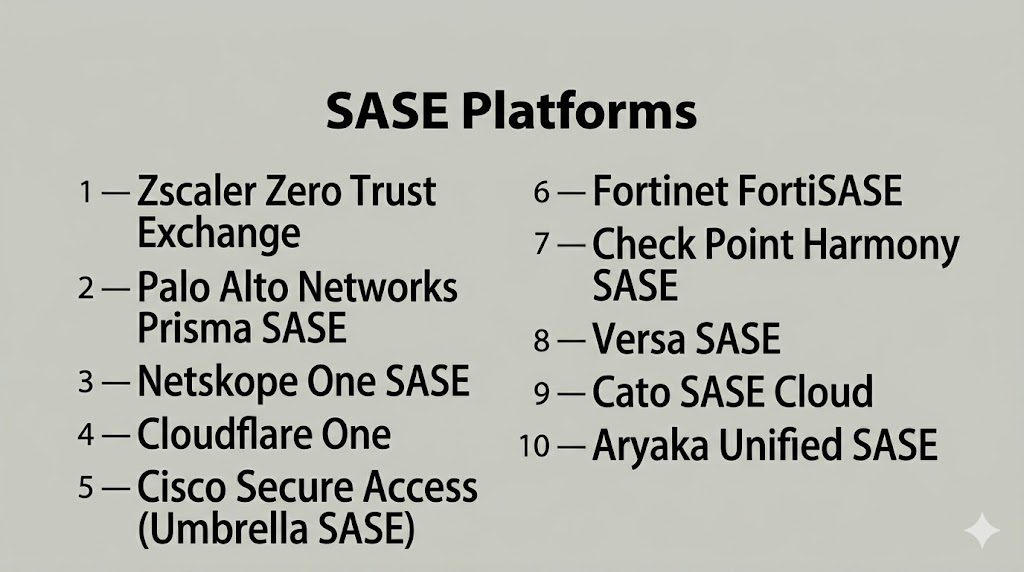
Top 10 SASE Platforms
#1 — Zscaler Zero Trust Exchange
A leading cloud-native SASE platform combining SWG, ZTNA, CASB, and firewall services.
Key Features
- Zero Trust access
- Secure web gateway
- Cloud firewall
- Threat intelligence
- Data protection
Pros
- Fully cloud-native
- Strong global infrastructure
Cons
- Premium pricing
- Complex setup
Platforms / Deployment
- Web
- Cloud
Security & Compliance
- SSO, MFA
- Not publicly stated
Integrations & Ecosystem
- Cloud apps
- SIEM, IAM tools
Support & Community
Enterprise support and documentation
#2 — Palo Alto Networks Prisma SASE
A comprehensive SASE solution integrating SD-WAN and security services into one platform.
Key Features
- SD-WAN + security
- Threat prevention
- Zero Trust access
- Data protection
- Policy enforcement
Pros
- Strong enterprise ecosystem
- Advanced threat protection
Cons
- Complex configuration
- Premium pricing
Platforms / Deployment
- Web
- Cloud
Security & Compliance
- SSO, MFA
- Not publicly stated
Integrations & Ecosystem
- Palo Alto ecosystem
Support & Community
Enterprise support
#3 — Netskope One SASE
A unified platform delivering secure access, data protection, and cloud security.
Key Features
- SWG, CASB, ZTNA integration
- Data protection
- Real-time monitoring
- Threat detection
- Policy enforcement
Pros
- Strong data-centric security
- Unified architecture
Cons
- Learning curve
- Requires expertise
Platforms / Deployment
- Web
- Cloud
Security & Compliance
- SSO, MFA
- Not publicly stated
Integrations & Ecosystem
- SaaS and cloud apps
Support & Community
Enterprise support
#4 — Cloudflare One
A global SASE platform delivering Zero Trust access with high performance and low latency.
Key Features
- Zero Trust access
- Secure web gateway
- DDoS protection
- Threat intelligence
- Analytics dashboards
Pros
- Fast global network
- Easy deployment
Cons
- Limited advanced enterprise features
- Requires tuning
Platforms / Deployment
- Web
- Cloud
Security & Compliance
- SSO, MFA
- Not publicly stated
Integrations & Ecosystem
- SaaS and cloud apps
Support & Community
Good documentation
#5 — Cisco Secure Access (Umbrella SASE)
A SASE platform combining DNS security, SWG, and Zero Trust access.
Key Features
- DNS filtering
- Secure web gateway
- Threat intelligence
- Access control
- Visibility dashboards
Pros
- Easy deployment
- Strong brand ecosystem
Cons
- Limited deep inspection
- Requires add-ons
Platforms / Deployment
- Web
- Cloud
Security & Compliance
- SSO, MFA
- Not publicly stated
Integrations & Ecosystem
- Cisco ecosystem
Support & Community
Strong enterprise support
#6 — Fortinet FortiSASE
A SASE platform integrating SD-WAN, firewall, and Zero Trust capabilities.
Key Features
- SD-WAN integration
- Secure web gateway
- ZTNA
- Threat protection
- Policy enforcement
Pros
- Strong security stack
- Flexible deployment
Cons
- Complex setup
- Requires Fortinet ecosystem
Platforms / Deployment
- Web
- Cloud
Security & Compliance
- SSO, MFA
- Not publicly stated
Integrations & Ecosystem
- Fortinet ecosystem
Support & Community
Enterprise support
#7 — Check Point Harmony SASE
A cloud-based SASE platform offering secure access and threat prevention.
Key Features
- Zero Trust access
- Threat prevention
- Web security
- Data protection
- User monitoring
Pros
- Strong security features
- Quick onboarding
Cons
- Limited ecosystem
- Mid-market focus
Platforms / Deployment
- Web
- Cloud
Security & Compliance
- SSO, MFA
- Not publicly stated
Integrations & Ecosystem
- Cloud apps
Support & Community
Vendor support
#8 — Versa SASE
A full-stack SASE platform combining networking and advanced security.
Key Features
- SD-WAN
- Secure web gateway
- CASB
- Firewall
- Analytics
Pros
- Strong networking capabilities
- Flexible architecture
Cons
- Complex deployment
- Requires expertise
Platforms / Deployment
- Web
- Cloud / Hybrid
Security & Compliance
- Not publicly stated
Integrations & Ecosystem
- Enterprise tools
Support & Community
Enterprise support
#9 — Cato SASE Cloud
A cloud-native SASE platform combining networking and security into a global service.
Key Features
- Private backbone network
- Zero Trust access
- Secure web gateway
- Threat protection
- Monitoring tools
Pros
- Fully integrated platform
- Strong performance
Cons
- Limited customization
- Vendor lock-in
Platforms / Deployment
- Web
- Cloud
Security & Compliance
- Not publicly stated
Integrations & Ecosystem
- Cloud apps
Support & Community
Enterprise support
#10 — Perimeter 81 (SASE Platform)
A SASE solution focused on secure network access and ease of deployment.
Key Features
- Secure access
- Network segmentation
- Identity-based policies
- Monitoring tools
- Cloud management
Pros
- Easy to use
- Quick deployment
Cons
- Limited enterprise features
- Smaller ecosystem
Platforms / Deployment
- Web
- Cloud
Security & Compliance
- SSO, MFA
- Not publicly stated
Integrations & Ecosystem
- Cloud tools
Support & Community
Good support
Comparison Table (Top 10)
| Tool Name | Best For | Platform(s) Supported | Deployment | Standout Feature | Public Rating |
|---|---|---|---|---|---|
| Zscaler | Enterprise | Web | Cloud | Zero Trust Exchange | N/A |
| Prisma SASE | Enterprise | Web | Cloud | SD-WAN + security | N/A |
| Netskope | Enterprise | Web | Cloud | Data-centric security | N/A |
| Cloudflare | SMB/Enterprise | Web | Cloud | Global performance | N/A |
| Cisco | SMB/Enterprise | Web | Cloud | DNS security | N/A |
| Fortinet | Enterprise | Web | Cloud | Integrated stack | N/A |
| Check Point | Mid-market | Web | Cloud | Fast onboarding | N/A |
| Versa | Enterprise | Web | Hybrid | Networking + security | N/A |
| Cato | Enterprise | Web | Cloud | Private backbone | N/A |
| Perimeter 81 | SMB | Web | Cloud | Ease of use | N/A |
Evaluation & Scoring of SASE Platforms
| Tool Name | Core (25%) | Ease (15%) | Integrations (15%) | Security (10%) | Performance (10%) | Support (10%) | Value (15%) | Weighted Total (0–10) |
|---|---|---|---|---|---|---|---|---|
| Zscaler | 9 | 8 | 9 | 9 | 9 | 8 | 7 | 8.5 |
| Prisma | 9 | 7 | 8 | 9 | 9 | 8 | 7 | 8.3 |
| Netskope | 9 | 7 | 9 | 9 | 9 | 8 | 7 | 8.4 |
| Cloudflare | 8 | 9 | 7 | 8 | 9 | 7 | 8 | 8.1 |
| Cisco | 8 | 8 | 7 | 8 | 8 | 7 | 8 | 7.9 |
| Fortinet | 8 | 7 | 7 | 8 | 8 | 7 | 7 | 7.7 |
| Check Point | 8 | 8 | 7 | 8 | 8 | 7 | 8 | 7.9 |
| Versa | 8 | 7 | 7 | 8 | 8 | 7 | 7 | 7.7 |
| Cato | 9 | 8 | 7 | 9 | 9 | 8 | 7 | 8.3 |
| Perimeter 81 | 7 | 9 | 6 | 7 | 7 | 7 | 8 | 7.5 |
Scores are comparative and reflect platform maturity, integrations, performance, and value.
Which SASE Platform Is Right for You?
Solo / Freelancer
Basic cloud security tools are sufficient.
SMB
Perimeter 81 and Cloudflare offer ease of use and quick deployment.
Mid-Market
Cisco and Check Point provide balanced features.
Enterprise
Zscaler, Netskope, and Prisma SASE deliver full capabilities.
Budget vs Premium
Budget tools focus on access; premium platforms offer full security stacks.
Feature Depth vs Ease of Use
Advanced platforms require expertise but provide deeper protection.
Integrations & Scalability
Choose platforms that integrate with IAM, cloud, and endpoint tools.
Security & Compliance Needs
Ensure alignment with Zero Trust and compliance frameworks.
Frequently Asked Questions (FAQs)
What is SASE?
SASE is a cloud-based architecture combining networking and security into one platform.
What components are included in SASE?
SWG, CASB, ZTNA, and firewall services.
Why is SASE important?
It simplifies security and improves protection for distributed environments.
Is SASE cloud-based?
Yes, it is primarily delivered from the cloud.
Can SASE replace VPN?
Yes, it provides more secure and granular access than VPN.
Does SASE support remote work?
Yes, it is designed for distributed users and cloud environments.
Is SASE part of Zero Trust?
Yes, it integrates Zero Trust principles.
Can SASE integrate with other tools?
Yes, it integrates with IAM, SIEM, and cloud platforms.
Are SASE platforms scalable?
Yes, they are designed for enterprise-scale environments.
What are common mistakes?
Choosing tools without considering integration and performance.
Conclusion
SASE platforms are transforming how organizations secure networks and users by combining networking and security into a single cloud-delivered solution. They eliminate complexity, improve visibility, and provide consistent protection across distributed environments.
As organizations move toward Zero Trust and cloud-first strategies, SASE becomes a foundational component for securing access to applications and data. It enables secure connectivity without relying on traditional network boundaries.
Choosing the right SASE platform depends on your infrastructure, scale, and integration needs. Enterprise solutions offer deep capabilities, while simpler platforms provide faster deployment and ease of use.
A practical approach is to shortlist a few platforms, run pilot deployments, and validate performance, security, and integration before making a final decision.
