Introduction
Synthetic Monitoring Tools are platforms that simulate user interactions with applications, websites, and APIs to proactively test performance, availability, and reliability. Instead of waiting for real users to encounter issues, these tools continuously run scripted tests—such as page loads, login flows, or API calls—from multiple geographic locations to detect problems early.
In modern digital environments where uptime and user experience directly impact business outcomes, synthetic monitoring plays a critical role. It complements real user monitoring by providing controlled, repeatable tests that help teams identify performance degradation, outages, or third-party service failures before they affect customers.
Common use cases include:
- Website uptime monitoring
- API and endpoint testing
- Simulating user journeys (login, checkout, transactions)
- Performance benchmarking across regions
- SLA monitoring and reporting
Key evaluation criteria:
- Global test locations and coverage
- Scripted and browser-based testing capabilities
- Real-time alerts and notifications
- Integration with DevOps and observability tools
- Scalability and performance
- Ease of use and test creation
- Reporting and analytics
- Security and access control
Best for: DevOps teams, SREs, QA engineers, product teams, and businesses running customer-facing digital platforms.
Not ideal for: Internal tools with minimal external usage or environments where real user monitoring alone is sufficient.
Key Trends in Synthetic Monitoring Tools
- AI-assisted test creation and anomaly detection
- Integration with CI/CD pipelines for continuous testing
- Expansion of global monitoring nodes for better coverage
- Shift toward unified observability platforms
- API-first synthetic testing frameworks
- Low-code and no-code test scripting
- Real-time performance benchmarking
- Integration with incident management systems
- Cloud-native synthetic monitoring solutions
- Increased focus on user journey simulation
How We Selected These Tools (Methodology)
- Strong market adoption and reputation
- Feature completeness across uptime, API, and browser testing
- Performance reliability and scalability
- Integration ecosystem with DevOps and monitoring tools
- Ease of setup and usability
- Security capabilities and enterprise readiness
- Flexibility across cloud and hybrid environments
- Quality of documentation and support
- Balance between enterprise-grade and developer-friendly tools
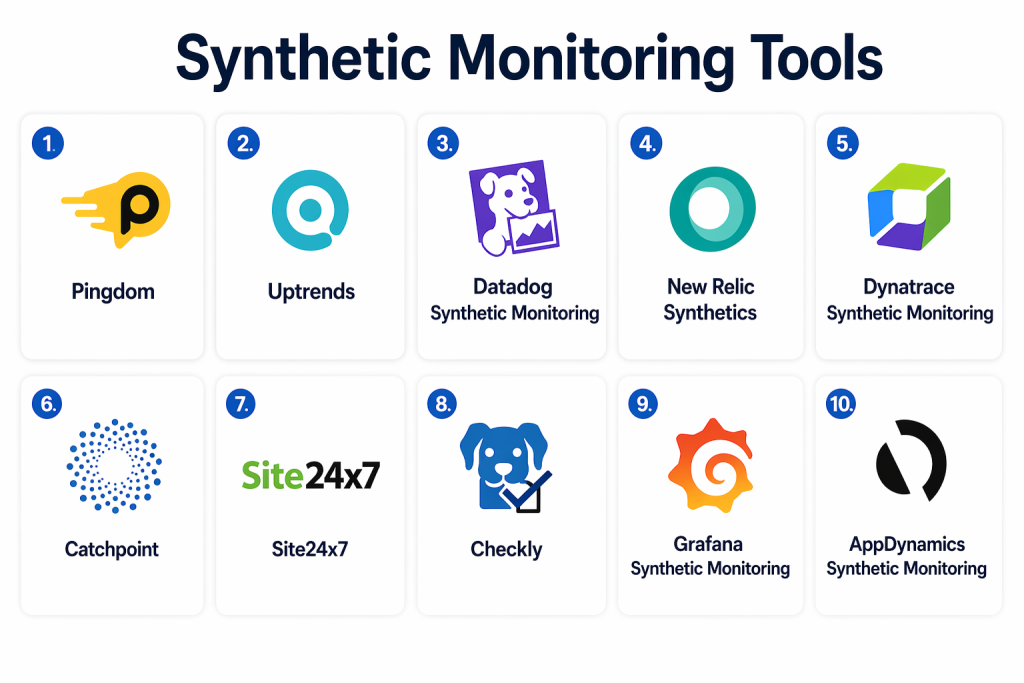
Top 10 Synthetic Monitoring Tools Tools
#1 — Pingdom
Short description: Pingdom is a widely used synthetic monitoring tool focused on uptime monitoring, performance tracking, and user experience testing.
Key Features
- Website uptime monitoring
- Real-time alerts
- Global test locations
- Performance reports
- Transaction monitoring
Pros
- Easy to use
- Reliable uptime monitoring
Cons
- Limited advanced scripting
- Pricing can scale
Platforms / Deployment
- Web
- Cloud
Security & Compliance
- Not publicly stated
Integrations & Ecosystem
Pingdom integrates with common monitoring and alerting tools.
- Slack
- APIs
- DevOps tools
Support & Community
Good documentation and support.
#2 — Uptrends
Short description: Uptrends provides synthetic monitoring with strong support for global testing and advanced scripting.
Key Features
- Browser-based monitoring
- API testing
- Global monitoring nodes
- Alerts and dashboards
- SLA reporting
Pros
- Wide global coverage
- Advanced scripting
Cons
- Interface complexity
- Learning curve
Platforms / Deployment
- Web
- Cloud
Security & Compliance
- Not publicly stated
Integrations & Ecosystem
- APIs
- DevOps tools
- Alerting systems
Support & Community
Strong support and onboarding.
#3 — Datadog Synthetic Monitoring
Short description: Datadog offers synthetic monitoring integrated with its observability platform for full-stack insights.
Key Features
- Browser and API tests
- CI/CD integration
- Real-time alerts
- Global testing locations
- Integration with metrics and logs
Pros
- Unified observability
- Strong integrations
Cons
- Pricing complexity
- Requires configuration
Platforms / Deployment
- Cloud
Security & Compliance
- Not publicly stated
Integrations & Ecosystem
- AWS
- Kubernetes
- APIs
- DevOps tools
Support & Community
Strong enterprise support.
#4 — New Relic Synthetics
Short description: New Relic provides synthetic monitoring for websites and APIs with deep analytics and observability integration.
Key Features
- Scripted browser monitoring
- API monitoring
- Alerting
- Global test locations
- Analytics dashboards
Pros
- Strong analytics
- Unified platform
Cons
- Learning curve
- Pricing structure
Platforms / Deployment
- Cloud
Security & Compliance
- Not publicly stated
Integrations & Ecosystem
- Cloud platforms
- APIs
- DevOps tools
Support & Community
Strong documentation and community.
#5 — Dynatrace Synthetic Monitoring
Short description: Dynatrace provides AI-powered synthetic monitoring with deep observability capabilities.
Key Features
- User journey simulation
- AI-driven insights
- Real-time alerts
- Integration with APM
- Global testing
Pros
- Advanced automation
- Deep insights
Cons
- High cost
- Complex setup
Platforms / Deployment
- Cloud / Hybrid
Security & Compliance
- Not publicly stated
Integrations & Ecosystem
- Kubernetes
- Cloud tools
- APIs
Support & Community
Enterprise-grade support.
#6 — Catchpoint
Short description: Catchpoint is an enterprise synthetic monitoring platform focused on performance, reliability, and internet resilience.
Key Features
- Global monitoring network
- Internet performance monitoring
- Synthetic testing
- Real-time alerts
- SLA tracking
Pros
- Extensive global coverage
- Enterprise capabilities
Cons
- Expensive
- Complex configuration
Platforms / Deployment
- Cloud
Security & Compliance
- Not publicly stated
Integrations & Ecosystem
- APIs
- DevOps tools
- Cloud platforms
Support & Community
Strong enterprise support.
#7 — Site24x7
Short description: Site24x7 offers synthetic monitoring as part of a broader monitoring platform for websites, servers, and applications.
Key Features
- Website monitoring
- API testing
- Real-time alerts
- Global locations
- Dashboard reporting
Pros
- Cost-effective
- Easy to use
Cons
- Limited advanced features
- UI improvements needed
Platforms / Deployment
- Cloud
Security & Compliance
- Not publicly stated
Integrations & Ecosystem
- Cloud platforms
- APIs
- DevOps tools
Support & Community
Good support and documentation.
#8 — Checkly
Short description: Checkly is a developer-focused synthetic monitoring tool with API and browser testing capabilities.
Key Features
- API monitoring
- Browser automation
- CI/CD integration
- Alerting
- Code-based testing
Pros
- Developer-friendly
- Modern workflows
Cons
- Requires coding knowledge
- Limited enterprise features
Platforms / Deployment
- Cloud
Security & Compliance
- Not publicly stated
Integrations & Ecosystem
- GitHub
- CI/CD tools
- APIs
Support & Community
Active developer community.
#9 — Grafana Synthetic Monitoring
Short description: Grafana provides synthetic monitoring integrated with its observability ecosystem.
Key Features
- Uptime monitoring
- API testing
- Dashboard visualization
- Integration with Grafana
- Alerts
Pros
- Easy integration with Grafana
- Cost-effective
Cons
- Limited advanced features
- Requires setup
Platforms / Deployment
- Cloud / Self-hosted
Security & Compliance
- Not publicly stated
Integrations & Ecosystem
- Grafana
- Prometheus
- APIs
Support & Community
Strong open-source community.
#10 — AppDynamics Synthetic Monitoring
Short description: AppDynamics offers synthetic monitoring focused on business transaction visibility and performance.
Key Features
- User journey monitoring
- API testing
- Real-time alerts
- Performance analytics
- Integration with APM
Pros
- Strong enterprise features
- Business insights
Cons
- Expensive
- Complex setup
Platforms / Deployment
- Cloud / Hybrid
Security & Compliance
- Not publicly stated
Integrations & Ecosystem
- Enterprise tools
- APIs
- Cloud platforms
Support & Community
Enterprise-level support.
Comparison Table (Top 10)
| Tool Name | Best For | Platform(s) Supported | Deployment | Standout Feature | Public Rating |
|---|---|---|---|---|---|
| Pingdom | Uptime monitoring | Web | Cloud | Simplicity | N/A |
| Uptrends | Global testing | Web | Cloud | Wide coverage | N/A |
| Datadog | Observability | Web | Cloud | Full-stack integration | N/A |
| New Relic | Analytics | Web | Cloud | Unified telemetry | N/A |
| Dynatrace | AI monitoring | Web | Hybrid | AI insights | N/A |
| Catchpoint | Enterprise | Web | Cloud | Global network | N/A |
| Site24x7 | SMB | Web | Cloud | Cost-effective | N/A |
| Checkly | Developers | Web | Cloud | Code-based testing | N/A |
| Grafana | Open-source | Web | Hybrid | Dashboard integration | N/A |
| AppDynamics | Enterprise | Web | Hybrid | Business insights | N/A |
Evaluation & Scoring of Synthetic Monitoring Tools
| Tool Name | Core | Ease | Integrations | Security | Performance | Support | Value | Weighted Total |
|---|---|---|---|---|---|---|---|---|
| Pingdom | 8 | 9 | 7 | 6 | 8 | 8 | 8 | 8.0 |
| Uptrends | 9 | 7 | 8 | 7 | 9 | 8 | 7 | 8.1 |
| Datadog | 9 | 8 | 10 | 8 | 9 | 9 | 7 | 8.6 |
| New Relic | 9 | 8 | 9 | 7 | 9 | 9 | 8 | 8.5 |
| Dynatrace | 10 | 7 | 9 | 8 | 10 | 9 | 7 | 8.8 |
| Catchpoint | 10 | 7 | 8 | 8 | 10 | 9 | 6 | 8.6 |
| Site24x7 | 8 | 8 | 7 | 7 | 8 | 8 | 9 | 8.1 |
| Checkly | 8 | 7 | 8 | 6 | 8 | 7 | 8 | 7.8 |
| Grafana | 7 | 7 | 8 | 6 | 8 | 7 | 9 | 7.7 |
| AppDynamics | 9 | 7 | 9 | 8 | 9 | 9 | 7 | 8.4 |
Interpretation:
These scores compare tools across features, usability, integrations, and value. Higher scores indicate well-rounded enterprise-ready platforms, while lower scores reflect niche or specialized tools.
Which Synthetic Monitoring Tools Tool Is Right for You?
Solo / Freelancer
Pingdom or Grafana Synthetic Monitoring are simple and effective.
SMB
Site24x7 or Uptrends provide balanced features and affordability.
Mid-Market
Datadog or New Relic offer strong integration and scalability.
Enterprise
Dynatrace, Catchpoint, or AppDynamics provide advanced analytics and automation.
Budget vs Premium
Open-source and lightweight tools reduce costs; enterprise tools offer deeper insights.
Feature Depth vs Ease of Use
Advanced tools offer more capabilities but require setup and expertise.
Integrations & Scalability
Choose tools that integrate with your DevOps and observability stack.
Security & Compliance Needs
Enterprises should prioritize governance and monitoring controls.
Frequently Asked Questions (FAQs)
1. What is synthetic monitoring?
Synthetic monitoring simulates user interactions to test application performance and availability.
2. Why is synthetic monitoring important?
It helps detect issues before users are affected, improving reliability and uptime.
3. How is it different from real user monitoring?
Synthetic monitoring uses simulated tests, while real user monitoring tracks actual user behavior.
4. Can synthetic monitoring test APIs?
Yes, most tools support API and endpoint testing.
5. Is it suitable for cloud environments?
Yes, these tools are designed for cloud-native systems.
6. Does it improve performance?
It helps identify issues, enabling performance optimization.
7. Are these tools expensive?
Costs vary based on scale and features.
8. Can it integrate with CI/CD?
Yes, many tools support CI/CD integration for continuous testing.
9. Is setup complex?
Some tools require scripting; others offer low-code options.
10. Is it scalable?
Enterprise tools are highly scalable, while simpler tools suit smaller setups.
Conclusion
Synthetic Monitoring Tools are essential for proactively ensuring application performance, reliability, and uptime in modern digital environments. By simulating real user interactions, these tools allow teams to identify issues before they impact customers, making them a critical part of any observability strategy. As systems grow more distributed and user expectations increase, relying solely on reactive monitoring is no longer sufficient. Synthetic monitoring complements other observability practices by providing controlled and repeatable testing across different regions and scenarios. From simple uptime checks to complex user journey simulations, these tools offer a wide range of capabilities suited to different needs. Choosing the right tool depends on your infrastructure, team expertise, and performance goals. It is important to evaluate integration capabilities, ease of use, and scalability before making a decision. Start by identifying your monitoring requirements, shortlist a few tools, and test them in real-world scenarios. A well-implemented synthetic monitoring solution can significantly enhance system reliability and user experience.
