Introduction
Marketing Automation Platforms are software systems that help businesses automate repetitive marketing tasks such as email campaigns, lead nurturing, segmentation, and customer journeys across multiple channels.
In simple terms, these tools allow you to send the right message to the right audience automatically, based on user behavior, timing, and predefined workflows.
Modern platforms go far beyond email—they now include AI-driven personalization, omnichannel campaigns (email, SMS, ads), lead scoring, and journey orchestration, making them a core part of any digital marketing stack.
Why it matters now
- Businesses need scalable marketing without increasing manual effort
- AI enables smarter targeting and automation
- Customer journeys are becoming multi-channel and complex
- Competition demands faster and more personalized engagement
Common use cases
- Lead nurturing and drip campaigns
- Email and SMS automation
- Customer onboarding flows
- Abandoned cart recovery
- Campaign performance tracking
What buyers should evaluate
- Workflow automation capabilities
- Omnichannel support (email, SMS, ads, push)
- AI and personalization features
- CRM and CDP integrations
- Ease of use vs flexibility
- Reporting and analytics depth
- Scalability and performance
- Pricing model (contacts, emails, usage)
- Security and compliance
Best for: Marketing teams, SaaS companies, ecommerce brands, agencies, and enterprises focused on growth and customer engagement.
Not ideal for: Very small teams with simple outreach needs or businesses that only require basic email tools.
Key Trends in Marketing Automation Platforms
- AI-driven campaign automation: Content generation and predictive targeting
- Journey orchestration: Multi-step, cross-channel automation flows
- First-party data activation: Stronger integration with CDPs
- No-code automation builders: Accessible for non-technical users
- Hyper-personalization: Real-time behavior-based campaigns
- Omnichannel engagement: Email, SMS, WhatsApp, ads in one platform
- Composable marketing stacks: Integration with multiple tools instead of all-in-one
- Privacy-first marketing: Consent and compliance built-in
- AI copilots for marketers: Automated campaign suggestions and optimization
How We Selected These Tools (Methodology)
- Market adoption and brand recognition
- Feature depth (automation, segmentation, AI)
- Ease of use for marketers and developers
- Integration ecosystem (CRM, CDP, analytics)
- Scalability across SMB to enterprise
- Performance and deliverability
- Security and compliance capabilities
- Pricing flexibility
- Support and documentation quality
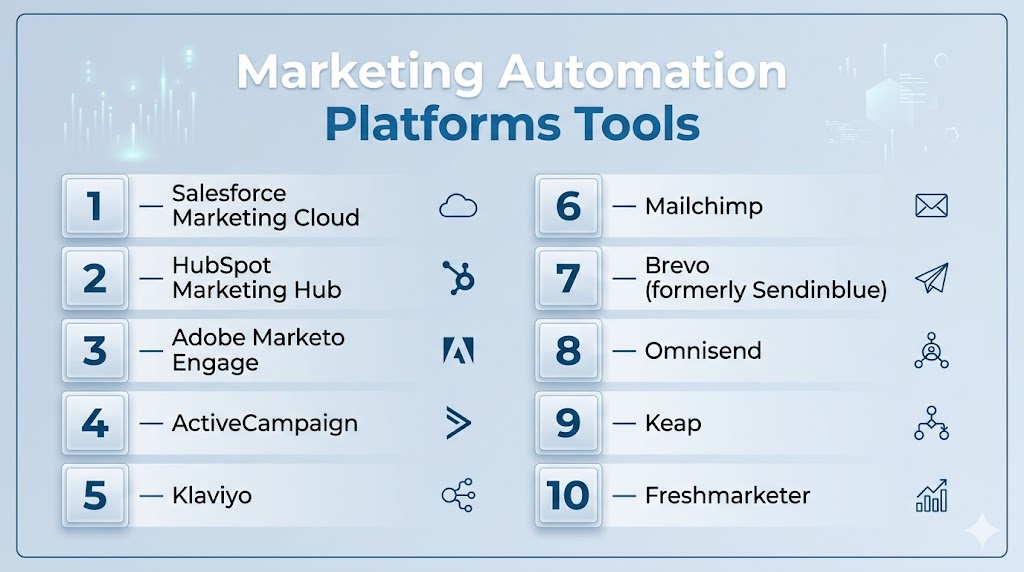
Top 10 Marketing Automation Platforms Tools
#1 — Salesforce Marketing Cloud
Short description: A powerful enterprise marketing automation platform integrated with CRM for large-scale, data-driven campaigns.
Key Features
- Journey orchestration
- AI-powered personalization
- Email, SMS, and mobile marketing
- Lead scoring
- Cross-channel campaigns
- Advanced analytics
Pros
- Deep CRM integration
- Enterprise scalability
- Strong AI capabilities
Cons
- Expensive
- Complex implementation
Platforms / Deployment
Web / Mobile
Cloud
Security & Compliance
Enterprise-grade security, SSO
Varies / Not publicly stated
Integrations & Ecosystem
Extensive ecosystem across CRM and marketing tools.
- CRM systems
- Analytics platforms
- APIs
- Data tools
Support & Community
Enterprise-level support and training resources.
#2 — HubSpot Marketing Hub
Short description: An all-in-one marketing automation platform with strong usability and CRM integration.
Key Features
- Email automation
- Lead nurturing workflows
- CRM integration
- Landing page builder
- Analytics dashboards
- Marketing automation workflows
Pros
- Easy to use
- Strong all-in-one platform
- Good for SMB to mid-market
Cons
- Expensive at scale
- Limited advanced customization
Platforms / Deployment
Web
Cloud
Security & Compliance
SSO, GDPR features
Varies / Not publicly stated
Integrations & Ecosystem
- CRM tools
- CMS platforms
- APIs
Support & Community
Large community and extensive documentation.
#3 — Adobe Marketo Engage
Short description: A robust B2B marketing automation platform focused on lead management and enterprise marketing.
Key Features
- Lead management
- Account-based marketing
- Campaign automation
- Personalization
- Analytics
- CRM integration
Pros
- Strong B2B capabilities
- Scalable
- Deep analytics
Cons
- Steep learning curve
- Expensive
Platforms / Deployment
Web
Cloud
Security & Compliance
Enterprise-grade controls
Varies / Not publicly stated
Integrations & Ecosystem
- CRM systems
- APIs
- Marketing tools
Support & Community
Strong enterprise support.
#4 — ActiveCampaign
Short description: A popular SMB-focused platform combining email marketing, automation, and CRM.
Key Features
- Workflow automation
- Email marketing
- CRM integration
- Predictive sending
- Segmentation
- Automation templates
Pros
- Easy to use
- Affordable
- Strong automation builder
Cons
- Limited enterprise features
- UI can feel complex
Platforms / Deployment
Web / Mobile
Cloud
Security & Compliance
Varies / Not publicly stated
Integrations & Ecosystem
- Ecommerce tools
- CRM systems
- APIs
Support & Community
Good support and onboarding.
#5 — Klaviyo
Short description: A marketing automation platform focused on ecommerce personalization and email/SMS marketing.
Key Features
- Email and SMS automation
- Customer segmentation
- Ecommerce integrations
- Predictive analytics
- Personalization
- Campaign automation
Pros
- Strong ecommerce focus
- Easy setup
- Good analytics
Cons
- Limited outside ecommerce
- Pricing increases with contacts
Platforms / Deployment
Web
Cloud
Security & Compliance
Varies / Not publicly stated
Integrations & Ecosystem
- Shopify, ecommerce tools
- APIs
- Marketing tools
Support & Community
Good SMB support.
#6 — Mailchimp
Short description: A widely used marketing platform offering email automation and basic marketing tools.
Key Features
- Email automation
- Campaign builder
- Audience segmentation
- Analytics
- Templates
- CRM-lite features
Pros
- Beginner-friendly
- Affordable
- Quick setup
Cons
- Limited advanced automation
- Scaling costs
Platforms / Deployment
Web / Mobile
Cloud
Security & Compliance
Varies / Not publicly stated
Integrations & Ecosystem
- Ecommerce tools
- APIs
- CRM systems
Support & Community
Large user base and support resources.
#7 — Brevo (formerly Sendinblue)
Short description: A cost-effective marketing automation platform with email, SMS, and CRM features.
Key Features
- Email and SMS campaigns
- Automation workflows
- CRM integration
- Transactional emails
- Segmentation
- Reporting
Pros
- Affordable
- Omnichannel support
- Easy to use
Cons
- Limited advanced AI
- Basic reporting
Platforms / Deployment
Web
Cloud
Security & Compliance
GDPR-friendly
Varies / Not publicly stated
Integrations & Ecosystem
- APIs
- Ecommerce tools
- CRM systems
Support & Community
Good support for SMBs.
#8 — Omnisend
Short description: An ecommerce-focused marketing automation platform combining email, SMS, and push notifications.
Key Features
- Email and SMS automation
- Ecommerce workflows
- Customer segmentation
- Campaign automation
- Push notifications
- Analytics
Pros
- Strong ecommerce features
- Easy automation
- Good templates
Cons
- Limited enterprise features
- Ecommerce-focused only
Platforms / Deployment
Web
Cloud
Security & Compliance
Varies / Not publicly stated
Integrations & Ecosystem
- Ecommerce platforms
- APIs
- Marketing tools
Support & Community
Good support.
#9 — Keap
Short description: A CRM + marketing automation platform designed for small businesses and entrepreneurs.
Key Features
- CRM integration
- Email automation
- Sales pipeline
- Campaign builder
- Lead tracking
- Automation workflows
Pros
- All-in-one solution
- Good for small teams
- Easy CRM integration
Cons
- Limited scalability
- Pricing varies
Platforms / Deployment
Web
Cloud
Security & Compliance
Varies / Not publicly stated
Integrations & Ecosystem
- CRM tools
- APIs
- Small business tools
Support & Community
Moderate support.
#10 — Freshmarketer
Short description: A marketing automation and engagement platform with personalization and analytics features.
Key Features
- Email campaigns
- Automation workflows
- Customer segmentation
- Personalization
- Analytics
- A/B testing
Pros
- Good UI
- Affordable
- Integrated analytics
Cons
- Limited advanced features
- Smaller ecosystem
Platforms / Deployment
Web
Cloud
Security & Compliance
Varies / Not publicly stated
Integrations & Ecosystem
- CRM tools
- APIs
- Analytics platforms
Support & Community
Growing community.
Comparison Table (Top 10)
| Tool Name | Best For | Platform(s) Supported | Deployment | Standout Feature | Public Rating |
|---|---|---|---|---|---|
| Salesforce | Enterprise | Web/Mobile | Cloud | Journey orchestration | N/A |
| HubSpot | SMB | Web | Cloud | All-in-one platform | N/A |
| Marketo | B2B enterprise | Web | Cloud | Lead management | N/A |
| ActiveCampaign | SMB | Web/Mobile | Cloud | Automation builder | N/A |
| Klaviyo | Ecommerce | Web | Cloud | Email + SMS | N/A |
| Mailchimp | Beginners | Web/Mobile | Cloud | Ease of use | N/A |
| Brevo | Budget teams | Web | Cloud | SMS + email | N/A |
| Omnisend | Ecommerce | Web | Cloud | Omnichannel campaigns | N/A |
| Keap | Small business | Web | Cloud | CRM + automation | N/A |
| Freshmarketer | SMB | Web | Cloud | Built-in analytics | N/A |
Evaluation & Scoring of Marketing Automation Platforms
| Tool Name | Core (25%) | Ease (15%) | Integrations (15%) | Security (10%) | Performance (10%) | Support (10%) | Value (15%) | Weighted Total |
|---|---|---|---|---|---|---|---|---|
| Salesforce | 10 | 6 | 10 | 9 | 9 | 9 | 6 | 8.9 |
| HubSpot | 9 | 9 | 9 | 8 | 8 | 9 | 7 | 8.6 |
| Marketo | 10 | 6 | 9 | 9 | 9 | 9 | 6 | 8.7 |
| ActiveCampaign | 8 | 9 | 8 | 7 | 8 | 8 | 9 | 8.4 |
| Klaviyo | 8 | 9 | 8 | 7 | 8 | 8 | 8 | 8.2 |
| Mailchimp | 7 | 10 | 7 | 7 | 7 | 8 | 9 | 8.0 |
| Brevo | 7 | 9 | 7 | 7 | 7 | 7 | 9 | 7.8 |
| Omnisend | 8 | 8 | 7 | 7 | 8 | 7 | 8 | 7.9 |
| Keap | 7 | 8 | 7 | 7 | 7 | 7 | 8 | 7.6 |
| Freshmarketer | 7 | 8 | 7 | 7 | 7 | 7 | 8 | 7.6 |
How to interpret scores:
- Enterprise tools rank higher in scalability and features
- SMB tools score higher in ease of use and value
- Scores are relative comparisons, not absolute performance
- Choose based on your use case, not just highest score
Which Marketing Automation Platform Is Right for You?
Solo / Freelancer
- Best: Mailchimp, Brevo
- Focus on simplicity and affordability
SMB
- Best: HubSpot, ActiveCampaign
- Balance ease and automation
Mid-Market
- Best: Klaviyo, Freshmarketer
- Need personalization and analytics
Enterprise
- Best: Salesforce, Marketo
- Focus on scale, AI, and integrations
Budget vs Premium
- Budget: Brevo, Mailchimp
- Premium: Salesforce, Marketo
Feature Depth vs Ease of Use
- Advanced: Salesforce, Marketo
- Easy: Mailchimp, HubSpot
Integrations & Scalability
- Best: Salesforce, HubSpot
Security & Compliance Needs
- High: Enterprise platforms
- Standard: SMB tools
Frequently Asked Questions (FAQs)
What is marketing automation?
Software that automates marketing tasks like campaigns, emails, and lead nurturing.
How does marketing automation work?
It uses workflows, triggers, and user data to automate communication.
Is marketing automation only for email?
No, it includes SMS, ads, social media, and more.
Do I need coding skills?
Most tools offer no-code builders.
Is it expensive?
Pricing varies from free plans to enterprise pricing.
Can it improve ROI?
Yes, by increasing efficiency and targeting accuracy.
How long does setup take?
From hours (basic) to weeks (enterprise setups).
What is lead scoring?
Ranking leads based on engagement and likelihood to convert.
Are these tools secure?
Most include standard security features, varies by vendor.
What is the biggest mistake?
Overcomplicating automation before defining clear workflows.
Conclusion
Marketing Automation Platforms are essential for scaling modern marketing efforts. They help businesses automate workflows, personalize engagement, and drive measurable growth.
