Introduction
Customer Data Platforms (CDPs) are software systems that collect, unify, and organize customer data from multiple sources into a single, consistent profile.
In simple terms, a CDP acts as a central hub for all your customer data—combining website behavior, app usage, transactions, CRM data, and more into a unified view that teams can use for marketing, analytics, and personalization.
Why it matters now
- Businesses deal with fragmented data across multiple tools
- First-party data strategies are becoming essential
- Personalization at scale requires unified customer profiles
- AI and automation depend on clean, structured data
Common use cases
- Building a 360° customer view
- Audience segmentation and targeting
- Personalized marketing campaigns
- Cross-channel customer journey orchestration
- Customer analytics and predictive insights
What buyers should evaluate
- Data ingestion capabilities (sources, real-time vs batch)
- Identity resolution and profile unification
- Segmentation and activation features
- Integration ecosystem (CRM, analytics, ads, warehouses)
- AI/ML capabilities
- Deployment model (cloud vs warehouse-native)
- Data governance and privacy controls
- Scalability and performance
- Ease of use for marketers vs developers
Best for: Marketing teams, data teams, SaaS companies, ecommerce brands, and enterprises managing large-scale customer data across multiple systems.
Not ideal for: Small teams with simple stacks or businesses that only need basic analytics or CRM functionality.
Key Trends in Customer Data Platforms
- Composable CDPs: Warehouse-first architectures replacing monolithic platforms
- Real-time data processing: Immediate customer insights and activation
- AI-powered segmentation: Predictive audiences and automation
- Privacy-first data management: Consent tracking and compliance features
- Reverse ETL adoption: Syncing warehouse data back into tools
- Cross-channel orchestration: Unified experiences across platforms
- Developer-first CDPs: API-driven, flexible data pipelines
- Identity resolution advancements: Better cross-device tracking
- First-party data dominance: Reduced reliance on third-party cookies
How We Selected These Tools (Methodology)
- Market adoption and industry recognition
- Feature completeness (data ingestion, identity resolution, activation)
- Integration ecosystem breadth
- Performance and scalability
- Security and compliance posture
- Flexibility (enterprise vs SMB vs developer-first)
- Innovation (AI, composable architecture)
- Ease of implementation and usability
- Customer support and documentation
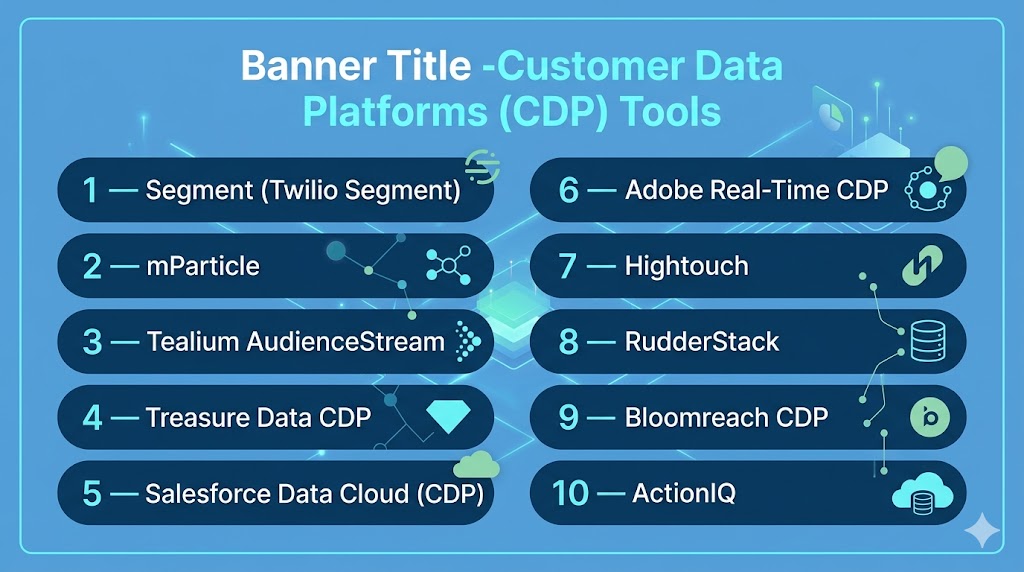
Top 10 Customer Data Platforms (CDP) Tools
#1 — Segment (Twilio Segment)
Short description: A developer-first CDP that collects, unifies, and routes customer data across tools with a strong integration ecosystem.
Key Features
- Real-time event tracking
- Identity resolution
- Data routing to 700+ integrations
- Audience building
- Data governance tools
- API-first architecture
Pros
- Massive integration ecosystem
- Developer-friendly
- Flexible data pipeline
Cons
- Requires additional tools for activation
- Pricing can scale quickly
Platforms / Deployment
Web / Mobile / Server
Cloud
Security & Compliance
Privacy controls, governance features
Varies / Not publicly stated
Integrations & Ecosystem
Extensive ecosystem with hundreds of connectors.
- Analytics tools
- CRM platforms
- Data warehouses
- APIs
Support & Community
Strong documentation and large developer community.
#2 — mParticle
Short description: A real-time customer data infrastructure platform focused on data quality, governance, and mobile-first use cases.
Key Features
- Real-time event streaming
- Data quality controls
- Identity resolution
- Consent management
- SDKs for mobile apps
- Data pipelines
Pros
- Strong mobile capabilities
- Excellent data governance
- Scalable
Cons
- Less marketer-friendly
- Requires technical expertise
Platforms / Deployment
Web / Mobile
Cloud / Hybrid
Security & Compliance
Consent management features
Varies / Not publicly stated
Integrations & Ecosystem
- Mobile SDKs
- APIs
- Analytics platforms
Support & Community
Enterprise support.
#3 — Tealium AudienceStream
Short description: A CDP with strong roots in tag management and real-time event processing.
Key Features
- Real-time data collection
- Identity stitching
- Audience segmentation
- Tag management integration
- Event stream processing
- Server-side tracking
Pros
- Large integration ecosystem
- Strong real-time capabilities
- Unified data collection
Cons
- Complex setup
- Less advanced AI features
Platforms / Deployment
Web / Mobile / IoT
Cloud
Security & Compliance
HIPAA support (context-dependent)
Integrations & Ecosystem
- 1,000+ integrations
- APIs
- Marketing tools
Support & Community
Enterprise-level support.
#4 — Treasure Data CDP
Short description: A hybrid CDP designed for large enterprises with strong AI and data processing capabilities.
Key Features
- Large-scale data ingestion
- AI-driven insights
- Customer segmentation
- Real-time personalization
- Flexible deployment
- Predictive analytics
Pros
- Enterprise scalability
- Strong AI features
- Flexible architecture
Cons
- Complex implementation
- Higher cost
Platforms / Deployment
Web / Mobile / IoT
Cloud / Hybrid
Security & Compliance
Enterprise-grade security
Varies / Not publicly stated
Integrations & Ecosystem
- Data platforms
- APIs
- Enterprise tools
Support & Community
Strong enterprise support.
#5 — Salesforce Data Cloud (CDP)
Short description: A CDP tightly integrated with Salesforce ecosystem for CRM-driven personalization.
Key Features
- Unified customer profiles
- Real-time data ingestion
- AI segmentation
- CRM integration
- Journey orchestration
- Predictive insights
Pros
- Strong CRM integration
- Scalable
- Enterprise-ready
Cons
- Expensive
- Best within Salesforce ecosystem
Platforms / Deployment
Web
Cloud
Security & Compliance
Varies / Not publicly stated
Integrations & Ecosystem
- Salesforce tools
- APIs
- Marketing platforms
Support & Community
Enterprise support.
#6 — Adobe Real-Time CDP
Short description: A real-time CDP within Adobe Experience Platform focused on personalization and marketing use cases.
Key Features
- Real-time customer profiles
- AI-driven segmentation
- Cross-channel orchestration
- Data ingestion
- Audience activation
- Identity resolution
Pros
- Strong personalization capabilities
- Real-time processing
- Enterprise-grade
Cons
- Complex
- Expensive
Platforms / Deployment
Web
Cloud
Security & Compliance
Varies / Not publicly stated
Integrations & Ecosystem
- Adobe ecosystem
- Marketing tools
- APIs
Support & Community
Enterprise support.
#7 — Hightouch
Short description: A composable CDP that syncs data from warehouses to business tools using reverse ETL.
Key Features
- Reverse ETL
- Warehouse-first architecture
- Audience sync
- Data activation
- SQL-based segmentation
- Real-time sync
Pros
- Flexible
- Uses existing data warehouse
- Developer-friendly
Cons
- Requires data infrastructure
- Limited UI for marketers
Platforms / Deployment
Web
Cloud
Security & Compliance
Varies / Not publicly stated
Integrations & Ecosystem
- Data warehouses
- CRM tools
- APIs
Support & Community
Growing community.
#8 — RudderStack
Short description: An open-source CDP focused on data pipelines and warehouse-first architecture.
Key Features
- Event streaming
- Identity resolution
- Open-source
- Warehouse integration
- Data routing
- SDKs
Pros
- Open-source flexibility
- Lower cost
- Developer-focused
Cons
- Requires setup
- Limited UI
Platforms / Deployment
Web / Mobile
Cloud / Self-hosted
Security & Compliance
Varies / Not publicly stated
Integrations & Ecosystem
- APIs
- Data tools
- SDKs
Support & Community
Active open-source community.
#9 — Bloomreach CDP
Short description: A CDP with built-in marketing and personalization features, especially for ecommerce.
Key Features
- Customer profiles
- Segmentation
- Personalization
- Marketing automation
- Analytics
- Omnichannel delivery
Pros
- Strong ecommerce capabilities
- Built-in marketing tools
- Easy activation
Cons
- Less flexible for developers
- Pricing varies
Platforms / Deployment
Web
Cloud
Security & Compliance
Varies / Not publicly stated
Integrations & Ecosystem
- Ecommerce platforms
- APIs
- Marketing tools
Support & Community
Good support.
#10 — ActionIQ
Short description: A marketer-friendly CDP designed for audience segmentation and campaign activation.
Key Features
- Audience segmentation
- Data orchestration
- Campaign activation
- Analytics
- Customer insights
- Omnichannel targeting
Pros
- Marketer-friendly UI
- Strong segmentation
- Flexible
Cons
- Requires data setup
- Pricing varies
Platforms / Deployment
Web
Cloud
Security & Compliance
Varies / Not publicly stated
Integrations & Ecosystem
- CRM systems
- APIs
- Marketing tools
Support & Community
Enterprise support.
Comparison Table (Top 10)
| Tool Name | Best For | Platform(s) Supported | Deployment | Standout Feature | Public Rating |
|---|---|---|---|---|---|
| Segment | Developers | Web/Mobile/Server | Cloud | 700+ integrations | N/A |
| mParticle | Mobile-first | Web/Mobile | Hybrid | Data governance | N/A |
| Tealium | Data collection | Web/Mobile/IoT | Cloud | Tag management | N/A |
| Treasure Data | Enterprise | Web/Mobile/IoT | Hybrid | AI insights | N/A |
| Salesforce CDP | CRM-driven | Web | Cloud | CRM integration | N/A |
| Adobe CDP | Enterprise | Web | Cloud | Real-time profiles | N/A |
| Hightouch | Composable | Web | Cloud | Reverse ETL | N/A |
| RudderStack | Open-source | Web/Mobile | Hybrid | Warehouse-first | N/A |
| Bloomreach | Ecommerce | Web | Cloud | Built-in marketing | N/A |
| ActionIQ | Marketers | Web | Cloud | Audience segmentation | N/A |
Evaluation & Scoring of Customer Data Platforms (CDP)
| Tool Name | Core (25%) | Ease (15%) | Integrations (15%) | Security (10%) | Performance (10%) | Support (10%) | Value (15%) | Weighted Total |
|---|---|---|---|---|---|---|---|---|
| Segment | 10 | 8 | 10 | 9 | 9 | 9 | 7 | 9.0 |
| mParticle | 9 | 7 | 9 | 9 | 9 | 8 | 7 | 8.6 |
| Tealium | 9 | 7 | 10 | 9 | 9 | 8 | 7 | 8.7 |
| Treasure Data | 10 | 6 | 9 | 9 | 9 | 9 | 6 | 8.7 |
| Salesforce | 9 | 7 | 9 | 9 | 9 | 9 | 6 | 8.6 |
| Adobe | 10 | 6 | 9 | 9 | 9 | 9 | 6 | 8.7 |
| Hightouch | 8 | 8 | 8 | 8 | 8 | 7 | 9 | 8.1 |
| RudderStack | 8 | 7 | 8 | 8 | 8 | 7 | 9 | 8.0 |
| Bloomreach | 8 | 8 | 7 | 8 | 8 | 7 | 8 | 7.9 |
| ActionIQ | 8 | 8 | 8 | 8 | 8 | 8 | 7 | 8.0 |
How to interpret scores:
- Higher scores indicate stronger overall capability
- Enterprise tools rank higher in scalability and AI
- Composable/open-source tools score higher in value
- Ease varies based on technical requirements
Which Customer Data Platform Is Right for You?
Solo / Freelancer
- Best: RudderStack (lightweight), Hightouch
- Focus on simplicity and cost
SMB
- Best: Segment, Bloomreach
- Balance ease of use and integrations
Mid-Market
- Best: Tealium, Hightouch
- Need scalable data infrastructure
Enterprise
- Best: Adobe, Salesforce, Treasure Data
- Focus on AI, scale, and governance
Budget vs Premium
- Budget: RudderStack, Hightouch
- Premium: Adobe, Salesforce
Feature Depth vs Ease of Use
- Advanced: Adobe, Treasure Data
- Easy: Bloomreach, Segment
Integrations & Scalability
- Best: Segment, Tealium
Security & Compliance Needs
- High: Enterprise CDPs
- Standard: SMB-focused tools
Frequently Asked Questions (FAQs)
What is a Customer Data Platform?
A CDP is software that unifies customer data into a single database for analysis and activation.
How is a CDP different from a CRM?
CRMs manage customer interactions, while CDPs unify data across systems.
Do I need a CDP?
Only if you have fragmented data across multiple tools.
Are CDPs expensive?
Yes, especially enterprise solutions.
Can CDPs improve marketing?
Yes, by enabling personalization and better targeting.
Do CDPs use AI?
Most modern CDPs include AI for segmentation and predictions.
What is composable CDP?
A warehouse-first approach using existing data infrastructure.
Are CDPs secure?
Most include strong data governance and compliance features.
How long does implementation take?
It depends on complexity—weeks to months.
What is the biggest challenge?
Data quality and integration across systems.
Conclusion
Customer Data Platforms are essential for businesses aiming to unify customer data, improve personalization, and drive better decision-making.
