Introduction
Digital Experience Platforms (DXP) are integrated software solutions that help businesses create, manage, deliver, and optimize digital experiences across multiple channels—such as websites, mobile apps, customer portals, and more. Unlike traditional CMS tools, DXPs go beyond content management to include personalization, customer data, analytics, and omnichannel delivery.
In simple terms, a DXP enables organizations to deliver the right content to the right user at the right time across every digital touchpoint.
As customer expectations grow, businesses must provide seamless, personalized, and consistent experiences. DXPs are becoming essential for managing this complexity at scale.
Why it matters now
- Customers expect personalized digital experiences
- Businesses operate across multiple digital channels
- Data-driven decision-making is critical
- Competition demands better customer engagement
Common use cases
- Personalized website and app experiences
- Customer portals and dashboards
- Omnichannel marketing campaigns
- Ecommerce and digital commerce experiences
- Enterprise digital transformation initiatives
What buyers should evaluate
- Personalization and targeting capabilities
- Content management and workflow features
- Integration with CRM, CDP, and analytics tools
- Scalability and performance
- Omnichannel delivery support
- Data management and insights
- Security and compliance features
- Ease of use for marketers and developers
- Deployment flexibility (cloud, hybrid)
Best for: Enterprises, marketing teams, digital teams, and organizations managing complex customer journeys across multiple channels.
Not ideal for: Small teams needing only basic website management or simple content publishing without personalization needs.
Key Trends in Digital Experience Platforms (DXP)
- Composable DXP architecture: Modular systems combining best-of-breed tools
- AI-driven personalization: Real-time content recommendations and targeting
- Customer data integration: Unified customer profiles across platforms
- Headless and hybrid approaches: Flexibility in frontend development
- Omnichannel delivery: Seamless experiences across web, mobile, and apps
- Low-code/no-code tools: Empowering non-technical users
- Real-time analytics: Immediate insights into user behavior
- Cloud-native platforms: Scalable and flexible infrastructure
- Experience orchestration: Managing entire customer journeys
How We Selected These Tools (Methodology)
- Market leadership and enterprise adoption
- Feature completeness (content, personalization, analytics)
- Integration capabilities and ecosystem strength
- Scalability and performance
- Security and compliance readiness
- Flexibility in deployment models
- Developer and marketer usability
- Support and documentation quality
- Suitability across industries and business sizes
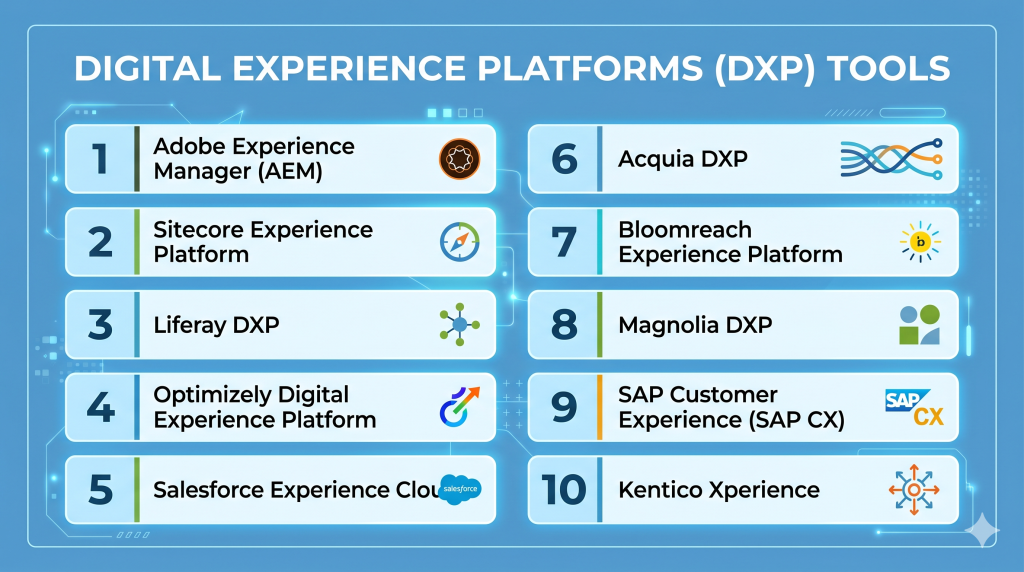
Top 10 Digital Experience Platforms (DXP) Tools
#1 — Adobe Experience Manager (AEM)
Short description: A leading enterprise DXP combining content management, digital asset management, and personalization capabilities.
Key Features
- Advanced content management
- Personalization engine
- Digital asset management
- Workflow automation
- Omnichannel delivery
- Integration with marketing tools
Pros
- Strong enterprise capabilities
- Advanced personalization
- Scalable architecture
Cons
- High cost
- Complex implementation
Platforms / Deployment
Web
Cloud / Hybrid
Security & Compliance
Enterprise-grade controls
Varies / Not publicly stated
Integrations & Ecosystem
Extensive enterprise ecosystem.
- Marketing tools
- Analytics platforms
- APIs
- Enterprise systems
Support & Community
Enterprise-level support and resources.
#2 — Sitecore Experience Platform
Short description: A powerful DXP focused on personalization and customer experience management.
Key Features
- Content management
- Personalization engine
- Customer data integration
- Marketing automation
- Analytics tools
- Omnichannel support
Pros
- Strong personalization
- Comprehensive feature set
- Enterprise-ready
Cons
- Complex setup
- Expensive
Platforms / Deployment
Web
Cloud / Hybrid
Security & Compliance
Varies / Not publicly stated
Integrations & Ecosystem
Designed for enterprise ecosystems.
- CRM systems
- Marketing tools
- APIs
Support & Community
Strong enterprise support.
#3 — Liferay DXP
Short description: An open-source-based DXP designed for building enterprise portals and digital experiences.
Key Features
- Portal and content management
- Personalization
- Workflow automation
- API support
- Role-based access control
- Integration capabilities
Pros
- Flexible and customizable
- Open-source foundation
- Good for enterprise portals
Cons
- Requires technical expertise
- Setup complexity
Platforms / Deployment
Web
Cloud / Self-hosted / Hybrid
Security & Compliance
RBAC, authentication
Varies / Not publicly stated
Integrations & Ecosystem
Strong enterprise integration capabilities.
- APIs
- Business systems
- Developer tools
Support & Community
Active community and enterprise support.
#4 — Optimizely Digital Experience Platform
Short description: A DXP focused on experimentation, personalization, and content-driven experiences.
Key Features
- A/B testing and experimentation
- Personalization tools
- Content management
- Analytics
- Workflow automation
- Omnichannel delivery
Pros
- Strong experimentation features
- Good personalization
- Marketer-friendly
Cons
- Pricing varies
- Requires setup
Platforms / Deployment
Web
Cloud
Security & Compliance
Varies / Not publicly stated
Integrations & Ecosystem
Supports marketing and analytics workflows.
- APIs
- Marketing tools
- Analytics platforms
Support & Community
Good support and documentation.
#5 — Salesforce Experience Cloud
Short description: A DXP built around customer engagement, integrated with CRM capabilities.
Key Features
- Customer portals
- Content management
- Personalization
- CRM integration
- Workflow automation
- Analytics
Pros
- Strong CRM integration
- Good for customer engagement
- Scalable
Cons
- Dependent on ecosystem
- Pricing complexity
Platforms / Deployment
Web
Cloud
Security & Compliance
Authentication, access control
Varies / Not publicly stated
Integrations & Ecosystem
Deep integration with CRM ecosystem.
- CRM tools
- APIs
- Business applications
Support & Community
Strong enterprise support.
#6 — Acquia DXP
Short description: A DXP built on Drupal, offering content management and digital experience capabilities.
Key Features
- Content management
- Personalization
- Marketing automation
- Cloud hosting
- Workflow tools
- Analytics
Pros
- Open-source flexibility
- Strong Drupal ecosystem
- Scalable
Cons
- Requires technical setup
- Complexity for beginners
Platforms / Deployment
Web
Cloud
Security & Compliance
Varies / Not publicly stated
Integrations & Ecosystem
Built around Drupal ecosystem.
- APIs
- Marketing tools
- Developer tools
Support & Community
Strong support and community.
#7 — Bloomreach Experience Platform
Short description: A DXP focused on ecommerce personalization and digital commerce experiences.
Key Features
- Personalization engine
- Product discovery
- Content management
- Search optimization
- Analytics
- Omnichannel delivery
Pros
- Strong ecommerce focus
- Good personalization
- Data-driven insights
Cons
- Niche focus
- Pricing varies
Platforms / Deployment
Web
Cloud
Security & Compliance
Varies / Not publicly stated
Integrations & Ecosystem
Supports ecommerce ecosystems.
- APIs
- Commerce platforms
- Marketing tools
Support & Community
Good enterprise support.
#8 — Magnolia DXP
Short description: A flexible DXP offering headless and traditional CMS capabilities.
Key Features
- Hybrid CMS
- Personalization
- Workflow management
- API support
- Omnichannel delivery
- Content authoring tools
Pros
- Flexible architecture
- Good for hybrid use cases
- Developer-friendly
Cons
- Smaller ecosystem
- Requires setup
Platforms / Deployment
Web
Cloud / Self-hosted
Security & Compliance
Varies / Not publicly stated
Integrations & Ecosystem
Supports flexible integrations.
- APIs
- Business tools
- Developer frameworks
Support & Community
Good documentation and support.
#9 — SAP Customer Experience (SAP CX)
Short description: An enterprise DXP integrated with commerce, marketing, and customer data solutions.
Key Features
- Customer data management
- Personalization
- Commerce integration
- Analytics
- Workflow automation
- Omnichannel delivery
Pros
- Strong enterprise integration
- Scalable
- Comprehensive platform
Cons
- Complex implementation
- High cost
Platforms / Deployment
Web
Cloud / Hybrid
Security & Compliance
Enterprise-grade controls
Varies / Not publicly stated
Integrations & Ecosystem
Deep enterprise ecosystem.
- ERP systems
- APIs
- Business tools
Support & Community
Enterprise-level support.
#10 — Kentico Xperience
Short description: A DXP combining CMS, ecommerce, and marketing automation features.
Key Features
- Content management
- Marketing automation
- Personalization
- Ecommerce capabilities
- Analytics
- Workflow tools
Pros
- All-in-one platform
- Easy to use compared to enterprise tools
- Good value
Cons
- Less flexible than composable DXPs
- Smaller ecosystem
Platforms / Deployment
Web
Cloud / On-premise
Security & Compliance
Varies / Not publicly stated
Integrations & Ecosystem
Supports business workflows.
- APIs
- Marketing tools
- Business applications
Support & Community
Good support and onboarding.
Comparison Table (Top 10)
| Tool Name | Best For | Platform(s) Supported | Deployment | Standout Feature | Public Rating |
|---|---|---|---|---|---|
| AEM | Enterprise | Web | Hybrid | Personalization | N/A |
| Sitecore | Enterprise | Web | Hybrid | Experience management | N/A |
| Liferay | Portals | Web | Hybrid | Open-source | N/A |
| Optimizely | Marketing | Web | Cloud | Experimentation | N/A |
| Salesforce Experience | CRM users | Web | Cloud | CRM integration | N/A |
| Acquia | Drupal users | Web | Cloud | Open-source base | N/A |
| Bloomreach | Ecommerce | Web | Cloud | Personalization | N/A |
| Magnolia | Hybrid CMS | Web | Hybrid | Flexibility | N/A |
| SAP CX | Enterprise | Web | Hybrid | Enterprise integration | N/A |
| Kentico | SMB/Enterprise | Web | Hybrid | All-in-one | N/A |
Evaluation & Scoring of Digital Experience Platforms (DXP)
| Tool Name | Core (25%) | Ease (15%) | Integrations (15%) | Security (10%) | Performance (10%) | Support (10%) | Value (15%) | Weighted Total |
|---|---|---|---|---|---|---|---|---|
| AEM | 10 | 5 | 9 | 9 | 9 | 9 | 6 | 8.3 |
| Sitecore | 9 | 6 | 9 | 9 | 9 | 8 | 6 | 8.2 |
| Liferay | 8 | 6 | 8 | 8 | 8 | 7 | 8 | 7.8 |
| Optimizely | 8 | 8 | 8 | 7 | 8 | 8 | 7 | 7.9 |
| Salesforce | 9 | 7 | 9 | 8 | 8 | 8 | 6 | 8.0 |
| Acquia | 8 | 6 | 8 | 8 | 8 | 7 | 7 | 7.7 |
| Bloomreach | 8 | 7 | 8 | 7 | 8 | 7 | 7 | 7.7 |
| Magnolia | 8 | 7 | 8 | 7 | 8 | 7 | 7 | 7.7 |
| SAP CX | 9 | 5 | 9 | 9 | 9 | 8 | 6 | 8.1 |
| Kentico | 8 | 8 | 7 | 7 | 8 | 7 | 8 | 7.8 |
How to interpret scores:
- Scores are comparative across tools
- Higher scores indicate stronger overall capabilities
- Enterprise platforms score higher in integrations and security
- Simpler platforms score higher in ease of use and value
Which Digital Experience Platform (DXP) Tool Is Right for You?
Solo / Freelancer
- Not ideal category; consider CMS instead
SMB
- Best: Kentico, Optimizely
- Focus on ease of use and cost efficiency
Mid-Market
- Best: Liferay, Bloomreach
- Need flexibility and personalization
Enterprise
- Best: AEM, Sitecore, SAP CX
- Focus on scalability, integrations, and advanced features
Budget vs Premium
- Budget: Liferay, Kentico
- Premium: AEM, Sitecore
Feature Depth vs Ease of Use
- Advanced: AEM, SAP CX
- Easy: Kentico, Optimizely
Integrations & Scalability
- Best: Salesforce, SAP CX
Security & Compliance Needs
- High: AEM, Sitecore
- Standard: Kentico, Optimizely
Frequently Asked Questions (FAQs)
What is a DXP?
A platform that manages and delivers digital experiences across channels.
How is DXP different from CMS?
DXP includes personalization, analytics, and customer data beyond content management.
Is DXP only for enterprises?
Mostly yes, but some tools support mid-market businesses.
What are key DXP features?
Content management, personalization, analytics, and integrations.
Is DXP expensive?
Generally higher cost compared to CMS platforms.
Can DXP integrate with CRM?
Yes, most DXPs offer strong CRM integrations.
Is DXP cloud-based?
Most modern platforms are cloud-based or hybrid.
What industries use DXP?
Retail, finance, healthcare, and enterprise sectors.
Can DXP handle ecommerce?
Yes, many DXPs include or integrate with commerce features.
What are common mistakes?
Overlooking complexity and integration requirements.
Conclusion
Digital Experience Platforms are transforming how organizations manage and deliver customer experiences across digital channels. They provide powerful tools for personalization, integration, and scalability, making them essential for businesses operating at scale.
