Introduction
Air Quality Monitoring Software helps organizations collect, analyze, visualize, and manage air pollution and environmental sensor data in real time. These platforms are widely used across industrial facilities, smart cities, environmental agencies, healthcare campuses, commercial buildings, and research institutions to monitor pollutants such as PM2.5, PM10, CO2, NOx, SO2, VOCs, ozone, temperature, humidity, and other environmental metrics.
Air quality management has become more important due to stricter environmental regulations, workplace health expectations, ESG reporting requirements, and growing public awareness around indoor and outdoor pollution. Modern platforms now combine IoT sensors, cloud dashboards, AI-driven analytics, alert automation, and predictive monitoring to improve operational visibility and environmental compliance.
Real-world use cases include:
- Industrial emissions monitoring
- Indoor air quality tracking in offices and hospitals
- Smart city pollution management
- Environmental compliance reporting
- Construction site dust monitoring
Key buyer evaluation criteria include:
- Sensor compatibility
- Real-time monitoring capabilities
- Alerting and automation
- Reporting and analytics
- Mobile accessibility
- API and integrations
- Scalability
- Security and access control
- Regulatory compliance support
- Ease of deployment
Best for: environmental agencies, manufacturing companies, commercial buildings, healthcare facilities, universities, energy companies, and sustainability teams needing continuous air quality visibility and reporting.
Not ideal for: very small businesses with minimal environmental monitoring needs or organizations requiring only standalone consumer-grade air sensors without centralized analytics.
Key Trends in Air Quality Monitoring Software
- AI-driven predictive pollution analytics are becoming standard in enterprise-grade platforms.
- IoT-based distributed sensor networks are replacing isolated monitoring devices.
- ESG and sustainability reporting integrations are increasingly important.
- Edge computing is improving real-time environmental data processing.
- Indoor air quality monitoring is growing rapidly across healthcare and commercial real estate.
- Automated compliance reporting is reducing manual environmental audit workloads.
- Cloud-native dashboards with mobile monitoring are becoming the default deployment model.
- Multi-location environmental monitoring support is expanding for enterprise operations.
- Integration with building management systems and industrial IoT platforms is becoming more common.
- Smart city deployments are driving large-scale environmental analytics adoption.
How We Selected These Tools
The tools included in this list were selected based on several practical and market-driven criteria:
- Industry adoption and environmental monitoring reputation
- Enterprise deployment capabilities
- Breadth of air quality sensor integrations
- Real-time monitoring and alerting functionality
- Analytics and reporting depth
- Scalability across multiple sites and regions
- Mobile and cloud accessibility
- API and ecosystem maturity
- Security and role-based access controls
- Customer fit across SMB, enterprise, government, and research environments
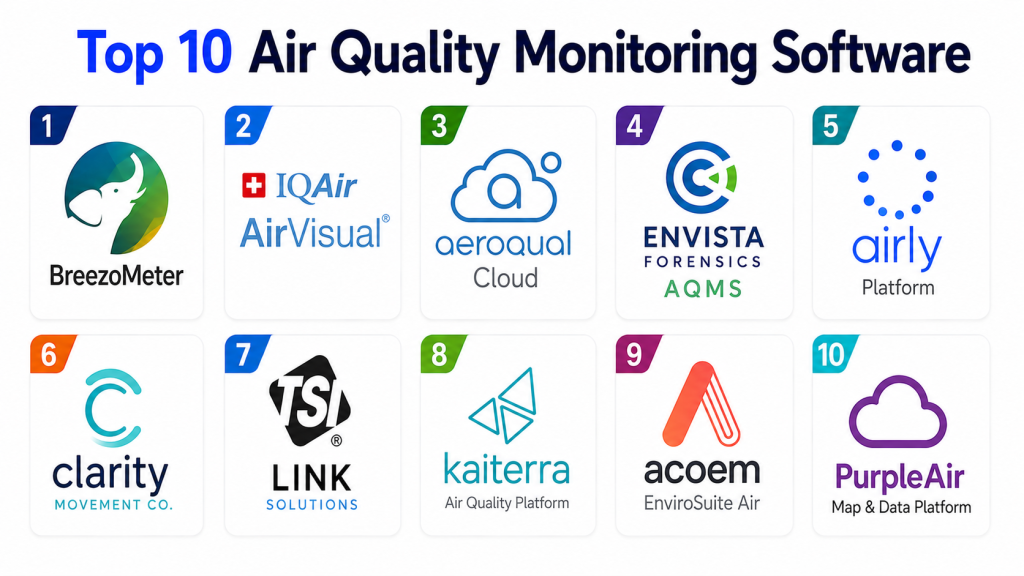
Top 10 Air Quality Monitoring Software Tools
#1 — IQAir AirVisual
Short description: IQAir AirVisual is one of the most recognized air quality monitoring platforms globally. It combines hardware sensors, cloud analytics, and real-time pollution visualization for homes, enterprises, schools, and smart city deployments. The platform is especially strong for outdoor pollution tracking and public air quality dashboards.
Key Features
- Real-time AQI monitoring
- PM2.5 and pollutant tracking
- Mobile air quality dashboards
- Historical trend analysis
- Smart alerts and notifications
- Indoor and outdoor monitoring
- Global air pollution mapping
Pros
- Strong global air quality database
- User-friendly mobile applications
- Good for both enterprise and consumer deployments
- Reliable real-time visualization
Cons
- Advanced enterprise analytics can be limited
- Some integrations require custom setup
- Premium hardware can be expensive
- Limited self-hosted deployment options
Platforms / Deployment
- Web / iOS / Android
- Cloud
Security & Compliance
- MFA support
- Encryption in transit
- GDPR support
- Additional certifications not publicly stated
Integrations & Ecosystem
IQAir integrates with smart sensors, environmental systems, and public pollution monitoring infrastructure. APIs enable external data access and custom dashboards.
- REST APIs
- IoT sensor integrations
- Smart building systems
- Environmental dashboards
- Mobile notifications
Support & Community
Strong documentation and consumer-friendly onboarding. Enterprise support is available for larger deployments.
#2 — Kaiterra
Short description: Kaiterra specializes in indoor air quality monitoring for commercial buildings, healthcare facilities, and smart workplaces. The platform combines IoT hardware with cloud analytics to help organizations improve workplace health and environmental performance.
Key Features
- Indoor air quality analytics
- CO2 and VOC monitoring
- Smart building integrations
- Real-time alerts
- Occupancy analytics
- Historical reporting
- Multi-site monitoring
Pros
- Excellent indoor monitoring capabilities
- Modern dashboard experience
- Strong smart building ecosystem
- Good healthcare and workplace focus
Cons
- Outdoor monitoring is less extensive
- Enterprise pricing may be high
- Hardware dependency
- Some advanced analytics require premium tiers
Platforms / Deployment
- Web / iOS / Android
- Cloud
Security & Compliance
- RBAC
- Encryption support
- GDPR support
- Additional certifications not publicly stated
Integrations & Ecosystem
Kaiterra integrates with commercial building platforms and HVAC management systems.
- Building management systems
- HVAC integrations
- APIs
- Smart office platforms
- ESG reporting tools
Support & Community
Strong enterprise onboarding and implementation support with growing community adoption.
#3 — Envira IoT
Short description: Envira IoT offers environmental monitoring software focused on industrial, smart city, and government deployments. The platform supports large-scale sensor deployments with advanced environmental analytics and compliance reporting capabilities.
Key Features
- Industrial air quality monitoring
- Compliance reporting
- GIS mapping
- IoT sensor management
- Predictive analytics
- Custom dashboards
- Environmental trend analysis
Pros
- Strong industrial capabilities
- Good compliance support
- Flexible sensor compatibility
- Scalable deployments
Cons
- Interface can feel technical
- Setup complexity for smaller teams
- Limited consumer features
- Premium enterprise pricing
Platforms / Deployment
- Web
- Cloud / Hybrid
Security & Compliance
- RBAC
- Audit logging
- Encryption
- Additional certifications not publicly stated
Integrations & Ecosystem
Envira IoT supports enterprise environmental systems and industrial IoT infrastructure.
- Industrial IoT integrations
- APIs
- GIS systems
- Compliance systems
- Sensor gateways
Support & Community
Good enterprise implementation support with technical onboarding assistance.
#4 — Aeroqual Cloud
Short description: Aeroqual Cloud is widely used in environmental monitoring, industrial compliance, and research applications. It combines portable air quality instruments with cloud-based analytics and centralized environmental monitoring.
Key Features
- Portable air monitoring
- Cloud analytics
- Sensor calibration management
- Compliance reporting
- Mobile monitoring
- Environmental alerts
- Multi-site management
Pros
- Trusted environmental monitoring reputation
- Strong portable device ecosystem
- Reliable sensor accuracy
- Good industrial use cases
Cons
- UI can appear dated
- Advanced analytics limited compared to AI-focused platforms
- Enterprise customization can be complex
- Higher hardware costs
Platforms / Deployment
- Web / Mobile
- Cloud
Security & Compliance
- Encryption support
- Role-based permissions
- Additional compliance certifications not publicly stated
Integrations & Ecosystem
Aeroqual integrates with environmental instrumentation and compliance systems.
- APIs
- Environmental sensors
- Compliance reporting systems
- Cloud exports
- Mobile dashboards
Support & Community
Strong support for environmental professionals and industrial users.
#5 — Clarity Movement
Short description: Clarity Movement provides smart air monitoring solutions designed for urban environments, government deployments, and large-scale environmental networks. The platform focuses on scalable sensor infrastructure and advanced environmental intelligence.
Key Features
- Hyperlocal pollution monitoring
- Smart city analytics
- AI-assisted pollution analysis
- Environmental mapping
- Mobile dashboards
- Multi-sensor support
- Public data sharing
Pros
- Excellent smart city capabilities
- Strong visualization tools
- Scalable monitoring networks
- Good AI-driven insights
Cons
- Enterprise-oriented pricing
- Requires sensor deployment planning
- Complex large-scale configurations
- Limited offline functionality
Platforms / Deployment
- Web
- Cloud
Security & Compliance
- Encryption support
- RBAC
- Additional certifications not publicly stated
Integrations & Ecosystem
Clarity integrates with smart city platforms and public environmental systems.
- APIs
- GIS platforms
- Smart city systems
- Public dashboards
- Environmental databases
Support & Community
Strong implementation services for municipalities and enterprise deployments.
#6 — BreezoMeter
Short description: BreezoMeter focuses on real-time environmental intelligence and air quality APIs for enterprises, mobile applications, and digital services. It is widely used in consumer apps, health platforms, and mobility solutions.
Key Features
- Air quality APIs
- Real-time pollution intelligence
- Weather integration
- Health risk analytics
- Mobile SDKs
- Global AQI data
- Predictive pollution insights
Pros
- Strong developer ecosystem
- Excellent API capabilities
- Global environmental data coverage
- Good for app integrations
Cons
- Less focused on industrial compliance
- API-centric model may not suit all users
- Advanced enterprise analytics limited
- Self-hosted deployment unavailable
Platforms / Deployment
- Web
- Cloud
Security & Compliance
- Encryption support
- API authentication
- Additional certifications not publicly stated
Integrations & Ecosystem
BreezoMeter integrates well with digital health and mobile application ecosystems.
- Mobile SDKs
- APIs
- Health applications
- Weather services
- Smart mobility platforms
Support & Community
Good developer documentation and API onboarding resources.
#7 — TSI Link Solutions
Short description: TSI Link Solutions delivers professional-grade environmental monitoring for industrial hygiene, laboratories, and occupational safety use cases. The platform is designed for organizations needing scientific-grade monitoring and reporting.
Key Features
- Occupational exposure monitoring
- Laboratory air analytics
- Scientific-grade sensors
- Compliance tracking
- Real-time reporting
- Environmental data storage
- Device fleet management
Pros
- High sensor accuracy
- Trusted scientific reputation
- Strong occupational safety focus
- Reliable industrial reporting
Cons
- Less user-friendly for non-technical teams
- Higher deployment costs
- Complex setup
- Limited SMB focus
Platforms / Deployment
- Web
- Cloud / Hybrid
Security & Compliance
- Encryption
- Role-based access
- Additional certifications not publicly stated
Integrations & Ecosystem
TSI integrates with industrial monitoring and laboratory systems.
- APIs
- Lab systems
- Industrial monitoring platforms
- Sensor management systems
- Data export tools
Support & Community
Strong technical support for enterprise and scientific deployments.
#8 — AirThings for Business
Short description: AirThings for Business focuses on indoor environmental monitoring for offices, schools, hospitality, and commercial buildings. It emphasizes simplicity, workplace wellness, and easy deployment.
Key Features
- Indoor air monitoring
- Radon detection
- CO2 monitoring
- Workplace wellness analytics
- Mobile notifications
- Dashboard reporting
- Multi-building monitoring
Pros
- Easy deployment
- User-friendly dashboards
- Strong indoor air focus
- Good SMB fit
Cons
- Limited industrial monitoring
- Outdoor monitoring less advanced
- Fewer enterprise customization options
- Advanced analytics limited
Platforms / Deployment
- Web / iOS / Android
- Cloud
Security & Compliance
- Encryption support
- RBAC
- Additional certifications not publicly stated
Integrations & Ecosystem
AirThings integrates with workplace management and smart office tools.
- Smart office systems
- APIs
- HVAC integrations
- Workplace analytics
- Mobile apps
Support & Community
Good onboarding experience and accessible customer support.
#9 — Awair Omni
Short description: Awair Omni provides indoor air quality monitoring for commercial buildings, educational facilities, and workplaces. The platform combines hardware sensors with cloud analytics and wellness-focused environmental reporting.
Key Features
- Indoor air quality scoring
- VOC and CO2 monitoring
- Cloud dashboards
- Wellness analytics
- Real-time alerts
- Historical reporting
- Device management
Pros
- Easy-to-understand dashboards
- Strong workplace wellness focus
- Quick deployment
- Good visualization features
Cons
- Limited industrial monitoring
- Less suited for outdoor deployments
- Fewer compliance-focused features
- Smaller enterprise ecosystem
Platforms / Deployment
- Web / iOS / Android
- Cloud
Security & Compliance
- Encryption support
- Additional certifications not publicly stated
Integrations & Ecosystem
Awair integrates with smart office and workplace wellness platforms.
- APIs
- Smart office systems
- HVAC platforms
- Environmental dashboards
- Mobile integrations
Support & Community
Simple onboarding with moderate enterprise support capabilities.
#10 — Siemens Enlighted Environmental Monitoring
Short description: Siemens Enlighted extends smart building intelligence into environmental monitoring and workplace analytics. It combines sensor infrastructure, occupancy insights, and air quality monitoring for enterprise facilities.
Key Features
- Smart building analytics
- Indoor air monitoring
- Occupancy intelligence
- Energy optimization
- Enterprise dashboards
- Real-time environmental insights
- Building automation integrations
Pros
- Strong enterprise building ecosystem
- Excellent smart facility integrations
- Scalable deployments
- Good workplace analytics
Cons
- Enterprise-focused pricing
- Requires existing infrastructure alignment
- Complex deployment for small organizations
- Less suitable for standalone use
Platforms / Deployment
- Web
- Cloud / Hybrid
Security & Compliance
- RBAC
- Enterprise authentication support
- Encryption
- Additional certifications not publicly stated
Integrations & Ecosystem
Siemens integrates deeply with enterprise building and infrastructure systems.
- Building management systems
- HVAC systems
- Smart building platforms
- APIs
- Enterprise facility tools
Support & Community
Strong enterprise implementation and professional services support.
Comparison Table
| Tool Name | Best For | Platform(s) Supported | Deployment | Standout Feature | Public Rating |
|---|---|---|---|---|---|
| IQAir AirVisual | Public and enterprise AQI monitoring | Web, iOS, Android | Cloud | Global AQI intelligence | N/A |
| Kaiterra | Indoor commercial air quality | Web, iOS, Android | Cloud | Smart building integrations | N/A |
| Envira IoT | Industrial monitoring | Web | Cloud, Hybrid | Compliance analytics | N/A |
| Aeroqual Cloud | Environmental professionals | Web, Mobile | Cloud | Portable monitoring devices | N/A |
| Clarity Movement | Smart cities | Web | Cloud | Hyperlocal pollution mapping | N/A |
| BreezoMeter | Developers and APIs | Web | Cloud | Environmental intelligence APIs | N/A |
| TSI Link Solutions | Scientific monitoring | Web | Cloud, Hybrid | Industrial-grade monitoring | N/A |
| AirThings for Business | SMB indoor monitoring | Web, iOS, Android | Cloud | Workplace wellness focus | N/A |
| Awair Omni | Indoor wellness monitoring | Web, iOS, Android | Cloud | Wellness-focused analytics | N/A |
| Siemens Enlighted | Enterprise facilities | Web | Cloud, Hybrid | Smart building ecosystem | N/A |
Evaluation & Scoring of Air Quality Monitoring Software
| Tool Name | Core 25% | Ease 15% | Integrations 15% | Security 10% | Performance 10% | Support 10% | Value 15% | Weighted Total |
|---|---|---|---|---|---|---|---|---|
| IQAir AirVisual | 8.8 | 9.0 | 7.8 | 7.5 | 8.5 | 8.4 | 8.3 | 8.4 |
| Kaiterra | 8.7 | 8.8 | 8.4 | 8.0 | 8.5 | 8.2 | 7.8 | 8.3 |
| Envira IoT | 9.0 | 7.2 | 8.5 | 8.4 | 8.8 | 8.0 | 7.5 | 8.3 |
| Aeroqual Cloud | 8.8 | 7.8 | 7.9 | 7.8 | 8.7 | 8.3 | 7.6 | 8.1 |
| Clarity Movement | 8.9 | 8.1 | 8.6 | 8.0 | 8.8 | 8.1 | 7.4 | 8.3 |
| BreezoMeter | 8.2 | 8.7 | 9.2 | 7.5 | 8.4 | 8.0 | 8.2 | 8.4 |
| TSI Link Solutions | 8.9 | 6.9 | 7.8 | 8.3 | 9.0 | 8.4 | 7.0 | 8.0 |
| AirThings for Business | 8.0 | 9.1 | 7.6 | 7.4 | 8.0 | 7.9 | 8.7 | 8.2 |
| Awair Omni | 7.8 | 8.9 | 7.2 | 7.0 | 7.9 | 7.5 | 8.5 | 7.9 |
| Siemens Enlighted | 9.1 | 7.5 | 9.0 | 8.6 | 9.0 | 8.5 | 7.1 | 8.5 |
These scores are comparative and intended to help buyers evaluate relative strengths across platforms. Higher scores do not necessarily mean a tool is universally better for every organization. Enterprise-focused tools may score highly on scalability and integrations while SMB-focused platforms may perform better on usability and value. Buyers should prioritize the categories that align most closely with their operational and compliance requirements.
Which Air Quality Monitoring Software Tool Is Right for You?
Solo / Freelancer
Independent consultants, researchers, and small facilities often benefit from simpler platforms like AirThings for Business or IQAir AirVisual. These tools provide easy deployment, mobile access, and lower operational complexity.
SMB
Small and mid-sized businesses typically prioritize affordability, ease of deployment, and workplace wellness monitoring. Kaiterra and AirThings for Business are strong choices for offices, schools, and commercial properties.
Mid-Market
Mid-sized industrial companies and commercial operators often require stronger reporting, analytics, and multi-site visibility. Aeroqual Cloud and Envira IoT offer stronger operational monitoring and compliance capabilities.
Enterprise
Large enterprises, smart cities, healthcare networks, and industrial organizations generally need scalable deployments, integrations, and advanced analytics. Siemens Enlighted, Clarity Movement, and Envira IoT are strong enterprise candidates.
Budget vs Premium
Budget-focused organizations should prioritize ease of deployment and essential analytics rather than advanced AI or industrial compliance tooling. Premium enterprise platforms typically justify their cost through scalability, automation, integrations, and advanced reporting.
Feature Depth vs Ease of Use
Highly advanced platforms often require more technical expertise. Simpler tools like AirThings and Awair Omni emphasize usability, while Envira IoT and Siemens Enlighted prioritize operational depth.
Integrations & Scalability
Organizations with existing smart building or industrial systems should prioritize platforms with mature APIs and integration ecosystems. Siemens Enlighted and Kaiterra are particularly strong in this area.
Security & Compliance Needs
Healthcare, industrial, and government environments should prioritize RBAC, encryption, audit logging, and enterprise authentication capabilities. Enterprise deployments may also require stronger governance and compliance workflows.
Frequently Asked Questions FAQs
1. What is Air Quality Monitoring Software?
Air Quality Monitoring Software collects and analyzes environmental data from connected sensors and monitoring systems. It helps organizations track pollutants, visualize trends, automate alerts, and improve environmental compliance. Many platforms also support ESG reporting and workplace wellness initiatives.
2. Who typically uses these platforms?
These platforms are commonly used by manufacturing companies, healthcare organizations, smart city programs, educational institutions, commercial real estate operators, and environmental agencies. Indoor air quality monitoring is also becoming popular in corporate workplaces and hospitality environments.
3. Are these tools mainly for indoor or outdoor monitoring?
Some tools specialize in indoor environments while others focus on outdoor pollution and industrial emissions. Many enterprise platforms support both use cases. Buyers should evaluate sensor compatibility and deployment flexibility before selecting a solution.
4. How are these platforms usually priced?
Pricing varies significantly based on sensor count, data retention, deployment scale, analytics capabilities, and support requirements. Some vendors charge subscription fees while others bundle software with hardware purchases or enterprise contracts.
5. Do these tools require dedicated hardware sensors?
Most enterprise-grade air quality monitoring platforms rely on specialized IoT sensors and environmental monitoring devices. However, API-focused platforms like BreezoMeter primarily deliver environmental intelligence through cloud services and integrations.
6. What are the most important features buyers should prioritize?
Real-time monitoring, alert automation, historical analytics, sensor compatibility, reporting, API integrations, scalability, and mobile accessibility are among the most important evaluation areas. Enterprise buyers should also review compliance and governance capabilities.
7. Can Air Quality Monitoring Software integrate with smart buildings?
Yes. Many platforms integrate with HVAC systems, building management systems, occupancy analytics platforms, and broader smart building infrastructure. This helps organizations automate ventilation and environmental optimization workflows.
8. Are AI capabilities becoming common in this category?
Yes. AI-driven analytics are increasingly used for predictive pollution forecasting, anomaly detection, sensor optimization, and environmental trend analysis. Enterprise platforms are adopting automation features to reduce operational monitoring overhead.
9. Is cloud deployment the standard model now?
Cloud deployment has become the dominant approach because it simplifies remote monitoring, multi-site management, and analytics access. However, some industrial and government deployments still require hybrid or private infrastructure models.
10. What common mistakes should organizations avoid?
Organizations often underestimate deployment planning, sensor calibration needs, integration complexity, and long-term scalability requirements. Choosing a platform without considering reporting, compliance, and ecosystem compatibility can create operational challenges later.
Conclusion
Air Quality Monitoring Software has evolved from basic environmental dashboards into advanced operational intelligence platforms that support compliance, workplace wellness, ESG initiatives, industrial safety, and smart infrastructure management. The best solution depends heavily on your deployment size, monitoring goals, regulatory needs, and integration requirements. SMBs may prioritize simplicity and affordability, while enterprise organizations often need large-scale sensor management, AI-driven analytics, and deep ecosystem integrations. Platforms like IQAir AirVisual and AirThings for Business work well for accessible monitoring, while Siemens Enlighted, Envira IoT, and Clarity Movement provide stronger enterprise-scale capabilities. Before making a final decision, shortlist two or three platforms, validate sensor compatibility, review security and reporting requirements, and run a pilot deployment to ensure the solution aligns with your operational and environmental objectives.

Very informative and well-structured blog on air quality monitoring software. The comparison of features, pros, and cons is clear and practical, making it easier to understand different air quality and environmental monitoring solutions.
Great overview of air quality monitoring software—this article clearly explains how these tools help track pollution levels, improve environmental analysis, and support compliance management.
Air quality monitoring software becomes far more impactful when it helps organizations understand pollution sources instead of only displaying environmental readings. In complex urban and industrial environments, identifying emission patterns, seasonal variations, and the influence of weather conditions is essential for effective mitigation strategies. Expanding the comparison to include source attribution analytics, meteorological data integration, predictive pollution modeling, and decision-support capabilities would provide readers with a more practical framework for selecting a platform that enables proactive environmental management rather than reactive monitoring.