Introduction
Catalog management software helps businesses centralize, organize, and distribute product information across multiple channels and platforms. These tools ensure product data accuracy, improve time-to-market, and streamline operations for e-commerce, retail, and wholesale businesses. In 2026+, businesses face increasing demand for multi-channel selling, personalized product experiences, and integration with marketplaces, making catalog management software essential for operational efficiency.
Real-world use cases include:
- Centralizing product information for e-commerce, marketplaces, and offline stores
- Managing product attributes, images, and digital assets
- Automating updates across multiple sales channels
- Ensuring data consistency for pricing, availability, and descriptions
- Supporting global multi-currency and multi-language product catalogs
Key evaluation criteria for buyers:
- Centralized product information management
- Integration with e-commerce platforms, marketplaces, and ERP systems
- Bulk editing and automated updates
- Digital asset management (images, videos, documents)
- Product categorization, attributes, and taxonomy support
- Multi-language and multi-currency capabilities
- Workflow automation for approvals and publishing
- Analytics for catalog completeness and performance
- Security and access control
- Scalability for large product portfolios
Best for: Retailers, e-commerce brands, wholesalers, distributors, and businesses managing large product catalogs.
Not ideal for: Businesses with very small product inventories or limited channel distribution needs.
Key Trends in Catalog Management Software
- Centralized multi-channel catalog management
- Integration with marketplaces, POS, and ERP systems
- AI-powered attribute mapping and auto-tagging
- Workflow automation for product approvals and publishing
- Support for complex product hierarchies and variants
- Multi-language, multi-currency, and localization features
- Real-time data synchronization across channels
- Enhanced digital asset management (images, videos, PDFs)
- Analytics dashboards for catalog health and completeness
- Subscription-based and API-first platforms for flexible integration
How We Selected These Tools (Methodology)
- Evaluated adoption across e-commerce, retail, and distribution industries
- Assessed capabilities for multi-channel product management
- Reviewed digital asset management features
- Measured integration capabilities with ERP, e-commerce, and marketplaces
- Examined workflow automation and approval processes
- Considered multi-language and multi-currency support
- Analyzed scalability for large product portfolios
- Reviewed analytics and reporting features
- Compared ease of use and onboarding
- Evaluated support, training, and documentation resources
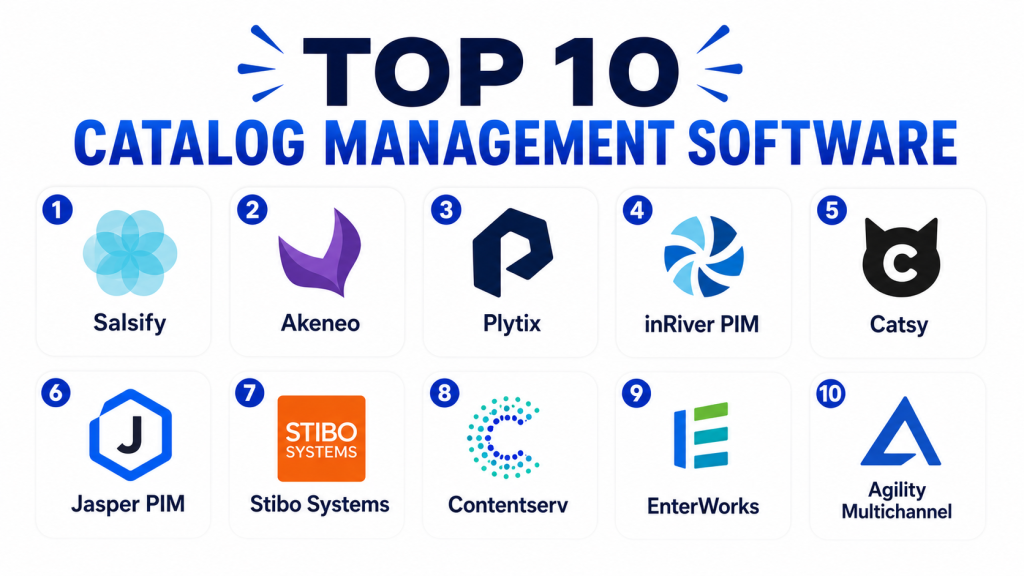
Top 10 Catalog Management Software
#1 — Salsify
Short description (4–5 lines):
Salsify centralizes product content and enables brands to distribute information across e-commerce, marketplaces, and retail partners. Ideal for large retailers and consumer brands.
Key Features
- Centralized product information management
- Multi-channel distribution
- Workflow automation and approvals
- Digital asset management
- Analytics dashboards
Pros
- Strong integration with marketplaces and e-commerce
- Scalable for large catalogs
Cons
- Premium pricing
- Implementation complexity for small teams
Platforms / Deployment
- Web; Cloud-based
Security & Compliance
- Not publicly stated
Integrations & Ecosystem
- Shopify, Amazon, Walmart, ERP systems
- API and connector support
- Digital asset management integrations
Support & Community
Documentation, onboarding, and support services.
#2 — Akeneo
Short description (4–5 lines):
Akeneo provides Product Information Management (PIM) with catalog centralization, multi-language support, and workflow automation. Suitable for brands managing global product portfolios.
Key Features
- Centralized PIM and catalog management
- Multi-language and localization support
- Workflow automation for content updates
- Digital asset management
- Integration with e-commerce and ERP platforms
Pros
- Open-source flexibility available
- Strong workflow and collaboration tools
Cons
- Setup and customization may require technical expertise
- Advanced features may need premium plan
Platforms / Deployment
- Web; Cloud or on-premise
Security & Compliance
- Not publicly stated
Integrations & Ecosystem
- Shopify, Magento, ERP systems
- API access for custom integrations
- Digital asset management systems
Support & Community
Documentation, forums, and support services.
#3 — Pimcore
Short description (4–5 lines):
Pimcore is an open-source PIM and catalog management platform enabling businesses to manage complex product data, digital assets, and multi-channel distribution. Ideal for enterprises needing flexible deployment.
Key Features
- Open-source PIM with catalog management
- Digital asset and content management
- Workflow automation and data quality controls
- Multi-language and multi-currency support
- API-driven integrations
Pros
- Flexible and scalable
- Strong multi-channel and DAM capabilities
Cons
- Technical expertise required
- Support may require premium subscription
Platforms / Deployment
- Web; Cloud or on-premise
Security & Compliance
- Not publicly stated
Integrations & Ecosystem
- ERP, e-commerce, marketplaces
- API and connector support
- Digital asset management
Support & Community
Documentation, forums, and community support.
#4 — Plytix
Short description (4–5 lines):
Plytix is a PIM platform for small and mid-sized businesses, simplifying catalog management, product data distribution, and analytics. Ideal for SMB e-commerce brands.
Key Features
- Centralized product catalog
- Multi-channel export
- Digital asset management
- Product data quality and completeness tracking
- Workflow and user management
Pros
- User-friendly interface
- Affordable for SMBs
Cons
- Limited enterprise features
- Smaller ecosystem integrations
Platforms / Deployment
- Web; Cloud-based
Security & Compliance
- Not publicly stated
Integrations & Ecosystem
- Shopify, WooCommerce, marketplaces
- API access
- Export connectors
Support & Community
Documentation, tutorials, and customer support.
#5 — inRiver
Short description (4–5 lines):
inRiver is a catalog management and PIM platform designed for enterprise brands with large, complex product portfolios. Ideal for global companies with multi-channel distribution.
Key Features
- Product content centralization
- Workflow automation
- Multi-channel distribution
- Digital asset management
- Analytics and reporting
Pros
- Enterprise-grade scalability
- Strong multi-channel support
Cons
- Premium pricing
- Complex implementation
Platforms / Deployment
- Web; Cloud-based
Security & Compliance
- Not publicly stated
Integrations & Ecosystem
- ERP, e-commerce, marketplaces
- API and connector support
- Digital asset management
Support & Community
Enterprise support, documentation, and training.
#6 — Catsy
Short description (4–5 lines):
Catsy provides PIM and catalog management solutions for mid-market brands, enabling product data centralization and multi-channel publishing. Ideal for SMBs seeking simplified workflows.
Key Features
- Product information centralization
- Multi-channel publishing
- Digital asset management
- Workflow automation
- Analytics dashboards
Pros
- Easy-to-use interface
- Affordable mid-market solution
Cons
- Limited enterprise capabilities
- Smaller integration ecosystem
Platforms / Deployment
- Web; Cloud-based
Security & Compliance
- Not publicly stated
Integrations & Ecosystem
- E-commerce platforms
- ERP systems
- API support
Support & Community
Documentation, tutorials, and support services.
#7 — Agility PIM
Short description (4–5 lines):
Agility PIM offers catalog management with centralized product data, workflow automation, and multi-channel publishing. Ideal for retailers and distributors managing large inventories.
Key Features
- Centralized catalog and PIM
- Workflow automation
- Multi-channel publishing
- Digital asset management
- Analytics dashboards
Pros
- Robust workflow and automation
- Supports multi-channel distribution
Cons
- Enterprise pricing
- Requires setup for complex catalogs
Platforms / Deployment
- Web; Cloud-based
Security & Compliance
- Not publicly stated
Integrations & Ecosystem
- ERP, e-commerce, marketplaces
- API integrations
- Digital asset management
Support & Community
Documentation, support team, and training.
#8 — Contentserv
Short description (4–5 lines):
Contentserv provides catalog management, PIM, and DAM solutions for enterprise brands needing product content centralization and distribution. Ideal for global enterprises.
Key Features
- Product catalog and PIM
- Digital asset management
- Multi-channel publishing
- Workflow automation
- Analytics and reporting
Pros
- Enterprise-grade solution
- Supports complex product portfolios
Cons
- High cost
- Implementation requires professional services
Platforms / Deployment
- Web; Cloud-based
Security & Compliance
- Not publicly stated
Integrations & Ecosystem
- ERP, e-commerce, marketplaces
- API connectors
- Digital asset integration
Support & Community
Enterprise support, documentation, and training.
#9 — Riversand
Short description (4–5 lines):
Riversand offers PIM and catalog management software with advanced data governance and multi-channel publishing for large enterprises. Suitable for brands with global product catalogs.
Key Features
- Centralized PIM and catalog
- Workflow and approval automation
- Multi-channel distribution
- Digital asset management
- Analytics dashboards
Pros
- Scalable for enterprise catalogs
- Strong data governance
Cons
- Enterprise pricing
- Complex onboarding
Platforms / Deployment
- Web; Cloud-based
Security & Compliance
- Not publicly stated
Integrations & Ecosystem
- ERP, e-commerce, marketplaces
- API and connector support
- DAM integration
Support & Community
Documentation, support, and professional services.
#10 — Stibo Systems
Short description (4–5 lines):
Stibo Systems provides enterprise-grade catalog management and PIM solutions for global organizations. Ideal for large brands with complex multi-channel needs.
Key Features
- Product information centralization
- Multi-channel publishing
- Workflow automation
- Digital asset management
- Analytics and reporting
Pros
- Enterprise scalability
- Comprehensive features
Cons
- High cost
- Requires professional implementation
Platforms / Deployment
- Web; Cloud-based
Security & Compliance
- Not publicly stated
Integrations & Ecosystem
- ERP, e-commerce, marketplaces
- API integrations
- DAM systems
Support & Community
Enterprise support, training, and documentation.
Comparison Table (Top 10)
| Tool Name | Best For | Platforms Supported | Deployment | Standout Feature | Public Rating |
|---|---|---|---|---|---|
| Salsify | Large retailers & brands | Web | Cloud | Multi-channel distribution | N/A |
| Akeneo | Global brands | Web | Cloud/On-prem | Multi-language & PIM | N/A |
| Pimcore | Enterprises needing flexibility | Web | Cloud/On-prem | Open-source & DAM integration | N/A |
| Plytix | SMB e-commerce brands | Web | Cloud | Affordable SMB-friendly PIM | N/A |
| inRiver | Enterprise brands | Web | Cloud | Multi-channel publishing | N/A |
| Catsy | Mid-market brands | Web | Cloud | Simple workflow & catalog management | N/A |
| Agility PIM | Retailers & distributors | Web | Cloud | Robust workflow automation | N/A |
| Contentserv | Global enterprises | Web | Cloud | Complex catalog support | N/A |
| Riversand | Enterprise multi-channel | Web | Cloud | Data governance | N/A |
| Stibo Systems | Large global brands | Web | Cloud | Enterprise-grade catalog management | N/A |
Evaluation & Scoring of Catalog Management Software
| Tool Name | Core (25%) | Ease (15%) | Integrations (15%) | Security (10%) | Performance (10%) | Support (10%) | Value (15%) | Weighted Total |
|---|---|---|---|---|---|---|---|---|
| Salsify | 9 | 8 | 8 | 8 | 8 | 7 | 7 | 7.90 |
| Akeneo | 9 | 8 | 8 | 8 | 8 | 7 | 7 | 7.90 |
| Pimcore | 9 | 7 | 8 | 8 | 8 | 7 | 7 | 7.85 |
| Plytix | 8 | 9 | 7 | 8 | 8 | 7 | 7 | 7.75 |
| inRiver | 9 | 8 | 8 | 8 | 8 | 7 | 7 | 7.90 |
| Catsy | 8 | 9 | 7 | 8 | 8 | 7 | 7 | 7.75 |
| Agility PIM | 9 | 8 | 8 | 8 | 8 | 7 | 7 | 7.85 |
| Contentserv | 9 | 7 | 8 | 8 | 8 | 7 | 7 | 7.80 |
| Riversand | 9 | 7 | 8 | 8 | 8 | 7 | 7 | 7.80 |
| Stibo Systems | 9 | 7 | 8 | 8 | 8 | 7 | 7 | 7.80 |
Which Catalog Management Software Is Right for You?
Solo / SMB Brands
Plytix and Catsy provide easy-to-use, affordable catalog management for small and mid-sized e-commerce operations.
Mid-Market / Growing Businesses
Salsify and Akeneo offer advanced features, multi-language support, and workflow automation for growing catalogs.
Enterprise / Global Brands
inRiver, Pimcore, Contentserv, Riversand, and Stibo Systems provide multi-channel distribution, digital asset management, and scalability for large product portfolios.
Budget vs Premium
Small brands can start with Plytix or Catsy. Enterprises benefit from Salsify, Akeneo, or Stibo Systems for advanced capabilities.
Feature Depth vs Ease of Use
Enterprise solutions deliver complex workflows, analytics, and integrations. SMB-focused platforms prioritize simplicity and speed.
Integrations & Scalability
Platforms with API and e-commerce integrations scale easily as product volume and channels increase.
Security & Compliance Needs
Ensure secure access controls, data encryption, and workflow audit trails.
Frequently Asked Questions (FAQs)
1. What is catalog management software?
A tool that centralizes product information and distributes it across multiple channels with accuracy and consistency.
2. Can it handle multi-channel sales?
Yes, most platforms support marketplaces, e-commerce stores, and POS systems.
3. Does it support multi-language and multi-currency?
Enterprise-grade tools like Akeneo, Salsify, and Stibo Systems provide robust localization features.
4. Can I manage digital assets?
Yes, platforms integrate product images, videos, and documents for catalog enrichment.
5. Are workflow automations included?
Most platforms provide automated approvals, updates, and content publishing workflows.
6. Can I integrate with ERP or e-commerce systems?
Yes, APIs and built-in connectors enable seamless integration with other enterprise systems.
7. Is reporting and analytics available?
Yes, dashboards track catalog completeness, sales performance, and content health.
8. Are these platforms scalable?
Yes, enterprise solutions like inRiver, Stibo Systems, and Riversand can handle large product portfolios.
9. Are they cloud-based or on-premise?
Most modern platforms are cloud-based; some like Pimcore offer on-premise options.
10. How do I choose the right software?
Consider product catalog size, channel distribution, localization needs, integration requirements, and budget.
Conclusion
Catalog management software is essential for businesses aiming to maintain accurate product information across multiple channels. Small to mid-sized brands may leverage Plytix or Catsy for simplicity and affordability. Mid-market businesses can scale efficiently with Salsify or Akeneo, which offer workflow automation and multi-language support. Enterprises with complex portfolios should consider inRiver, Pimcore, or Stibo Systems for multi-channel distribution, digital asset management, and advanced analytics. Evaluate your catalog size, integration needs, and global requirements before selecting a solution. Shortlist 2–3 platforms, test data workflows, and ensure multi-channel consistency for a seamless product experience.

This article provides a clear comparison of catalog management software and explains how different platforms help organize and distribute product information. The detailed feature breakdown makes it easier to understand the strengths of each solution and make an informed choice.