Introduction
Enterprise technology is currently undergoing its most profound shift since the transition to cloud computing. Over the past few years, organizations have rushed to integrate Large Language Models (LLMs) and Generative AI into their existing digital workflows. However, many IT leaders and engineering teams have encountered a common wall: isolated artificial intelligence experiments rarely deliver long-term business value without a scalable operational foundation.
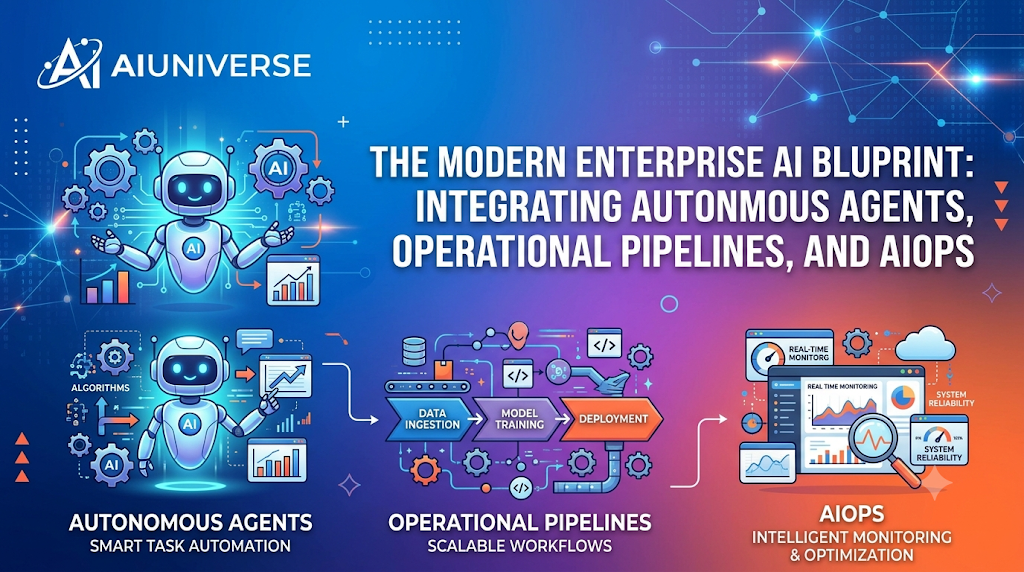
Standard conversational interfaces and passive prompt-and-response systems can answer questions, but they cannot execute multi-step business logic, reason through dynamic system errors, or autonomously manage mission-critical infrastructure. As organizations aim to move from static predictive models and basic chat assistants toward fully autonomous digital workflows, three pillars have emerged as the foundation of modern technology stacks: Agentic AI, MLOps (Machine Learning Operations), and AIOps (Artificial Intelligence for IT Operations).
Building resilient, secure, and production-grade artificial intelligence workflows requires much more than just fine-tuning a model or writing effective prompts. It demands end-to-end operational visibility, dynamic multi-agent orchestration, continuous integration and deployment pipelines, strict AI governance, and automated IT monitoring. Understanding how these paradigms intersect is essential for technology decision-makers, platform engineers, AI architects, and developers seeking to transform operational efficiency across the modern enterprise.
       +-----------------------------------------------------------------------+
       |                           ENTERPRISE VALUE                            |
       +-----------------------------------------------------------------------+
                                           |
     +-------------------------------------+-------------------------------------+
     |                                     |                                     |
     v                                     v                                     v
+-----------------------+       +-----------------------+       +-----------------------+
|      AGENTIC AI       |       |         MLOPS         |       |         AIOPS         |
|  Autonomous Action &  | <---> | Model Lifecycle, CI/CD| <---> | System Resilience &   |
|   Complex Reasoning   |       |   & Monitoring Engine |       | Self-Healing Operations|
+-----------------------+       +-----------------------+       +-----------------------+
Understanding the Pillars: Agentic AI, MLOps, and AIOps
To build enterprise-grade intelligence, engineering teams must distinguish between autonomous decision-making engines, the software engineering discipline that deploys models, and the operational systems that keep infrastructure resilient.
1. Agentic AI: Beyond Passive Text Generation
Unlike traditional Generative AI models that simply predict the next token based on a user prompt, Agentic AI systems possess agency. They are designed with clear objectives, perception capabilities, reasoning loops (such as ReAct architectures), and tool-use integrations. An autonomous AI agent can decompose a complex prompt into actionable sub-tasks, query internal SQL databases, evaluate intermediate outputs, invoke external web APIs, execute code in secure sandboxes, and adjust its plan dynamically when errors occur.
2. MLOps: The Production Backbone of Machine Learning
MLOps is the engineering discipline that bridges the gap between machine learning development and production operations. It adapts traditional DevOps principles—such as Continuous Integration and Continuous Deployment (CI/CD), infrastructure as code, automated testing, and version control—specifically to ML workflows. MLOps covers data pipeline versioning, feature stores, experiment tracking, model registries, distributed training, and real-time inference monitoring to ensure models remain performant over time.
3. AIOps: Autonomous System Resilience and Infrastructure Management
AIOps leverages machine learning algorithms, deep telemetry analysis, and natural language processing to automate IT operations. As distributed cloud architecture becomes increasingly complex, human teams are overwhelmed by log volume, metric spikes, and telemetry noise. AIOps platforms collect and correlate massive streams of event data across microservices, perform real-time root cause analysis, predict system failures before outages occur, and trigger automated self-healing scripts.
Together, these three disciplines form the operational engine of the modern digital enterprise.
Why Organizations Need an Integrated Operational AI Strategy
Deploying machine learning models in production without operational framework leads to technical debt, degraded performance, and high operational costs. Enterprise environments present unique challenges that static software development methods cannot solve alone.
+-----------------------+     +-----------------------+     +-----------------------+
|  Operational Friction |     | Governance Failures   |     | System Instability    |
| Unmonitored drift,    | --> | Privacy breaches,     | --> | Downtime, alert noise,|
| manual retraining     |     | compliance risks      |     | ballooning cloud cost |
+-----------------------+     +-----------------------+     +-----------------------+
                                          |
                                          v
+-----------------------------------------------------------------------------------+
|                            INTEGRATED STRATEGY SOLUTION                           |
|      Standardized Pipelines | Automated Monitoring | Robust Governance Framework      |
+-----------------------------------------------------------------------------------+
Scalability and Productivity
Manual data preparation, ad-hoc model deployment, and manual system monitoring severely limit an organization’s velocity. An integrated operational architecture automates continuous integration, validation, and delivery pipelines. This allows data science and engineering teams to focus on core business logic rather than manual system maintenance.
Automation of Complex Workflows
Traditional software automation relies on rigid, deterministic IF-THEN rules. Agentic systems introduce dynamic reasoning capable of handling unstructured inputs, multi-step approvals, and non-deterministic business logic. When coupled with AIOps, automated agents can handle technical support incidents, optimize cloud infrastructure provisioning, and route software tickets without human intervention.
Governance, Compliance, and Security
With regulatory standards like the EU AI Act, HIPAA, SOC 2, and GDPR, enterprises cannot treat machine learning as a “black box.” An integrated architecture establishes strict auditing for data provenance, model lineage, prompt-and-response logging, and policy compliance. This ensures data privacy and regulatory compliance across all deployment environments.
Cost Optimization and Infrastructure Management
Foundation models, high-performance GPUs, and distributed cloud clusters carry significant operational expenses. Without continuous model monitoring, automated resource scaling, and specialized optimization (such as model quantization and prompt caching), cloud budgets can quickly escalate out of control.
Key Technical Concepts and Architecture
Building robust intelligence requires mastering core technical patterns that govern execution, lifecycle management, and system stability.
The Agentic Reasoning Loop
Agentic systems execute through iterative loops rather than single-pass inference. The framework processes user intent, evaluates context, formulates multi-step execution plans, and executes tools sequentially.
+-------------------------------------------------------------------+
|                        1. PLAN FORMULATION                        |
|        Goal: Analyze system error & patch database connection    |
+-------------------------------------------------------------------+
                                  |
                                  v
+-------------------------------------------------------------------+
|                         2. TOOL EXECUTION                         |
|     Action: Execute diagnostic query on Log API sandbox          |
+-------------------------------------------------------------------+
                                  |
                                  v
+-------------------------------------------------------------------+
|                       3. OBSERVE & EVALUATE                       |
|   Result: Connection pool exhausted (Max Connections = 100)       |
+-------------------------------------------------------------------+
                                  |
                                  v
+-------------------------------------------------------------------+
|                       4. REFINE & RE-EXECUTE                      |
|   Action: Scale connection pool parameters & issue deployment     |
+-------------------------------------------------------------------+
Key patterns include:
- ReAct (Reasoning and Acting): Combining explicit chain-of-thought reasoning with real-time tool execution.
- Multi-Agent Collaboration: Specializing autonomous agents into dedicated roles (e.g., Planner, Coder, Critic, Reviewer) that communicate via explicit message buses to accomplish goals.
- Human-in-the-Loop (HITL): Inserting strategic authorization gates before agents execute high-risk write operations or financial transactions.
MLOps and LLMOps Pipelines
Traditional MLOps managed structured tabular data and deep learning models. Modern LLMOps extends this foundation to accommodate non-deterministic foundation models:
+-------------------+     +--------------------+     +-------------------+
| Data & Prompt     | --> | Model Registry &   | --> | Continuous        |
| Version Control   |     | Experiment Tracking|     | Evaluation (Evals)|
+-------------------+     +--------------------+     +-------------------+
                                                               |
                                                               v
+-------------------+     +--------------------+     +-------------------+
| Guardrail &       | <-- | Inference & Telemetry| <-- | Production        |
| Security Layer    |     | Drift Detection    |     | Deployment        |
+-------------------+     +--------------------+     +-------------------+
- Data and Prompt Versioning: Treating prompts, context retrievers, system configurations, and training data as versioned artifacts.
- Automated Model Evaluation (Evals): Evaluating outputs against performance parameters such as hallucination indices, answer relevance, context recall, and safety guardrails.
- Inference Drift and Performance Tracking: Monitoring statistical distribution shifts in operational input data (data drift) and model output accuracy degradation (concept drift).
AIOps Event Correlation and Anomaly Detection
AIOps relies on machine learning models built specifically for time-series telemetry, unstructured log analysis, and system event correlation:
- Dynamic Thresholding: Replacing static alert triggers with adaptive ML baselines that adjust for seasonal traffic variance.
- Root Cause Analysis (RCA): Applying directed acyclic graphs (DAGs) and causal inference to trace system anomalies back to their precise origin point across distributed microservices.
Technical and Business Benefits
Implementing an integrated strategy delivers measurable benefits across technical metrics and operational business outcomes.
Technical Advantages
- Reduced Mean Time to Detect and Resolve (MTTD/MTTR): AIOps isolates root causes across telemetry logs within seconds, reducing downtime during critical service disruptions.
- Continuous Integration and Deployment for AI: MLOps pipelines replace manual model deployment with automated testing, canary releases, and seamless rollback protocols.
- Dynamic Adaptation to Edge Cases: Agentic architectures handle non-standard input schema variations without throwing unhandled exceptions or breaking upstream pipelines.
Business Advantages
- Accelerated Time to Market: Standardized operational frameworks allow engineering teams to take new AI concepts to production in weeks rather than months.
- Lower Total Cost of Ownership (TCO): Intelligent model routing, prompt caching, and automated resource management optimize API costs and cloud infrastructure spend.
- Improved Operational Risk Management: Automated policy validation prevents sensitive data leaks, bad outputs, and unauthorized system access.
Enterprise Use Cases Across Key Industries
The combination of autonomous intelligence, operational pipelines, and automated monitoring drives practical value across major enterprise sectors.
+------------------------------------------------------------------------------------+
|                             ENTERPRISE USE CASES                                   |
+------------------------------------------------------------------------------------+
| Financial Services: Automated Fraud Resolution & Continuous Regulatory Compliance  |
| Healthcare: Clinical Workflow Automation & Dynamic Patient Triage Processing       |
| Manufacturing: Predictive Maintenance & Supply Chain Optimization                  |
| Telecommunications: Network Topology Optimization & Automated Incident Healing    |
+------------------------------------------------------------------------------------+
Financial Services & Banking
- Automated Anti-Money Laundering (AML) Investigations: Autonomous agents review flagged transactions, gather evidence across disparate ledgers, build regulatory case files, and submit findings to human compliance managers.
- Algorithmic Risk and Fraud Monitoring: MLOps pipelines continuously update credit scoring and fraud detection models against real-time data feeds, preventing performance drift in volatile market conditions.
Healthcare and Life Sciences
- Clinical Trial Data Reconciliation: Agentic workflows pull patient data from unstructured EHR documents, validate entries against clinical trial parameters, and raise flags on compliance discrepancies.
- Medical Imaging Pipelines: MLOps frameworks oversee continuous validation, governance tracking, and deployment of diagnostic imaging models to ensure compliance with strict medical software standards.
Manufacturing and Supply Chain
- Predictive Asset Maintenance: AIOps algorithms parse continuous telemetry streams from IoT sensors embedded on factory floors, detecting machinery micro-vibrations to trigger repair orders prior to equipment failure.
- Dynamic Supply Chain Rerouting: Autonomous agents track weather, geopolitical disruptions, and port logistics data to adjust inventory routing schedules automatically.
Telecommunications and Cloud Service Providers
- Autonomous Telemetry Healing: AIOps platforms monitor global network traffic flows, dynamically rerouting bandwidth around damaged infrastructure and optimizing tower energy draw in real time.
Key Challenges and Implementation Obstacles
While the business value is clear, technology leaders must navigate significant engineering and organizational hurdles when building enterprise capability.
+-----------------------------------------------------------------------------------+
|                             IMPLEMENTATION CHALLENGES                             |
+-----------------------------------------------------------------------------------+
|  [Security & Hallucinations]  --> Non-deterministic outputs & prompt injection    |
|  [Operational Friction]       --> Fragmented tooling & missing telemetry standards|
|  [Skills Gap & Talent]        --> Shortage of unified MLOps & Agentic Architects  |
|  [Governance & Compliance]    --> Unclear auditing trails & opaque decision pathways|
+-----------------------------------------------------------------------------------+
Non-Deterministic Behavior and Safety Risks
Agentic AI architectures introduce operational risk: their output is inherently non-deterministic. Without strict guardrail layers, autonomous agents can enter infinite loops, generate incorrect API payloads, or fall victim to prompt injection vulnerabilities.
Tooling Fragmentation and System Complexity
Integrating vector databases, experiment trackers, prompt management suites, message buses, telemetry aggregators, and enterprise access control matrices creates significant architectural complexity. Connecting disparate open-source tools with legacy systems requires substantial platform engineering overhead.
Data Governance and Siloed Data Architecture
Machine learning algorithms and contextual retrieval systems require clean, structured, and securely partitioned data. Unorganized data architectures, lack of metadata standards, and ambiguous data ownership models slow down implementation schedules.
The Enterprise Talent and Skills Gap
Deploying these hybrid technologies demands cross-disciplinary expertise. Organizations often lack professionals who bridge the gap between software development, data science, infrastructure management, and cloud security engineering.
Implementation Best Practices
To successfully deploy production-grade intelligent systems, enterprise engineering teams should implement these battle-tested architectural guidelines.
+-------------------------------------------------------------------+
|                    ENTERPRISE DEPLOYMENT ROADMAP                  |
+-------------------------------------------------------------------+
| 1. Implement Strict Guardrails & Verification Layers              |
| 2. Adopt Modular Microservices Architecture                       |
| 3. Centralize Telemetry, Prompt, & Model Registries               |
| 4. Integrate Continuous Evaluation (Evals) into CI/CD Pipelines   |
+-------------------------------------------------------------------+
1. Implement Strict Guardrails and Verification Layers
Never grant autonomous agents unrestricted system access. Wrap agent actions inside deterministic evaluation layers, leverage programmatic schema enforcement (such as Pydantic or JSON schema validation), and isolate execution within zero-trust sandbox environments.
2. Standardize on Open Standards and Decoupled Architecture
Avoid vendor lock-in by designing modular systems. Decouple your prompt orchestration engines, model serving layers, vector stores, and telemetry aggregators. Use standard open-source protocols (like OpenTelemetry) to track traces across LLM calls and infrastructure microservices.
3. Establish Continuous Evaluation (Evals) as CI/CD Gates
Shift model evaluation left in your development lifecycle. Integrate automated test suites that measure hallucination rates, toxicity, context precision, and latency metrics directly into your CI/CD pipelines before code merges into main branches.
4. Enforce Human-in-the-Loop Safeguards for Critical Systems
Design workflow architectures with clear privilege tiers. High-impact operations—such as executing financial refunds, modifying production database schemas, or pushing code fixes—should require explicit human approval via structured notifications.
Popular Tools and Modern Technology Ecosystem
Building an operational stack requires selecting the right software components across orchestration, deployment, monitoring, and prompt engineering tiers.
Prompt Management and Agent Orchestration
- LangChain / LangGraph: Frameworks designed for building stateful, multi-actor applications with explicit graph-based agent routing.
- CrewAI / AutoGen: Platforms for orchestrating collaborative autonomous agent squads with dedicated role assignments.
- LangFuse / Arize Phoenix: Modern best prompt management tools providing prompt versioning, trace evaluation, latency profiling, and LLM observability.
MLOps Infrastructure and Model Management
- MLflow: An open-source standard for tracking experiments, packaging code, and logging model registries across diverse frameworks.
- Kubeflow: Kubernetes-native orchestration platform designed for managing complex, distributed machine learning pipelines on cloud infrastructure.
- Feast / Hopsworks: Enterprise feature stores ensuring consistent data definitions across training and real-time inference workflows.
- BentoML / vLLM: High-performance, specialized serving frameworks designed for high-throughput model inference.
Privacy-Preserving and Distributed AI
- Flower / PySyft: Leading federated learning platforms enabling distributed model training across edge devices and isolated enterprise data silos without exposing underlying raw datasets.
AIOps and Telemetry Platforms
- Dynatrace / Datadog AIOps: Enterprise observability platforms leveraging automated anomaly detection, trace correlation, and incident root-cause pinpointing.
- PagerDuty Process Automation: Operational response platform for executing automated remediation routines triggered by infrastructure events.
Comparative Architectural Frameworks
Selecting the right operational strategy requires comparing traditional development models with modern artificial intelligence architectures.
Table 1: Technological Comparison of AI Operational Disciplines
| Feature | Agentic AI | MLOps | AIOps |
| Primary Focus | Autonomous reasoning, tool execution, complex task completion | Machine learning lifecycle, continuous integration, model serving | IT system observability, incident automation, self-healing infrastructure |
| Core Input | User intent, prompt context, API tools, unstructured data | Structured datasets, feature pipelines, hyperparameter configs | Telemetry streams, system logs, metric spikes, cloud event traces |
| Primary Output | Multi-step actions, code execution, dynamic decisions | Deployed inference endpoints, model artifacts, evaluation scores | Root cause reports, auto-scaling actions, automated ticket resolution |
| Key Metrics | Task completion rate, reasoning accuracy, tool execution success | Latency, throughput, data drift, model accuracy, F1-score | Mean Time to Detect (MTTD), Mean Time to Resolve (MTTR), Uptime % |
| Primary Users | AI Engineers, Software Developers, Solutions Architects | ML Engineers, Data Scientists, MLOps Engineers | DevOps Engineers, SREs, Cloud Infrastructure Engineers |
Table 2: Traditional IT vs. AI-Driven Enterprise Operations
| Operational Dimension | Traditional Approach | AI-Based Integrated Approach |
| System Automation | Hardcoded, deterministic rules and scripts | Dynamic, context-aware reasoning via multi-agent systems |
| Deployment Lifecycles | Manual testing, fixed update schedules, static code builds | Automated continuous evaluation (Evals), canary releases, auto-retraining |
| Incident Response | Human log parsing, manual triage, reactive alert management | Automated root-cause identification, proactive anomaly detection, self-healing |
| Data Processing | Static relational queries, batch ETL pipelines | Real-time vector retrieval, dynamic context integration, streaming feature store pipelines |
| System Adaptability | Fails upon encountering unexpected inputs or schema alterations | Reason through edge cases, adjusts execution paths, logs exceptions dynamically |
Career Opportunities and Professional Pathways
The rapid convergence of software architecture, data science, and cloud operations has created demand for specialized professionals.
                  +-----------------------------------+
                  |   EMERGING ENTERPRISE ROLES       |
                  +-----------------------------------+
                                    |
    +------------------+------------+------------+-------------------+
    |                  |                         |                   |
    v                  v                         v                   v
+-------+      +---------------+         +---------------+   +---------------+
| AI    |      | Agentic AI    |         | MLOps / LLMOps|   | AIOps System  |
| Architect    | Engineer      |         | Engineer      |   | Specialist    |
+-------+      +---------------+         +---------------+   +---------------+
Emerging Technical Roles
- Agentic AI Engineer: Specializes in building multi-agent systems, writing robust tool interfaces, designing state management graphs, and setting up guardrail layers.
- MLOps / LLMOps Engineer: Focuses on model deployment pipelines, continuous evaluation frameworks, feature stores, GPU infrastructure optimization, and inference monitoring.
- AIOps Systems Architect: Designs automated incident management infrastructure, telemetry pipelines, anomaly detection engines, and self-healing cloud routines.
- AI Governance and Security Officer: Oversees policy enforcement, ethical compliance, data security, prompt injection prevention, and regulatory audit readiness.
Key Skills Required
- Programming Languages: Python, TypeScript, Go, C++.
- Orchestration & Infrastructure: Docker, Kubernetes, Terraform, Ray, Helm.
- Frameworks & Libraries: PyTorch, LangChain, LangGraph, MLflow, vLLM, OpenTelemetry.
- Cloud & Data Platforms: AWS, Azure, GCP, Snowflake, Databricks, Pinecone, Milvus.
Participating in focused industry training and acquiring structured certifications accelerates career transitions into these technical roles.
Advancing Your Enterprise Strategy with AIUniverse
Navigating modern artificial intelligence infrastructure requires practical guidance, structured learning, and clear architectural execution. AIUniverse serves as a specialized education and advisory hub designed to equip organizations and technical professionals with practical, production-ready expertise.
+-----------------------------------------------------------------------------------+
|                                AIUNIVERSE ADVANTAGE                               |
+-----------------------------------------------------------------------------------+
|  [Industry-Aligned Curriculum]   --> Real-world case studies & hands-on labs     |
|  [End-to-End Enterprise Training]--> Custom corporate upskilling programs         |
|  [Strategic AI Consulting]       --> Architectural roadmaps & production audits   |
+-----------------------------------------------------------------------------------+
Specialized Professional Certification Programs
AIUniverse provides focused online learning pathways built by industry practitioners. Whether you are aiming to master autonomous multi-agent orchestration, streamline machine learning lifecycles, or automate IT operations, targeted courses deliver actionable expertise:
- Agentic AI certification course: Learn how to construct stateful, multi-agent frameworks, design tool-use protocols, implement safety guardrails, and build autonomous enterprise workflows.
- MLOps certification course: Master end-to-end pipeline automation, model registries, continuous evaluation strategies, feature store implementation, and production monitoring.
- AIOps certification course: Gain hands-on experience setting up intelligent telemetry platforms, automated incident triaging, dynamic anomaly detection, and cloud infrastructure self-healing.
- AI certification courses online: Comprehensive learning tracks covering foundational machine learning, prompt engineering, generative models, and corporate governance frameworks.
Tailored Corporate AI Training and Strategic Advisory
For organizations seeking to transform their internal engineering capacity, AIUniverse offers specialized Corporate AI training packages tailored to your company’s technology stack. Furthermore, through hands-on AI consulting services, expert advisors assist leaders in evaluating technology options, implementing the best AI tools for business, identifying the best MLOps tools, and executing secure, enterprise-grade digital transformations.
Frequently Asked Questions
What is the core difference between Generative AI and Agentic AI?
Generative AI focuses primarily on producing content—such as text, images, or code—in response to user-provided prompts within a single-turn or conversational interface. Agentic AI goes further by introducing autonomous goal pursuit. An agent decomposes complex objectives into sub-tasks, plans execution routes, interacts with external tools and APIs, processes intermediate errors, and executes multi-step workflows with minimal human oversight.
How does MLOps differ from traditional DevOps?
Traditional DevOps manages code versioning, continuous integration, testing, and deployment of deterministic software applications. MLOps manages code along with two dynamic components: data and machine learning models. MLOps addresses non-deterministic behavior, requiring continuous tracking of data drift, model concept decay, hyperparameter experiment logging, specialized hardware resource management (such as GPUs), and automated retraining pipelines.
What specific role does AIOps play in enterprise IT infrastructure?
AIOps applies machine learning and telemetry analytics to modern cloud environments. It ingests high-volume metrics, logs, and trace data from distributed microservices, filters operational noise, detects anomalies, isolates root causes during system incidents, and executes automated self-healing workflows to reduce system downtime and operational support overhead.
Why are enterprise teams combining MLOps and LLMOps frameworks?
LLMOps is a subset of MLOps tailored specifically to Large Language Models and Foundation Models. While traditional MLOps focuses on tabular, image, or structured time-series regression and classification models, LLMOps introduces tools for prompt engineering, vector database retrieval (RAG), continuous output evaluations (Evals), guardrail security enforcement, and context-window latency optimization.
How do federated learning platforms improve enterprise data security?
Federated learning platforms enable machine learning models to train across multiple decentralized edge devices or isolated enterprise servers without exchanging raw underlying datasets. Only encrypted model parameter updates (gradients) are sent to a centralized server. This architecture protects sensitive data privacy, satisfies compliance regulations, and prevents data exposure.
What is the function of prompt management tools in production AI applications?
Prompt management tools act as specialized operational systems for storing, versioning, testing, and tracking prompts used in LLM applications. They allow engineering teams to track prompt performance metrics, measure output quality, monitor latency and token utilization, execute evaluations, and push prompt updates without altering core application code.
Can small-to-medium businesses benefit from Agentic AI and MLOps frameworks?
Yes. Modern open-source orchestration libraries, managed cloud services, and specialized SaaS tooling have lowered the barrier to entry. SMBs leverage agentic workflows to automate routine customer support, process documentation, analyze market data, and streamline software updates without needing massive dedicated infrastructure engineering teams.
How can professionals prepare for careers in Agentic AI and MLOps engineering?
Engineers should build strong foundations in software engineering, cloud infrastructure (Docker, Kubernetes), Python programming, API design, and telemetry tracking. Completing structured learning tracks, earning practical certifications, building hands-on open-source projects, and gaining experience with framework toolkits provide the fastest path into these in-demand roles.
Conclusion
The evolution from isolated, experimental machine learning projects to production-grade, autonomous digital operations represents the next frontier of enterprise technology. Sifting through market noise requires prioritizing foundational engineering disciplines: Agentic AI supplies the autonomous reasoning and task execution layer; MLOps provides the reliable continuous integration and lifecycle delivery engine; and AIOps maintains system resilience, observability, and self-healing infrastructure performance.
Mastering these connected paradigms requires moving beyond superficial prompt experiments toward enterprise-grade architectures, robust security guardrails, standardized operational workflows, and continuous evaluation models. Organizations that establish these operational capabilities early will drive meaningful business transformation, lower cloud infrastructure costs, accelerate time to market, and build sustainable competitive advantages.
To help your team lead this technological shift, explore the comprehensive educational pathways, professional training programs, and expert strategic consulting solutions available at AIUniverse. Whether you are an engineer looking to upskill or an enterprise leader building an operational strategy, AIUniverse provides the practical tools, expert insights, and hands-on guidance needed to succeed in the modern artificial intelligence ecosystem.
