Introduction
In today’s digital landscape, having a social media presence is no longer optional for businesses. Whether you run a local retail shop, an e-commerce store, a B2B SaaS startup, or a growing marketing agency, social media channels serve as the primary bridge between your brand and your customers. However, simply setting up business profiles and posting updates randomly will not yield results. Many business owners discover that publishing content without structured Social Media Campaign Planning leads to low visibility, zero interactions, and wasted marketing budgets.
Building a successful Social Media Marketing Strategy requires more than creative graphics and catchy captions. It demands clear objectives, a deep understanding of target demographics, consistent scheduling, and continuous performance tracking. When businesses execute a well-defined Social Media Marketing Campaign, they can transform passive scrollers into active community members and loyal customers.
This guide explores everything you need to know about designing Social Media Campaigns, mastering Audience Engagement Strategy, utilizing a Social Media Content Calendar, and leveraging digital management platforms like WizBrand to streamline your promotional workflows.
What Is a Social Media Campaign?
A social media campaign is a coordinated, strategic marketing effort executed across one or more digital platforms to achieve a specific business goal over a defined period. Unlike day-to-day organic posting, a campaign has a distinct beginning, a clear middle, and a measurable end.
Key elements of a campaign include:
- A central theme or promotional message
- Specific, measurable objectives (e.g., lead generation, product launches, brand awareness)
- Targeted content assets (graphics, videos, polls, articles)
- A dedicated Social Media Content Calendar for timing
- Performance tracking and analytics to gauge success
What Does Social Media Engagement Mean?
Social media engagement refers to how users interact with your brand’s content. It goes beyond passive viewing and includes active participation.
Common forms of engagement include:
- Likes and Reactions: Basic affirmation of content resonance.
- Comments: Direct conversational touchpoints with your audience.
- Shares and Reposts: Amplification of your content to wider networks.
- Saves and Bookmarks: Indications of high-value, referenceable content.
- Clicks: Direct traffic movement from social channels to your website or landing pages.
Achieving high Social Media Engagement indicates that your audience finds your messaging relevant, entertaining, or useful enough to invest their time and attention.
Why Engagement Matters for Business Growth
Engagement is the heartbeat of digital marketing. Without it, your brand messages echo in an empty room.
- Algorithmic Favorability: Social media algorithms prioritize content that sparks conversations. High initial engagement pushes your posts onto feeds of non-followers.
- Trust and Credibility: Active comment sections and user interactions signal to prospective buyers that your business is responsive, authentic, and reliable.
- Customer Insights: Direct replies and discussions provide invaluable feedback regarding product preferences, pain points, and customer satisfaction.
- Higher Conversion Rates: Engaged audiences are far more likely to click through your links, subscribe to newsletters, and complete purchases.
Difference Between Social Media Reach and Engagement
Many marketers confuse reach with engagement. Understanding the distinction is vital for accurate Social Media Performance Tracking.
| Metric | Definition | Primary Purpose |
|---|---|---|
| Reach | The total number of unique accounts that viewed your content. | Measures top-of-funnel brand visibility and audience size. |
| Engagement | The total number of interactions (likes, comments, shares, clicks) on your content. | Measures audience interest, relationship quality, and content resonance. |
Common Challenges in Social Media Campaign Planning
Executing effective Social Media Campaign Management comes with several hurdles:
- Resource Constraints: Small teams often struggle to produce high-quality visual and written content consistently.
- Algorithm Changes: Frequent updates to platform algorithms can alter organic reach overnight.
- Maintaining Consistency: Without a standardized Social Media Content Calendar, posting schedules become erratic.
- Cross-Channel Coordination: Managing different messaging across Instagram, LinkedIn, Facebook, and X (formerly Twitter) creates operational silos.
Understanding Your Target Audience
You cannot craft an effective Audience Engagement Strategy if you do not know who you are talking to. Audience research forms the bedrock of every successful campaign.
- Demographic Data: Age, location, gender, profession, income level, and education.
- Psychographic Traits: Interests, hobbies, values, political views, and lifestyle choices.
- Behavioral Patterns: Preferred social platforms, active online hours, content consumption habits, and buying triggers.
Choosing the Right Social Media Platforms
Not every platform suits every business. Selecting the right channels prevents wasted effort:
| Platform | Best For | Ideal Content Format |
|---|---|---|
| B2B networking, professional services, thought leadership | Articles, professional insights, carousels, text posts | |
| Visual brands, e-commerce, lifestyle, local businesses | Reels, high-res images, stories, interactive stickers | |
| Community building, local events, broad demographic reach | Long-form updates, groups, video content, live streams | |
| X (Twitter) | Real-time updates, tech, customer support, industry news | Short text threads, quick commentary, news links |
| TikTok / Shorts | Gen Z targeting, entertainment, brand awareness, viral trends | Short-form vertical videos (15–60 seconds) |
Setting Clear Campaign Goals and Objectives
Every campaign must align with overarching business goals using the SMART framework (Specific, Measurable, Achievable, Relevant, Time-bound).
- Poor Goal: “We want more social media attention.”
- SMART Goal: “We want to increase Instagram engagement rate by 25% over a 6-week product launch campaign.”
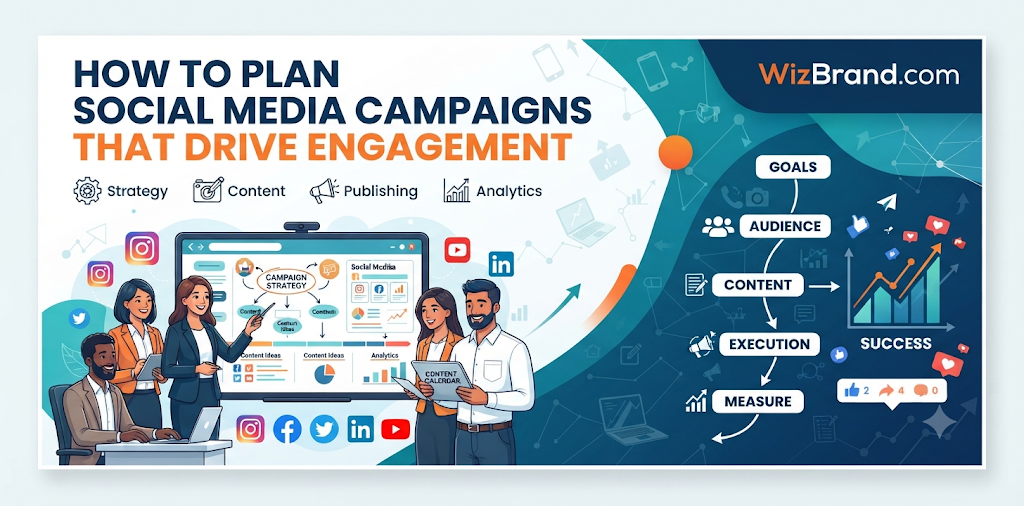
Step-by-Step Guide to Planning Social Media Campaigns That Drive Engagement
Step 1: Define Campaign Goals
- Main Objective: Establish clear targets for what the campaign should achieve.
- Important Activities: Outline key performance indicators (KPIs) such as comment volume, share counts, or click-through rates.
- Practical Recommendations: Focus on one primary goal per campaign to avoid diluting your messaging.
- Common Mistakes to Avoid: Setting vague metrics like “getting viral.”
- Expected Outcomes: A focused campaign framework with measurable benchmarks.
Step 2: Research Your Target Audience
- Main Objective: Identify audience pain points, desires, and online behavior.
- Important Activities: Build detailed buyer personas and review historical analytics.
- Practical Recommendations: Analyze competitor comment sections to see what resonates with shared target groups.
- Common Mistakes to Avoid: Relying on assumptions rather than data.
- Expected Outcomes: Precise audience targeting that improves relevance.
Step 3: Select the Right Social Media Platforms
- Main Objective: Focus marketing efforts where your audience spends their time.
- Important Activities: Evaluate platform demographics and format constraints.
- Practical Recommendations: Master 1 or 2 core platforms before expanding to secondary networks.
- Common Mistakes to Avoid: Trying to be active everywhere without sufficient resources.
- Expected Outcomes: Higher efficiency and stronger channel-specific resonance.
Step 4: Develop a Content Strategy
- Main Objective: Outline core messaging themes, tone of voice, and content pillars.
- Important Activities: Define educational, promotional, and entertaining content ratios.
- Practical Recommendations: Ensure your brand voice remains consistent across all messaging.
- Common Mistakes to Avoid: Publishing exclusively promotional content.
- Expected Outcomes: A balanced content mix that builds sustained audience interest.
Step 5: Create Engaging Visual and Written Content
- Main Objective: Produce high-quality assets that capture attention within seconds.
- Important Activities: Design graphics, shoot videos, and write compelling copy with clear calls to action (CTAs).
- Practical Recommendations: Use clean typography, high-contrast imagery, and conversational copywriting.
- Common Mistakes to Avoid: Overcrowding visuals with excessive text.
- Expected Outcomes: Scroll-stopping assets that encourage user interaction.
Step 6: Prepare a Social Media Content Calendar
- Main Objective: Organize publishing dates, times, captions, and asset links in one place.
- Important Activities: Map out posting schedules weeks in advance using tools like WizBrand.
- Practical Recommendations: Schedule posts during peak audience activity hours.
- Common Mistakes to Avoid: Creating content on an ad-hoc, last-minute basis.
- Expected Outcomes: Seamless workflow coordination and consistent publishing.
Step 7: Schedule and Publish Campaign Content
- Main Objective: Deliver content live across selected channels efficiently.
- Important Activities: Upload assets, verify formatting, and set automated publishing triggers.
- Practical Recommendations: Double-check links, hashtags, and tag handles before publishing.
- Common Mistakes to Avoid: Publishing broken links or misspelled copy.
- Expected Outcomes: Error-free campaign execution.
Step 8: Interact with Your Audience
- Main Objective: Foster two-way conversations and build community rapport.
- Important Activities: Respond to comments, answer direct messages, and participate in discussions.
- Practical Recommendations: Reply within the first hour of posting to boost algorithmic visibility.
- Common Mistakes to Avoid: Ignoring comments or sending robotic, automated replies.
- Expected Outcomes: Stronger customer trust and elevated engagement metrics.
Step 9: Track Engagement Metrics
- Main Objective: Monitor real-time performance against established campaign KPIs.
- Important Activities: Review weekly analytics reports covering likes, shares, comments, and CTR.
- Practical Recommendations: Centralize campaign tracking dashboards for easy team visibility.
- Common Mistakes to Avoid: Checking analytics only after the campaign has concluded.
- Expected Outcomes: Early identification of high-performing content types.
Step 10: Analyze Results and Improve Future Campaigns
- Main Objective: Document learnings to refine upcoming marketing strategies.
- Important Activities: Conduct post-campaign reviews with marketing teams.
- Practical Recommendations: Archive top-performing assets to replicate successful patterns.
- Common Mistakes to Avoid: Failing to document campaign insights for future reference.
- Expected Outcomes: Continuous improvement in marketing ROI and audience engagement.
Types of Social Media Content That Generate Engagement
| Content Type | When to Use | Why It Works |
|---|---|---|
| Educational Posts | To position your brand as an industry authority | Solves specific audience problems; highly shareable and saveable. |
| Behind-the-Scenes | To humanize your brand and build trust | Shows real people, processes, and workspace culture. |
| Short-Form Videos | To capture rapid attention on mobile feeds | High algorithmic reach and engaging visual storytelling. |
| Polls & Interactive Posts | To boost quick participation with minimal effort | Low barrier to entry for users; instant feedback collection. |
| Infographics | To simplify complex data or industry stats | Easily digestible visual summaries that encourage saves. |
| Customer Stories | To build social proof and credibility | Real-world validation of product value and customer satisfaction. |
| User-Generated Content | To build authentic community connection | Showcases real customers enjoying your products or services. |
| Questions & Discussions | To drive comment section activity | Invites personal opinions and sparks active dialogue. |
| Contests & Giveaways | To rapidly expand reach and follower interaction | Incentivizes shares, tags, and comment activity. |
How to Measure Social Media Campaign Engagement
Evaluating success requires looking beyond vanity metrics.
The Engagement Rate Formula
One standard formula used by marketers is:
$$\text{Engagement Rate} = \left( \frac{\text{Total Engagements (Likes + Comments + Shares + Saves)}}{\text{Total Reach}} \right) \times 100$$
Practical Calculation Example
If a brand publishes a post that reaches $10,000$ unique users, and garnys $400$ likes, $50$ comments, $30$ shares, and $20$ saves ($500$ total engagements):
$$\text{Engagement Rate} = \left( \frac{500}{10,000} \right) \times 100 = 5%$$
A 5% engagement rate on social media is generally considered strong, reflecting high resonance with your target audience.
How WizBrand Helps Businesses Manage Social Media Campaigns
Executing a multi-channel Social Media Marketing Campaign requires tight coordination between content creators, copywriters, designers, and managers. When teams rely on scattered spreadsheets, disjointed chat apps, and disconnected publishing tools, communication breaks down and deadlines slip.
WizBrand functions as an integrated digital marketing management platform that helps businesses and marketing teams organize campaigns, coordinate workflows, manage marketing activities, and monitor performance more efficiently.
- Campaign Organization: Centralize all campaign assets, briefs, timelines, and goals in one unified workspace.
- Content Planning & Coordination: Streamline the creation and review of your Social Media Content Calendar across multiple channels.
- Team Collaboration: Eliminate silos by keeping designers, writers, and managers aligned on daily tasks and deliverables.
- Marketing Task Management: Assign responsibilities, track task progress, and ensure deadlines are met without micromanagement.
- Performance Tracking: Monitor campaign outputs and digital marketing activities to understand what drives real engagement.
By bringing planning, execution, and tracking into a single platform, WizBrand helps businesses maintain consistency and improve overall marketing productivity.
Common Social Media Campaign Planning Mistakes to Avoid
- Posting Without a Strategy: Dropping random content without defined goals or audience research.
- Targeting the Wrong Audience: Speaking to everyone results in resonating with no one.
- Choosing Unsuitable Platforms: Promoting B2B enterprise software on platforms meant purely for light entertainment.
- Publishing Repetitive Content: Boring audiences with endless promotional sales pitches.
- Ignoring Audience Comments: Leaving questions unanswered damages brand credibility.
- Focusing Only on Likes: Chasing vanity metrics while ignoring meaningful conversions.
- Inconsistent Posting Schedules: Disappearing for weeks and then flooding feeds all at once.
- Not Tracking Campaign Results: Failing to analyze data leaves you repeating past mistakes.
- Failing to Optimize Content: Ignoring insights from ongoing campaigns.
Social Media Campaign Planning Checklist
- Define primary campaign goals and KPIs
- Conduct thorough target audience research
- Select optimal social media platforms
- Establish content pillars and tone of voice
- Create engaging visual and written assets
- Populate your Social Media Content Calendar
- Schedule posts for peak audience activity hours
- Monitor and respond to audience comments actively
- Track performance metrics weekly
- Review results and document optimization insights
Frequently Asked Questions
What is the main purpose of a social media campaign?
A social media campaign focuses brand messaging around a specific goal, such as launching a product, driving website traffic, or building community engagement over a defined timeframe.
How often should businesses post on social media?
Posting frequency depends on the platform and your team’s capacity. Consistency matters more than volume; publishing 3 to 4 high-quality posts per week is often better than daily erratic posting.
What constitutes a good engagement rate?
While benchmarks vary by industry and follower size, an engagement rate between 1% and 5% is generally considered solid for most business accounts.
How can I create a reliable social media content calendar?
You can use spreadsheet tools or centralized digital marketing management platforms like WizBrand to plan, schedule, and organize your content pipeline weeks in advance.
Why is audience engagement more important than follower count?
A large follower count means little if users ignore your posts. High engagement indicates active interest, trust, and higher conversion potential.
What types of content drive the most comments?
Questions, polls, controversial (yet polite) industry debates, and behind-the-scenes posts naturally encourage users to share their opinions in the comments.
How do I choose the right social media platforms for my brand?
Analyze where your target demographic spends their time online and match your content format (text, video, imagery) to the strengths of each platform.
What is the difference between organic and paid social media campaigns?
Organic campaigns rely on free reach and unpaid engagement, while paid campaigns use advertising budgets to guarantee visibility among targeted audience segments.
How does WizBrand help streamline marketing campaigns?
WizBrand provides a centralized workspace for campaign organization, content planning, team collaboration, task management, and performance tracking.
How do I measure the success of a social media campaign?
Track key performance metrics such as engagement rate, click-through rate, comment volume, saves, and conversions relative to your initial campaign goals.
Conclusion
Planning social media campaigns that drive meaningful engagement requires a blend of strategy, audience understanding, and consistent execution. By moving away from random posting and adopting a structured approach—defining clear goals, choosing the right platforms, crafting valuable content, and actively interacting with your community—you can turn social channels into powerful growth engines.
To keep your marketing teams organized, streamline content workflows, coordinate tasks efficiently, and monitor performance seamlessly, consider integrating a platform like WizBrand into your daily operations. With proper planning and the right digital tools, your business can build lasting connections and achieve sustained success across the digital landscape.
