Introduction
School Management Systems are comprehensive platforms designed to manage the entire operation of an educational institution, including admissions, attendance, academics, communication, finance, and staff management. Unlike Student Information Systems which focus mainly on student data, School Management Systems cover broader administrative and operational workflows across the institution.
With the rapid digital transformation in education, schools are moving away from manual processes and disconnected tools toward unified platforms that improve efficiency, communication, and data accuracy. These systems help administrators automate routine tasks, enable real-time insights, and enhance collaboration between teachers, students, and parents.
Common use cases include:
- Student admissions and enrollment management
- Attendance, grading, and academic tracking
- Fee collection and financial management
- Communication with parents and staff
- Scheduling and timetable management
Key evaluation criteria:
- Core administrative and academic features
- Integration with LMS and education tools
- Automation of workflows
- Reporting and analytics capabilities
- Ease of use for staff and students
- Scalability for growing institutions
- Security and data protection
- Pricing and deployment flexibility
Best for: Schools, colleges, and educational institutions seeking to streamline operations, improve communication, and centralize data.
Not ideal for: Very small institutions or tutors who only need basic record-keeping tools without full administrative workflows.
Key Trends in School Management Systems
- Cloud-based platforms replacing legacy on-premise systems
- Integration with learning and analytics platforms
- AI-driven insights for student performance and engagement
- Mobile-first platforms for parents, teachers, and students
- Automation of administrative and financial workflows
- Real-time dashboards and reporting tools
- Increased focus on data security and compliance
- Personalized communication and notifications
- Modular systems allowing flexible feature adoption
- Integration of finance, HR, and academic operations in one platform
How We Selected These Tools Methodology
- Evaluated global adoption across educational institutions
- Assessed feature completeness for school operations
- Reviewed scalability and performance capabilities
- Considered integration with LMS and ERP systems
- Analyzed usability for administrators and teachers
- Included both enterprise and SMB-friendly tools
- Focused on security and compliance readiness
- Balanced traditional and modern cloud-based platforms
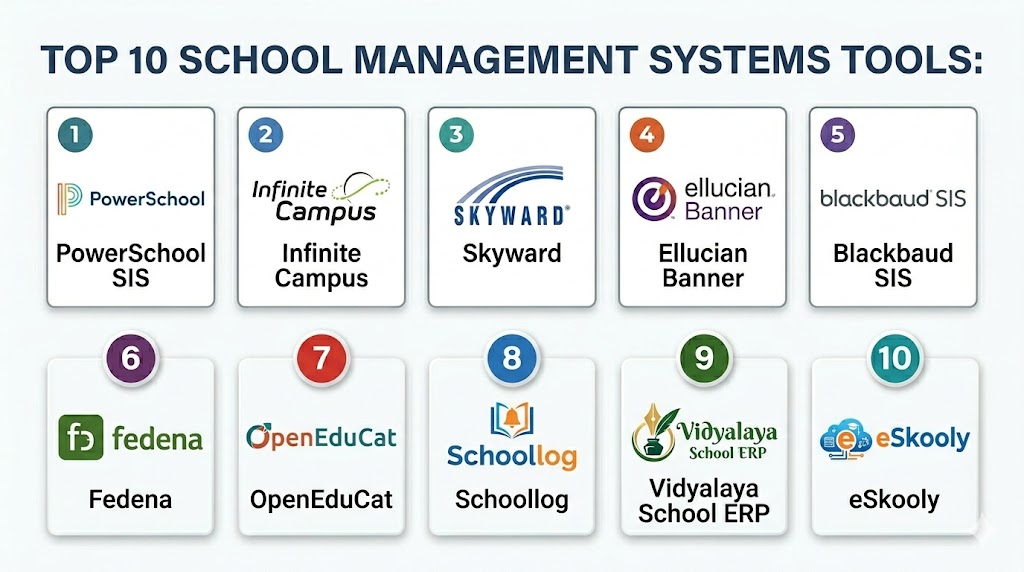
Top 10 School Management Systems Tools
#1 — PowerSchool
Short description:
PowerSchool is a widely adopted school management platform offering comprehensive tools for student data, attendance, grading, and communication. It supports K-12 institutions with scalable solutions. The platform integrates multiple functions into a unified system. It is ideal for large school networks and districts.
Key Features
- Student and academic management
- Attendance and grading
- Parent and student portals
- Reporting and analytics
- Scheduling tools
- Integration capabilities
Pros
- Highly scalable
- Feature-rich platform
- Strong ecosystem
Cons
- Complex implementation
- Requires training
- Pricing varies
Platforms / Deployment
Cloud
Security & Compliance
Not publicly stated
Integrations & Ecosystem
Integrates with education tools and systems for seamless workflows.
- APIs
- LMS integrations
- Education apps
Support & Community
Strong support and large community
#2 — Infinite Campus
Short description:
Infinite Campus is a comprehensive school management system designed for K-12 institutions. It offers tools for managing student data, attendance, and communication. The platform emphasizes usability and efficiency. It is widely used across school districts.
Key Features
- Student information management
- Attendance tracking
- Gradebook
- Communication tools
- Reporting dashboards
Pros
- User-friendly
- Comprehensive features
- Good reporting
Cons
- Limited customization
- Pricing varies
- Requires training
Platforms / Deployment
Cloud
Security & Compliance
Not publicly stated
Integrations & Ecosystem
Supports integration with academic and administrative systems.
- APIs
- LMS integrations
Support & Community
Reliable support
#3 — Skyward
Short description:
Skyward is a school management platform focused on administrative efficiency and communication. It offers tools for attendance, grading, and financial management. The platform is widely used in K-12 education. It supports streamlined operations for schools.
Key Features
- Student data management
- Attendance tracking
- Gradebook
- Financial tools
- Communication features
Pros
- Easy to use
- Reliable
- Good support
Cons
- Limited analytics
- UI can feel outdated
- Customization limits
Platforms / Deployment
Cloud
Security & Compliance
Not publicly stated
Integrations & Ecosystem
Integrates with school systems and applications.
- APIs
- Education integrations
Support & Community
Strong support
#4 — Blackbaud School Management
Short description:
Blackbaud School Management provides a unified platform for private schools. It includes academic, financial, and communication tools. The system focuses on ease of use and integration. It is suitable for private institutions.
Key Features
- Student management
- Communication tools
- Financial management
- Reporting
- Parent portals
Pros
- User-friendly
- Integrated features
- Good interface
Cons
- Limited scalability
- Pricing varies
- Feature limitations
Platforms / Deployment
Cloud
Security & Compliance
Not publicly stated
Integrations & Ecosystem
Integrates with school and fundraising systems.
- APIs
- School integrations
Support & Community
Good support
#5 — Fedena
Short description:
Fedena is a flexible school management system designed for schools and colleges. It offers tools for managing student data, attendance, and communication. The platform is suitable for small and mid-sized institutions. It provides customization options.
Key Features
- Student management
- Attendance tracking
- Communication tools
- Reporting
- Customization
Pros
- Affordable
- Flexible
- Easy to use
Cons
- Limited enterprise features
- Basic analytics
- Smaller ecosystem
Platforms / Deployment
Cloud / Self-hosted
Security & Compliance
Not publicly stated
Integrations & Ecosystem
Supports integration with education tools and systems.
- APIs
- LMS integrations
Support & Community
Good support
#6 — OpenEduCat
Short description:
OpenEduCat is an open-source school management system offering tools for managing academic and administrative processes. It provides flexibility and customization for institutions. The platform is suitable for organizations with technical expertise. It supports modular features.
Key Features
- Student information management
- Attendance tracking
- Academic management
- Reporting tools
- Customization
Pros
- Open-source flexibility
- Cost-effective
- Customizable
Cons
- Requires technical expertise
- Limited support
- Smaller community
Platforms / Deployment
Web / Self-hosted
Security & Compliance
Not publicly stated
Integrations & Ecosystem
Supports integration with open-source systems.
- APIs
- Custom integrations
Support & Community
Community-driven support
#7 — Schoollog
Short description:
Schoollog is a cloud-based school management system designed for small and mid-sized schools. It offers tools for attendance, communication, and academic management. The platform focuses on simplicity and usability. It is suitable for growing institutions.
Key Features
- Student management
- Attendance tracking
- Communication tools
- Reporting
- Fee management
Pros
- Easy to use
- Affordable
- Quick setup
Cons
- Limited advanced features
- Smaller ecosystem
- Basic analytics
Platforms / Deployment
Cloud
Security & Compliance
Not publicly stated
Integrations & Ecosystem
Supports integration with school systems.
- APIs
- Basic integrations
Support & Community
Standard support
#8 — Vidyalaya School ERP
Short description:
Vidyalaya School ERP is a comprehensive platform for managing school operations. It offers tools for academic, administrative, and financial management. The system is widely used in educational institutions. It supports efficient workflows.
Key Features
- Student data management
- Attendance and grading
- Financial management
- Communication tools
- Reporting
Pros
- Comprehensive features
- Reliable
- Scalable
Cons
- Complex setup
- UI limitations
- Pricing varies
Platforms / Deployment
Cloud
Security & Compliance
Not publicly stated
Integrations & Ecosystem
Integrates with education and administrative systems.
- APIs
- ERP integrations
Support & Community
Good support
#9 — eSkooly
Short description:
eSkooly is a cloud-based school management system designed for simplicity and accessibility. It provides essential tools for managing school operations. The platform is suitable for small institutions. It focuses on ease of use.
Key Features
- Student management
- Attendance tracking
- Communication tools
- Reporting
- Fee management
Pros
- Easy to use
- Cost-effective
- Quick deployment
Cons
- Limited features
- Smaller ecosystem
- Basic analytics
Platforms / Deployment
Cloud
Security & Compliance
Not publicly stated
Integrations & Ecosystem
Supports integration with basic school systems.
- APIs
- Basic integrations
Support & Community
Standard support
#10 — Ellucian Banner
Short description:
Ellucian Banner is an enterprise-grade system used by higher education institutions. It supports academic, financial, and administrative workflows. The platform is highly scalable. It is suitable for large universities.
Key Features
- Student lifecycle management
- Academic records
- Financial management
- Reporting tools
- Integration capabilities
Pros
- Enterprise-grade
- Scalable
- Strong functionality
Cons
- Complex implementation
- Expensive
- Requires expertise
Platforms / Deployment
Cloud / Hybrid
Security & Compliance
Not publicly stated
Integrations & Ecosystem
Integrates with enterprise systems and academic platforms.
- APIs
- ERP integrations
Support & Community
Enterprise support
Comparison Table
| Tool Name | Best For | Platform Supported | Deployment | Standout Feature | Public Rating |
|---|---|---|---|---|---|
| PowerSchool | Large schools | Web | Cloud | Comprehensive features | N/A |
| Infinite Campus | School districts | Web | Cloud | Ease of use | N/A |
| Skyward | K-12 schools | Web | Cloud | Reliability | N/A |
| Blackbaud | Private schools | Web | Cloud | User experience | N/A |
| Fedena | SMB schools | Web | Cloud | Flexibility | N/A |
| OpenEduCat | Custom setups | Web | Self-hosted | Open-source | N/A |
| Schoollog | Small schools | Web | Cloud | Simplicity | N/A |
| Vidyalaya | Institutions | Web | Cloud | All-in-one ERP | N/A |
| eSkooly | Small schools | Web | Cloud | Cost-effective | N/A |
| Ellucian Banner | Universities | Web | Hybrid | Enterprise features | N/A |
Evaluation and Scoring of School Management Systems
| Tool Name | Core | Ease | Integrations | Security | Performance | Support | Value | Weighted Total |
|---|---|---|---|---|---|---|---|---|
| PowerSchool | 9 | 7 | 8 | 8 | 9 | 8 | 7 | 8.3 |
| Infinite Campus | 8 | 8 | 7 | 8 | 8 | 7 | 7 | 7.8 |
| Skyward | 8 | 8 | 7 | 7 | 8 | 7 | 7 | 7.7 |
| Blackbaud | 8 | 8 | 7 | 7 | 8 | 7 | 7 | 7.8 |
| Fedena | 7 | 9 | 6 | 7 | 7 | 7 | 9 | 7.8 |
| OpenEduCat | 7 | 7 | 6 | 7 | 7 | 6 | 9 | 7.3 |
| Schoollog | 7 | 9 | 6 | 7 | 7 | 7 | 8 | 7.6 |
| Vidyalaya | 8 | 7 | 7 | 7 | 8 | 7 | 7 | 7.7 |
| eSkooly | 7 | 9 | 6 | 7 | 7 | 6 | 9 | 7.6 |
| Ellucian Banner | 9 | 6 | 9 | 9 | 9 | 8 | 6 | 8.3 |
How to interpret these scores:
These scores provide a comparative overview of how each platform performs across key categories such as functionality, usability, integrations, and value. Higher scores indicate stronger overall capabilities, but they should not be treated as absolute rankings. Enterprise platforms typically score higher in scalability, integrations, and performance, while smaller platforms excel in ease of use and affordability. The weighted scoring balances multiple criteria to give a realistic comparison across different use cases. Decision-makers should prioritize the factors most relevant to their institution, such as cost, scalability, or ease of deployment. Testing shortlisted tools in real scenarios is recommended before final selection.
Which School Management System Is Right for You
Solo Freelancer
Not required unless managing structured educational operations.
SMB
Fedena, eSkooly, or Schoollog are suitable for small schools due to affordability and simplicity.
Mid Market
Infinite Campus or Vidyalaya offer balanced features and scalability.
Enterprise
PowerSchool and Ellucian provide advanced capabilities for large institutions.
Budget vs Premium
Budget tools focus on ease of use, while premium platforms offer deeper functionality and integrations.
Feature Depth vs Ease of Use
Advanced platforms provide more control but require training, while simpler tools prioritize usability.
Integrations and Scalability
Cloud-based and API-driven platforms are better for scaling operations.
Security and Compliance Needs
Institutions should prioritize platforms with strong data protection and compliance capabilities.
Frequently Asked Questions
1 What is a school management system
A school management system is software used to manage administrative and academic operations in schools. It centralizes data and automates workflows. It improves efficiency and communication. It supports the entire school ecosystem.
2 How is it different from SIS
A school management system covers broader operations including finance, HR, and communication, while SIS focuses mainly on student data. Both systems often work together. SMS provides a more comprehensive solution.
3 Can it improve school efficiency
Yes, it automates administrative tasks and reduces manual work. It improves data accuracy. It enhances communication. It supports better decision-making.
4 Can parents access these systems
Most systems provide portals for parents to track student progress and communicate with teachers. This improves transparency. It enhances engagement. It strengthens communication.
5 Are these systems secure
Most platforms include data protection measures, but security depends on the provider. Schools should choose trusted vendors. Data privacy is critical. Compliance is important.
6 How much does it cost
Pricing varies based on features and institution size. Enterprise solutions are more expensive. Smaller tools are more affordable. Cost should match needs.
7 Can it integrate with LMS
Yes, most systems integrate with learning platforms. This ensures seamless workflows. Integration improves efficiency. API support is important.
8 Is cloud better than on-premise
Cloud solutions offer flexibility and scalability. They reduce infrastructure costs. On-premise systems offer more control. Choice depends on needs.
9 Can small schools use these systems
Yes, many tools are designed for small schools. They offer basic features and easy setup. Cost-effective options are available. Simplicity is key.
10 How do I choose the right system
Evaluate features, scalability, integrations, and cost. Consider your institution size. Test different tools before deciding. Choose one that fits your workflow.
Conclusion
School Management Systems have become essential for modern educational institutions by providing a unified platform to manage administrative, academic, and financial operations efficiently. These systems help reduce manual work, improve communication, and provide real-time insights that support better decision-making across the entire school ecosystem. While enterprise-grade solutions offer scalability, advanced integrations, and deep analytics for large institutions, smaller platforms provide simplicity, affordability, and faster implementation for growing schools. The right choice depends on factors such as institution size, budget, and operational complexity. Schools should shortlist a few platforms, evaluate them through pilot implementations, and ensure they integrate well with existing tools before making a final decision. A structured selection process ensures long-term efficiency and improved educational outcomes.
