Introduction
Credential Issuance Platforms are software solutions that enable organizations to create, issue, manage, and verify digital credentials such as certificates, badges, and professional qualifications. These platforms replace traditional paper-based credentials with secure, verifiable digital formats that can be easily shared and validated.
As digital learning, remote hiring, and skills-based economies continue to grow, credential issuance platforms are becoming essential for education providers, enterprises, certification bodies, and training organizations. They help reduce fraud, improve credential transparency, and enhance the value of certifications through verifiable metadata and digital sharing capabilities.
Common use cases include:
- Issuing digital certificates for training and courses
- Employee skill validation and internal credentialing
- Professional certification programs
- Academic credential management
- Workforce skill verification
Key evaluation criteria:
- Credential creation and customization capabilities
- Verification and anti-fraud features
- Automation and bulk issuance
- Integration with LMS and HR systems
- Analytics and reporting
- User experience and sharing options
- Standards support for digital credentials
- Pricing and scalability
Best for: Educational institutions, corporate training teams, certification providers, and HR departments managing large-scale credentialing programs.
Not ideal for: Small teams with no formal certification needs or organizations that rely only on informal recognition methods.
Key Trends in Credential Issuance Platforms
- Shift from paper certificates to fully digital credentials
- Growth of verifiable credentials and metadata-based validation
- Integration with professional networks for credential sharing
- Automation of credential lifecycle management
- Adoption of decentralized and blockchain-based credential systems
- Increased demand for skills-based credentialing
- Integration with learning and talent platforms
- Real-time credential issuance and tracking
- Focus on branding and white-label credential experiences
- Expansion into enterprise workforce development
How We Selected These Tools Methodology
- Evaluated market leaders and widely adopted platforms
- Assessed credential issuance and verification capabilities
- Reviewed automation and scalability features
- Considered integration with LMS and HR systems
- Analyzed ease of use and customization
- Included both enterprise and SMB-friendly tools
- Focused on global adoption and ecosystem strength
- Balanced centralized and decentralized solutions
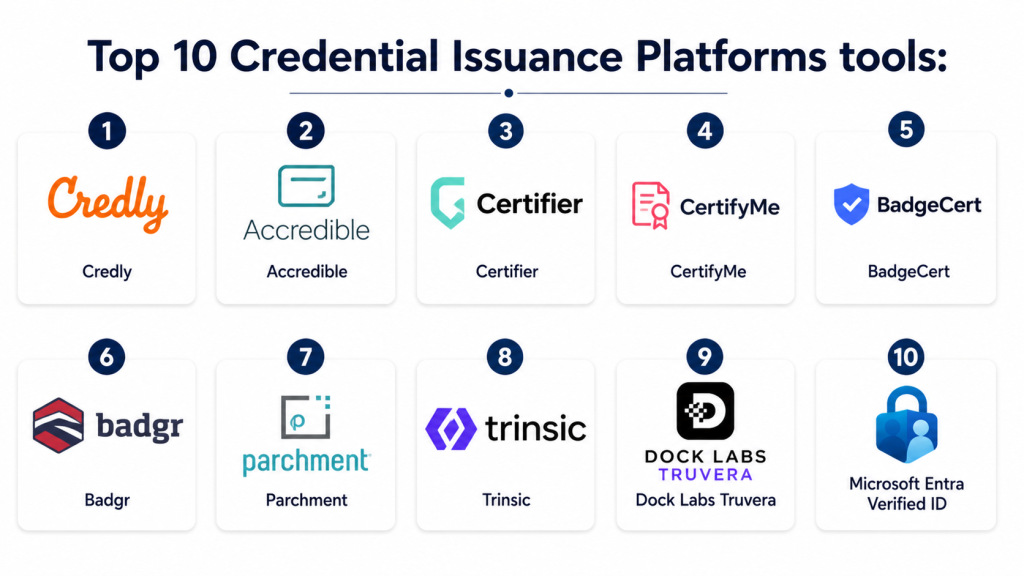
Top 10 Credential Issuance Platforms Tools
#1 — Credly
Short description:
Credly is a widely used digital credential platform that enables organizations to issue, manage, and track digital badges and certifications at scale. It provides a strong network effect by allowing credentials to be shared across professional platforms. The platform is trusted by large enterprises and certification providers. It also supports workforce development and skills tracking.
Key Features
- Digital badge issuance
- Credential management
- Skill tracking and analytics
- Social sharing capabilities
- Workforce insights
- Automated issuance
- Credential verification
Pros
- Strong global network
- Enterprise-grade scalability
- Excellent visibility for credentials
Cons
- Expensive for small teams
- Limited customization compared to some tools
- Learning curve for new users
Platforms / Deployment
Cloud
Security & Compliance
Enterprise-grade security and data protection
Integrations & Ecosystem
Integrates with learning platforms, HR systems, and certification tools.
- APIs
- LMS integrations
- HR system connections
Support & Community
Strong enterprise support and ecosystem
#2 — Accredible
Short description:
Accredible is a leading credential platform designed to issue and manage digital certificates and badges at scale. It focuses on automation, branding, and learner engagement. The platform is widely used by educational institutions and training providers. It enables organizations to track and verify credentials efficiently.
Key Features
- Digital certificate issuance
- Badge creation
- Credential verification
- Automation workflows
- Analytics and reporting
- Branding customization
Pros
- Highly customizable
- Easy to use
- Strong automation
Cons
- Pricing can be high
- Advanced features require setup
- Limited free options
Platforms / Deployment
Cloud
Security & Compliance
Not publicly stated
Integrations & Ecosystem
Integrates with LMS, CRM, and training platforms.
- APIs
- LMS integrations
- CRM tools
Support & Community
Good documentation and support
#3 — Certifier
Short description:
Certifier is a modern credential issuance platform designed for creating and managing digital certificates and badges efficiently. It focuses on automation and branding flexibility. The platform is suitable for small to mid-sized organizations. It simplifies the credentialing process with intuitive tools.
Key Features
- Certificate creation
- Automated issuance
- Credential tracking
- Branding customization
- Analytics dashboard
- Sharing options
Pros
- Easy to use
- Affordable
- Strong automation
Cons
- Limited enterprise features
- Smaller ecosystem
- Fewer integrations
Platforms / Deployment
Cloud
Security & Compliance
Not publicly stated
Integrations & Ecosystem
Supports integration with training and onboarding systems.
- APIs
- Basic integrations
Support & Community
Responsive support
#4 — CertifyMe
Short description:
CertifyMe is a credentialing platform designed for issuing digital certificates and badges with automation and verification features. It focuses on simplicity and efficiency. The platform is suitable for training providers and educators. It supports large-scale credential distribution.
Key Features
- Digital certificate issuance
- Automation tools
- Verification features
- Branding customization
- Analytics
Pros
- Simple interface
- Fast deployment
- Scalable
Cons
- Limited advanced features
- Smaller ecosystem
- Pricing varies
Platforms / Deployment
Cloud
Security & Compliance
Not publicly stated
Integrations & Ecosystem
Supports integration with learning platforms.
- APIs
- LMS integrations
Support & Community
Standard support
#5 — BadgeCert
Short description:
BadgeCert is a digital credential platform focused on secure certificate issuance and verification. It provides tools for managing and sharing credentials. The platform is designed for education and enterprise use. It emphasizes credential authenticity.
Key Features
- Digital credential issuance
- Verification tools
- Secure sharing
- Analytics
- Branding options
Pros
- Strong security focus
- Easy credential sharing
- Good reporting
Cons
- Limited customization
- Smaller adoption
- UI limitations
Platforms / Deployment
Cloud
Security & Compliance
Not publicly stated
Integrations & Ecosystem
Supports integration with enterprise systems.
- APIs
- Integration tools
Support & Community
Standard support
#6 — Badgr
Short description:
Badgr is a digital badging platform that supports credential issuance and verification. It is built around open standards for digital credentials. The platform is widely used in education. It focuses on interoperability and flexibility.
Key Features
- Digital badge issuance
- Open standards support
- Credential verification
- Analytics
- Integration capabilities
Pros
- Open standard support
- Flexible
- Good for education
Cons
- Limited enterprise features
- UI can be basic
- Smaller ecosystem
Platforms / Deployment
Cloud
Security & Compliance
Not publicly stated
Integrations & Ecosystem
Supports integration with LMS and education systems.
- APIs
- LMS integrations
Support & Community
Active community
#7 — Parchment
Short description:
Parchment is a platform focused on academic credential issuance and transcript management. It is widely used by educational institutions. The platform supports secure and verifiable credential sharing. It is suitable for universities and schools.
Key Features
- Academic credential issuance
- Transcript management
- Verification tools
- Secure sharing
- Compliance features
Pros
- Strong academic focus
- Trusted platform
- Reliable
Cons
- Limited enterprise use cases
- Less flexible
- Pricing varies
Platforms / Deployment
Cloud
Security & Compliance
Not publicly stated
Integrations & Ecosystem
Integrates with education systems and registries.
- APIs
- Education integrations
Support & Community
Institutional support
#8 — Trinsic
Short description:
Trinsic provides credential issuance and management using decentralized identity technologies. It enables organizations to issue verifiable credentials securely. The platform is developer-friendly. It is suitable for building identity ecosystems.
Key Features
- Verifiable credential issuance
- Identity integration
- Secure storage
- API support
- Interoperability
Pros
- Developer-friendly
- Flexible
- Supports decentralized identity
Cons
- Requires technical knowledge
- Limited UI tools
- Smaller ecosystem
Platforms / Deployment
Cloud
Security & Compliance
Not publicly stated
Integrations & Ecosystem
Integrates with identity and developer platforms.
- APIs
- SDKs
Support & Community
Developer-focused support
#9 — Dock Labs Truvera
Short description:
Dock Labs Truvera offers decentralized credential issuance and verification solutions. It focuses on blockchain-based identity systems. The platform supports secure and verifiable credentials. It is suitable for advanced identity use cases.
Key Features
- Credential issuance
- Blockchain integration
- Verification tools
- Secure sharing
- Interoperability
Pros
- Strong security
- Decentralized approach
- Flexible
Cons
- Technical complexity
- Limited adoption
- Requires expertise
Platforms / Deployment
Cloud
Security & Compliance
Not publicly stated
Integrations & Ecosystem
Supports integration with blockchain and identity systems.
- APIs
- Developer tools
Support & Community
Growing ecosystem
#10 — Microsoft Entra Verified ID
Short description:
Microsoft Entra Verified ID is an enterprise solution for issuing and verifying digital credentials. It supports verifiable credentials and integrates with enterprise systems. The platform is designed for scalability and compliance. It is suitable for large organizations.
Key Features
- Credential issuance
- Identity verification
- Enterprise integration
- Secure sharing
- Compliance tools
Pros
- Enterprise-ready
- Strong integrations
- Scalable
Cons
- Complex setup
- Requires expertise
- Not SMB-focused
Platforms / Deployment
Cloud
Security & Compliance
Encryption and access controls
Integrations & Ecosystem
Integrates with enterprise identity and cloud systems.
- APIs
- Identity integrations
Support & Community
Enterprise support
Comparison Table
| Tool Name | Best For | Platform Supported | Deployment | Standout Feature | Public Rating |
|---|---|---|---|---|---|
| Credly | Enterprise credentialing | Web | Cloud | Global credential network | N/A |
| Accredible | Training providers | Web | Cloud | Custom branding | N/A |
| Certifier | SMB credentialing | Web | Cloud | Automation | N/A |
| CertifyMe | Certificate issuance | Web | Cloud | Simplicity | N/A |
| BadgeCert | Secure credentials | Web | Cloud | Verification tools | N/A |
| Badgr | Education sector | Web | Cloud | Open standards | N/A |
| Parchment | Academic institutions | Web | Cloud | Transcript management | N/A |
| Trinsic | Developers | Web | Cloud | Decentralized identity | N/A |
| Dock Labs | Blockchain identity | Web | Cloud | Decentralized credentials | N/A |
| Microsoft Entra | Enterprise identity | Web | Cloud | Verifiable credentials | N/A |
Evaluation and Scoring of Credential Issuance Platforms
| Tool Name | Core | Ease | Integrations | Security | Performance | Support | Value | Weighted Total |
|---|---|---|---|---|---|---|---|---|
| Credly | 9 | 7 | 9 | 9 | 9 | 8 | 7 | 8.4 |
| Accredible | 9 | 8 | 8 | 8 | 8 | 8 | 7 | 8.1 |
| Certifier | 8 | 9 | 7 | 7 | 8 | 7 | 9 | 8.0 |
| CertifyMe | 7 | 9 | 7 | 7 | 7 | 7 | 8 | 7.6 |
| BadgeCert | 7 | 8 | 7 | 7 | 7 | 7 | 7 | 7.3 |
| Badgr | 8 | 7 | 8 | 7 | 7 | 7 | 7 | 7.5 |
| Parchment | 8 | 7 | 7 | 8 | 8 | 7 | 7 | 7.6 |
| Trinsic | 8 | 7 | 9 | 8 | 8 | 7 | 7 | 7.9 |
| Dock Labs | 8 | 6 | 8 | 8 | 7 | 6 | 7 | 7.5 |
| Microsoft Entra | 9 | 6 | 9 | 9 | 8 | 8 | 7 | 8.2 |
How to interpret these scores:
These scores compare platforms across critical factors such as features, usability, integrations, and value. Higher scores indicate stronger overall capabilities, but they do not automatically mean the tool is the best fit for every use case. Enterprise platforms typically rank higher in security and integrations, while SMB-focused tools perform better in ease of use and cost efficiency. The weighted total provides a balanced perspective across all categories, helping decision-makers evaluate trade-offs more effectively. It is important to prioritize the criteria most relevant to your organization, such as scalability, automation, or compliance, rather than relying only on the total score. Use these scores as guidance and validate through real-world testing.
Which Credential Issuance Platform Is Right for You
Solo Freelancer
Use simple tools like Certifier or CertifyMe for quick certificate issuance with minimal setup.
SMB
Choose Accredible or Certifier for automation, branding, and ease of use.
Mid Market
Badgr or Trinsic provide flexibility and integration options for growing teams.
Enterprise
Credly and Microsoft Entra offer scalability, analytics, and enterprise-grade integrations.
Budget vs Premium
Budget tools focus on simplicity, while premium tools provide advanced analytics and ecosystem reach.
Feature Depth vs Ease of Use
Advanced platforms offer more customization but require training, while simpler tools prioritize usability.
Integrations and Scalability
API-first platforms are better for scaling and integrating with enterprise systems.
Security and Compliance Needs
Organizations in regulated industries should prioritize platforms with strong verification and security features.
Frequently Asked Questions
1 What is a credential issuance platform
A credential issuance platform allows organizations to create, issue, and manage digital credentials such as certificates and badges. These credentials are verifiable and can be shared easily. They replace traditional paper certificates. They improve trust and efficiency in credentialing systems.
2 How do digital credentials work
Digital credentials use metadata and verification mechanisms to confirm authenticity. They contain details about the issuer, recipient, and achievement. Verification can be done instantly online. This reduces fraud and increases transparency.
3 Are digital credentials secure
Most platforms use encryption and verification methods to ensure credential authenticity. Security depends on the platform implementation. Choosing a reliable provider is important. Advanced platforms include anti-fraud features.
4 Can these platforms integrate with LMS
Yes, most credential platforms integrate with learning systems to automate issuance. This helps streamline workflows. Integration is a key factor for scalability. API support is important.
5 How much do these platforms cost
Pricing varies based on features and usage volume. Some platforms offer subscription models while others charge per credential. Enterprise tools are more expensive. SMB tools are more affordable.
6 What industries use credential platforms
Education, corporate training, certification bodies, and HR teams use these platforms. They are also used in professional development. Any organization issuing certifications can benefit. Adoption is growing rapidly.
7 What is a digital badge
A digital badge represents a skill or achievement and includes verifiable information. It can be shared online and verified instantly. It helps showcase skills. It is widely used in modern credentialing.
8 Can credentials be revoked
Yes, most platforms allow revocation or expiration of credentials. This ensures accuracy and trust. It helps maintain compliance. Revocation is important for dynamic certifications.
9 Are blockchain credentials better
Blockchain-based credentials offer enhanced security and decentralization. However, they may be more complex to implement. Traditional platforms are still widely used. Choice depends on use case.
10 How do I choose the right platform
Consider factors like ease of use, integrations, scalability, and security. Evaluate your specific needs. Test multiple platforms before deciding. Choose one that aligns with your workflow.
Conclusion
Credential issuance platforms are transforming how organizations recognize and verify skills, achievements, and qualifications in a digital-first world by replacing manual processes with automated, secure, and scalable solutions. These tools improve trust, reduce fraud, and enhance the visibility of credentials through verifiable digital formats that can be shared across professional ecosystems. While enterprise platforms provide advanced analytics, integrations, and global reach, smaller tools offer simplicity, affordability, and faster implementation for growing teams. The right platform depends on your specific goals, whether it is workforce development, certification programs, or academic credentialing. Organizations should shortlist a few platforms, evaluate their features in real scenarios, and ensure they align with integration and security requirements before making a final decision. A structured evaluation approach will help maximize long-term value and operational efficiency.

It provides a clear overview of the leading credential issuance platforms and makes it much easier to understand which solution fits different certification needs.