Introduction
Port Community Systems are digital platforms that connect all stakeholders within a port ecosystem, including port authorities, customs, shipping lines, terminal operators, freight forwarders, and logistics providers. These systems enable secure, real-time data exchange and coordination across the maritime supply chain, replacing fragmented communication methods like emails and paper-based processes.
In modern global trade, ports must handle high cargo volumes while maintaining efficiency, transparency, and compliance. Port Community Systems play a critical role by automating workflows, reducing delays, and improving coordination among multiple entities. They act as the digital backbone of smart ports, enabling faster cargo clearance and optimized operations.
Common use cases include:
- Managing vessel calls and cargo documentation
- Automating customs clearance and compliance
- Coordinating stakeholders across port operations
- Tracking cargo and shipments in real time
- Enabling digital payments and invoicing
What buyers should evaluate:
- Real-time data exchange capabilities
- Integration with customs and logistics systems
- Automation of workflows and documentation
- Scalability for port size and traffic
- Security and data protection
- Reporting and analytics features
- Ease of integration with existing systems
- Stakeholder collaboration features
Best for: Port authorities, terminal operators, logistics providers, shipping companies, and governments managing port ecosystems.
Not ideal for: Small logistics setups without multi-stakeholder coordination needs.
Key Trends in Port Community Systems
- Real-time data sharing across stakeholders
- AI-driven cargo flow optimization
- Integration with customs and regulatory systems
- Paperless documentation and digital workflows
- Cloud-based deployment for scalability
- Smart port initiatives with IoT integration
- Blockchain-based trade documentation
- Automated payment and invoicing systems
- Enhanced cybersecurity for data exchange
How We Selected These Tools
- Global adoption in port ecosystems
- Completeness of logistics and documentation features
- Performance in real-time operations
- Security and compliance capabilities
- Integration with customs and logistics systems
- Scalability across ports of different sizes
- Ease of use for multiple stakeholders
- Vendor reliability and ecosystem maturity
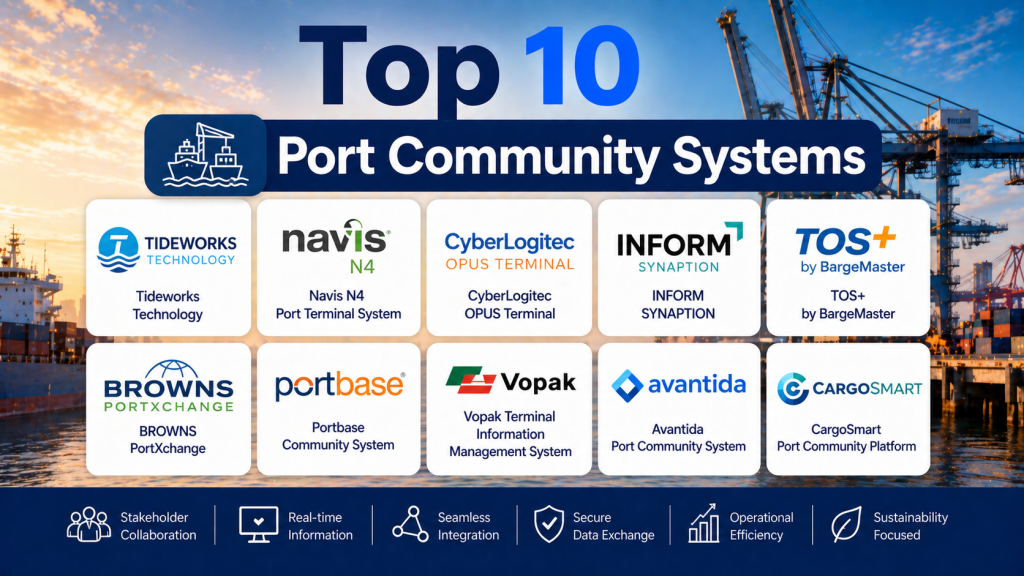
Top 10 Port Community Systems Tools
1 — Tideworks Technology
Short description: Tideworks Technology provides terminal and port management solutions designed to improve cargo handling and logistics coordination. It focuses on operational efficiency and integration. The platform supports real-time data exchange and automation. It is suitable for large ports. It enhances supply chain visibility.
Key Features
- Terminal operations management
- Real-time data exchange
- Workflow automation
- Reporting and analytics
- Integration capabilities
Pros
- Strong operational control
- Scalable solution
Cons
- Complex setup
- Enterprise pricing
Platforms / Deployment
Web — Cloud
Security & Compliance
Not publicly stated
Integrations & Ecosystem
Integrates with terminal and logistics systems
Support & Community
Enterprise support
2 — Navis N4 Port Terminal System
Short description: Navis N4 is a widely used port terminal operating system that integrates with Port Community Systems. It provides tools for cargo management and logistics coordination. It is suitable for large container terminals. It supports automation and analytics. It improves efficiency.
Key Features
- Terminal operations
- Cargo tracking
- Real-time analytics
- Automation
- Integration
Pros
- Industry standard
- Strong ecosystem
Cons
- Complex implementation
- High cost
Platforms / Deployment
Web — Cloud
Security & Compliance
Enterprise-grade controls
Integrations & Ecosystem
Integration with global logistics systems
Support & Community
Strong global support
3 — CyberLogitec OPUS Terminal
Short description: OPUS Terminal is a logistics and port management solution designed to streamline container terminal operations. It provides automation and integration features. The platform supports real-time data exchange. It is suitable for mid to large ports. It enhances efficiency.
Key Features
- Terminal management
- Cargo tracking
- Workflow automation
- Reporting
- Integration
Pros
- Efficient operations
- Reliable performance
Cons
- Learning curve
- Limited flexibility
Platforms / Deployment
Web — Cloud
Security & Compliance
Not publicly stated
Integrations & Ecosystem
Supports logistics integrations
Support & Community
Standard support
4 — INFORM SYNAPTION
Short description: INFORM SYNAPTION is a port operations platform focused on optimization and analytics. It helps manage resources and logistics processes. The system uses data-driven insights. It is suitable for modern ports. It improves decision-making.
Key Features
- Resource optimization
- Analytics
- Workflow automation
- Reporting
- Integration
Pros
- Strong analytics
- Optimization capabilities
Cons
- Complex system
- Requires training
Platforms / Deployment
Web — Cloud
Security & Compliance
Not publicly stated
Integrations & Ecosystem
Supports enterprise integrations
Support & Community
Enterprise support
5 — BROWNS PortXchange
Short description: PortXchange is a digital platform focused on port call optimization and data sharing. It improves coordination among stakeholders. The system provides real-time insights. It is suitable for smart ports. It enhances efficiency and sustainability.
Key Features
- Port call optimization
- Real-time data sharing
- Analytics
- Collaboration tools
- Reporting
Pros
- Easy collaboration
- Strong analytics
Cons
- Limited operational modules
- Smaller ecosystem
Platforms / Deployment
Web — Cloud
Security & Compliance
Not publicly stated
Integrations & Ecosystem
Integrates with port systems
Support & Community
Standard support
6 — Portbase Community System
Short description: Portbase is a leading Port Community System used in major European ports. It provides a centralized platform for data exchange and logistics coordination. It supports customs integration and document management. It is suitable for large ports. It enhances transparency.
Key Features
- Data exchange platform
- Document management
- Customs integration
- Real-time updates
- Reporting
Pros
- Strong adoption
- Reliable system
Cons
- Limited customization
- Regional focus
Platforms / Deployment
Web — Cloud
Security & Compliance
Secure data exchange
Integrations & Ecosystem
Extensive logistics integrations
Support & Community
Strong support
7 — Vopak Terminal Information Management System
Short description: Vopak Terminal Information Management System focuses on terminal operations and logistics coordination. It provides tools for managing cargo and workflows. The system supports integration with port systems. It is suitable for terminal operators. It improves efficiency.
Key Features
- Terminal management
- Workflow automation
- Reporting
- Integration
- Analytics
Pros
- Strong operational focus
- Reliable
Cons
- Limited ecosystem
- Specialized use case
Platforms / Deployment
Web — Cloud
Security & Compliance
Not publicly stated
Integrations & Ecosystem
Supports integrations
Support & Community
Standard support
8 — Avantida Port Community System
Short description: Avantida provides a digital platform for container logistics and port community coordination. It focuses on improving efficiency and reducing empty container movements. The system supports automation and real-time tracking. It is suitable for logistics networks.
Key Features
- Container logistics
- Real-time tracking
- Automation
- Reporting
- Integration
Pros
- Focus on efficiency
- Easy to use
Cons
- Limited features
- Smaller ecosystem
Platforms / Deployment
Web — Cloud
Security & Compliance
Not publicly stated
Integrations & Ecosystem
Basic integrations
Support & Community
Standard support
9 — CargoSmart Port Community Platform
Short description: CargoSmart offers a digital platform for port and logistics coordination. It enables real-time data sharing and visibility. The system integrates with shipping lines and terminals. It is suitable for global logistics networks. It enhances efficiency.
Key Features
- Real-time visibility
- Data sharing
- Analytics
- Workflow automation
- Integration
Pros
- Strong visibility
- Global reach
Cons
- Premium pricing
- Complex setup
Platforms / Deployment
Web — Cloud
Security & Compliance
Not publicly stated
Integrations & Ecosystem
Extensive integrations
Support & Community
Enterprise support
10 — Webb Ports
Short description: Webb Ports is a modern Port Community System designed to streamline communication and operations across stakeholders. It reduces paperwork and improves cargo movement efficiency. The platform integrates with customs and logistics systems. It supports digital payments and analytics. It is suitable for smart ports.
Key Features
- Stakeholder communication
- Digital payments
- Cargo tracking
- Workflow automation
- Analytics
Pros
- Improves efficiency
- Reduces paperwork
Cons
- Implementation complexity
- Requires integration
Platforms / Deployment
Web — Cloud
Security & Compliance
Secure data exchange
Integrations & Ecosystem
Integration with customs and logistics systems
Support & Community
Enterprise support
Comparison Table
| Tool | Best For | Platforms | Deployment | Standout Feature | Public Rating |
|---|---|---|---|---|---|
| Tideworks | Large ports | Web | Cloud | Terminal control | N/A |
| Navis N4 | Container terminals | Web | Cloud | Industry standard | N/A |
| OPUS | Mid-large ports | Web | Cloud | Automation | N/A |
| INFORM | Smart ports | Web | Cloud | Optimization | N/A |
| PortXchange | Smart ports | Web | Cloud | Collaboration | N/A |
| Portbase | European ports | Web | Cloud | Data exchange | N/A |
| Vopak | Terminals | Web | Cloud | Operations | N/A |
| Avantida | Logistics networks | Web | Cloud | Container tracking | N/A |
| CargoSmart | Global logistics | Web | Cloud | Visibility | N/A |
| Webb Ports | Smart ports | Web | Cloud | Communication | N/A |
Evaluation & Scoring
| Tool | Core | Ease | Integrations | Security | Performance | Support | Value | Total |
|---|---|---|---|---|---|---|---|---|
| Tideworks | 9 | 7 | 9 | 8 | 9 | 9 | 7 | 8.4 |
| Navis N4 | 9 | 6 | 9 | 8 | 9 | 9 | 6 | 8.1 |
| OPUS | 8 | 7 | 8 | 7 | 8 | 8 | 7 | 7.7 |
| INFORM | 8 | 7 | 8 | 7 | 8 | 8 | 7 | 7.7 |
| PortXchange | 7 | 8 | 7 | 7 | 7 | 7 | 8 | 7.4 |
| Portbase | 9 | 8 | 9 | 8 | 9 | 9 | 7 | 8.5 |
| Vopak | 7 | 7 | 7 | 7 | 7 | 7 | 7 | 7.0 |
| Avantida | 7 | 8 | 6 | 6 | 7 | 7 | 8 | 7.1 |
| CargoSmart | 8 | 7 | 9 | 7 | 8 | 8 | 7 | 7.8 |
| Webb Ports | 8 | 7 | 8 | 7 | 8 | 8 | 7 | 7.7 |
These scores are comparative and based on overall functionality, integration strength, and operational efficiency. Higher scores indicate strong enterprise capabilities and scalability. Mid-range scores reflect balanced usability and performance. Smaller tools often excel in simplicity but may lack advanced features. Always align scoring with your port size and operational needs.
Which Port Community System Is Right for You
Small Ports
Avantida and PortXchange provide simple and cost-effective solutions.
Regional Ports
INFORM and OPUS offer balanced features and scalability.
Large Ports
Portbase, Navis N4, and Tideworks deliver comprehensive enterprise solutions.
Smart Ports
Webb Ports and CargoSmart are ideal for digital transformation and automation.
Budget vs Premium
Budget tools focus on simplicity, while premium tools provide advanced analytics and integrations.
Feature Depth vs Ease of Use
Complex systems offer deeper control but require training.
Integrations & Scalability
Choose systems with strong integration capabilities for long-term growth.
Security & Compliance Needs
Large ports should prioritize secure data exchange and compliance features.
Frequently Asked Questions
1. What is a Port Community System
A Port Community System is a digital platform that connects all port stakeholders. It enables real-time data exchange. It improves coordination and efficiency. It replaces manual processes with automation.
2. Why is it important
Ports handle complex logistics operations. PCS helps reduce delays and improve efficiency. It ensures smooth communication. It enhances transparency. It supports global trade operations.
3. What are the main features
Key features include data exchange, workflow automation, and integration. It supports cargo tracking and documentation. It enables real-time updates. It improves decision-making.
4. Can small ports use PCS
Yes, there are solutions designed for smaller ports. They offer simplified features. They are easier to deploy. Businesses should choose based on needs.
5. Are PCS platforms cloud-based
Most modern PCS platforms are cloud-based. This improves scalability and accessibility. It enables real-time data sharing.
6. How do PCS improve efficiency
They automate workflows and reduce paperwork. They improve communication. They speed up cargo processing. They reduce operational costs.
7. Do PCS integrate with customs
Yes, integration with customs systems is a key feature. It enables faster clearance. It improves compliance.
8. What are common mistakes when choosing PCS
Choosing based only on cost is a mistake. Ignoring integration needs can cause issues. Not testing the system can lead to problems.
9. Are PCS secure
Yes, they include security features for data exchange. However, security levels vary by platform. Businesses should verify compliance.
10. Can PCS scale with port growth
Yes, modern PCS platforms are scalable. They support increasing cargo volumes. They adapt to operational needs.
Conclusion
Port Community Systems have become essential for modern port operations by enabling seamless communication, automation, and real-time data exchange across multiple stakeholders. These platforms eliminate inefficiencies caused by manual processes and fragmented systems, helping ports improve cargo handling speed, compliance, and overall operational performance. As global trade continues to grow, adopting a robust PCS is critical for maintaining competitiveness and ensuring smooth logistics operations.Different systems cater to different needs, from simple solutions for smaller ports to enterprise-grade platforms for large international hubs. The right choice depends on port size, integration requirements, and operational complexity. Organizations should focus on scalability, security, and interoperability when evaluating solutions.A practical approach is to shortlist a few platforms, test their capabilities, and validate how well they integrate with existing systems. Running a pilot implementation can help identify gaps and ensure the platform meets real-world requirements. Choosing the right Port Community System can significantly enhance efficiency, reduce delays, and improve overall port ecosystem performance

One thing that often gets overlooked with Port Community Systems is user adoption across smaller logistics partners. Even the most feature-rich platform delivers limited value if smaller stakeholders still rely on emails and spreadsheets. A successful PCS is as much about ecosystem participation as it is about technology.