Introduction
Recommendation Engines are software systems that use data, algorithms, and machine learning to suggest relevant products, content, or actions to users. These systems analyze user behavior—such as clicks, purchases, and preferences—to deliver personalized suggestions in real time.
In simple terms, recommendation engines power the “You may also like”, “Recommended for you”, and “Customers also bought” experiences across digital platforms.
Why it matters now
- Users expect highly personalized digital experiences
- Data-driven engagement drives conversions and retention
- AI and machine learning enable real-time recommendations
- Businesses need to reduce choice overload and improve UX
Common use cases
- Product recommendations in ecommerce
- Content suggestions in streaming platforms
- Personalized feeds in social media
- Cross-sell and upsell recommendations
- Email and marketing recommendations
What buyers should evaluate
- Recommendation algorithms (collaborative, content-based, hybrid)
- Real-time vs batch recommendation capabilities
- AI/ML sophistication and accuracy
- Data ingestion and processing capabilities
- Integration with data warehouses and analytics tools
- Scalability for high traffic and large datasets
- Personalization depth and segmentation
- Ease of implementation (APIs, SDKs)
- Privacy and compliance features
Best for: Ecommerce platforms, SaaS companies, media/streaming services, marketplaces, and enterprises focused on personalization and revenue growth.
Not ideal for: Small websites with limited user data or businesses that rely on manual curation instead of automated recommendations.
Key Trends in Recommendation Engines
- AI-powered recommendation models: Deep learning and vector search improving accuracy
- Real-time recommendations: Instant personalization based on live behavior
- Hybrid recommendation systems: Combining collaborative + content-based approaches
- First-party data reliance: Reduced dependence on third-party tracking
- Composable architectures: Integration with CDPs, analytics, and headless systems
- Explainable AI: Transparency in recommendation logic
- Edge-based recommendations: Faster delivery via edge computing
- Cross-channel recommendations: Unified personalization across web, mobile, and email
- Cold-start problem solutions: Better handling of new users and products
How We Selected These Tools (Methodology)
- Market adoption and industry credibility
- Feature depth (AI, personalization, real-time recommendations)
- Ease of integration (APIs, SDKs, developer tools)
- Scalability across SMB to enterprise
- Performance and latency
- Security and compliance considerations
- Integration ecosystem (data, analytics, marketing tools)
- Flexibility (cloud vs self-hosted options)
- Support, documentation, and community
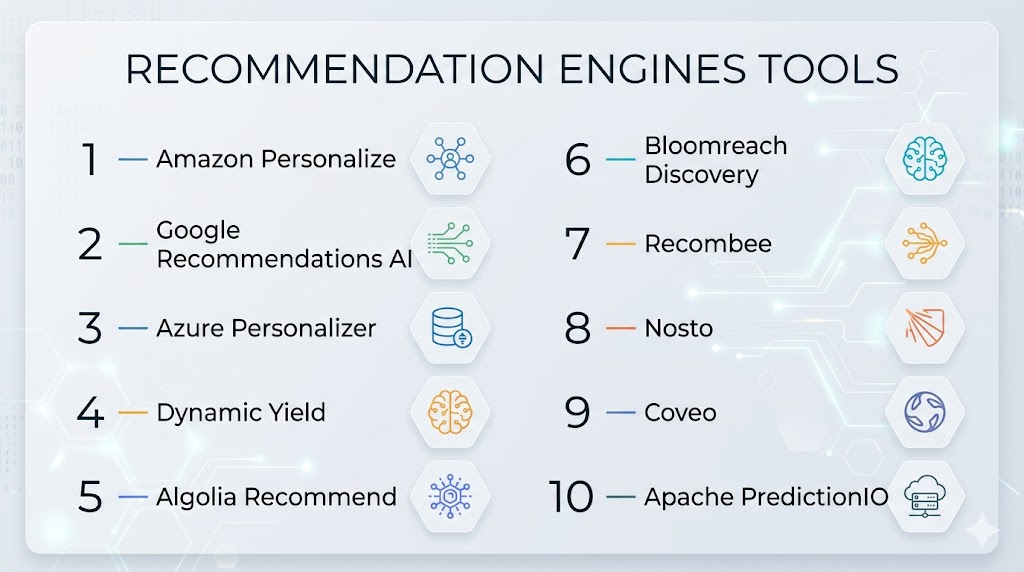
Top 10 Recommendation Engines Tools
#1 — Amazon Personalize
Short description: A fully managed machine learning service that enables developers to build real-time recommendation systems at scale.
Key Features
- Real-time and batch recommendations
- AutoML model selection
- Pre-built recommendation recipes
- Cold-start handling
- Deep learning models
- AWS ecosystem integration
Pros
- Highly scalable
- Strong ML capabilities
- Proven recommendation models
Cons
- Requires AWS knowledge
- Pricing varies with usage
Platforms / Deployment
Cloud
Security & Compliance
SOC, ISO, GDPR, HIPAA (commonly associated with AWS services)
Integrations & Ecosystem
Deep AWS ecosystem integration.
- Data storage systems
- APIs
- Serverless tools
- Analytics platforms
Support & Community
Extensive documentation and enterprise support.
#2 — Google Recommendations AI
Short description: A cloud-based recommendation service designed for retail and ecommerce personalization.
Key Features
- AI-driven product recommendations
- Real-time personalization
- Retail-specific models
- AutoML optimization
- A/B testing support
- Scalable infrastructure
Pros
- Strong AI capabilities
- Easy integration with Google Cloud
- Optimized for ecommerce
Cons
- Limited outside Google ecosystem
- Pricing varies
Platforms / Deployment
Cloud
Security & Compliance
Varies / Not publicly stated
Integrations & Ecosystem
- Google Cloud services
- APIs
- Analytics tools
Support & Community
Strong documentation and support.
#3 — Azure Personalizer
Short description: A machine learning-based recommendation service focused on real-time decision-making.
Key Features
- Reinforcement learning models
- Real-time personalization
- Context-aware recommendations
- API-first design
- Scalable infrastructure
- Integration with Azure ecosystem
Pros
- Strong AI models
- Flexible APIs
- Enterprise-ready
Cons
- Requires Azure expertise
- Limited UI
Platforms / Deployment
Cloud
Security & Compliance
Varies / Not publicly stated
Integrations & Ecosystem
- Azure services
- APIs
- Data tools
Support & Community
Enterprise-level support.
#4 — Dynamic Yield
Short description: A personalization and recommendation platform focused on ecommerce and customer experience.
Key Features
- Product recommendations
- Behavioral targeting
- Real-time personalization
- A/B testing
- Customer segmentation
- Omnichannel delivery
Pros
- Strong ecommerce focus
- Easy to use
- Real-time insights
Cons
- Pricing varies
- Requires data maturity
Platforms / Deployment
Web
Cloud
Security & Compliance
Varies / Not publicly stated
Integrations & Ecosystem
- Ecommerce platforms
- APIs
- Marketing tools
Support & Community
Good enterprise support.
#5 — Algolia Recommend
Short description: A recommendation engine built on top of Algolia’s search platform, focused on fast and scalable suggestions.
Key Features
- Related products recommendations
- Frequently bought together
- Trending items
- Real-time indexing
- High-performance search integration
- API-first design
Pros
- Extremely fast
- Easy integration
- Developer-friendly
Cons
- Limited advanced AI models
- Requires Algolia ecosystem
Platforms / Deployment
Web
Cloud
Security & Compliance
Varies / Not publicly stated
Integrations & Ecosystem
- Search APIs
- Ecommerce platforms
- Developer tools
Support & Community
Strong developer documentation.
#6 — Bloomreach Discovery
Short description: A recommendation and search platform designed for ecommerce personalization.
Key Features
- AI-driven recommendations
- Search + recommendation engine
- Customer segmentation
- Real-time personalization
- Analytics
- Omnichannel support
Pros
- Strong ecommerce features
- Combines search + recommendations
- Scalable
Cons
- Complex setup
- Pricing varies
Platforms / Deployment
Web
Cloud
Security & Compliance
Varies / Not publicly stated
Integrations & Ecosystem
- Ecommerce tools
- APIs
- CMS platforms
Support & Community
Enterprise support.
#7 — Recombee
Short description: A developer-focused recommendation engine API with strong flexibility and customization.
Key Features
- Real-time recommendations
- Collaborative filtering
- Content-based recommendations
- API-first architecture
- Personalization models
- High scalability
Pros
- Flexible APIs
- Good performance
- Developer-friendly
Cons
- Requires technical setup
- Limited UI
Platforms / Deployment
Web
Cloud
Security & Compliance
Varies / Not publicly stated
Integrations & Ecosystem
- APIs
- Data platforms
- SDKs
Support & Community
Good documentation.
#8 — Nosto
Short description: An ecommerce-focused recommendation and personalization platform.
Key Features
- Product recommendations
- Personalization
- Merchandising tools
- AI insights
- Segmentation
- Omnichannel capabilities
Pros
- Easy for marketers
- Strong ecommerce focus
- Quick setup
Cons
- Limited developer flexibility
- Pricing varies
Platforms / Deployment
Web
Cloud
Security & Compliance
Varies / Not publicly stated
Integrations & Ecosystem
- Ecommerce platforms
- Marketing tools
- APIs
Support & Community
Good SMB support.
#9 — Coveo
Short description: An AI-powered relevance platform combining search, recommendations, and personalization.
Key Features
- AI-powered recommendations
- Search + recommendation integration
- Personalization
- Analytics
- Machine learning models
- Omnichannel delivery
Pros
- Strong enterprise features
- Unified platform
- Scalable
Cons
- Complex implementation
- Pricing varies
Platforms / Deployment
Web
Cloud
Security & Compliance
Varies / Not publicly stated
Integrations & Ecosystem
- CRM systems
- APIs
- Enterprise tools
Support & Community
Enterprise-level support.
#10 — Apache PredictionIO
Short description: An open-source machine learning server for building custom recommendation engines.
Key Features
- Open-source framework
- Custom recommendation models
- Data pipelines
- Machine learning engine
- API support
- Scalable architecture
Pros
- Highly customizable
- Free and open-source
- Flexible
Cons
- Requires ML expertise
- Setup complexity
Platforms / Deployment
Web
Self-hosted
Security & Compliance
Varies / Not publicly stated
Integrations & Ecosystem
- APIs
- Data tools
- Developer frameworks
Support & Community
Open-source community support.
Comparison Table (Top 10)
| Tool Name | Best For | Platform(s) Supported | Deployment | Standout Feature | Public Rating |
|---|---|---|---|---|---|
| Amazon Personalize | Enterprise ML | Cloud | Cloud | AutoML recommendations | N/A |
| Google Recommendations AI | Ecommerce | Cloud | Cloud | Retail optimization | N/A |
| Azure Personalizer | Real-time AI | Cloud | Cloud | Reinforcement learning | N/A |
| Dynamic Yield | Ecommerce | Web | Cloud | Behavioral targeting | N/A |
| Algolia Recommend | Developers | Web | Cloud | Speed | N/A |
| Bloomreach | Commerce | Web | Cloud | Search + recommendations | N/A |
| Recombee | Developers | Web | Cloud | API-first design | N/A |
| Nosto | SMB ecommerce | Web | Cloud | Easy setup | N/A |
| Coveo | Enterprise | Web | Cloud | AI relevance platform | N/A |
| PredictionIO | Developers | Web | Self-hosted | Open-source ML | N/A |
Evaluation & Scoring of Recommendation Engines
| Tool Name | Core (25%) | Ease (15%) | Integrations (15%) | Security (10%) | Performance (10%) | Support (10%) | Value (15%) | Weighted Total |
|---|---|---|---|---|---|---|---|---|
| Amazon Personalize | 10 | 7 | 10 | 9 | 9 | 9 | 6 | 8.9 |
| Google AI | 9 | 8 | 9 | 8 | 9 | 8 | 7 | 8.5 |
| Azure Personalizer | 9 | 7 | 9 | 8 | 9 | 8 | 7 | 8.4 |
| Dynamic Yield | 9 | 8 | 8 | 8 | 8 | 8 | 7 | 8.3 |
| Algolia | 8 | 9 | 8 | 7 | 9 | 8 | 8 | 8.3 |
| Bloomreach | 9 | 7 | 8 | 8 | 8 | 8 | 7 | 8.2 |
| Recombee | 8 | 7 | 8 | 7 | 8 | 7 | 9 | 8.0 |
| Nosto | 8 | 9 | 7 | 7 | 8 | 7 | 8 | 8.0 |
| Coveo | 9 | 7 | 9 | 8 | 8 | 8 | 6 | 8.2 |
| PredictionIO | 8 | 6 | 7 | 7 | 8 | 7 | 10 | 7.9 |
How to interpret scores:
- Scores are comparative across tools
- Enterprise tools rank higher in scalability and features
- Open-source tools rank higher in value
- Ease scores reflect implementation complexity
Which Recommendation Engine Is Right for You?
Solo / Freelancer
- Best: Apache PredictionIO
- Focus on flexibility and cost
SMB
- Best: Nosto, Algolia Recommend
- Easy setup and fast deployment
Mid-Market
- Best: Dynamic Yield, Bloomreach
- Balance personalization and scalability
Enterprise
- Best: Amazon Personalize, Google AI, Coveo
- Advanced AI and large-scale data processing
Budget vs Premium
- Budget: PredictionIO, Recombee
- Premium: Amazon, Google, Coveo
Feature Depth vs Ease of Use
- Advanced: Amazon Personalize, Azure
- Easy: Nosto, Algolia
Integrations & Scalability
- Best: Amazon, Google, Azure
Security & Compliance Needs
- High: Cloud enterprise tools
- Standard: SMB-focused tools
Frequently Asked Questions (FAQs)
What is a recommendation engine?
It is software that suggests products or content based on user behavior and data.
How do recommendation engines work?
They analyze user interactions and use algorithms to predict preferences.
What are the main types?
Collaborative filtering, content-based, and hybrid systems.
Are recommendation engines AI-based?
Most modern systems use machine learning and AI.
Do they improve conversions?
Yes, they increase engagement and sales significantly.
Are they expensive?
Pricing varies based on scale and usage.
Can small businesses use them?
Yes, but simpler tools may be sufficient.
What is the cold-start problem?
Difficulty recommending items for new users or products.
Do they require big data?
More data improves accuracy, but smaller datasets can still work.
Are they secure?
Most platforms offer security features, but varies.
Conclusion
Recommendation Engines are a cornerstone of modern digital experiences, helping businesses deliver personalized, relevant, and engaging content at scale. They reduce friction, improve discovery, and drive measurable business outcomes.
