Introduction
Feature Flag Management Tools are software platforms that allow teams to enable, disable, or modify features in an application without deploying new code. These tools act as a control layer between your code and users, helping teams release features safely and progressively.
In simple terms, feature flags (or feature toggles) let you turn features on or off in real time, test them with specific users, and roll them out gradually.
Today, feature flagging is a core part of modern software delivery. It supports continuous deployment, experimentation, and risk reduction, making it essential for agile and DevOps-driven teams.
Why it matters now
- Faster release cycles with reduced risk
- Safer deployments using gradual rollouts
- Experimentation and A/B testing at scale
- Real-time control over production features
Common use cases
- Gradual feature rollouts (canary releases)
- A/B testing and experimentation
- Kill switches for production issues
- User segmentation and personalization
- Continuous delivery and DevOps workflows
What buyers should evaluate
- Ease of implementation (SDKs, APIs)
- Rollout and targeting capabilities
- Experimentation and analytics features
- Integration with CI/CD pipelines
- Real-time control and latency
- Scalability across environments
- Security and access control
- Self-hosted vs cloud options
- Pricing based on usage or seats
Best for: Developers, DevOps teams, product managers, SaaS companies, and enterprises practicing continuous delivery.
Not ideal for: Small projects with infrequent releases or teams that don’t require dynamic feature control.
Key Trends in Feature Flag Management Tools
- Feature flags + experimentation platforms: Combined A/B testing and rollout control
- OpenFeature standard adoption: Vendor-neutral feature flagging
- AI-assisted rollouts: Smarter targeting and automation
- Flag lifecycle management: Detecting and removing stale flags
- Server-side + edge flagging: Improved performance and control
- Git-based and code-first flagging: Managing flags as code
- Real-time analytics integration: Immediate feedback on feature impact
- Privacy-first deployments: Self-hosting and data control
- Developer-first platforms: SDK-heavy, API-driven tools
How We Selected These Tools (Methodology)
- Market adoption and developer mindshare
- Feature completeness (flags, targeting, experimentation)
- Ease of integration and SDK availability
- Performance and reliability in production
- Security and compliance capabilities
- Flexibility (cloud vs self-hosted)
- Integration ecosystem (CI/CD, analytics, cloud)
- Pricing flexibility for startups to enterprise
- Community and documentation strength
Top 10 Feature Flag Management Tools
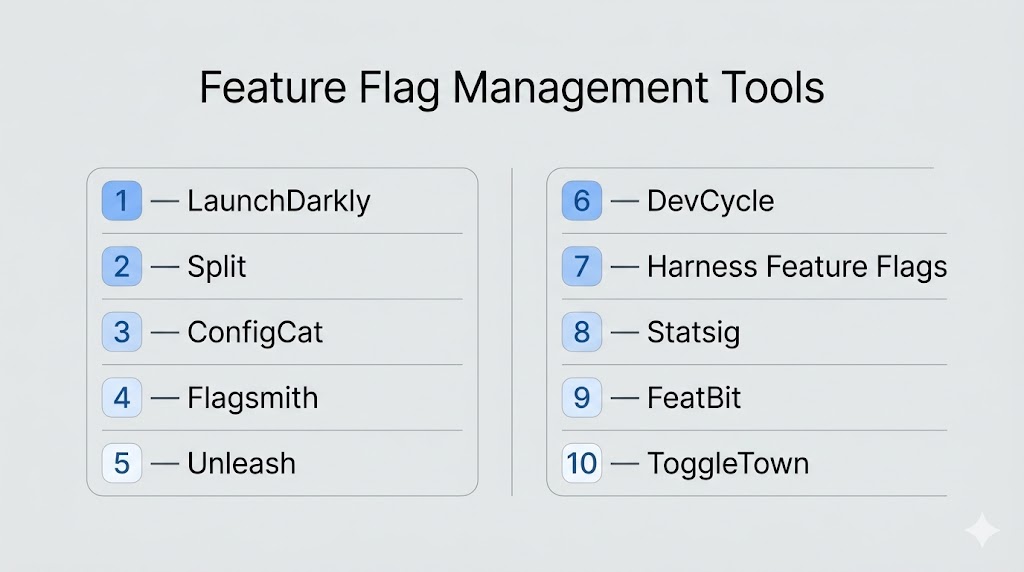
#1 — LaunchDarkly
Short description: A leading enterprise feature management platform offering advanced targeting, experimentation, and real-time control.
Key Features
- Real-time feature flagging
- Advanced targeting and segmentation
- Experimentation and analytics
- Feature flag lifecycle management
- Multi-environment support
- SDKs across languages
Pros
- Highly scalable
- Rich feature set
- Strong enterprise adoption
Cons
- Expensive
- Complex for beginners
Platforms / Deployment
Web / Mobile
Cloud
Security & Compliance
SSO, RBAC, audit logs
Varies / Not publicly stated
Integrations & Ecosystem
Extensive ecosystem across DevOps and analytics tools.
- CI/CD pipelines
- Cloud platforms
- APIs
- Monitoring tools
Support & Community
Strong enterprise support and large community.
#2 — Split
Short description: A feature delivery platform combining feature flags with experimentation and product analytics.
Key Features
- Feature flags and rollouts
- A/B testing
- Real-time metrics
- User targeting
- Data-driven experimentation
- SDK support
Pros
- Combines analytics + flags
- Strong experimentation features
- Scalable
Cons
- Pricing varies
- Learning curve
Platforms / Deployment
Web / Mobile
Cloud
Security & Compliance
Varies / Not publicly stated
Integrations & Ecosystem
- Data platforms
- APIs
- Analytics tools
Support & Community
Good enterprise support.
#3 — ConfigCat
Short description: A developer-friendly feature flag service focused on simplicity and fast implementation.
Key Features
- Remote configuration
- Percentage rollouts
- User targeting
- SDKs for multiple languages
- Dashboard control
- Audit logs
Pros
- Easy to use
- Affordable
- Fast setup
Cons
- Limited advanced experimentation
- Smaller ecosystem
Platforms / Deployment
Web
Cloud
Security & Compliance
Varies / Not publicly stated
Integrations & Ecosystem
- APIs
- Dev tools
- SDKs
Support & Community
Good documentation.
#4 — Flagsmith
Short description: An open-source feature flag platform with both cloud and self-hosted deployment options.
Key Features
- Feature flags
- Remote config
- A/B testing
- User segmentation
- API-first architecture
- Self-hosting support
Pros
- Open-source flexibility
- Self-hosting available
- Good for privacy-focused teams
Cons
- Requires setup for self-hosting
- UI less polished
Platforms / Deployment
Web
Cloud / Self-hosted
Security & Compliance
Varies / Not publicly stated
Integrations & Ecosystem
- APIs
- Dev tools
- SDKs
Support & Community
Active community.
#5 — Unleash
Short description: An open-source feature flag platform focused on flexibility and developer control.
Key Features
- Feature toggles
- Gradual rollouts
- Activation strategies
- A/B testing
- Audit logs
- Self-hosted or managed
Pros
- Open-source
- Strong privacy control
- Flexible targeting
Cons
- Requires technical setup
- Limited UI features
Platforms / Deployment
Web
Cloud / Self-hosted
Security & Compliance
Audit logs, role-based access
Varies / Not publicly stated
Integrations & Ecosystem
- APIs
- CI/CD tools
- SDKs
Support & Community
Strong open-source community.
#6 — DevCycle
Short description: A modern feature flag platform with OpenFeature support and strong developer integrations.
Key Features
- Feature flag management
- A/B testing
- OpenFeature compatibility
- SDK support
- CI/CD integrations
- Real-time updates
Pros
- Developer-friendly
- Flexible integration
- Good free tier
Cons
- Newer platform
- Smaller ecosystem
Platforms / Deployment
Web
Cloud
Security & Compliance
Varies / Not publicly stated
Integrations & Ecosystem
- GitHub
- Jira
- Slack
- APIs
Support & Community
Growing community.
#7 — Harness Feature Flags
Short description: A feature flag solution integrated into the Harness DevOps platform.
Key Features
- Feature flagging
- CI/CD integration
- Targeting and rollouts
- Experimentation
- Governance controls
- Audit trails
Pros
- Strong DevOps integration
- Enterprise-ready
- Scalable
Cons
- Best within Harness ecosystem
- Pricing varies
Platforms / Deployment
Web
Cloud
Security & Compliance
RBAC, audit logs
Varies / Not publicly stated
Integrations & Ecosystem
- CI/CD pipelines
- DevOps tools
- APIs
Support & Community
Enterprise support.
#8 — Statsig
Short description: A modern platform combining feature flags, analytics, and experimentation.
Key Features
- Feature flags
- A/B testing
- Real-time analytics
- Experiment tracking
- Developer SDKs
- Feature rollout controls
Pros
- All-in-one platform
- Affordable
- Developer-focused
Cons
- Newer tool
- Limited enterprise history
Platforms / Deployment
Web
Cloud
Security & Compliance
Varies / Not publicly stated
Integrations & Ecosystem
- APIs
- Data tools
- SDKs
Support & Community
Growing ecosystem.
#9 — FeatBit
Short description: An open-source feature flag management platform designed for flexibility and performance.
Key Features
- Feature flag control
- A/B testing
- Multi-language support
- Self-hosting
- Observability tools
- High availability
Pros
- Open-source
- Flexible deployment
- Strong performance
Cons
- Smaller ecosystem
- Requires setup
Platforms / Deployment
Web
Cloud / Self-hosted
Security & Compliance
Varies / Not publicly stated
Integrations & Ecosystem
- APIs
- Developer tools
- SDKs
Support & Community
Growing open-source community.
#10 — ToggleTown
Short description: A startup-friendly feature flag platform with built-in experimentation and monitoring tools.
Key Features
- Feature flags
- A/B testing
- Percentage rollouts
- User segmentation
- Audit logs
- SDK support
Pros
- Affordable pricing
- Easy setup
- Good for startups
Cons
- Limited enterprise features
- Smaller network
Platforms / Deployment
Web
Cloud
Security & Compliance
Audit logging
Varies / Not publicly stated
Integrations & Ecosystem
- APIs
- Developer SDKs
Support & Community
Emerging community.
Comparison Table (Top 10)
| Tool Name | Best For | Platform(s) Supported | Deployment | Standout Feature | Public Rating |
|---|---|---|---|---|---|
| LaunchDarkly | Enterprise | Web/Mobile | Cloud | Advanced targeting | N/A |
| Split | Data-driven teams | Web/Mobile | Cloud | Analytics + flags | N/A |
| ConfigCat | SMB | Web | Cloud | Simplicity | N/A |
| Flagsmith | Open-source | Web | Hybrid | Self-hosting | N/A |
| Unleash | Developers | Web | Hybrid | Open-source control | N/A |
| DevCycle | Modern teams | Web | Cloud | OpenFeature support | N/A |
| Harness | DevOps teams | Web | Cloud | CI/CD integration | N/A |
| Statsig | Startups | Web | Cloud | Experimentation | N/A |
| FeatBit | Open-source | Web | Hybrid | Flexibility | N/A |
| ToggleTown | Startups | Web | Cloud | Simplicity | N/A |
Evaluation & Scoring of Feature Flag Management Tools
| Tool Name | Core (25%) | Ease (15%) | Integrations (15%) | Security (10%) | Performance (10%) | Support (10%) | Value (15%) | Weighted Total |
|---|---|---|---|---|---|---|---|---|
| LaunchDarkly | 10 | 7 | 10 | 9 | 9 | 9 | 6 | 8.9 |
| Split | 9 | 7 | 9 | 8 | 9 | 8 | 7 | 8.5 |
| ConfigCat | 8 | 9 | 7 | 7 | 8 | 7 | 9 | 8.2 |
| Flagsmith | 8 | 8 | 8 | 8 | 8 | 8 | 9 | 8.3 |
| Unleash | 9 | 7 | 8 | 9 | 8 | 8 | 9 | 8.4 |
| DevCycle | 8 | 8 | 8 | 7 | 8 | 7 | 9 | 8.1 |
| Harness | 9 | 7 | 9 | 9 | 8 | 8 | 7 | 8.4 |
| Statsig | 8 | 8 | 8 | 7 | 8 | 7 | 9 | 8.1 |
| FeatBit | 8 | 7 | 7 | 7 | 8 | 7 | 9 | 7.9 |
| ToggleTown | 7 | 9 | 6 | 7 | 8 | 7 | 9 | 7.8 |
How to interpret scores:
- Scores are relative comparisons across tools
- Higher scores indicate stronger overall capabilities
- Enterprise tools score higher in scalability and security
- Open-source tools score higher in value and flexibility
Which Feature Flag Tool Is Right for You?
Solo / Freelancer
- Best: ConfigCat, ToggleTown
- Focus on simplicity and affordability
SMB
- Best: Flagsmith, DevCycle
- Balance flexibility and cost
Mid-Market
- Best: Split, Statsig
- Focus on experimentation and insights
Enterprise
- Best: LaunchDarkly, Harness
- Focus on scalability, governance, and security
Budget vs Premium
- Budget: Unleash, Flagsmith
- Premium: LaunchDarkly, Split
Feature Depth vs Ease of Use
- Advanced: LaunchDarkly, Harness
- Easy: ConfigCat, ToggleTown
Integrations & Scalability
- Best: LaunchDarkly, Split
Security & Compliance Needs
- High: LaunchDarkly, Harness
- Standard: ConfigCat, DevCycle
Frequently Asked Questions (FAQs)
What are feature flags?
They allow you to enable or disable features without deploying new code.
Why use feature flag tools?
To release features safely and test them in production.
Are feature flags only for developers?
Mostly yes, but product teams also use them for experimentation.
Can feature flags replace A/B testing tools?
Some tools include A/B testing, but not all.
Are these tools expensive?
Pricing varies from free open-source to enterprise plans.
Do feature flags affect performance?
Minimal impact if implemented correctly.
Can I self-host feature flag tools?
Yes, many open-source tools support self-hosting.
What is gradual rollout?
Releasing features to a small percentage of users first.
Are feature flags secure?
Most tools include access control and audit logs.
What is the biggest challenge?
Managing and cleaning up stale feature flags.
Conclusion
Feature Flag Management Tools are essential for modern software development, enabling safer releases, faster experimentation, and better user experiences.
