Introduction
Business Continuity Planning (BCP) Tools are software solutions that help organizations prepare for, respond to, and recover from disruptions such as natural disasters, IT outages, cyber incidents, supply chain interruptions, or other critical operational events. These platforms centralize business impact analysis, plan creation, crisis management workflows, and testing to ensure resilience.
In an era of increasing operational complexity and regulatory scrutiny, BCP tools are essential for safeguarding organizational operations. They enable teams to identify critical processes, assign recovery priorities, automate workflows, and maintain compliance with regulatory and industry standards. By providing a structured approach to continuity, these tools reduce downtime, mitigate risk, and enhance organizational confidence during disruptions.
Common use cases include:
- Business impact analysis (BIA) and risk assessment
- Developing and managing continuity and recovery plans
- Crisis management and incident response coordination
- Testing and validating continuity procedures
- Compliance tracking for standards like ISO 22301
- Reporting and dashboards for executives
What buyers should evaluate:
- Risk assessment and BIA capabilities
- Plan creation, storage, and version control
- Automated workflows and task management
- Crisis response and communication tools
- Reporting and analytics dashboards
- Integration with IT, HR, and operational systems
- Mobile access and multi-location support
- Testing and simulation features
- Regulatory compliance tracking
- Security and access control
Best for: Risk managers, IT leaders, operations teams, business continuity officers, and organizations in regulated industries.
Not ideal for: Small teams with minimal disruption risk or organizations without formal continuity requirements.
Key Trends in Business Continuity Planning Tools
- Unified platforms for BCP, disaster recovery, and crisis management
- Integration with EHS, IT, and risk management systems
- Cloud-native solutions for scalability and real-time updates
- AI-assisted risk prediction and scenario planning
- Mobile access for response teams
- Automation of recovery workflows and notifications
- Continuous testing and simulation capabilities
- Advanced reporting and executive dashboards
- Multi-jurisdictional compliance support
- Collaboration and communication tools embedded in plans
How We Selected These Tools (Methodology)
- Evaluated business impact analysis and risk assessment capabilities
- Assessed plan creation, management, and version control
- Reviewed crisis management and communication features
- Analyzed workflow automation and notification tools
- Considered integration with enterprise systems
- Evaluated mobile access and distributed support
- Reviewed testing and simulation functionalities
- Assessed reporting, analytics, and executive dashboards
- Evaluated compliance support and audit readiness
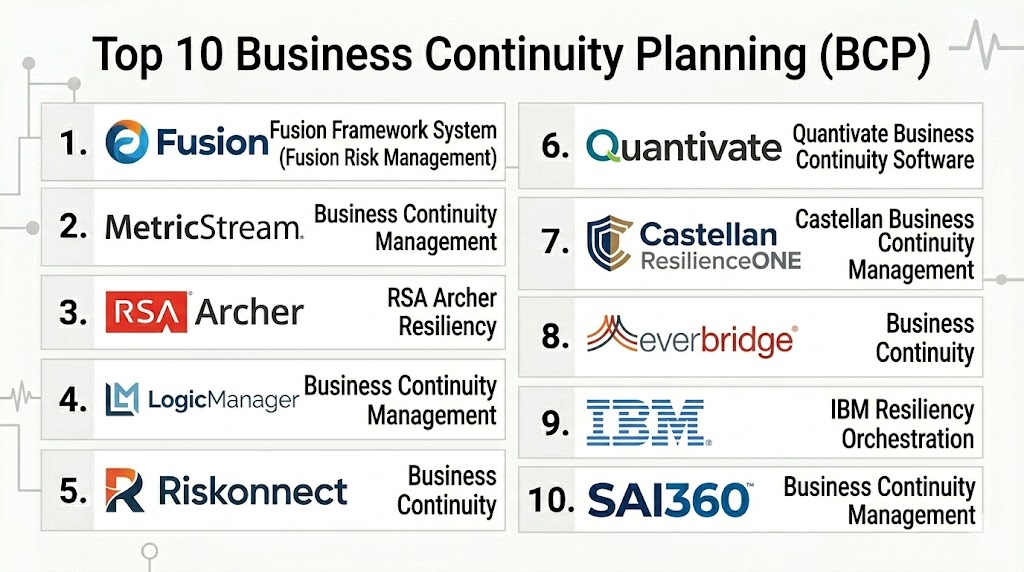
Top 10 Business Continuity Planning (BCP) Tools
#1 — Fusion Framework System (Fusion Risk Management)
Short description:
Fusion Framework provides an integrated platform for business continuity, crisis management, and risk assessment. It offers real-time dashboards, plan automation, and scenario simulations for enterprise resilience.
Key Features
- Centralized BCP repository
- Crisis response workflows
- Business impact analysis
- Risk scoring and dashboards
- Simulation and testing
Pros
- Enterprise-grade features
- Comprehensive analytics
Cons
- Premium pricing
- Implementation complexity
Platforms / Deployment
Web / Mobile
Cloud
Security & Compliance
SSO, encryption
ISO 22301 alignment
Integrations & Ecosystem
- Risk management systems
- ERP and IT tools
Support & Community
24/7 enterprise support.
#2 — MetricStream Business Continuity Management
Short description:
MetricStream BCM helps organizations automate continuity planning, risk assessments, and recovery workflows. It supports regulatory compliance and integrates with other GRC modules.
Key Features
- Risk-based BCP planning
- Incident and crisis management
- Workflow automation
- Compliance reporting
Pros
- Integrated with GRC suite
- Scalable for large organizations
Cons
- Complex for smaller teams
- Premium pricing
Platforms / Deployment
Web
Cloud
Security & Compliance
Encryption
Integrations & Ecosystem
- GRC modules
- ERP systems
Support & Community
Enterprise-level support.
#3 — RSA Archer Business Resiliency
Short description:
Archer enables organizations to identify mission-critical processes, develop BCPs, and manage incident response workflows. It also provides testing and audit features.
Key Features
- Mission-critical process mapping
- Plan creation and management
- Incident response workflows
- Testing and simulations
Pros
- Enterprise-grade resiliency
- Strong regulatory support
Cons
- Requires configuration
- Higher cost
Platforms / Deployment
Web
Cloud
Security & Compliance
SSO, encryption
Integrations & Ecosystem
- ITSM
- Risk and compliance platforms
Support & Community
Professional enterprise support.
#4 — LogicManager Business Continuity
Short description:
LogicManager offers business continuity management as part of its enterprise risk platform, with plan automation, workflow management, and dashboard reporting.
Key Features
- Plan creation and version control
- Workflow automation
- Risk and impact analysis
- Reporting dashboards
Pros
- User-friendly interface
- Integrated risk management
Cons
- Limited advanced simulation
- Smaller enterprise depth
Platforms / Deployment
Web
Cloud
Security & Compliance
Encryption
Integrations & Ecosystem
- Risk tools
- Compliance systems
Support & Community
Good support resources.
#5 — Riskonnect Business Continuity
Short description:
Riskonnect provides business continuity and risk management tools with scenario planning, impact analysis, and response coordination for global organizations.
Key Features
- BIA and risk assessments
- Recovery plan automation
- Crisis workflows
- Dashboard analytics
Pros
- Real-time updates
- Scalable platform
Cons
- Enterprise focus
- Premium pricing
Platforms / Deployment
Web / Mobile
Cloud
Security & Compliance
Encryption
Integrations & Ecosystem
- ERP systems
- Risk tools
Support & Community
Enterprise-level support.
#6 — Quantivate Business Continuity Software
Short description:
Quantivate offers BCP software with risk assessments, plan templates, and compliance reporting for small to mid-sized enterprises.
Key Features
- Risk and impact analysis
- Plan templates
- Incident response workflows
- Compliance reporting
Pros
- Affordable for SMBs
- Easy to implement
Cons
- Limited enterprise depth
- Fewer integrations
Platforms / Deployment
Web
Cloud
Security & Compliance
Encryption
Integrations & Ecosystem
- Basic HR and IT systems
Support & Community
Support available.
#7 — Castellan Solutions (ResilienceONE)
Short description:
ResilienceONE combines BCP, incident management, and risk analytics to help organizations maintain operational continuity and compliance.
Key Features
- Continuity planning
- Crisis response coordination
- Incident tracking
- Risk dashboards
Pros
- Unified platform
- Enterprise scalability
Cons
- Learning curve
- Cost
Platforms / Deployment
Web
Cloud
Security & Compliance
Encryption
Integrations & Ecosystem
- Risk and compliance tools
Support & Community
Enterprise support.
#8 — Everbridge Business Continuity
Short description:
Everbridge combines BCP planning with real-time alerting and crisis coordination, enabling organizations to respond quickly to operational disruptions.
Key Features
- Plan creation and automation
- Real-time alerts
- Workflow coordination
- Analytics dashboards
Pros
- Strong alerting capabilities
- Enterprise-ready
Cons
- Premium cost
- Implementation effort
Platforms / Deployment
Web / Mobile
Cloud
Security & Compliance
SSO, encryption
Integrations & Ecosystem
- HR and IT systems
Support & Community
24/7 support.
#9 — IBM Resiliency Orchestration
Short description:
IBM provides a BCP platform integrated with IT and disaster recovery orchestration to manage incidents and maintain service continuity.
Key Features
- BCP plan automation
- IT DR integration
- Workflow orchestration
- Analytics and reporting
Pros
- Strong IT integration
- Enterprise scalability
Cons
- Complex setup
- Premium pricing
Platforms / Deployment
Web
Cloud
Security & Compliance
Encryption
ISO-aligned
Integrations & Ecosystem
- ITSM
- Risk systems
Support & Community
Enterprise support.
#10 — SAI360 Business Continuity Management
Short description:
SAI360 delivers BCP and operational resilience planning with workflow automation, risk assessments, and compliance tracking.
Key Features
- Plan management
- Risk assessments
- Crisis response workflows
- Compliance dashboards
Pros
- Integrated risk platform
- Scalable
Cons
- Premium pricing
- Setup complexity
Platforms / Deployment
Web
Cloud
Security & Compliance
Encryption
Integrations & Ecosystem
- ERP and compliance systems
Support & Community
Enterprise-level support.
Comparison Table
| Tool Name | Best For | Platform(s) Supported | Deployment | Standout Feature | Public Rating |
|---|---|---|---|---|---|
| Fusion Framework | Enterprise | Web/Mobile | Cloud | Real-time dashboards | N/A |
| MetricStream | Large orgs | Web | Cloud | Integrated GRC | N/A |
| RSA Archer | Enterprise | Web | Cloud | Incident management | N/A |
| LogicManager | Mid-market | Web | Cloud | User-friendly interface | N/A |
| Riskonnect | Enterprise | Web/Mobile | Cloud | Scenario planning | N/A |
| Quantivate | SMB | Web | Cloud | Plan templates | N/A |
| Castellan | Enterprise | Web | Cloud | Unified platform | N/A |
| Everbridge | Enterprise | Web/Mobile | Cloud | Real-time alerting | N/A |
| IBM Resiliency | Enterprise | Web | Cloud | IT DR integration | N/A |
| SAI360 | Enterprise | Web | Cloud | Risk dashboards | N/A |
Evaluation & Scoring of BCP Tools
| Tool Name | Core | Ease | Integrations | Security | Performance | Support | Value | Weighted Total |
|---|---|---|---|---|---|---|---|---|
| Fusion | 9 | 7 | 9 | 9 | 9 | 9 | 7 | 8.4 |
| MetricStream | 9 | 7 | 8 | 9 | 8 | 8 | 7 | 8.0 |
| RSA Archer | 9 | 7 | 9 | 9 | 9 | 9 | 7 | 8.4 |
| LogicManager | 8 | 9 | 7 | 8 | 8 | 8 | 8 | 8.0 |
| Riskonnect | 9 | 7 | 9 | 9 | 9 | 9 | 7 | 8.4 |
| Quantivate | 7 | 9 | 6 | 8 | 7 | 8 | 8 | 7.6 |
| Castellan | 8 | 7 | 8 | 8 | 8 | 8 | 7 | 7.9 |
| Everbridge | 9 | 7 | 9 | 9 | 9 | 9 | 7 | 8.4 |
| IBM Resiliency | 9 | 7 | 8 | 9 | 9 | 9 | 7 | 8.3 |
| SAI360 | 8 | 7 | 8 | 8 | 8 | 8 | 7 | 7.9 |
How to interpret scores:
Scores reflect each tool’s ability to manage BCP planning, crisis response, and continuity workflows. Enterprise platforms excel in integration, scalability, and analytics, while SMB-friendly tools prioritize ease of use and affordability. Select based on your organization’s size, complexity, and regulatory requirements.
Which BCP Tool Is Right for You?
Solo / Small Teams
Quantivate offers templates and affordability.
SMB
LogicManager and SAI360 balance features and usability.
Mid-Market
MetricStream and Castellan provide structured plans and analytics.
Enterprise
Fusion, RSA Archer, Riskonnect, Everbridge, and IBM Resiliency deliver global scalability and advanced workflows.
Budget vs Premium
Quantivate is budget-friendly; Fusion and RSA Archer are premium.
Feature Depth vs Ease of Use
Fusion offers depth; LogicManager prioritizes ease.
Integrations & Scalability
Enterprise platforms provide the most robust integrations and scalability.
Compliance & Risk Needs
RSA Archer and MetricStream excel in compliance and audit reporting.
Frequently Asked Questions (FAQs)
1. What is a Business Continuity Planning tool?
A BCP tool helps organizations plan, manage, and execute business continuity and disaster recovery processes, ensuring operations continue during disruptions.
2. Why is BCP software important?
It reduces downtime, maintains regulatory compliance, and provides structured workflows for crisis response, improving organizational resilience.
3. What features should I look for?
Key features include risk assessments, plan management, workflow automation, crisis management, testing, analytics, and integrations with enterprise systems.
4. Can these platforms automate workflows?
Yes, BCP tools automate alerts, notifications, task assignments, and recovery procedures to streamline response during incidents.
5. Are these tools suitable for SMBs?
Yes, tools like Quantivate and LogicManager provide SMB-friendly features, while enterprise platforms suit large organizations.
6. Can BCP tools integrate with other systems?
Yes, most tools integrate with HR, ERP, ITSM, EHS, and compliance systems to centralize continuity management.
7. How do these tools improve crisis response?
They provide real-time dashboards, alert workflows, and task assignments to coordinate response teams effectively.
8. Do these platforms support testing and simulations?
Yes, most BCP platforms allow scenario simulations and testing to validate recovery plans.
9. How long does implementation take?
Simple SMB tools may deploy in weeks; enterprise solutions can take months due to customization and integration.
10. What industries benefit most?
Finance, healthcare, IT, manufacturing, logistics, and government organizations benefit from structured business continuity management.
Conclusion
Business Continuity Planning (BCP) Tools are essential for organizations seeking operational resilience in an unpredictable environment. These platforms provide centralized management of continuity plans, risk assessments, and crisis response workflows, reducing downtime and enhancing recovery capabilities. From SMB-friendly tools like Quantivate and LogicManager to enterprise-grade platforms like Fusion, RSA Archer, and Everbridge, organizations have a spectrum of solutions tailored to scale, complexity, and regulatory requirements. Evaluating features such as workflow automation, scenario testing, and analytics dashboards will ensure your organization is prepared to maintain operations during any disruption. Shortlist and test a few platforms to find the best fit for your business continuity objectives.

This article provides a practical overview of business continuity planning tools, with a clear comparison that makes it easier to understand their strengths and choose the right solution for resilience planning.