Introduction
Matter Management Systems are specialized legal software platforms designed to organize, track, and manage all legal work within a centralized system. A “matter” can include anything from contract reviews and compliance tasks to litigation and regulatory issues. These systems provide structured workflows, document management, and real-time visibility across all legal activities.
In modern legal operations, teams handle increasing workloads with tighter budgets and higher compliance demands. Matter management systems help legal departments move from fragmented tools like emails and spreadsheets to a unified, data-driven environment. This improves efficiency, reduces risk, and enhances collaboration across internal teams and external counsel.
Common use cases include:
- Tracking legal matters from intake to resolution
- Managing documents, deadlines, and workflows
- Monitoring legal spend and budgets
- Collaborating with external counsel
- Ensuring compliance and risk management
What buyers should evaluate:
- Matter tracking and lifecycle management
- Workflow automation and intake systems
- Integration with ERP, CLM, and billing tools
- Reporting and analytics capabilities
- Ease of use and adoption
- Collaboration features
- Security and compliance standards
- Scalability across departments
- Cost and value
Best for: In-house legal teams, law firms, enterprise legal operations, compliance teams, and organizations handling high volumes of legal work.
Not ideal for: Very small teams with minimal legal workload or those using simple document storage tools.
Key Trends in Matter Management Systems
- AI-powered legal intake and triage automation
- Real-time dashboards for matter tracking and reporting
- Integration with legal billing and spend management tools
- Cloud-native platforms for scalability and accessibility
- Automation of routine legal workflows
- Predictive analytics for risk and case outcomes
- Enhanced collaboration tools for internal and external stakeholders
- API-first platforms for enterprise integrations
- Compliance monitoring and audit readiness
- Data-driven legal operations and performance tracking
How We Selected These Tools (Methodology)
- Evaluated market adoption and legal tech relevance
- Assessed core matter management capabilities
- Reviewed workflow automation and intake features
- Considered integration with legal and enterprise systems
- Analyzed reporting and analytics functionality
- Evaluated scalability for enterprise and mid-market use
- Reviewed usability and onboarding experience
- Considered support quality and ecosystem strength
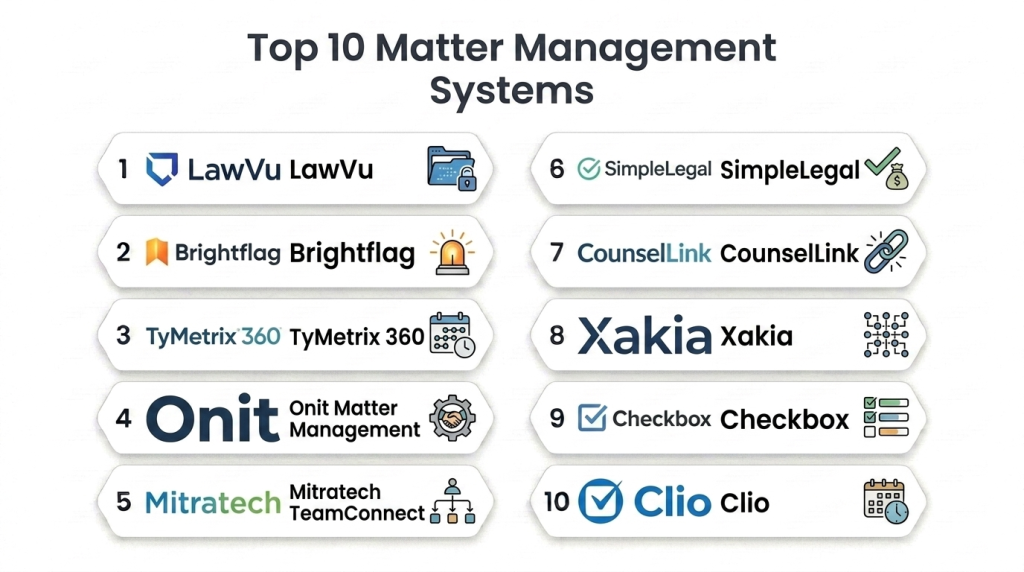
Top 10 Matter Management Systems
#1 — LawVu
Short description:
LawVu is a modern legal workspace designed for in-house legal teams. It centralizes legal matters, contracts, and workflows into a single platform. The system provides visibility across all legal activities. It is ideal for organizations seeking simplicity and efficiency.
Key Features
- Centralized matter tracking
- Legal intake and workflow automation
- Contract and document management
- Reporting dashboards
- Collaboration tools
Pros
- Easy to use
- Strong visibility features
Cons
- Limited enterprise customization
- Smaller ecosystem
Platforms / Deployment
Web
Cloud
Security & Compliance
SSO, encryption
Integrations & Ecosystem
LawVu integrates with business tools to streamline legal workflows.
- Document systems
- Collaboration tools
Support & Community
Responsive support with onboarding assistance.
#2 — Brightflag
Short description:
Brightflag focuses on legal operations and spend management alongside matter tracking. It provides AI-driven insights into legal work and costs. The platform is widely used by enterprises. It helps improve efficiency and cost control.
Key Features
- Matter tracking
- Legal spend analytics
- AI insights
- Reporting dashboards
Pros
- Strong analytics
- Cost optimization features
Cons
- Enterprise-focused
- Pricing considerations
Platforms / Deployment
Web
Cloud
Security & Compliance
SSO, MFA
Integrations & Ecosystem
- ERP systems
- Billing tools
Support & Community
Enterprise-level support.
#3 — TyMetrix 360
Short description:
TyMetrix 360 is a comprehensive legal management system designed for enterprises. It provides matter management, billing, and analytics in one platform. It helps legal teams manage operations efficiently. It is suitable for large organizations.
Key Features
- Matter management
- Legal billing
- Analytics tools
- Workflow automation
Pros
- Integrated platform
- Strong reporting
Cons
- Complex setup
- Learning curve
Platforms / Deployment
Web
Cloud
Security & Compliance
Not publicly stated
Integrations & Ecosystem
- ERP systems
- Legal tools
Support & Community
Enterprise support.
#4 — Onit Matter Management
Short description:
Onit offers a flexible matter management platform designed for enterprise legal teams. It supports automation, collaboration, and analytics. The platform is highly configurable. It is ideal for organizations with complex workflows.
Key Features
- Workflow automation
- Matter tracking
- Collaboration tools
- Analytics dashboards
Pros
- Highly customizable
- Strong enterprise capabilities
Cons
- Implementation effort
- Cost
Platforms / Deployment
Web
Cloud
Security & Compliance
SSO, MFA
Integrations & Ecosystem
- ERP systems
- Legal tools
Support & Community
Enterprise support with training.
#5 — Mitratech TeamConnect
Short description:
Mitratech TeamConnect is a widely used enterprise legal management platform. It offers matter management, compliance tracking, and analytics. The system provides strong governance features. It is suitable for large organizations.
Key Features
- Matter lifecycle management
- Compliance tracking
- Reporting tools
- Workflow automation
Pros
- Strong compliance features
- Scalable platform
Cons
- Complex UI
- Implementation effort
Platforms / Deployment
Web
Cloud
Security & Compliance
SSO, encryption
Integrations & Ecosystem
- Enterprise systems
- Legal tools
Support & Community
Enterprise-level support.
#6 — SimpleLegal
Short description:
SimpleLegal is a cloud-based legal operations platform focusing on matter management and spend tracking. It is designed for ease of use and quick deployment. The platform is popular among mid-market organizations. It provides strong reporting capabilities.
Key Features
- Matter tracking
- Legal spend management
- Reporting dashboards
- Workflow automation
Pros
- Easy to use
- Quick implementation
Cons
- Limited advanced features
- Smaller ecosystem
Platforms / Deployment
Web
Cloud
Security & Compliance
Not publicly stated
Integrations & Ecosystem
- Accounting tools
- ERP systems
Support & Community
Good support for mid-market users.
#7 — CounselLink
Short description:
CounselLink is a legal management platform offering matter tracking, billing, and analytics. It helps organizations manage legal operations efficiently. The platform is widely used in enterprise environments. It provides strong reporting and insights.
Key Features
- Matter management
- Legal billing
- Analytics tools
- Reporting dashboards
Pros
- Strong analytics
- Enterprise focus
Cons
- Complex setup
- Learning curve
Platforms / Deployment
Web
Cloud
Security & Compliance
SSO, MFA
Integrations & Ecosystem
- ERP systems
- Legal tools
Support & Community
Enterprise support.
#8 — Xakia
Short description:
Xakia is a matter management platform designed for in-house legal teams. It provides visibility into legal work and improves collaboration. The platform is easy to deploy. It is suitable for mid-sized organizations.
Key Features
- Matter tracking
- Workflow automation
- Reporting tools
- Collaboration features
Pros
- Easy to use
- Fast deployment
Cons
- Limited enterprise depth
- Smaller ecosystem
Platforms / Deployment
Web
Cloud
Security & Compliance
Not publicly stated
Integrations & Ecosystem
- Business tools
- Data systems
Support & Community
Responsive support.
#9 — Checkbox
Short description:
Checkbox is a legal automation platform with strong matter management capabilities. It focuses on intake, workflow automation, and reporting. The platform helps legal teams scale operations efficiently. It is suitable for modern legal teams.
Key Features
- AI-powered intake
- Workflow automation
- Matter tracking
- Reporting dashboards
Pros
- Strong automation
- Easy integration
Cons
- Niche focus
- Growing ecosystem
Platforms / Deployment
Web
Cloud
Security & Compliance
Not publicly stated
Integrations & Ecosystem
- ERP systems
- Data tools
Support & Community
Growing support ecosystem.
#10 — Clio
Short description:
Clio is a legal practice management platform that includes matter management features. It is widely used by law firms and small legal teams. The platform offers ease of use and affordability. It is ideal for smaller organizations.
Key Features
- Matter tracking
- Document management
- Billing tools
- Client management
Pros
- Easy to use
- Affordable
Cons
- Limited enterprise features
- Basic analytics
Platforms / Deployment
Web / Mobile
Cloud
Security & Compliance
SSO, encryption
Integrations & Ecosystem
- Legal tools
- Accounting systems
Support & Community
Strong community and support.
Comparison Table
| Tool Name | Best For | Platform(s) Supported | Deployment | Standout Feature | Public Rating |
|---|---|---|---|---|---|
| LawVu | SMB | Web | Cloud | Legal workspace | N/A |
| Brightflag | Enterprise | Web | Cloud | Spend analytics | N/A |
| TyMetrix | Enterprise | Web | Cloud | Billing + matter | N/A |
| Onit | Enterprise | Web | Cloud | Custom workflows | N/A |
| Mitratech | Enterprise | Web | Cloud | Compliance tracking | N/A |
| SimpleLegal | Mid-market | Web | Cloud | Ease of use | N/A |
| CounselLink | Enterprise | Web | Cloud | Analytics | N/A |
| Xakia | Mid-market | Web | Cloud | Quick deployment | N/A |
| Checkbox | Modern teams | Web | Cloud | Automation | N/A |
| Clio | SMB | Web/Mobile | Cloud | Simplicity | N/A |
Evaluation & Scoring of Matter Management Systems
| Tool Name | Core | Ease | Integrations | Security | Performance | Support | Value | Weighted Total |
|---|---|---|---|---|---|---|---|---|
| LawVu | 8 | 9 | 7 | 8 | 8 | 8 | 8 | 8.1 |
| Brightflag | 9 | 8 | 8 | 8 | 9 | 9 | 7 | 8.3 |
| TyMetrix | 9 | 7 | 8 | 8 | 9 | 9 | 7 | 8.2 |
| Onit | 9 | 7 | 9 | 8 | 9 | 9 | 7 | 8.4 |
| Mitratech | 9 | 7 | 8 | 9 | 9 | 9 | 7 | 8.4 |
| SimpleLegal | 8 | 9 | 7 | 7 | 8 | 8 | 8 | 8.0 |
| CounselLink | 9 | 7 | 8 | 8 | 9 | 9 | 7 | 8.2 |
| Xakia | 7 | 9 | 7 | 7 | 7 | 7 | 8 | 7.7 |
| Checkbox | 8 | 9 | 8 | 7 | 8 | 8 | 8 | 8.1 |
| Clio | 7 | 9 | 7 | 8 | 7 | 8 | 9 | 8.0 |
How to interpret scores:
These scores provide a comparative view of each platform’s strengths across critical categories. Enterprise tools typically score higher in core features, integrations, and scalability, while SMB-focused tools excel in ease of use and value. Organizations should prioritize criteria based on their operational needs, such as automation, compliance, or cost efficiency. The scoring helps shortlist options but should be combined with real-world testing and integration validation.
Which Matter Management System Is Right for You?
Solo / Freelancer
Clio is ideal for small legal teams needing simple and affordable matter tracking with minimal setup.
SMB
LawVu and SimpleLegal provide a balance of usability, cost, and essential features for growing teams.
Mid-Market
Xakia and Checkbox offer scalability, automation, and better collaboration for expanding legal operations.
Enterprise
Onit, Mitratech, Brightflag, and CounselLink are best for complex environments requiring deep integrations and compliance.
Budget vs Premium
Budget-friendly tools include Clio and Xakia, while premium enterprise solutions include Onit and Mitratech.
Feature Depth vs Ease of Use
Onit offers deep customization, while LawVu and SimpleLegal provide more intuitive user experiences.
Integrations & Scalability
Onit, Mitratech, and Brightflag lead in enterprise integrations and scalability.
Security & Compliance Needs
Enterprise platforms provide stronger compliance, governance, and audit capabilities.
Frequently Asked Questions
1. What is a matter management system?
A matter management system is software that helps legal teams organize, track, and manage legal work from intake to resolution. It centralizes documents, tasks, and communication. This improves efficiency and visibility. It also reduces reliance on spreadsheets and manual processes.
2. How do matter management systems improve legal operations?
They automate workflows, centralize data, and provide real-time visibility into legal matters. This reduces manual work and errors. Teams can track progress and deadlines more easily. It also supports better decision-making through analytics.
3. What features should I look for in a matter management system?
Look for matter tracking, workflow automation, intake systems, and reporting tools. Integration with ERP and billing systems is also important. Collaboration features add value. Security and compliance capabilities are essential for legal data.
4. Are matter management systems only for large enterprises?
No, many platforms are designed for SMBs and mid-sized organizations. Smaller tools offer simpler features and lower costs. Enterprise tools provide advanced capabilities. The choice depends on workload and complexity.
5. Can matter management systems integrate with other tools?
Yes, most systems integrate with ERP, billing, and document management tools. This ensures seamless data flow across systems. Integration improves efficiency and reduces manual work. It also enhances collaboration.
6. How long does implementation take?
Implementation time varies depending on the platform and organization size. SMB tools can be deployed quickly. Enterprise systems may take months. Proper planning and training are important for success.
7. What industries use matter management systems?
Legal departments, law firms, financial institutions, and large enterprises use these systems. Any organization handling legal work can benefit. They are especially useful in regulated industries. They improve compliance and efficiency.
8. What are common challenges when using these systems?
Challenges include user adoption, integration complexity, and data accuracy. Teams may resist switching from traditional tools. Proper training helps overcome these issues. Choosing the right system also reduces challenges.
9. Do matter management systems support compliance?
Yes, they include features for compliance tracking and audit readiness. They help ensure regulatory requirements are met. This reduces legal risk. It also improves governance and transparency.
10. Can companies switch matter management systems easily?
Switching is possible but requires careful planning. Data migration and integration are key challenges. Organizations should evaluate compatibility before switching. Running a pilot helps reduce risks.
Conclusion
Matter Management Systems have become the backbone of modern legal operations, enabling organizations to move from fragmented, manual processes to centralized, efficient, and data-driven workflows. By providing a single source of truth for all legal matters, these platforms improve visibility, streamline collaboration, and reduce operational risks while supporting better decision-making across departments. As legal workloads continue to grow and compliance requirements become more complex, adopting a robust matter management solution is no longer optional but essential for maintaining efficiency and control. The tools covered in this guide offer a wide range of capabilities, from simple solutions for small teams to highly customizable enterprise platforms with advanced analytics and automation. However, the best choice depends on your organization’s size, legal complexity, and integration needs. Businesses should shortlist a few tools, conduct pilot testing, and validate system integrations before finalizing a solution to ensure long-term success and measurable value.

A well-organized comparison that clearly explains matter management systems and helps identify the right tool for efficient case and legal workflow management.