Introduction
Public Transit Scheduling Tools are software platforms used by transportation agencies to plan routes, create timetables, assign vehicles, and manage driver schedules efficiently. These systems help ensure that buses, trains, and other public transit services run on time while optimizing resources and reducing operational costs. Instead of relying on manual planning, agencies use these tools to automate scheduling, improve service reliability, and respond quickly to demand changes.
As cities grow and mobility needs evolve, transit agencies face increasing pressure to deliver efficient, reliable, and sustainable services. Modern scheduling tools now incorporate real-time data, AI-based optimization, and simulation capabilities to improve planning accuracy and passenger experience.
Common use cases include:
- Route planning and timetable creation
- Vehicle and driver scheduling
- Demand forecasting and optimization
- Service adjustments and disruption handling
- Performance monitoring and reporting
What buyers should evaluate:
- Scheduling and optimization capabilities
- Ease of use and interface
- Integration with fleet and ticketing systems
- Real-time data support
- Scalability for large networks
- Reporting and analytics
- Compliance with labor rules
- Customer support
Best for: Public transport agencies, city planners, metro systems, and mobility operators managing complex transit networks.
Not ideal for: Small private transport providers with simple scheduling needs.
Key Trends in Public Transit Scheduling Tools
- AI-driven route and schedule optimization
- Real-time adjustments based on traffic and demand
- Cloud-based scheduling platforms
- Integration with GPS and IoT devices
- Passenger demand forecasting using analytics
- Mobile access for drivers and planners
- Simulation tools for route planning
- Sustainability-focused scheduling to reduce emissions
How We Selected These Tools
- Adoption across global transit agencies
- Feature completeness for scheduling and planning
- Performance and reliability
- Integration capabilities with transit systems
- Usability for planners and operators
- Scalability across different network sizes
- Vendor support and ecosystem maturity
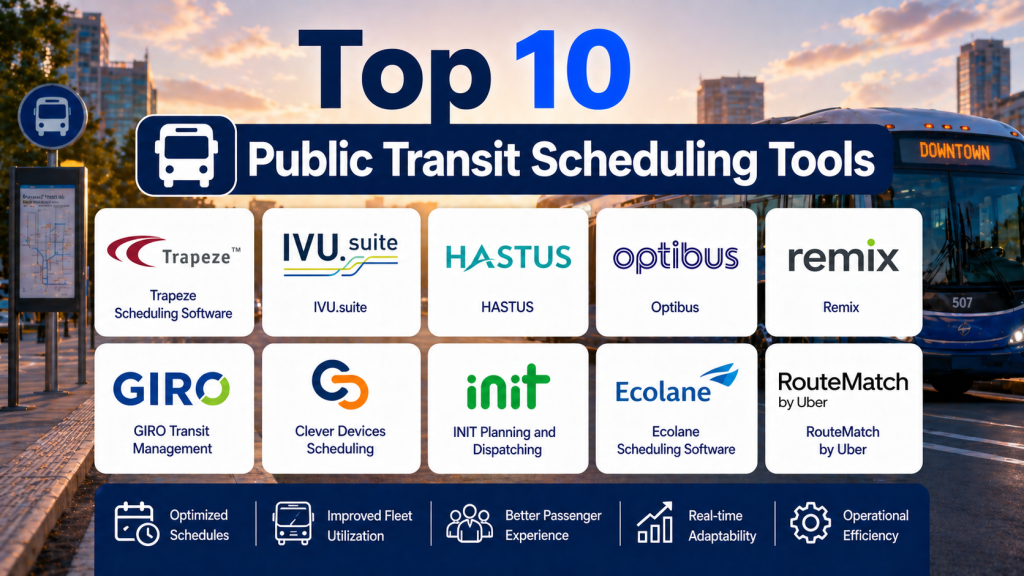
Top 10 Public Transit Scheduling Tools
1 — Trapeze Scheduling Software
Short description: Trapeze is a widely used scheduling solution for public transit agencies. It helps manage routes, schedules, and workforce assignments efficiently. The platform supports large transit networks. It provides strong optimization tools. It is ideal for complex operations.
Key Features
- Route and timetable planning
- Workforce scheduling
- Optimization tools
- Reporting
- Integration capabilities
Pros
- Industry standard
- Strong feature set
Cons
- Complex setup
- Requires training
Platforms / Deployment
Web — Cloud / On-premise
Security & Compliance
Not publicly stated
Integrations & Ecosystem
Integrates with transit and fleet systems
Support & Community
Enterprise support
2 — IVU.suite
Short description: IVU.suite is a modular transit management platform offering scheduling, dispatching, and optimization tools. It supports real-time operations. The system is suitable for mid to large transit agencies. It provides flexibility and scalability. It improves efficiency.
Key Features
- Timetable planning
- Vehicle scheduling
- Crew management
- Real-time dispatching
- Analytics
Pros
- Modular design
- Strong optimization
Cons
- Requires customization
- Learning curve
Platforms / Deployment
Web — Cloud
Security & Compliance
Not publicly stated
Integrations & Ecosystem
Supports ERP and API integrations
Support & Community
Strong support
3 — HASTUS
Short description: HASTUS is a comprehensive transit scheduling solution used by major transit agencies worldwide. It supports planning, scheduling, and operations management. The platform is known for its reliability. It handles complex scheduling needs. It is ideal for large agencies.
Key Features
- Scheduling and planning
- Crew management
- Optimization
- Reporting
- Real-time operations
Pros
- Highly reliable
- Advanced features
Cons
- Complex interface
- High cost
Platforms / Deployment
Web — Cloud
Security & Compliance
Not publicly stated
Integrations & Ecosystem
Integrates with transit systems
Support & Community
Enterprise support
4 — Optibus
Short description: Optibus is a cloud-based scheduling platform that uses AI to optimize transit operations. It helps agencies improve efficiency and reduce costs. The platform is user-friendly and scalable. It is suitable for modern transit systems. It supports real-time planning.
Key Features
- AI-based optimization
- Scheduling and planning
- Real-time adjustments
- Reporting
- Scenario simulation
Pros
- Easy to use
- Strong optimization
Cons
- Premium pricing
- Requires data quality
Platforms / Deployment
Web — Cloud
Security & Compliance
Not publicly stated
Integrations & Ecosystem
API integrations available
Support & Community
Responsive support
5 — Remix
Short description: Remix is a transit planning platform focused on route design and scenario simulation. It helps agencies plan efficient transit networks. The system is intuitive and collaborative. It is suitable for planners. It supports data-driven decisions.
Key Features
- Route design
- Scenario planning
- Data visualization
- Collaboration tools
- Reporting
Pros
- User-friendly
- Strong visualization
Cons
- Limited operational features
- Not full scheduling suite
Platforms / Deployment
Web — Cloud
Security & Compliance
Not publicly stated
Integrations & Ecosystem
Supports data integrations
Support & Community
Good support
6 — GIRO Transit Management
Short description: GIRO provides advanced scheduling and optimization tools for public transit. It supports complex planning and operations. The platform is used by large agencies. It offers strong analytics capabilities. It improves efficiency and reliability.
Key Features
- Scheduling
- Optimization
- Crew management
- Reporting
- Analytics
Pros
- Strong optimization
- Enterprise capabilities
Cons
- Complex system
- Higher cost
Platforms / Deployment
Web — Cloud
Security & Compliance
Not publicly stated
Integrations & Ecosystem
Enterprise integrations
Support & Community
Enterprise support
7 — Clever Devices Scheduling
Short description: Clever Devices provides transit management solutions including scheduling and real-time operations. It helps agencies improve service reliability. The platform integrates with GPS and fleet systems. It is suitable for mid-sized agencies. It supports real-time updates.
Key Features
- Scheduling
- Real-time tracking
- Fleet integration
- Reporting
- Analytics
Pros
- Real-time capabilities
- Reliable system
Cons
- Limited customization
- Smaller ecosystem
Platforms / Deployment
Web — Cloud
Security & Compliance
Not publicly stated
Integrations & Ecosystem
Integrates with fleet systems
Support & Community
Standard support
8 — INIT Planning and Dispatching
Short description: INIT offers planning and dispatching tools for public transit operations. It supports scheduling, monitoring, and optimization. The platform is suitable for large transit systems. It improves coordination. It provides analytics.
Key Features
- Planning and scheduling
- Dispatching
- Monitoring
- Analytics
- Reporting
Pros
- Strong coordination
- Reliable
Cons
- Complex setup
- Requires training
Platforms / Deployment
Web — Cloud
Security & Compliance
Not publicly stated
Integrations & Ecosystem
Enterprise integrations
Support & Community
Enterprise support
9 — Ecolane Scheduling Software
Short description: Ecolane provides scheduling solutions for demand-responsive transit services. It focuses on paratransit and specialized transport. The platform supports dynamic scheduling. It is suitable for smaller agencies. It improves service efficiency.
Key Features
- Demand-responsive scheduling
- Route optimization
- Real-time updates
- Reporting
- Analytics
Pros
- Flexible scheduling
- Good for specialized services
Cons
- Limited enterprise features
- Smaller ecosystem
Platforms / Deployment
Web — Cloud
Security & Compliance
Not publicly stated
Integrations & Ecosystem
Basic integrations
Support & Community
Standard support
10 — RouteMatch by Uber
Short description: RouteMatch provides scheduling and dispatching solutions for transit agencies. It focuses on improving efficiency and reliability. The platform supports real-time operations. It is suitable for mid-sized agencies. It offers analytics and reporting.
Key Features
- Scheduling
- Dispatching
- Real-time tracking
- Reporting
- Analytics
Pros
- Easy to use
- Good real-time features
Cons
- Limited customization
- Smaller ecosystem
Platforms / Deployment
Web — Cloud
Security & Compliance
Not publicly stated
Integrations & Ecosystem
Supports integration with transit systems
Support & Community
Standard support
Comparison Table
| Tool | Best For | Platforms | Deployment | Standout Feature |
|---|---|---|---|---|
| Trapeze | Large agencies | Web | Cloud / On-premise | Industry standard |
| IVU | Mid-large agencies | Web | Cloud | Modular design |
| HASTUS | Enterprise | Web | Cloud | Reliability |
| Optibus | Modern transit | Web | Cloud | AI optimization |
| Remix | Planning teams | Web | Cloud | Visualization |
| GIRO | Enterprise | Web | Cloud | Optimization |
| Clever Devices | Mid-size | Web | Cloud | Real-time tracking |
| INIT | Large systems | Web | Cloud | Coordination |
| Ecolane | Specialized transit | Web | Cloud | Demand response |
| RouteMatch | Mid-size | Web | Cloud | Real-time dispatch |
Evaluation & Scoring
| Tool | Core | Ease | Integrations | Security | Performance | Support | Value | Total |
|---|---|---|---|---|---|---|---|---|
| Trapeze | 9 | 6 | 8 | 7 | 9 | 9 | 6 | 8.0 |
| IVU | 8 | 7 | 8 | 7 | 8 | 8 | 7 | 7.8 |
| HASTUS | 9 | 6 | 8 | 7 | 9 | 9 | 6 | 8.0 |
| Optibus | 8 | 9 | 7 | 7 | 8 | 8 | 7 | 8.0 |
| Remix | 7 | 9 | 6 | 6 | 7 | 7 | 8 | 7.3 |
| GIRO | 9 | 6 | 8 | 7 | 9 | 9 | 6 | 8.0 |
| Clever Devices | 7 | 8 | 7 | 6 | 8 | 7 | 7 | 7.3 |
| INIT | 8 | 6 | 8 | 7 | 8 | 8 | 6 | 7.6 |
| Ecolane | 7 | 8 | 6 | 6 | 7 | 7 | 8 | 7.2 |
| RouteMatch | 7 | 8 | 6 | 6 | 7 | 7 | 8 | 7.2 |
These scores provide a comparative evaluation across functionality, usability, and scalability. Enterprise tools score higher in performance and integrations, while modern cloud tools excel in ease of use. Smaller tools offer better value but may lack advanced features. Always align scores with your transit network needs.
Which Public Transit Scheduling Tool Is Right for You
Small Agencies
Ecolane and RouteMatch are simple and cost-effective.
Mid-Sized Agencies
Optibus and Clever Devices offer automation and real-time capabilities.
Large Transit Systems
Trapeze, HASTUS, and GIRO provide comprehensive enterprise solutions.
Planning-Focused Teams
Remix is ideal for route design and scenario planning.
Budget vs Premium
Budget tools focus on simplicity, premium tools offer advanced optimization.
Feature Depth vs Ease of Use
Advanced systems require training, simpler tools offer faster adoption.
Integrations & Scalability
Choose tools with strong integration for future growth.
Security & Compliance Needs
Larger agencies should prioritize compliance and data protection.
Frequently Asked Questions
1. What are public transit scheduling tools
They are software systems used to plan routes, schedules, and operations. They help transit agencies manage services efficiently. They improve reliability and reduce costs.
2. Why are these tools important
Transit networks are complex. These tools help optimize operations. They reduce delays. They improve passenger experience.
3. What features should I look for
Look for scheduling, optimization, and real-time capabilities. Integration is important. Reporting helps decision-making.
4. Are these tools cloud-based
Most modern tools are cloud-based. This improves scalability and accessibility. It enables real-time updates.
5. Can small agencies use these tools
Yes, there are tools designed for smaller agencies. They offer simplified features. They are easier to deploy.
6. How do these tools improve efficiency
They automate scheduling and provide real-time insights. They optimize routes and reduce costs.
7. Do these tools support real-time updates
Yes, many tools provide real-time data. This helps manage disruptions. It improves service reliability.
8. What are common mistakes when choosing tools
Choosing only based on cost is a mistake. Ignoring integrations can cause issues. Not testing tools can lead to problems.
9. Can these tools scale
Yes, most tools are scalable. They support growing transit networks. They adapt to operational needs.
10. How long does implementation take
Implementation varies by tool. Enterprise tools take longer. Cloud tools are faster to deploy.
Conclusion
Public Transit Scheduling Tools play a vital role in modern transportation systems by enabling agencies to efficiently plan, manage, and optimize transit operations. These platforms bring together scheduling, route planning, real-time tracking, and analytics into a unified system, helping reduce delays, improve service reliability, and enhance passenger satisfaction. As cities continue to grow and mobility demands evolve, adopting advanced scheduling tools is essential for maintaining efficient and sustainable transit services.
From enterprise-grade solutions like Trapeze and HASTUS to modern AI-driven platforms like Optibus, there are tools available for every type of transit agency. The right choice depends on factors such as network size, operational complexity, and budget. There is no single best solution, and agencies must carefully evaluate their needs before making a decision.
A practical approach is to shortlist a few tools, test their capabilities, and assess how well they integrate with existing systems. Running a pilot implementation can help identify operational challenges and ensure the solution meets real-world requirements.
