Introduction
Plagiarism Detection Tools are software platforms that analyze text to identify copied, duplicated, or paraphrased content by comparing it against vast databases of web pages, academic papers, and proprietary sources. These tools help ensure originality, maintain credibility, and prevent intellectual property violations across education, publishing, and digital content industries.
As digital content creation and AI-generated writing continue to grow, plagiarism detection has become more critical than ever. Modern tools go beyond simple copy detection by using advanced algorithms and natural language processing to detect paraphrased or disguised plagiarism.
Common use cases include:
- Academic integrity checks for students and institutions
- Content originality verification for writers and marketers
- Research publication screening
- SEO content validation
- Hiring assessments and submissions
Key evaluation criteria:
- Accuracy in detecting copied and paraphrased content
- Database size and coverage
- AI-content detection capability
- Reporting and similarity scoring
- Integration with LMS and content platforms
- Ease of use and speed
- Security and data privacy
- Pricing and scalability
Best for: Students, educators, researchers, publishers, marketers, and businesses ensuring content originality.
Not ideal for: Casual writing tasks where originality verification is not required.
Key Trends in Plagiarism Detection Tools
- AI-powered detection for paraphrased and rewritten content
- Integration with writing and publishing platforms
- Real-time plagiarism scanning
- Combined AI-content and plagiarism detection
- Expansion of academic and proprietary databases
- Cloud-based tools replacing standalone software
- Automated reporting and similarity scoring
- API-based integration for enterprise workflows
- Privacy-first approaches to document handling
- Increased demand for multilingual plagiarism detection
How We Selected These Tools Methodology
- Evaluated global adoption across academia and content industries
- Assessed detection accuracy for direct and paraphrased plagiarism
- Reviewed database coverage and scanning depth
- Considered ease of use and reporting quality
- Analyzed integration with LMS and publishing systems
- Included tools for students, enterprises, and developers
- Focused on scalability and performance
- Balanced premium and accessible tools
Top 10 Plagiarism Detection Tools
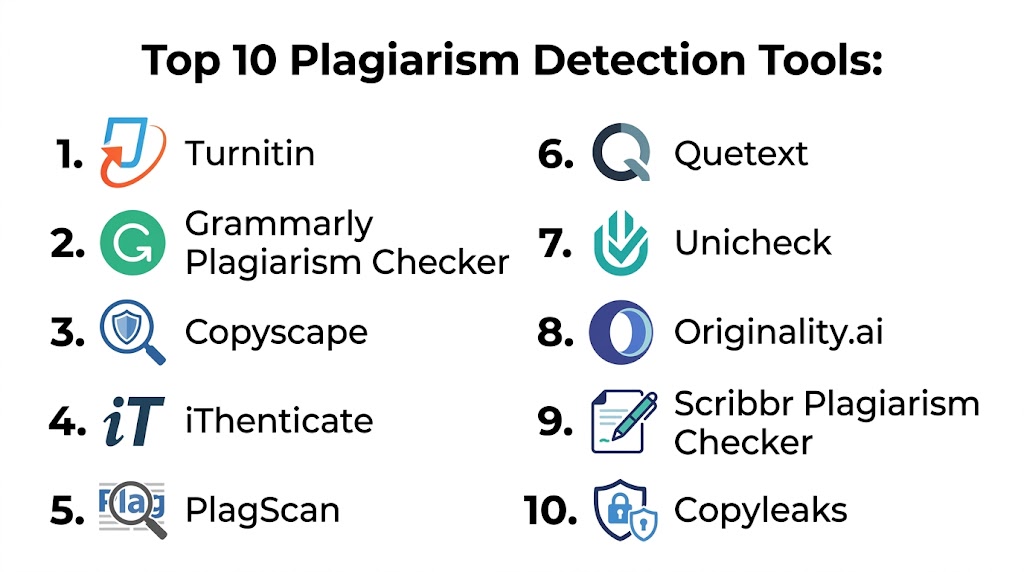
#1 — Turnitin
Short description:
Turnitin is a leading plagiarism detection platform widely used in academic institutions. It compares submissions against extensive databases of student papers, academic publications, and web content. It provides detailed similarity reports with highlighted matches. It is considered a benchmark tool for academic integrity.
Key Features
- Large academic database comparison
- Similarity reports with percentage scoring
- AI-based detection capabilities
- LMS integration
- Feedback and grading tools
- Detailed match highlighting
Pros
- Highly accurate
- Trusted globally
- Strong academic ecosystem
Cons
- Expensive
- Not easily accessible to individuals
- Requires institutional access
Platforms / Deployment
Cloud
Security & Compliance
Encryption, access control, audit logs
Integrations & Ecosystem
Integrates with learning management systems and academic platforms.
- LMS integrations
- APIs
- Institutional workflows
Support & Community
Enterprise-grade academic support
#2 — Grammarly Plagiarism Checker
Short description:
Grammarly offers a plagiarism checker integrated with its writing assistant. It scans text against billions of web pages and academic sources. It is suitable for writers and professionals. It combines grammar correction with originality checks.
Key Features
- Plagiarism detection
- Grammar and writing suggestions
- Real-time checking
- Web database scanning
- Integrated writing tools
Pros
- Easy to use
- Multi-purpose tool
- Fast results
Cons
- Limited academic database
- Requires premium plan
- Less detailed reports
Platforms / Deployment
Web / Browser
Security & Compliance
Not publicly stated
Integrations & Ecosystem
Integrates with writing tools and browsers.
- Browser extensions
- Writing apps
Support & Community
Strong user base
#3 — Copyscape
Short description:
Copyscape is a popular plagiarism checker focused on detecting duplicate web content. It is widely used by bloggers, marketers, and SEO professionals. It scans online content for exact matches. It is effective for detecting direct copying.
Key Features
- Web-based plagiarism detection
- Duplicate content search
- Batch scanning
- API integration
- Automated monitoring
Pros
- Simple to use
- Reliable for web content
- Affordable
Cons
- Limited detection of paraphrasing
- Not academic-focused
- Basic reporting
Platforms / Deployment
Web
Security & Compliance
Not publicly stated
Integrations & Ecosystem
Supports integration with content workflows.
- API
- CMS integrations
Support & Community
Standard support
#4 — iThenticate
Short description:
iThenticate is a plagiarism detection tool designed for researchers and publishers. It helps identify similarity in academic manuscripts before publication. It is trusted by major publishers and institutions. It focuses on research integrity.
Key Features
- Academic content scanning
- Similarity reports
- Large research database
- AI-content detection
- Publishing workflows
Pros
- Strong research focus
- Trusted by publishers
- High accuracy
Cons
- Expensive
- Not for casual users
- Requires setup
Platforms / Deployment
Cloud
Security & Compliance
Not publicly stated
Integrations & Ecosystem
Integrates with publishing systems and research workflows.
- APIs
- Publishing tools
Support & Community
Enterprise support
#5 — PlagScan
Short description:
PlagScan is a plagiarism detection platform designed for academic and business use. It offers detailed reports and customizable scanning options. The platform supports secure document handling. It is suitable for institutions and individuals.
Key Features
- Document comparison
- Similarity reports
- Secure document storage
- Custom scanning options
- Reporting tools
Pros
- Secure
- Flexible
- Detailed reports
Cons
- Pricing varies
- Smaller database
- Limited integrations
Platforms / Deployment
Cloud
Security & Compliance
Not publicly stated
Integrations & Ecosystem
Supports integration with academic tools.
- APIs
- LMS integrations
Support & Community
Good support
#6 — Quetext
Short description:
Quetext is a plagiarism detection tool known for its deep search capabilities and contextual analysis. It is designed for writers and students. The platform provides easy-to-read reports. It supports real-time scanning.
Key Features
- Deep search technology
- Contextual plagiarism detection
- Citation assistance
- Real-time scanning
- Reporting tools
Pros
- User-friendly
- Good for paraphrasing detection
- Affordable
Cons
- Limited enterprise features
- Smaller database
- Basic integrations
Platforms / Deployment
Web
Security & Compliance
Not publicly stated
Integrations & Ecosystem
Supports basic integrations.
- APIs
- Writing tools
Support & Community
Good support
#7 — Unicheck
Short description:
Unicheck is a cloud-based plagiarism detection tool used in education and business. It provides fast scanning and integration with LMS platforms. The platform offers real-time results. It is suitable for institutions and teams.
Key Features
- Real-time scanning
- LMS integration
- Similarity reports
- API support
- Document comparison
Pros
- Fast
- Easy integration
- Scalable
Cons
- Limited advanced features
- Pricing varies
- Smaller ecosystem
Platforms / Deployment
Cloud
Security & Compliance
Not publicly stated
Integrations & Ecosystem
Integrates with learning platforms and business tools.
- APIs
- LMS integrations
Support & Community
Standard support
#8 — Originality.ai
Short description:
Originality.ai is a modern plagiarism and AI detection tool designed for content creators and publishers. It detects both copied content and AI-generated text. The platform provides detailed reports. It is suitable for SEO and publishing teams.
Key Features
- Plagiarism detection
- AI content detection
- High accuracy scanning
- Reporting tools
- Collaboration features
Pros
- Detects AI and plagiarism
- High accuracy
- Modern tool
Cons
- Pricing required
- Limited academic database
- Newer platform
Platforms / Deployment
Cloud
Security & Compliance
Not publicly stated
Integrations & Ecosystem
Supports integration with content workflows.
- APIs
- CMS integrations
Support & Community
Growing community
#9 — Scribbr Plagiarism Checker
Short description:
Scribbr offers a plagiarism checker focused on academic writing and research. It is known for high accuracy in detecting paraphrased content. The platform provides detailed reports. It is widely used by students and researchers.
Key Features
- Academic plagiarism detection
- Detailed similarity reports
- Paraphrase detection
- Secure document handling
- User-friendly interface
Pros
- High accuracy
- Strong academic focus
- Reliable reports
Cons
- Paid service
- Limited integrations
- Not real-time
Platforms / Deployment
Cloud
Security & Compliance
Secure document handling
Integrations & Ecosystem
Supports academic workflows.
- Basic integrations
Support & Community
Strong support
#10 — Copyleaks
Short description:
Copyleaks is a plagiarism detection tool that also supports AI content detection and multilingual scanning. It is used by businesses and educational institutions. The platform offers API integration. It is suitable for enterprise use.
Key Features
- Plagiarism detection
- AI content detection
- Multilingual support
- API integration
- Real-time scanning
Pros
- Developer-friendly
- Supports multiple languages
- Scalable
Cons
- Pricing varies
- Requires setup
- Complex features
Platforms / Deployment
Cloud
Security & Compliance
Not publicly stated
Integrations & Ecosystem
Integrates with enterprise and academic systems.
- APIs
- LMS integrations
Support & Community
Enterprise support
Comparison Table
| Tool Name | Best For | Platform Supported | Deployment | Standout Feature | Public Rating |
|---|---|---|---|---|---|
| Turnitin | Academic institutions | Web | Cloud | Academic database | N/A |
| Grammarly | Writers | Web | Cloud | Writing + plagiarism | N/A |
| Copyscape | SEO content | Web | Cloud | Web scanning | N/A |
| iThenticate | Researchers | Web | Cloud | Research integrity | N/A |
| PlagScan | Institutions | Web | Cloud | Secure scanning | N/A |
| Quetext | Students | Web | Cloud | Deep search | N/A |
| Unicheck | Education | Web | Cloud | Real-time scanning | N/A |
| Originality.ai | Content teams | Web | Cloud | AI detection | N/A |
| Scribbr | Academic writing | Web | Cloud | Paraphrase detection | N/A |
| Copyleaks | Enterprise | Web | Cloud | Multilingual AI detection | N/A |
Evaluation & Scoring of Plagiarism Detection Tools
| Tool Name | Core | Ease | Integrations | Security | Performance | Support | Value | Weighted Total |
|---|---|---|---|---|---|---|---|---|
| Turnitin | 10 | 7 | 9 | 9 | 9 | 9 | 6 | 8.8 |
| Grammarly | 8 | 9 | 8 | 8 | 8 | 8 | 8 | 8.2 |
| Copyscape | 7 | 9 | 7 | 7 | 8 | 7 | 9 | 7.8 |
| iThenticate | 9 | 7 | 8 | 9 | 9 | 8 | 6 | 8.3 |
| PlagScan | 8 | 8 | 7 | 8 | 8 | 7 | 7 | 7.8 |
| Quetext | 8 | 9 | 7 | 7 | 8 | 7 | 8 | 7.9 |
| Unicheck | 8 | 8 | 8 | 8 | 8 | 7 | 7 | 7.9 |
| Originality.ai | 9 | 8 | 7 | 8 | 9 | 7 | 8 | 8.2 |
| Scribbr | 9 | 8 | 6 | 8 | 9 | 8 | 7 | 8.1 |
| Copyleaks | 9 | 7 | 9 | 8 | 9 | 8 | 7 | 8.3 |
How to interpret these scores:
These scores provide a comparative evaluation across essential factors such as detection accuracy, usability, integrations, and value. Higher scores indicate stronger overall performance, but they do not necessarily mean the tool is the best for every use case. Academic-focused tools tend to score higher in database depth and detection accuracy, while content-focused tools perform better in usability and cost efficiency. The weighted scoring model balances all criteria, giving a realistic comparison across different needs. Organizations should prioritize factors such as accuracy, scalability, or ease of use depending on their goals. These scores should be used as a guide and validated through real-world testing before making a final decision.
Which Plagiarism Detection Tool Is Right for You
Solo Freelancer
Use Grammarly or Quetext for quick and affordable plagiarism checks.
SMB
Copyscape or Originality.ai provide strong value for content teams.
Mid Market
Unicheck and Scribbr offer balance between accuracy and usability.
Enterprise
Turnitin, iThenticate, and Copyleaks provide advanced features and scalability.
Budget vs Premium
Budget tools focus on simplicity, while premium tools offer deeper analysis and databases.
Feature Depth vs Ease of Use
Advanced tools provide more accurate detection, while simpler tools prioritize usability.
Integrations & Scalability
API-driven tools are better for scaling across workflows.
Security & Compliance Needs
Academic and enterprise users should prioritize tools with strong data protection.
Frequently Asked Questions FAQs
1 What is a plagiarism detection tool
A plagiarism detection tool scans text and compares it against databases to identify duplicate or copied content. It helps ensure originality. It is widely used in education and publishing. It improves credibility.
2 How do these tools detect plagiarism
They use algorithms to compare text with existing sources and identify similarities. These systems can detect copied and paraphrased content. Advanced tools use AI and NLP techniques.
3 Are plagiarism tools accurate
Most tools are accurate for direct copying, but detecting paraphrased content can be challenging. Advanced tools perform better. Accuracy depends on database size. Choosing the right tool is important.
4 Can they detect AI-generated content
Some modern tools include AI detection features. They identify patterns typical of machine-generated text. Not all tools support this. AI detection is evolving rapidly.
5 Are these tools secure
Security depends on the platform. Many tools offer encryption and secure storage. Users should check data policies. Privacy is important.
6 Do they support academic use
Yes, tools like Turnitin and iThenticate are widely used in academia. They ensure academic integrity. They support research and education. They are trusted globally.
7 How much do these tools cost
Pricing varies widely. Some tools offer free versions. Others require subscriptions or pay-per-use models. Enterprise tools are more expensive. Cost depends on features.
8 Can they integrate with LMS
Yes, many tools integrate with learning platforms for seamless workflows. This improves efficiency. API support is important. Integration varies by tool.
9 What industries use plagiarism tools
Education, publishing, marketing, and recruitment industries use these tools. They ensure originality. They support compliance. Adoption is growing.
10 How do I choose the right tool
Evaluate factors like accuracy, ease of use, integrations, and pricing. Consider your use case. Test multiple tools. Choose one that fits your workflow.
Conclusion
Plagiarism detection tools have become essential in maintaining originality, credibility, and trust in an increasingly digital and AI-driven world by enabling users to identify copied or manipulated content efficiently and at scale. These platforms play a critical role across education, publishing, and content creation by ensuring that work meets ethical and professional standards while reducing the risks associated with intellectual property violations. While enterprise-grade tools offer unmatched database coverage, accuracy, and integration capabilities, lightweight tools provide affordability and ease of use for individuals and small teams. The best choice ultimately depends on your specific needs, whether academic integrity, SEO content validation, or enterprise-scale workflows. A practical approach is to shortlist a few tools, test them in real scenarios, and evaluate how well they align with your accuracy, integration, and security requirements before making a final decision.
