Introduction
Incident Reporting (Safety) Tools are software platforms designed to capture, track, investigate, and resolve workplace incidents such as injuries, near-misses, hazards, and safety violations. These tools replace paper forms and manual reporting with centralized digital systems, enabling faster response, better compliance, and improved workplace safety outcomes.
Incident reporting is a critical part of safety management because it ensures organizations can document events, identify root causes, and take corrective actions before issues escalate. Without structured reporting, incidents may go unnoticed or unresolved, increasing operational risk and compliance exposure.
Common use cases include:
- Logging workplace injuries and near-miss incidents
- Hazard identification and reporting
- Root cause analysis and corrective actions
- Regulatory compliance reporting
- Safety audits and inspections
What buyers should evaluate:
- Real-time incident reporting capabilities
- Mobile and offline access
- Automated alerts and workflows
- Root cause analysis tools
- Corrective and preventive action tracking
- Compliance reporting support
- Integration with EHS and HR systems
- Analytics and dashboards
- Ease of use for frontline workers
- Scalability across sites
Best for: Safety managers, EHS professionals, compliance officers, operations leaders, and organizations in high-risk industries.
Not ideal for: Small teams with minimal safety processes or those relying on basic manual tracking.
Key Trends in Incident Reporting (Safety) Tools
- Mobile-first reporting with offline capability
- Real-time alerts and automated escalation workflows
- AI-driven predictive risk analytics
- Integration with IoT and equipment monitoring systems
- Visual dashboards for safety metrics and trends
- Automated compliance reporting for regulations
- Photo, video, and GPS-enabled reporting
- Cloud-native deployment for scalability
- Cross-location incident visibility
- Integration with maintenance and work order systems
How We Selected These Tools (Methodology)
- Evaluated incident capture and reporting capabilities
- Assessed investigation and root cause analysis features
- Reviewed workflow automation and corrective action tracking
- Considered compliance and regulatory reporting support
- Analyzed mobile usability and offline access
- Evaluated analytics and dashboard capabilities
- Reviewed integrations with EHS and enterprise systems
- Considered scalability across industries
- Assessed vendor reputation and adoption
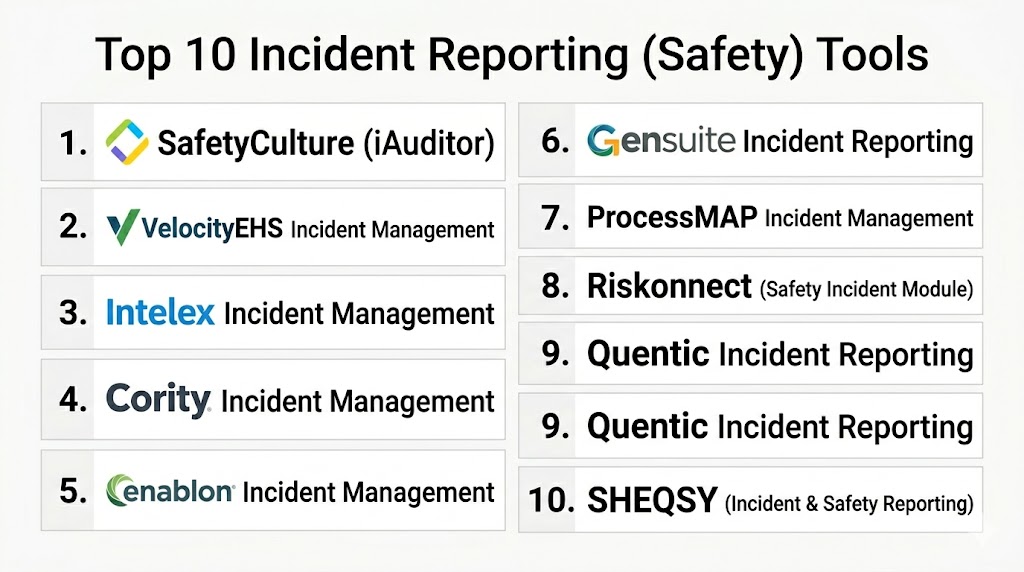
Top 10 Incident Reporting (Safety) Tools
#1 — SafetyCulture (iAuditor)
Short description:
SafetyCulture is a mobile-first incident reporting and inspection tool designed for frontline workers. It enables quick incident capture, audits, and corrective action tracking with an intuitive interface.
Key Features
- Mobile incident reporting
- Inspection checklists
- Photo and video capture
- Corrective action tracking
- Analytics dashboards
Pros
- Easy to use
- Strong mobile experience
Cons
- Limited enterprise compliance depth
- Basic advanced analytics
Platforms / Deployment
Web / Mobile
Cloud
Security & Compliance
Encryption
Integrations & Ecosystem
- Reporting tools
- Workflow automation
Support & Community
Strong community and support.
#2 — VelocityEHS Incident Management
Short description:
VelocityEHS provides comprehensive incident management with real-time reporting, risk assessment, and compliance tracking. It is widely used across industries for safety workflows.
Key Features
- Incident reporting
- Risk tracking
- Compliance tools
- Mobile access
Pros
- User-friendly
- Fast deployment
Cons
- Limited customization
- Analytics depth varies
Platforms / Deployment
Web / Mobile
Cloud
Security & Compliance
Encryption
Integrations & Ecosystem
- HR systems
- Compliance tools
Support & Community
Responsive support.
#3 — Intelex Incident Management
Short description:
Intelex offers a robust EHS platform with incident reporting, investigation workflows, and compliance tracking. It is suited for mid-to-large organizations.
Key Features
- Incident tracking
- Root cause analysis
- Compliance calendar
- Reporting dashboards
Pros
- Comprehensive features
- Strong compliance support
Cons
- Complex setup
- Premium pricing
Platforms / Deployment
Web / Mobile
Cloud
Security & Compliance
SSO, encryption
Integrations & Ecosystem
- HRIS
- ERP systems
Support & Community
Enterprise support.
#4 — Cority Incident Management
Short description:
Cority delivers enterprise-grade incident reporting with end-to-end workflows, analytics, and risk management. It helps organizations prevent incidents through proactive insights.
Key Features
- Incident lifecycle tracking
- Root cause analysis
- Risk scoring
- Analytics dashboards
Pros
- Advanced analytics
- Enterprise scalability
Cons
- Complex implementation
- Higher cost
Platforms / Deployment
Web / Mobile
Cloud
Security & Compliance
SSO, encryption
Integrations & Ecosystem
- ERP
- HR systems
Support & Community
Enterprise-level support.
#5 — Enablon Incident Management
Short description:
Enablon provides advanced incident management as part of its EHS suite. It supports global compliance, risk management, and incident tracking.
Key Features
- Incident reporting
- Risk assessment
- Compliance tracking
- Audit workflows
Pros
- Strong compliance features
- Global scalability
Cons
- Complex setup
- Premium pricing
Platforms / Deployment
Web / Mobile
Cloud
Security & Compliance
SSO, encryption
Integrations & Ecosystem
- Enterprise systems
Support & Community
Enterprise support.
#6 — Gensuite Incident Reporting
Short description:
Gensuite offers modular incident reporting tools with mobile apps and compliance workflows. It supports safety tracking and reporting across multiple locations.
Key Features
- Incident tracking
- Mobile reporting
- Compliance workflows
- Training tools
Pros
- Easy onboarding
- Modular design
Cons
- Limited advanced analytics
- Pricing variability
Platforms / Deployment
Web / Mobile
Cloud
Security & Compliance
Encryption
Integrations & Ecosystem
- ERP systems
Support & Community
Good support.
#7 — ProcessMAP Incident Management
Short description:
ProcessMAP provides incident reporting with analytics, compliance tracking, and risk management tools. It supports mobile and web reporting.
Key Features
- Incident reporting
- Analytics dashboards
- Compliance tracking
- Risk assessment
Pros
- Strong analytics
- Mobile capabilities
Cons
- Setup complexity
- Premium pricing
Platforms / Deployment
Web / Mobile
Cloud
Security & Compliance
Encryption
Integrations & Ecosystem
- HR systems
Support & Community
Professional support.
#8 — Riskonnect Safety Incident Module
Short description:
Riskonnect offers incident reporting and risk management tools with analytics and compliance tracking. It is designed for enterprise risk visibility.
Key Features
- Incident tracking
- Risk analysis
- Compliance workflows
- Reporting dashboards
Pros
- Strong risk management
- Enterprise features
Cons
- Complex implementation
- Cost
Platforms / Deployment
Web
Cloud
Security & Compliance
SSO, encryption
Integrations & Ecosystem
- Risk platforms
Support & Community
Enterprise support.
#9 — Quentic Incident Reporting
Short description:
Quentic provides EHS incident reporting with analytics and compliance tools. It supports environmental and safety tracking.
Key Features
- Incident reporting
- Compliance tracking
- Analytics dashboards
- Environmental modules
Pros
- Sustainability focus
- Scalable
Cons
- Feature complexity
- Pricing
Platforms / Deployment
Web / Mobile
Cloud
Security & Compliance
Encryption
Integrations & Ecosystem
- ERP
- HR systems
Support & Community
Strong support.
#10 — SHEQSY
Short description:
SHEQSY is a safety reporting tool designed for lone worker protection and incident reporting. It supports real-time alerts and mobile safety tracking.
Key Features
- Incident alerts
- Lone worker monitoring
- Mobile reporting
- GPS tracking
Pros
- Real-time safety tracking
- Easy deployment
Cons
- Limited enterprise features
- Focused use case
Platforms / Deployment
Web / Mobile
Cloud
Security & Compliance
Encryption
Integrations & Ecosystem
- Safety systems
Support & Community
Support available.
Comparison Table
| Tool Name | Best For | Platform(s) Supported | Deployment | Standout Feature | Public Rating |
|---|---|---|---|---|---|
| SafetyCulture | SMB | Web/Mobile | Cloud | Mobile reporting | N/A |
| VelocityEHS | Mid-market | Web/Mobile | Cloud | Ease of use | N/A |
| Intelex | Enterprise | Web/Mobile | Cloud | Compliance workflows | N/A |
| Cority | Enterprise | Web/Mobile | Cloud | Advanced analytics | N/A |
| Enablon | Enterprise | Web/Mobile | Cloud | Regulatory depth | N/A |
| Gensuite | Mid-market | Web/Mobile | Cloud | Modular tools | N/A |
| ProcessMAP | Analytics users | Web/Mobile | Cloud | Risk analytics | N/A |
| Riskonnect | Enterprise | Web | Cloud | Risk management | N/A |
| Quentic | Sustainability | Web/Mobile | Cloud | Environmental tracking | N/A |
| SHEQSY | Field teams | Web/Mobile | Cloud | Lone worker safety | N/A |
Evaluation & Scoring of Incident Reporting Tools
| Tool Name | Core | Ease | Integrations | Security | Performance | Support | Value | Weighted Total |
|---|---|---|---|---|---|---|---|---|
| SafetyCulture | 7 | 9 | 7 | 8 | 8 | 8 | 9 | 8.0 |
| VelocityEHS | 8 | 9 | 7 | 8 | 8 | 8 | 8 | 8.1 |
| Intelex | 9 | 7 | 8 | 9 | 8 | 8 | 7 | 8.2 |
| Cority | 9 | 7 | 9 | 9 | 9 | 9 | 7 | 8.6 |
| Enablon | 9 | 7 | 9 | 9 | 9 | 9 | 7 | 8.6 |
| Gensuite | 7 | 9 | 7 | 8 | 8 | 8 | 8 | 8.0 |
| ProcessMAP | 8 | 7 | 8 | 9 | 8 | 8 | 7 | 8.0 |
| Riskonnect | 8 | 7 | 9 | 9 | 8 | 9 | 7 | 8.2 |
| Quentic | 8 | 7 | 8 | 9 | 8 | 8 | 7 | 8.0 |
| SHEQSY | 7 | 9 | 6 | 8 | 7 | 7 | 8 | 7.7 |
How to interpret scores:
These scores compare how each tool performs across key areas such as reporting capabilities, usability, integration, and compliance readiness. Higher scores indicate balanced performance across enterprise needs, while others may excel in specific areas like mobile usability or affordability. Organizations should align scores with operational priorities like compliance depth or ease of use.
Incident reporting tools are especially valuable because they provide real-time visibility, centralized data, and corrective workflows, helping organizations reduce risks and improve safety culture.
Which Incident Reporting Tool Is Right for You?
Solo / Small Teams
SafetyCulture and SHEQSY provide easy-to-use mobile reporting tools.
SMB
VelocityEHS and Gensuite balance usability and features.
Mid-Market
ProcessMAP and Intelex provide analytics and compliance workflows.
Enterprise
Cority, Enablon, and Riskonnect offer scalability and deep compliance features.
Budget vs Premium
SafetyCulture is cost-effective; enterprise tools are premium.
Feature Depth vs Ease of Use
Cority offers depth; SafetyCulture prioritizes ease.
Integrations & Scalability
Enablon, Cority, and Riskonnect lead in integrations.
Security & Compliance Needs
Enterprise tools provide stronger audit trails and regulatory support.
Frequently Asked Questions (FAQs)
1. What are incident reporting tools?
Incident reporting tools are software platforms used to document and manage workplace incidents, near misses, and hazards. They help organizations capture data, investigate causes, and implement corrective actions to improve safety and compliance.
2. Why are these tools important?
They ensure incidents are recorded quickly, enabling timely response and investigation. This helps reduce workplace accidents, improve compliance, and strengthen safety culture.
3. What features should I look for?
Look for real-time reporting, mobile access, automated alerts, root cause analysis, and corrective action tracking. These features ensure efficient incident management.
4. Do these tools support mobile reporting?
Yes, most modern tools allow employees to report incidents via mobile devices, often with offline capabilities for remote environments.
5. How do they improve compliance?
They automate documentation, maintain audit trails, and generate regulatory reports, ensuring organizations meet safety standards.
6. Can these tools reduce accidents?
Yes, by identifying trends and root causes, organizations can implement preventive measures and reduce recurring incidents.
7. Are these tools suitable for all industries?
Yes, they are widely used in manufacturing, construction, healthcare, logistics, and energy sectors.
8. How long does implementation take?
Simple tools can be deployed quickly, while enterprise solutions may take longer due to customization and integration.
9. What is root cause analysis?
It is the process of identifying the underlying cause of an incident to prevent recurrence. These tools automate and standardize this process.
10. Can these tools integrate with other systems?
Yes, most tools integrate with HR systems, ERP platforms, and EHS solutions to provide a unified safety management system.
Conclusion
Incident Reporting (Safety) Tools are essential for organizations that prioritize workplace safety, compliance, and operational efficiency. By replacing manual processes with automated, real-time systems, these tools enable faster reporting, better investigation, and more effective corrective actions. They not only help organizations meet regulatory requirements but also create a proactive safety culture where risks are identified and mitigated early. Whether you choose a simple mobile-first solution like SafetyCulture or an enterprise-grade platform like Cority or Enablon, the right tool depends on your operational scale, compliance needs, and integration requirements. Start by identifying your key safety challenges, shortlist a few tools, and run pilot implementations to ensure the best fit for your organization.

A helpful comparison that clearly explains the features of incident reporting and safety tools, making it easier to evaluate different options and choose the right platform for workplace safety management.