Introduction
Workplace Safety (EHS) Software (Environmental, Health & Safety) refers to digital platforms that help organizations manage safety programs, incidents, risks, compliance obligations, audits, training, and environmental performance in one place. These tools replace spreadsheets, paper‑based reporting, and siloed systems with automated workflows and real‑time visibility into safety operations.
Workplace safety is critical for protecting employees, reducing accidents, complying with regulations, and minimizing environmental impact. Modern EHS platforms centralize incident reporting, automate corrective actions, enable hazard identification, track compliance requirements, and support data‑driven decision‑making. They are increasingly essential in industries like manufacturing, construction, logistics, energy, and chemicals where risks are complex and regulatory scrutiny is high.
Common use cases include:
- Incident and near‑miss reporting
- Risk assessment and hazard tracking
- Safety audits and inspections
- Corrective and preventive action (CAPA) workflows
- Environmental compliance and reporting
- Regulatory tracking (OSHA, EPA, ISO)
What buyers should evaluate:
- Workflow automation and mobile reporting
- Incident tracking and root cause analysis
- Audit and inspection management
- Risk and hazard assessment tools
- Compliance requirements engine
- Reporting and analytics dashboards
- Integration with ERP, HRIS, and IoT data
- Scalability across facilities/geographies
- Security and data governance
- Support and training resources
Best for: EHS leaders, safety managers, compliance officers, risk teams, and operations leaders in industries with safety and environmental risk.
Not ideal for: Small teams with minimal safety obligations or those using basic checklists.
Key Trends in Workplace Safety (EHS) Software
- Mobile first reporting with offline capabilities
- AI‑assisted risk prediction and trend analysis
- Integration with IoT, sensors, and equipment monitoring
- Automated regulatory updates and compliance tracking
- Real‑time dashboards for safety performance metrics
- Predictive analytics for accident prevention
- Cloud‑native platforms with scalable modules
- EHS training and certification tracking
- Gamification of safety engagement
- ESG and sustainability reporting alignment
How We Selected These Tools (Methodology)
- Assessed breadth of core EHS features
- Evaluated incident and risk management capabilities
- Reviewed compliance and regulatory support
- Considered mobile and offline reporting
- Analyzed analytics and dashboard insights
- Evaluated integrations and extensibility
- Considered scalability and global use cases
- Assessed security and data governance
- Reviewed support quality and customer success
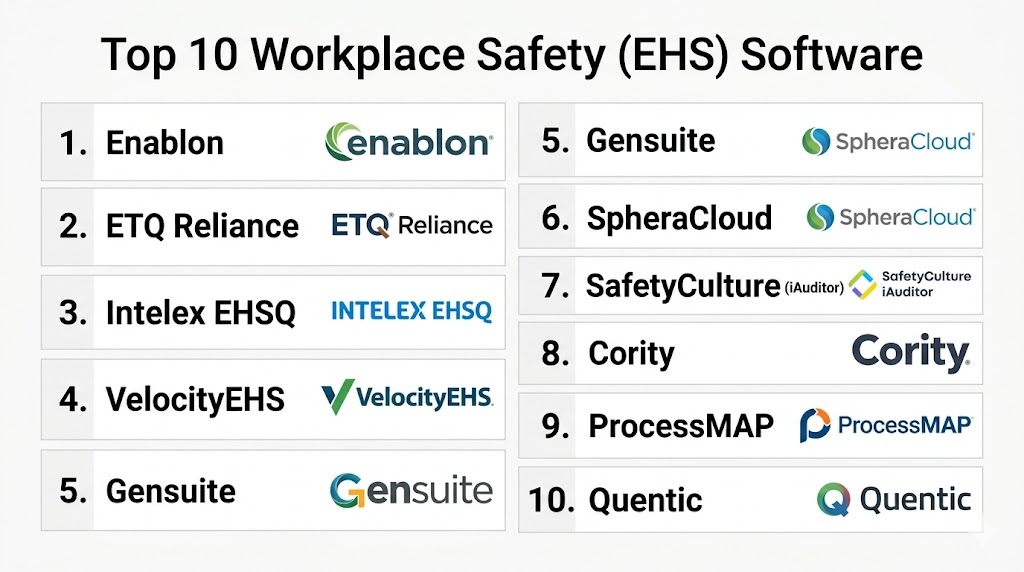
Top 10 Workplace Safety (EHS) Software
#1 — Enablon
Short description:
Enablon is a comprehensive EHS, risk, and sustainability platform used by global enterprises. It supports incident management, risk assessment, compliance, audits, and environmental performance tracking. It is suited for highly regulated industries.
Key Features
- Incident & accident reporting
- Risk assessment modules
- Compliance tracking
- Audit & inspection workflows
- Analytics dashboards
Pros
- Deep enterprise capabilities
- Strong regulatory support
Cons
- Complex implementation
- Premium pricing
Platforms / Deployment
Web / Mobile
Cloud
Security & Compliance
SSO, encryption
Not publicly stated detailed certifications
Integrations & Ecosystem
Integrates with ERP and compliance systems.
Support & Community
Enterprise support with training.
#2 — ETQ Reliance
Short description:
ETQ Reliance provides EHSQ management with powerful workflows, CAPA, and incident tracking. It emphasizes flexibility and configurability for organizations of all sizes.
Key Features
- CAPA & incident management
- Audit & inspection tools
- Risk and hazard tracking
- Compliance requirements engine
Pros
- Highly configurable
- Broad EHSQ coverage
Cons
- Configuration effort
- Learning curve
Platforms / Deployment
Web / Mobile
Cloud
Security & Compliance
SSO, encryption
Integrations & Ecosystem
- ERP
- HR systems
Support & Community
Strong implementation support.
#3 — Intelex EHSQ
Short description:
Intelex EHSQ delivers an integrated platform for safety, risk, and compliance. It provides incident reporting, hazard identification, audits, and training tracking. It is suited for mid‑to‑large organizations.
Key Features
- Incident & near‑miss reporting
- Hazard assessment
- Compliance calendar
- Training tracking
Pros
- Integrated modules
- Mobile reporting
Cons
- Customization complexity
- Premium pricing
Platforms / Deployment
Web / Mobile
Cloud
Security & Compliance
SSO, encryption
Integrations & Ecosystem
- HRIS
- Analytics tools
Support & Community
Comprehensive support.
#4 — VelocityEHS
Short description:
VelocityEHS offers user‑friendly EHS software with strong mobile capabilities. It provides incident management, audits, hazard recognition, and compliance reporting. It is widely adopted across industries.
Key Features
- Mobile incident reporting
- Inspection checklists
- Risk assessment
- OSHA reporting
Pros
- Intuitive interface
- Fast deployment
Cons
- Limited advanced analytics
- Smaller enterprise depth
Platforms / Deployment
Web / Mobile
Cloud
Security & Compliance
Encryption
Not publicly stated detailed certifications
Integrations & Ecosystem
Integrates with HR and reporting systems.
Support & Community
Responsive support.
#5 — Gensuite
Short description:
Gensuite provides EHS and operational risk management with modular apps for incidents, audits, compliance, and training. It supports configurable workflows and real‑time reporting.
Key Features
- Incident tracking
- Audit & compliance tools
- Mobile apps
- Training modules
Pros
- Modular platform
- Easy onboarding
Cons
- Enterprise features limited
- Pricing variable
Platforms / Deployment
Web / Mobile
Cloud
Security & Compliance
Encryption
Integrations & Ecosystem
- ERP
- Analytics systems
Support & Community
Good support resources.
#6 — SpheraCloud
Short description:
SpheraCloud offers EHS, risk, and product stewardship software. It supports incident management, risk analysis, compliance, and environmental data tracking.
Key Features
- EHS & risk reporting
- Compliance tracking
- Environmental performance
- Audit workflows
Pros
- Strong environmental focus
- Scalable platform
Cons
- Complex setup
- Advanced pricing
Platforms / Deployment
Web / Mobile
Cloud
Security & Compliance
Encryption
Integrations & Ecosystem
- ERP systems
Support & Community
Enterprise support.
#7 — SafetyCulture (iAuditor)
Short description:
SafetyCulture (iAuditor) provides inspection, audit, and checklist tools with mobile first reporting. It supports incident reporting and corrective action tracking with easy‑to‑use templates.
Key Features
- Mobile inspection checklists
- Incident reporting
- Corrective actions
- Analytics dashboards
Pros
- Mobile and intuitive
- Affordable for SMBs
Cons
- Limited advanced EHS compliance
- Not suited for large enterprises
Platforms / Deployment
Web / Mobile
Cloud
Security & Compliance
Encryption
Integrations & Ecosystem
- Reporting tools
Support & Community
Strong community support.
#8 — Cority
Short description:
Cority delivers EHSQ and occupational health software with incident tracking, risk assessment, exposure management, and compliance reporting. It serves large enterprises across industries.
Key Features
- Incident & risk management
- Exposure tracking
- Compliance & reporting
- Analytics
Pros
- Enterprise depth
- Broad health modules
Cons
- Complex deployment
- Premium cost
Platforms / Deployment
Web / Mobile
Cloud
Security & Compliance
SSO, encryption
Integrations & Ecosystem
- HRIS
- ERP
Support & Community
Enterprise support.
#9 — ProcessMAP
Short description:
ProcessMAP provides EHS and risk management solutions with incident reporting, audits, compliance tracking, and analytics. It supports mobile and web reporting.
Key Features
- Incident tracking
- Audit & compliance
- Dashboards
- Mobile reporting
Pros
- Analytics focus
- Mobile capabilities
Cons
- Setup effort
- Premium pricing
Platforms / Deployment
Web / Mobile
Cloud
Security & Compliance
Encryption
Integrations & Ecosystem
- HR systems
Support & Community
Professional support.
#10 — Quentic
Short description:
Quentic provides EHS and sustainability software with incident management, risk assessment, compliance, and environmental tracking. It supports configurable workflows and mobile reporting.
Key Features
- Incident & risk tools
- Compliance tracking
- Environmental modules
- Mobile reporting
Pros
- Sustainability alignment
- Scalable
Cons
- Feature complexity
- Pricing model
Platforms / Deployment
Web / Mobile
Cloud
Security & Compliance
Encryption
Integrations & Ecosystem
- ERP
- HRIS
Support & Community
Strong support.
Comparison Table
| Tool Name | Best For | Platform(s) Supported | Deployment | Standout Feature | Public Rating |
|---|---|---|---|---|---|
| Enablon | Enterprise | Web/Mobile | Cloud | Regulatory depth | N/A |
| ETQ Reliance | Mid/Enterprise | Web/Mobile | Cloud | Configurable workflows | N/A |
| Intelex EHSQ | Mid/Large | Web/Mobile | Cloud | Integrated modules | N/A |
| VelocityEHS | SMB/All | Web/Mobile | Cloud | Intuitive UI | N/A |
| Gensuite | Modular users | Web/Mobile | Cloud | Modular apps | N/A |
| SpheraCloud | Environmental focus | Web/Mobile | Cloud | Environmental tracking | N/A |
| SafetyCulture | SMB | Web/Mobile | Cloud | Mobile inspections | N/A |
| Cority | Enterprise health | Web/Mobile | Cloud | Occupational health | N/A |
| ProcessMAP | Analytics users | Web/Mobile | Cloud | Analytics | N/A |
| Quentic | Sustainability | Web/Mobile | Cloud | Sustainability features | N/A |
Evaluation & Scoring of Workplace Safety (EHS) Software
| Tool Name | Core | Ease | Integrations | Security | Performance | Support | Value | Weighted Total |
|---|---|---|---|---|---|---|---|---|
| Enablon | 9 | 7 | 9 | 9 | 9 | 9 | 7 | 8.6 |
| ETQ Reliance | 8 | 8 | 8 | 9 | 8 | 8 | 7 | 8.1 |
| Intelex EHSQ | 8 | 7 | 8 | 9 | 8 | 8 | 7 | 8.0 |
| VelocityEHS | 7 | 9 | 7 | 8 | 8 | 8 | 8 | 8.0 |
| Gensuite | 7 | 9 | 7 | 8 | 8 | 8 | 8 | 8.0 |
| SpheraCloud | 8 | 7 | 8 | 9 | 8 | 8 | 7 | 8.0 |
| SafetyCulture | 7 | 9 | 7 | 8 | 7 | 8 | 9 | 8.0 |
| Cority | 9 | 7 | 9 | 9 | 9 | 9 | 7 | 8.6 |
| ProcessMAP | 8 | 7 | 8 | 9 | 8 | 8 | 7 | 8.0 |
| Quentic | 8 | 7 | 8 | 9 | 8 | 8 | 7 | 8.0 |
How to interpret scores:
Scores show comparative strengths across core safety management, user experience, integrations, security, performance, support, and overall value. Enterprise platforms like Enablon and Cority shine in depth and analytics, while user‑friendly tools like VelocityEHS and SafetyCulture excel in ease and mobile reporting. Organizations should match scoring with their risk profile, compliance complexity, and reporting needs.
Which Workplace Safety (EHS) Software Is Right for You?
Solo / Small Teams
VelocityEHS and SafetyCulture offer intuitive, affordable reporting with mobile support.
SMB / Growing Organizations
Gensuite and ProcessMAP balance features and analytics suitable for mid‑sized teams.
Mid‑Market / Large Organizations
ETQ Reliance and Intelex provide modular tools and compliance workflows.
Enterprise & Regulated Industries
Enablon and Cority deliver depth, scalability, and advanced safety and health modules.
Budget vs Premium
SafetyCulture and VelocityEHS are cost‑effective; Enablon and Cority are premium.
Feature Depth vs Ease of Use
Enablon offers comprehensive compliance features; VelocityEHS prioritizes ease of use.
Integrations & Scalability
Cority, Enablon, and ETQ lead in enterprise integrations and scalability.
Environmental & Sustainability Needs
SpheraCloud and Quentic align with EHS plus sustainability reporting.
Frequently Asked Questions
1. What is EHS software?
EHS software helps organizations manage environmental, health, and safety activities such as incident reporting, audits, risk assessments, and compliance. It centralizes processes and data to improve safety performance and reduce risk.
2. Why do organizations need workplace safety software?
Safety software automates incident capture, hazard identification, compliance tracking, and audits. This improves accuracy, reduces manual work, and supports legal and regulatory compliance.
3. What features should I prioritize?
Key features include incident reporting, mobile inspection tools, risk assessment, compliance tracking, analytics dashboards, and integrations with HR/ERP systems.
4. Do these tools support mobile reporting?
Yes, most modern EHS tools include mobile apps for on‑site reporting, inspections, and alerts — often with offline capabilities.
5. How do EHS platforms help compliance?
They maintain compliance calendars, automate reminders, provide audit trails, and generate reports that demonstrate conformance with OSHA, EPA, ISO, and other requirements.
6. Are these tools suitable for small companies?
Some solutions like SafetyCulture and VelocityEHS are well‑suited for smaller teams. Larger platforms are more appropriate for complex enterprise environments.
7. What integrations matter?
Integrations with HR systems, ERP, analytics platforms, and IoT data sources extend visibility and automate safety KPI tracking.
8. How long does implementation take?
Implementation timelines vary by platform and company size. Simpler systems can be deployed in weeks; enterprise suites may take several months.
9. Can EHS software track compliance internationally?
Yes, many enterprise platforms support multi‑jurisdictional compliance tracking and reporting.
10. How do these tools improve safety culture?
They facilitate timely reporting, visibility into performance metrics, and accountability workflows, which help build a proactive safety culture.
Conclusion
Workplace Safety (EHS) software has become essential for organizations striving to protect employees, ensure regulatory compliance, and manage environmental impact with efficiency and insight. By digitizing incident reporting, risk tracking, audits, and compliance workflows, these platforms help teams reduce accidents, minimize risk exposure, and make data‑driven decisions. From intuitive mobile tools like VelocityEHS and SafetyCulture to enterprise suites like Enablon and Cority, there are solutions for organizations of all sizes and complexity levels. The best choice depends on your industry’s risk profile, regulatory environment, scale of operations, and reporting needs. Shortlist tools that align with your workflows, trial key features, and validate integrations to ensure a seamless fit that enhances your safety culture and operational resilience.

This article provides a useful overview of workplace safety and EHS software, with a clear comparison that helps readers understand the strengths of different platforms and make informed decisions.