Introduction
Supplier Portal Platforms are digital systems that enable organizations to collaborate, communicate, and transact with suppliers through a centralized interface. These platforms allow suppliers to manage orders, submit invoices, update information, and track performance in real time—eliminating manual processes and email-based workflows.
In modern supply chains, supplier portals are essential for improving transparency, efficiency, and collaboration. Businesses are increasingly moving toward digital procurement ecosystems where suppliers actively participate through self-service portals. This shift helps organizations reduce operational friction and strengthen supplier relationships.
Common use cases include:
- Supplier onboarding and self-registration
- Purchase order and invoice management
- Supplier performance tracking
- Real-time communication and collaboration
- Compliance and documentation management
What buyers should evaluate:
- Supplier onboarding and usability
- Integration with procurement and ERP systems
- Workflow automation capabilities
- Real-time visibility and reporting
- Collaboration and communication tools
- Scalability for global supplier networks
- Security and compliance features
- Mobile accessibility
- Customization and flexibility
Best for: Procurement teams, supply chain managers, finance departments, and enterprises managing multiple vendors across regions.
Not ideal for: Small businesses with very few suppliers or those with simple procurement processes.
Key Trends in Supplier Portal Platforms
- AI-driven supplier risk monitoring and alerts
- Self-service supplier onboarding workflows
- Real-time collaboration and messaging
- Integration with full procurement suites
- Cloud-native platforms for scalability
- Advanced analytics and dashboards
- Automation of invoicing and approvals
- ESG and compliance tracking
- API-first integration ecosystems
- Mobile-friendly supplier interfaces
How We Selected These Tools (Methodology)
- Evaluated market adoption and industry recognition
- Assessed supplier portal functionality and usability
- Reviewed integration with procurement and ERP systems
- Considered automation and workflow capabilities
- Analyzed scalability across global supply chains
- Evaluated analytics and reporting features
- Reviewed security and compliance readiness
- Considered customer support and ecosystem strength
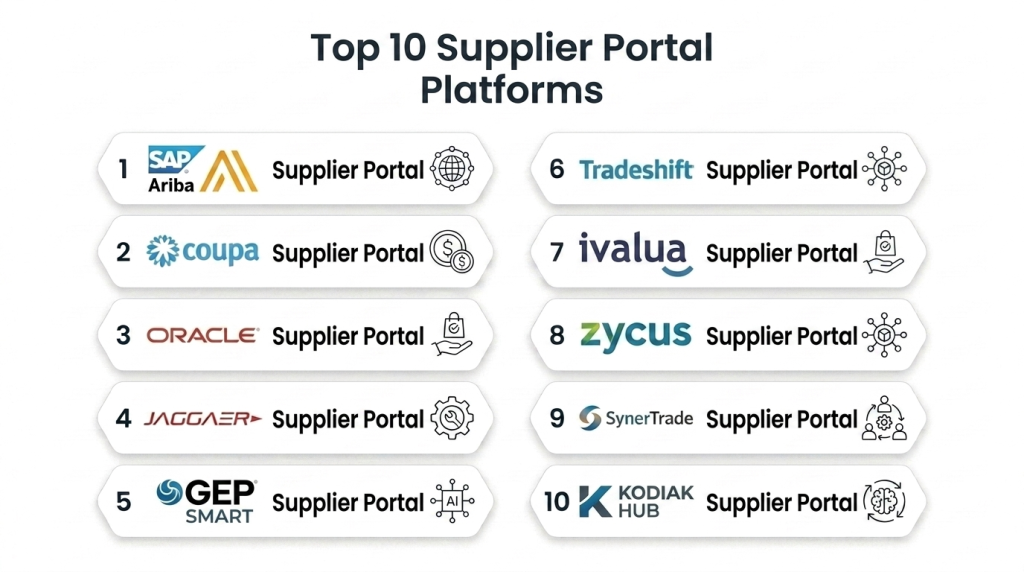
Top 10 Supplier Portal Platforms
#1 — SAP Ariba Supplier Portal
Short description:
SAP Ariba Supplier Portal is one of the most widely used supplier collaboration platforms. It enables suppliers to manage transactions, invoices, and communication in a unified environment. The platform connects buyers and suppliers globally. It is ideal for enterprises with large supplier networks.
Key Features
- Supplier onboarding and registration
- Purchase order management
- Invoice submission and tracking
- Supplier collaboration tools
- Analytics dashboards
Pros
- Large supplier network
- Strong enterprise capabilities
Cons
- Complex implementation
- Cost considerations
Platforms / Deployment
Web
Cloud
Security & Compliance
SSO, MFA, encryption
SOC 2, GDPR
Integrations & Ecosystem
SAP Ariba integrates deeply with enterprise procurement systems.
- SAP ERP
- Procurement tools
- Supply chain platforms
Support & Community
Enterprise-grade support with extensive documentation.
#2 — Coupa Supplier Portal
Short description:
Coupa Supplier Portal provides a user-friendly interface for supplier collaboration and transaction management. It helps organizations manage supplier interactions and spending efficiently. The platform emphasizes usability and real-time insights. It is suitable for mid-market and enterprise companies.
Key Features
- Supplier onboarding
- Invoice management
- Spend visibility
- Risk monitoring
Pros
- Easy to use
- Strong analytics
Cons
- Premium pricing
- Customization limits
Platforms / Deployment
Web
Cloud
Security & Compliance
SSO, encryption
Integrations & Ecosystem
Coupa integrates with finance and procurement systems.
- ERP systems
- Accounting tools
Support & Community
Strong onboarding and support resources.
#3 — Oracle Supplier Portal
Short description:
Oracle Supplier Portal is part of Oracle’s procurement suite, offering supplier collaboration and transaction management. It allows suppliers to manage orders, invoices, and contracts efficiently. The platform integrates seamlessly with Oracle Cloud. It is ideal for enterprise environments.
Key Features
- Supplier self-service
- Invoice and order management
- Contract management
- Analytics
Pros
- Strong integration
- Scalable platform
Cons
- Best within Oracle ecosystem
- Implementation complexity
Platforms / Deployment
Web
Cloud
Security & Compliance
SSO, encryption
Integrations & Ecosystem
Oracle integrates with enterprise applications for unified workflows.
- Oracle ERP
- Supply chain tools
Support & Community
Enterprise-level support.
#4 — JAGGAER Supplier Portal
Short description:
JAGGAER Supplier Portal provides tools for supplier onboarding, collaboration, and performance tracking. It is designed for industries like healthcare, education, and manufacturing. The platform supports scalable supplier management. It focuses on improving procurement efficiency.
Key Features
- Supplier lifecycle management
- Performance tracking
- Collaboration tools
- Analytics dashboards
Pros
- Industry-specific features
- Scalable platform
Cons
- Complex setup
- Cost considerations
Platforms / Deployment
Web
Cloud
Security & Compliance
Not publicly stated
Integrations & Ecosystem
JAGGAER integrates with procurement systems.
- ERP systems
- Data tools
Support & Community
Enterprise support with onboarding.
#5 — GEP SMART Supplier Portal
Short description:
GEP SMART Supplier Portal is part of a unified procurement platform that enables supplier collaboration and management. It offers automation, analytics, and global supplier network capabilities. The platform supports digital procurement transformation. It is designed for large enterprises.
Key Features
- Supplier onboarding
- Spend analysis
- Risk tracking
- Collaboration tools
Pros
- Integrated platform
- Strong analytics
Cons
- Implementation complexity
- Premium pricing
Platforms / Deployment
Web
Cloud
Security & Compliance
Not publicly stated
Integrations & Ecosystem
GEP SMART integrates with enterprise procurement systems.
- ERP systems
- Supply chain tools
Support & Community
Enterprise-level support.
#6 — Tradeshift Supplier Portal
Short description:
Tradeshift Supplier Portal connects buyers and suppliers through a global network. It offers invoicing, procurement, and collaboration tools. The platform focuses on digital transformation and automation. It is suitable for global enterprises.
Key Features
- Supplier network
- Invoice management
- Collaboration tools
- Analytics
Pros
- Global reach
- Strong network effects
Cons
- Complex pricing
- Setup effort
Platforms / Deployment
Web
Cloud
Security & Compliance
Not publicly stated
Integrations & Ecosystem
Tradeshift integrates with financial and procurement systems.
- ERP systems
- Finance tools
Support & Community
Enterprise support with onboarding.
#7 — Ivalua Supplier Portal
Short description:
Ivalua Supplier Portal provides a unified platform for supplier management and collaboration. It supports onboarding, performance tracking, and risk management. The platform is highly configurable. It is ideal for organizations with complex procurement processes.
Key Features
- Supplier onboarding
- Risk management
- Performance tracking
- Contract management
Pros
- Highly configurable
- Strong feature set
Cons
- Learning curve
- Implementation effort
Platforms / Deployment
Web
Cloud
Security & Compliance
SSO, MFA
Integrations & Ecosystem
Ivalua integrates with enterprise systems for comprehensive workflows.
- ERP systems
- Supply chain tools
Support & Community
Enterprise support with training.
#8 — Zycus Supplier Portal
Short description:
Zycus Supplier Portal offers AI-driven supplier management and collaboration tools. It helps organizations manage suppliers, track performance, and automate workflows. The platform focuses on analytics and automation. It is suitable for enterprises and mid-sized companies.
Key Features
- Supplier lifecycle management
- AI-driven insights
- Risk tracking
- Analytics dashboards
Pros
- Strong automation
- AI capabilities
Cons
- Implementation effort
- Cost considerations
Platforms / Deployment
Web
Cloud
Security & Compliance
Not publicly stated
Integrations & Ecosystem
Zycus integrates with procurement systems for unified operations.
- ERP systems
- Data tools
Support & Community
Enterprise support.
#9 — SynerTrade Supplier Portal
Short description:
SynerTrade Supplier Portal provides procurement and supplier collaboration tools with strong analytics capabilities. It supports supplier lifecycle management and performance tracking. The platform is designed for enterprise organizations. It focuses on digital procurement transformation.
Key Features
- Supplier management
- Risk tracking
- Analytics tools
- Collaboration features
Pros
- Strong analytics
- Enterprise focus
Cons
- Learning curve
- Limited SMB adoption
Platforms / Deployment
Web
Cloud
Security & Compliance
Not publicly stated
Integrations & Ecosystem
SynerTrade integrates with enterprise systems for procurement workflows.
- ERP systems
- Data tools
Support & Community
Enterprise support.
#10 — Kodiak Hub Supplier Portal
Short description:
Kodiak Hub Supplier Portal focuses on supplier collaboration and performance management. It provides data-driven insights and risk monitoring. The platform is designed for mid-market and enterprise companies. It helps improve supplier relationships and visibility.
Key Features
- Supplier performance tracking
- Risk management
- Collaboration tools
- Analytics dashboards
Pros
- Easy to use
- Strong collaboration
Cons
- Smaller ecosystem
- Limited enterprise depth
Platforms / Deployment
Web
Cloud
Security & Compliance
Not publicly stated
Integrations & Ecosystem
Kodiak Hub integrates with procurement and data systems.
- ERP systems
- Data tools
Support & Community
Responsive support with growing community.
Comparison Table
| Tool Name | Best For | Platform(s) Supported | Deployment | Standout Feature | Public Rating |
|---|---|---|---|---|---|
| SAP Ariba | Enterprise | Web | Cloud | Global supplier network | N/A |
| Coupa | Mid-market | Web | Cloud | Spend visibility | N/A |
| Oracle | Enterprise | Web | Cloud | ERP integration | N/A |
| JAGGAER | Enterprise | Web | Cloud | Industry focus | N/A |
| GEP SMART | Enterprise | Web | Cloud | Unified procurement | N/A |
| Tradeshift | Enterprise | Web | Cloud | Supplier network | N/A |
| Ivalua | Enterprise | Web | Cloud | Configurability | N/A |
| Zycus | Enterprise | Web | Cloud | AI insights | N/A |
| SynerTrade | Enterprise | Web | Cloud | Analytics | N/A |
| Kodiak Hub | Mid-market | Web | Cloud | Collaboration | N/A |
Evaluation & Scoring of Supplier Portal Platforms
| Tool Name | Core | Ease | Integrations | Security | Performance | Support | Value | Weighted Total |
|---|---|---|---|---|---|---|---|---|
| SAP Ariba | 9 | 7 | 9 | 9 | 9 | 9 | 7 | 8.5 |
| Coupa | 8 | 9 | 8 | 8 | 8 | 8 | 8 | 8.1 |
| Oracle | 9 | 7 | 9 | 8 | 9 | 9 | 7 | 8.4 |
| JAGGAER | 8 | 7 | 8 | 7 | 8 | 8 | 7 | 7.8 |
| GEP SMART | 9 | 7 | 8 | 7 | 8 | 8 | 7 | 8.0 |
| Tradeshift | 8 | 7 | 8 | 7 | 8 | 8 | 7 | 7.8 |
| Ivalua | 9 | 7 | 8 | 8 | 9 | 8 | 7 | 8.2 |
| Zycus | 8 | 8 | 8 | 7 | 8 | 8 | 7 | 7.9 |
| SynerTrade | 8 | 7 | 7 | 7 | 8 | 8 | 7 | 7.7 |
| Kodiak Hub | 7 | 9 | 7 | 7 | 7 | 7 | 8 | 7.6 |
How to interpret scores:
These scores are comparative and designed to help you shortlist the right tools. Higher scores reflect stronger enterprise capabilities, integrations, and scalability. Some platforms focus more on usability and collaboration, while others prioritize deep functionality and automation. Always align your choice with your business needs, supplier complexity, and integration requirements.
Which Supplier Portal Platform Is Right for You?
Solo / Freelancer
Supplier portals are generally not required due to limited supplier complexity.
SMB
Kodiak Hub or Coupa provide easy-to-use interfaces and essential features.
Mid-Market
Coupa and Zycus offer a balance of usability and functionality.
Enterprise
SAP Ariba, Oracle, and Ivalua are ideal for managing large supplier ecosystems.
Budget vs Premium
Budget-friendly options include Kodiak Hub, while premium solutions include SAP and Oracle.
Feature Depth vs Ease of Use
SAP Ariba offers deep functionality, while Coupa provides a more user-friendly experience.
Integrations & Scalability
SAP, Oracle, and GEP SMART lead in integrations and scalability.
Security & Compliance Needs
Enterprise platforms provide stronger security and compliance features.
Frequently Asked Questions
1. What is a supplier portal platform?
A supplier portal platform is a digital system that allows suppliers to interact with buyers through a centralized interface. It enables tasks like order management, invoicing, and communication. These platforms improve efficiency and transparency. They also reduce manual processes across procurement workflows.
2. Why are supplier portals important for businesses?
Supplier portals improve collaboration and communication between companies and suppliers. They provide real-time visibility into transactions and performance. This helps reduce delays and errors. Ultimately, they strengthen supplier relationships and improve supply chain efficiency.
3. What features should a good supplier portal include?
Key features include supplier onboarding, invoice management, performance tracking, and analytics. Automation and integration with ERP systems are also important. Collaboration tools enhance communication. These features ensure smooth supplier interactions.
4. Can supplier portals integrate with ERP systems?
Yes, most modern supplier portals integrate with ERP systems. This allows seamless data sharing across procurement and finance functions. Integration improves accuracy and efficiency. It also reduces manual work and errors.
5. Are supplier portals suitable for small businesses?
Some platforms are designed for SMBs, but many are enterprise-focused. Small businesses with limited suppliers may not need advanced tools. However, growing companies can benefit from basic supplier portals. The decision depends on complexity.
6. How long does it take to implement a supplier portal?
Implementation time varies depending on the platform and organization size. SMB solutions may take a few weeks. Enterprise platforms can take several months. Proper planning and training help ensure successful deployment.
7. What industries benefit most from supplier portals?
Industries like manufacturing, retail, logistics, and healthcare benefit the most. These sectors rely heavily on supplier networks. Supplier portals help manage complexity. They also improve operational efficiency and collaboration.
8. Do supplier portals support real-time updates?
Yes, many modern platforms provide real-time updates on orders, invoices, and supplier performance. This helps organizations respond quickly to changes. Real-time visibility improves decision-making. It also enhances supply chain agility.
9. What are common challenges when using supplier portals?
Common challenges include integration complexity, user adoption, and data quality issues. Organizations may also face resistance to change. Proper training and support can address these challenges. Choosing the right platform also helps.
10. Can companies switch supplier portal platforms easily?
Switching is possible but requires careful planning. Data migration and system integration are key challenges. Organizations should evaluate compatibility before switching. Running a pilot phase can reduce risks.
Conclusion
Supplier Portal Platforms have become a critical component of modern procurement and supply chain strategies, enabling organizations to build stronger, more transparent, and collaborative relationships with their suppliers. By centralizing communication, automating workflows, and providing real-time visibility into supplier interactions, these platforms help reduce operational inefficiencies and improve decision-making. As supply chains grow more complex and globalized, businesses must move away from manual processes and adopt digital solutions that support scalability and resilience. The tools covered in this guide offer a wide range of capabilities, from simple supplier onboarding to advanced analytics and AI-driven insights. However, the right platform depends on your organization’s size, supplier network complexity, and integration requirements. Enterprises may benefit from comprehensive platforms like SAP or Oracle, while mid-sized businesses may prefer more flexible and user-friendly solutions. The best approach is to shortlist a few tools, run pilot implementations, and validate integrations before making a final decision to ensure long-term success and value.
