Introduction
Supplier Relationship Management Tools help organizations manage, evaluate, and collaborate with their suppliers more effectively. These platforms go beyond basic procurement by enabling businesses to track supplier performance, manage risks, streamline onboarding, and improve communication across the supply chain.
In today’s global and highly interconnected supply chains, managing supplier relationships is critical. Disruptions, compliance requirements, and cost pressures make it essential for companies to have visibility and control over their supplier ecosystem. SRM tools help organizations move from transactional supplier interactions to strategic partnerships.
Common use cases include:
- Supplier onboarding and qualification
- Performance tracking and scorecards
- Risk management and compliance monitoring
- Contract and document management
- Collaboration with vendors and partners
What buyers should evaluate:
- Supplier lifecycle management capabilities
- Risk and compliance tracking
- Ease of onboarding suppliers
- Integration with procurement and ERP systems
- Analytics and reporting features
- Collaboration and communication tools
- Scalability across global suppliers
- Automation capabilities
- Security and compliance standards
Best for: Procurement teams, supply chain managers, finance departments, and enterprises managing large supplier networks.
Not ideal for: Small businesses with limited suppliers or those that rely on simple procurement processes.
Key Trends in Supplier Relationship Management Tools
- AI-driven supplier risk analysis
- Real-time supplier performance monitoring
- Integration with procurement and finance platforms
- Cloud-based supplier collaboration portals
- Automation of supplier onboarding workflows
- Advanced analytics and predictive insights
- ESG and sustainability tracking
- Increased focus on compliance and regulations
- API-driven ecosystems for integration
- Supplier diversity and inclusion tracking
How We Selected These Tools (Methodology)
- Evaluated market adoption and vendor reputation
- Assessed supplier lifecycle management capabilities
- Reviewed integration with ERP and procurement systems
- Considered ease of use and onboarding experience
- Analyzed risk and compliance features
- Evaluated analytics and reporting capabilities
- Checked scalability for global operations
- Reviewed customer support and ecosystem strength
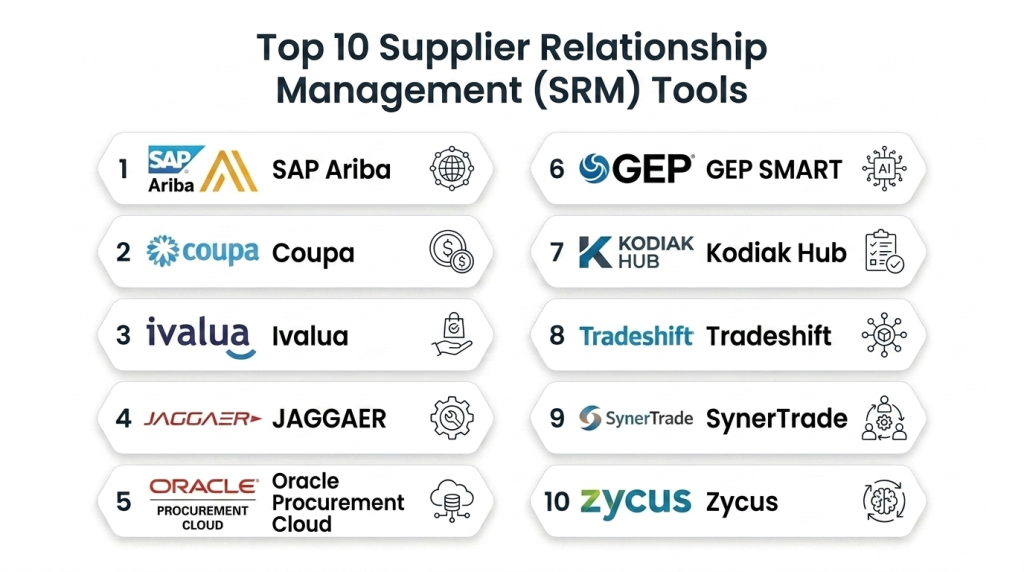
Top 10 Supplier Relationship Management Tools
#1 — SAP Ariba
Short description:
SAP Ariba is a leading SRM platform designed for large enterprises. It provides comprehensive supplier management, procurement, and collaboration tools. The platform enables organizations to manage supplier relationships at scale. It also integrates deeply with SAP systems for end-to-end procurement workflows.
Key Features
- Supplier lifecycle management
- Risk and compliance tracking
- Procurement integration
- Supplier collaboration tools
- Analytics dashboards
Pros
- Strong enterprise capabilities
- Large supplier network
Cons
- Complex implementation
- Higher cost
Platforms / Deployment
Web
Cloud
Security & Compliance
SSO, MFA, encryption
SOC 2, GDPR
Integrations & Ecosystem
SAP Ariba integrates with enterprise systems for seamless procurement workflows.
- SAP ERP
- Procurement systems
- Data platforms
Support & Community
Enterprise-grade support with global reach and strong documentation.
#2 — Coupa
Short description:
Coupa is a cloud-based spend management platform with strong SRM capabilities. It helps organizations manage suppliers, track spending, and optimize procurement processes. The platform focuses on usability and data-driven insights. It is widely used by mid-market and enterprise companies.
Key Features
- Supplier management
- Spend analysis
- Risk monitoring
- Procurement workflows
Pros
- User-friendly interface
- Strong analytics
Cons
- Premium pricing
- Customization limitations
Platforms / Deployment
Web
Cloud
Security & Compliance
SSO, encryption
Integrations & Ecosystem
Coupa integrates with finance and procurement systems for unified spend management.
- ERP systems
- Accounting tools
Support & Community
Strong support with onboarding resources.
#3 — Ivalua
Short description:
Ivalua provides a unified procurement and SRM platform for enterprises. It supports supplier onboarding, risk management, and performance tracking. The platform is highly configurable. It is suitable for organizations with complex procurement needs.
Key Features
- Supplier onboarding
- Risk and compliance tracking
- Performance management
- Contract management
Pros
- Highly configurable
- Strong feature set
Cons
- Implementation effort
- Learning curve
Platforms / Deployment
Web
Cloud
Security & Compliance
SSO, MFA
Integrations & Ecosystem
Ivalua integrates with enterprise systems for comprehensive procurement workflows.
- ERP systems
- Supply chain tools
Support & Community
Enterprise support with training services.
#4 — JAGGAER
Short description:
JAGGAER offers procurement and SRM solutions with strong supplier management capabilities. It is designed for industries like education, healthcare, and manufacturing. The platform supports supplier lifecycle management and analytics. It is scalable for large organizations.
Key Features
- Supplier lifecycle management
- Risk management
- Procurement integration
- Analytics dashboards
Pros
- Industry-specific solutions
- Scalable platform
Cons
- Complex setup
- Cost considerations
Platforms / Deployment
Web
Cloud
Security & Compliance
Not publicly stated
Integrations & Ecosystem
JAGGAER integrates with enterprise systems for procurement workflows.
- ERP systems
- Data platforms
Support & Community
Enterprise support with onboarding.
#5 — Oracle Procurement Cloud
Short description:
Oracle Procurement Cloud includes SRM capabilities as part of its procurement suite. It helps organizations manage suppliers, contracts, and procurement processes. The platform is scalable and integrates with Oracle applications. It is suitable for enterprise use.
Key Features
- Supplier management
- Contract management
- Procurement workflows
- Analytics tools
Pros
- Strong integration
- Scalable platform
Cons
- Best within Oracle ecosystem
- Implementation complexity
Platforms / Deployment
Web
Cloud
Security & Compliance
SSO, encryption
Integrations & Ecosystem
Oracle integrates with enterprise systems for end-to-end procurement.
- Oracle ERP
- Supply chain tools
Support & Community
Enterprise support with training resources.
#6 — GEP SMART
Short description:
GEP SMART is a unified procurement and SRM platform that offers strong supplier management capabilities. It focuses on automation and analytics. The platform is designed for enterprises seeking digital transformation in procurement. It supports global supplier networks.
Key Features
- Supplier lifecycle management
- Spend analysis
- Risk tracking
- Automation tools
Pros
- Strong analytics
- Integrated platform
Cons
- Complex implementation
- Premium pricing
Platforms / Deployment
Web
Cloud
Security & Compliance
Not publicly stated
Integrations & Ecosystem
GEP SMART integrates with enterprise procurement systems.
- ERP systems
- Supply chain tools
Support & Community
Enterprise-level support.
#7 — Kodiak Hub
Short description:
Kodiak Hub is an SRM platform focused on supplier collaboration and performance management. It is designed for mid-market and enterprise companies. The platform emphasizes data-driven insights. It helps improve supplier relationships and reduce risks.
Key Features
- Supplier performance tracking
- Risk management
- Collaboration tools
- Analytics dashboards
Pros
- Easy to use
- Strong collaboration features
Cons
- Smaller ecosystem
- Limited enterprise depth
Platforms / Deployment
Web
Cloud
Security & Compliance
Not publicly stated
Integrations & Ecosystem
Kodiak Hub integrates with procurement and data systems.
- ERP systems
- Data tools
Support & Community
Responsive support with growing community.
#8 — Tradeshift
Short description:
Tradeshift is a cloud-based platform that connects buyers and suppliers. It provides tools for supplier management, invoicing, and collaboration. The platform focuses on digital transformation. It is suitable for global supply chains.
Key Features
- Supplier network
- Invoice management
- Collaboration tools
- Analytics
Pros
- Strong network effects
- Global reach
Cons
- Complex pricing
- Setup effort
Platforms / Deployment
Web
Cloud
Security & Compliance
Not publicly stated
Integrations & Ecosystem
Tradeshift integrates with enterprise systems for supplier collaboration.
- ERP systems
- Financial tools
Support & Community
Enterprise support with onboarding.
#9 — SynerTrade
Short description:
SynerTrade provides procurement and SRM solutions with strong analytics capabilities. It supports supplier lifecycle management and collaboration. The platform is designed for enterprise organizations. It focuses on digital procurement transformation.
Key Features
- Supplier management
- Risk tracking
- Analytics tools
- Procurement workflows
Pros
- Strong analytics
- Enterprise focus
Cons
- Learning curve
- Limited SMB adoption
Platforms / Deployment
Web
Cloud
Security & Compliance
Not publicly stated
Integrations & Ecosystem
SynerTrade integrates with enterprise systems for procurement workflows.
- ERP systems
- Data tools
Support & Community
Enterprise support.
#10 — Zycus
Short description:
Zycus offers procurement and SRM solutions with AI-driven insights. It helps organizations manage suppliers, contracts, and risks. The platform focuses on automation and analytics. It is suitable for enterprises and mid-sized companies.
Key Features
- Supplier lifecycle management
- AI-driven insights
- Risk management
- Analytics dashboards
Pros
- Strong automation
- AI capabilities
Cons
- Implementation effort
- Cost considerations
Platforms / Deployment
Web
Cloud
Security & Compliance
Not publicly stated
Integrations & Ecosystem
Zycus integrates with procurement and enterprise systems.
- ERP systems
- Supply chain tools
Support & Community
Enterprise support with onboarding.
Comparison Table
| Tool Name | Best For | Platform(s) Supported | Deployment | Standout Feature | Public Rating |
|---|---|---|---|---|---|
| SAP Ariba | Enterprise | Web | Cloud | Supplier network | N/A |
| Coupa | Mid-market | Web | Cloud | Spend management | N/A |
| Ivalua | Enterprise | Web | Cloud | Configurability | N/A |
| JAGGAER | Enterprise | Web | Cloud | Industry focus | N/A |
| Oracle Procurement | Enterprise | Web | Cloud | ERP integration | N/A |
| GEP SMART | Enterprise | Web | Cloud | Unified platform | N/A |
| Kodiak Hub | Mid-market | Web | Cloud | Collaboration | N/A |
| Tradeshift | Enterprise | Web | Cloud | Supplier network | N/A |
| SynerTrade | Enterprise | Web | Cloud | Analytics | N/A |
| Zycus | Enterprise | Web | Cloud | AI insights | N/A |
Evaluation & Scoring of Supplier Relationship Management Tools
| Tool Name | Core | Ease | Integrations | Security | Performance | Support | Value | Weighted Total |
|---|---|---|---|---|---|---|---|---|
| SAP Ariba | 9 | 7 | 9 | 9 | 9 | 9 | 7 | 8.5 |
| Coupa | 8 | 9 | 8 | 8 | 8 | 8 | 8 | 8.1 |
| Ivalua | 9 | 7 | 8 | 8 | 9 | 8 | 7 | 8.2 |
| JAGGAER | 8 | 7 | 8 | 7 | 8 | 8 | 7 | 7.8 |
| Oracle | 9 | 7 | 9 | 8 | 9 | 9 | 7 | 8.4 |
| GEP SMART | 9 | 7 | 8 | 7 | 8 | 8 | 7 | 8.0 |
| Kodiak Hub | 7 | 9 | 7 | 7 | 7 | 7 | 8 | 7.6 |
| Tradeshift | 8 | 7 | 8 | 7 | 8 | 8 | 7 | 7.8 |
| SynerTrade | 8 | 7 | 7 | 7 | 8 | 8 | 7 | 7.7 |
| Zycus | 8 | 8 | 8 | 7 | 8 | 8 | 7 | 7.9 |
How to interpret scores:
These scores provide a comparative view across key evaluation criteria. Higher scores indicate stronger capabilities across enterprise features, integrations, and performance. Some tools focus more on usability and cost efficiency, while others prioritize depth and scalability. Always align tool selection with your organization’s needs and priorities.
Which Supplier Relationship Management Tool Is Right for You?
Solo / Freelancer
SRM tools are generally not required at this level due to complexity.
SMB
Kodiak Hub is suitable for simpler supplier management needs.
Mid-Market
Coupa and Zycus provide balanced features and usability.
Enterprise
SAP Ariba, Oracle, and Ivalua are best for large-scale supplier management.
Budget vs Premium
Budget options include Kodiak Hub, while premium tools include SAP and Oracle.
Feature Depth vs Ease of Use
SAP Ariba provides deep functionality, while Coupa offers better usability.
Integrations & Scalability
SAP, Oracle, and GEP SMART lead in integrations and scalability.
Security & Compliance Needs
Enterprise tools provide stronger compliance and security features.
Frequently Asked Questions
1. What is Supplier Relationship Management software?
Supplier Relationship Management software helps organizations manage interactions with suppliers, track performance, and improve collaboration. It centralizes supplier data and processes. This improves efficiency and reduces risks. It also supports better decision-making.
2. Why is SRM important for businesses?
SRM improves supplier performance and reduces supply chain risks. It helps organizations build stronger partnerships with vendors. Better supplier relationships lead to cost savings and efficiency. It also improves compliance and transparency.
3. Can SRM tools integrate with ERP systems?
Yes, most SRM tools integrate with ERP systems. This ensures seamless data flow across procurement and finance functions. Integration improves accuracy and reduces manual work. It also enhances visibility across operations.
4. Are SRM tools suitable for small businesses?
Some SRM tools are designed for SMBs, but many are enterprise-focused. Small businesses with limited suppliers may not need advanced tools. However, growing companies can benefit from basic SRM features. The choice depends on complexity.
5. What features should I look for in an SRM tool?
Look for supplier onboarding, performance tracking, risk management, and analytics. Integration capabilities are also important. Collaboration tools and automation features add value. These features ensure effective supplier management.
6. How long does it take to implement SRM software?
Implementation time varies based on the platform and organization size. SMB tools may take weeks, while enterprise solutions can take months. Proper planning and training are essential. Data preparation also impacts timelines.
7. What industries benefit from SRM tools?
Industries like manufacturing, retail, healthcare, and logistics benefit the most. These sectors rely heavily on supplier networks. SRM tools help manage complexity. They also improve operational efficiency.
8. What are common challenges with SRM tools?
Common challenges include integration complexity and user adoption. Data quality issues can also affect performance. Organizations may face resistance to change. Proper training and support help overcome these challenges.
9. Do SRM tools support risk management?
Yes, most SRM platforms include risk management features. They help monitor supplier compliance and performance. This reduces potential disruptions. It also ensures better control over supply chains.
10. Can companies switch SRM tools easily?
Switching tools is possible but requires careful planning. Data migration and system integration are key challenges. Organizations should evaluate compatibility before switching. A pilot phase can help reduce risks.
Conclusion
Supplier Relationship Management tools are essential for organizations aiming to build stronger, more strategic partnerships with their suppliers while maintaining control over risk, compliance, and performance. As supply chains grow more complex and interconnected, relying on manual processes or fragmented systems is no longer effective. The tools covered in this guide provide a wide range of capabilities, from supplier onboarding and performance tracking to advanced analytics and AI-driven insights. However, selecting the right SRM platform depends on your organization’s size, industry, and operational complexity. Enterprises may require comprehensive solutions with deep integrations, while mid-sized businesses may prefer more flexible and user-friendly platforms. To make the best decision, organizations should evaluate their requirements, shortlist a few tools, and conduct pilot testing to ensure alignment with existing systems. This structured approach helps maximize efficiency, reduce risk, and drive long-term value.
