Introduction
Sales & Operations Planning Software helps organizations align demand, supply, finance, and operations into a single, unified planning process. These platforms enable businesses to balance customer demand with production capacity while maintaining profitability and efficiency. Instead of relying on disconnected spreadsheets, S&OP tools bring real-time data, forecasting, and collaboration into one system.
In modern business environments, companies face volatile demand, supply chain disruptions, and increasing complexity across global operations. S&OP software helps bridge the gap between strategic planning and execution, ensuring better coordination across departments.
Common use cases include:
- Aligning sales forecasts with production and inventory planning
- Managing supply chain risks and disruptions
- Financial planning and revenue forecasting
- Scenario planning and decision-making
- Cross-functional collaboration between teams
What buyers should evaluate:
- Demand and supply planning capabilities
- Scenario modeling and forecasting accuracy
- Ease of use and adoption
- Integration with ERP and supply chain systems
- Real-time analytics and dashboards
- Collaboration tools
- Scalability across departments
- Security and compliance
- Performance and reliability
Best for: Mid-market to enterprise organizations, supply chain leaders, operations managers, finance teams, and manufacturers with complex planning needs.
Not ideal for: Very small businesses with simple operations or those that do not require advanced planning beyond basic spreadsheets.
Key Trends in Sales & Operations Planning Software
- AI-driven forecasting and demand sensing
- Real-time scenario planning and simulations
- Integration with end-to-end supply chain platforms
- Cloud-based deployments for scalability
- Increased focus on financial planning integration
- Cross-functional collaboration tools
- Automation of planning workflows
- Predictive analytics and insights
- Integration with IoT and real-time data sources
- Sustainability and risk management planning
How We Selected These Tools (Methodology)
- Evaluated market adoption and industry recognition
- Assessed feature completeness across planning functions
- Reviewed forecasting and scenario planning capabilities
- Considered ease of use and implementation complexity
- Analyzed integration with ERP and supply chain systems
- Evaluated scalability for mid-market and enterprise use
- Reviewed security and compliance readiness
- Considered support quality and ecosystem strength
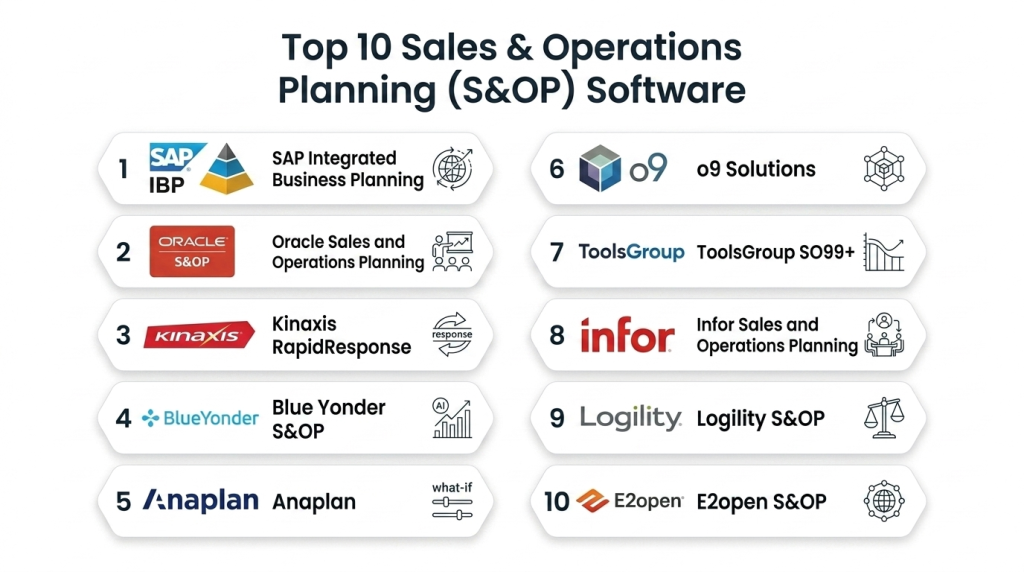
Top 10 Sales & Operations Planning Software
#1 — SAP Integrated Business Planning
Short description:
SAP Integrated Business Planning is a comprehensive S&OP platform designed for large enterprises. It provides real-time planning, advanced analytics, and deep integration with SAP systems. It enables cross-functional collaboration across supply chain, finance, and operations. The platform supports long-term and short-term planning strategies.
Key Features
- Integrated demand and supply planning
- Real-time analytics
- Scenario simulation
- Inventory optimization
- Financial alignment
Pros
- Strong enterprise capabilities
- Deep ERP integration
Cons
- Complex implementation
- Higher cost
Platforms / Deployment
Web
Cloud
Security & Compliance
SSO, MFA, encryption
SOC 2, GDPR
Integrations & Ecosystem
SAP IBP integrates deeply with enterprise systems for seamless planning workflows.
- SAP ERP
- Supply chain platforms
- Data systems
Support & Community
Enterprise-grade support with onboarding and training resources.
#2 — Oracle Sales and Operations Planning
Short description:
Oracle S&OP software provides AI-driven planning and forecasting capabilities. It integrates with Oracle Cloud applications and supports end-to-end supply chain planning. The platform is designed for scalability and accuracy. It helps organizations improve decision-making and operational efficiency.
Key Features
- Demand forecasting
- Scenario planning
- Real-time analytics
- Financial planning integration
Pros
- Strong analytics capabilities
- Scalable for enterprise use
Cons
- Best suited for Oracle ecosystem
- Complex implementation
Platforms / Deployment
Web
Cloud
Security & Compliance
SSO, encryption
Integrations & Ecosystem
Oracle integrates with enterprise applications for unified planning processes.
- Oracle ERP
- Supply chain tools
Support & Community
Enterprise support with onboarding assistance.
#3 — Kinaxis RapidResponse
Short description:
Kinaxis RapidResponse is a real-time planning platform focused on agility and responsiveness. It enables organizations to run scenario simulations and respond quickly to changes. The platform is widely used in manufacturing and supply chain industries. It supports collaborative decision-making.
Key Features
- Real-time planning
- Scenario simulation
- Demand and supply alignment
- Supply chain visibility
Pros
- Fast data processing
- Strong scenario planning
Cons
- Learning curve
- Premium pricing
Platforms / Deployment
Web
Cloud
Security & Compliance
SSO, MFA
Integrations & Ecosystem
Kinaxis integrates with ERP and supply chain systems to enhance planning.
- ERP tools
- Data platforms
Support & Community
Strong enterprise support with training services.
#4 — Blue Yonder S&OP
Short description:
Blue Yonder offers AI-powered S&OP solutions focused on retail and supply chain optimization. It helps organizations improve forecasting accuracy and manage inventory effectively. The platform leverages machine learning for predictive insights. It is suitable for complex supply chains.
Key Features
- AI-driven forecasting
- Demand sensing
- Inventory optimization
- Analytics dashboards
Pros
- Strong AI capabilities
- Industry-focused solutions
Cons
- Complex setup
- High cost
Platforms / Deployment
Web
Cloud
Security & Compliance
Not publicly stated
Integrations & Ecosystem
Blue Yonder integrates with supply chain systems for comprehensive planning.
- Retail platforms
- Supply chain tools
Support & Community
Enterprise-level support.
#5 — Anaplan
Short description:
Anaplan is a connected planning platform that supports S&OP alongside financial planning. It enables collaboration across departments and provides flexible modeling capabilities. The platform is scalable and suitable for mid-market and enterprise organizations. It focuses on alignment and visibility.
Key Features
- Connected planning
- Scenario modeling
- Forecasting tools
- Collaboration features
Pros
- Flexible and scalable
- Strong collaboration
Cons
- Requires customization
- Pricing varies
Platforms / Deployment
Web
Cloud
Security & Compliance
SSO, encryption
Integrations & Ecosystem
Anaplan connects with multiple enterprise systems for unified planning.
- ERP
- CRM
- Data tools
Support & Community
Active community and support.
#6 — o9 Solutions
Short description:
o9 Solutions provides an AI-driven planning platform for S&OP and supply chain management. It combines analytics, forecasting, and scenario planning. The platform supports end-to-end decision-making. It is ideal for large enterprises.
Key Features
- AI-driven planning
- Scenario modeling
- Demand forecasting
- Advanced analytics
Pros
- Advanced AI capabilities
- Highly scalable
Cons
- Complex implementation
- Premium pricing
Platforms / Deployment
Web
Cloud
Security & Compliance
Not publicly stated
Integrations & Ecosystem
o9 integrates with enterprise systems for comprehensive planning.
- ERP systems
- Data platforms
Support & Community
Enterprise support with onboarding.
#7 — ToolsGroup SO99+
Short description:
ToolsGroup SO99+ offers demand planning and inventory optimization with AI capabilities. It is designed for retail and distribution industries. The platform helps improve service levels and reduce costs. It supports complex supply chain environments.
Key Features
- AI forecasting
- Inventory optimization
- Demand sensing
- Analytics tools
Pros
- Accurate forecasting
- Industry-focused
Cons
- Complex setup
- Higher cost
Platforms / Deployment
Web
Cloud
Security & Compliance
Not publicly stated
Integrations & Ecosystem
ToolsGroup integrates with supply chain systems for better planning.
- ERP systems
- Supply chain tools
Support & Community
Enterprise support.
#8 — Infor Sales and Operations Planning
Short description:
Infor S&OP provides integrated planning tools for demand, supply, and finance. It is designed for manufacturing and distribution industries. The platform supports real-time insights and collaboration. It helps align operational and financial plans.
Key Features
- Demand and supply planning
- Financial integration
- Scenario modeling
- Analytics dashboards
Pros
- Industry-specific solutions
- Good integration
Cons
- UI complexity
- Implementation effort
Platforms / Deployment
Web
Cloud
Security & Compliance
Not publicly stated
Integrations & Ecosystem
Infor integrates with ERP and industry-specific systems.
- Infor ERP
- Supply chain tools
Support & Community
Enterprise support with onboarding.
#9 — Logility S&OP
Short description:
Logility S&OP focuses on supply chain optimization and demand planning. It provides analytics and forecasting tools for better decision-making. The platform is suitable for mid-sized and enterprise businesses. It supports collaboration across teams.
Key Features
- Demand planning
- Inventory optimization
- Analytics tools
- Scenario modeling
Pros
- Strong analytics
- Scalable platform
Cons
- Learning curve
- Cost considerations
Platforms / Deployment
Web
Cloud
Security & Compliance
Not publicly stated
Integrations & Ecosystem
Logility integrates with enterprise systems for planning workflows.
- ERP systems
- Data tools
Support & Community
Enterprise-level support.
#10 — E2open S&OP
Short description:
E2open provides cloud-based S&OP solutions with strong supply chain visibility. It helps organizations manage demand, supply, and logistics in one platform. The tool focuses on collaboration and real-time insights. It is suitable for global enterprises.
Key Features
- End-to-end planning
- Demand forecasting
- Supply chain visibility
- Collaboration tools
Pros
- Strong visibility features
- Cloud-based scalability
Cons
- Complex setup
- Pricing varies
Platforms / Deployment
Web
Cloud
Security & Compliance
Not publicly stated
Integrations & Ecosystem
E2open integrates with supply chain and enterprise systems for unified planning.
- ERP systems
- Logistics platforms
Support & Community
Enterprise support with training and onboarding.
Comparison Table
| Tool Name | Best For | Platform(s) Supported | Deployment | Standout Feature | Public Rating |
|---|---|---|---|---|---|
| SAP IBP | Enterprise | Web | Cloud | Deep ERP integration | N/A |
| Oracle S&OP | Enterprise | Web | Cloud | AI forecasting | N/A |
| Kinaxis | Enterprise | Web | Cloud | Real-time planning | N/A |
| Blue Yonder | Retail | Web | Cloud | AI demand sensing | N/A |
| Anaplan | Mid-market | Web | Cloud | Connected planning | N/A |
| o9 Solutions | Enterprise | Web | Cloud | AI planning platform | N/A |
| ToolsGroup | Enterprise | Web | Cloud | AI forecasting | N/A |
| Infor | Manufacturing | Web | Cloud | Industry focus | N/A |
| Logility | Mid-market | Web | Cloud | Supply chain optimization | N/A |
| E2open | Enterprise | Web | Cloud | End-to-end visibility | N/A |
Evaluation & Scoring of Sales & Operations Planning Software
| Tool Name | Core | Ease | Integrations | Security | Performance | Support | Value | Weighted Total |
|---|---|---|---|---|---|---|---|---|
| SAP IBP | 9 | 7 | 9 | 9 | 9 | 9 | 7 | 8.5 |
| Oracle | 9 | 7 | 9 | 8 | 9 | 9 | 7 | 8.4 |
| Kinaxis | 8 | 8 | 8 | 8 | 9 | 9 | 7 | 8.3 |
| Blue Yonder | 9 | 7 | 8 | 8 | 9 | 9 | 7 | 8.3 |
| Anaplan | 8 | 8 | 8 | 8 | 8 | 8 | 7 | 8.0 |
| o9 Solutions | 9 | 7 | 8 | 8 | 9 | 9 | 7 | 8.4 |
| ToolsGroup | 8 | 7 | 8 | 7 | 8 | 8 | 7 | 7.9 |
| Infor | 8 | 7 | 7 | 7 | 8 | 8 | 7 | 7.8 |
| Logility | 8 | 7 | 7 | 7 | 8 | 8 | 7 | 7.8 |
| E2open | 8 | 7 | 8 | 7 | 8 | 8 | 7 | 7.9 |
How to interpret scores:
These scores provide a comparative view across key evaluation criteria. Higher scores indicate stronger performance in enterprise capabilities and scalability. Some tools prioritize usability and cost efficiency, while others focus on deep functionality and integration. Always evaluate tools based on your specific business requirements and priorities.
Which Sales & Operations Planning Software Is Right for You?
Solo / Freelancer
S&OP tools are generally not required at this level due to complexity and cost.
SMB
Anaplan or Logility provide manageable features with scalability for growing businesses.
Mid-Market
Kinaxis and Infor offer strong capabilities with balanced complexity and performance.
Enterprise
SAP IBP, Oracle, and o9 Solutions are best for large-scale planning and integration needs.
Budget vs Premium
Budget options include Logility, while premium tools include SAP and Oracle platforms.
Feature Depth vs Ease of Use
SAP IBP provides deep functionality, while Anaplan offers a more flexible and user-friendly approach.
Integrations & Scalability
SAP, Oracle, and E2open lead in integration capabilities and scalability.
Security & Compliance Needs
Enterprise tools provide stronger compliance and security features.
Frequently Asked Questions
1. What is Sales and Operations Planning software?
Sales and Operations Planning software helps organizations align sales forecasts with production, inventory, and financial planning. It connects different departments into a unified planning process. This improves decision-making and operational efficiency. It is especially useful for businesses with complex supply chains.
2. How does S&OP software improve business performance?
It provides better visibility into demand and supply, allowing companies to optimize inventory and reduce waste. By aligning teams, it minimizes conflicts between departments. It also supports data-driven decision-making. This leads to improved efficiency and profitability.
3. Is S&OP software only for large enterprises?
While many S&OP tools are designed for enterprises, some solutions also cater to mid-sized businesses. Smaller companies can benefit from simplified tools. However, very small businesses may not need such advanced systems. The choice depends on operational complexity.
4. What are the key features to look for in S&OP software?
Key features include demand forecasting, supply planning, scenario modeling, and analytics. Integration with ERP systems is also important. Collaboration tools and real-time data processing are valuable. These features ensure effective planning and execution.
5. Can S&OP tools integrate with ERP systems?
Yes, most S&OP platforms are designed to integrate with ERP systems. This ensures seamless data flow between departments. Integration improves accuracy and efficiency. It also reduces manual data entry and errors.
6. How long does implementation take?
Implementation time varies depending on the tool and organization size. SMB solutions may take weeks, while enterprise deployments can take months. Proper planning and data preparation can speed up the process. Training is also a key factor.
7. What industries benefit from S&OP software?
Industries like manufacturing, retail, distribution, and logistics benefit the most. These sectors deal with complex supply chains and fluctuating demand. S&OP tools help them stay competitive. They also improve customer satisfaction.
8. What are common challenges when using S&OP software?
Challenges include data quality issues, integration complexity, and user adoption. Organizations may struggle with change management. Proper training and clear processes are essential. Choosing the right tool can reduce these challenges.
9. Does S&OP software support real-time planning?
Many modern tools support real-time or near real-time planning. They use live data inputs to update forecasts. This helps organizations respond quickly to changes. Real-time planning improves agility and resilience.
10. Can companies switch S&OP tools easily?
Switching tools is possible but requires careful planning. Data migration and system integration are key challenges. Organizations should evaluate compatibility before switching. Running a pilot phase can help reduce risks.
Conclusion
Sales and Operations Planning software plays a critical role in aligning business functions, improving forecasting accuracy, and enhancing overall operational efficiency. As supply chains become more complex and customer expectations continue to rise, organizations must adopt advanced planning tools to stay competitive. The platforms discussed in this guide offer a wide range of capabilities, from AI-driven forecasting to real-time scenario planning and cross-functional collaboration. However, selecting the right solution depends on your organization’s size, industry, and operational complexity. Enterprises may require comprehensive platforms with deep integrations, while mid-sized businesses may prefer flexible and scalable solutions. The best approach is to shortlist a few tools, evaluate their features, and conduct pilot testing before full deployment. This ensures better alignment with business goals and maximizes long-term value.
