Introduction
Demand Planning Tools are software solutions that help organizations forecast customer demand, optimize inventory levels, and align supply chain operations with real-world market needs. These platforms use historical data, statistical models, and increasingly AI-driven insights to improve forecasting accuracy and reduce uncertainty.
In today’s fast-moving supply chain environment, businesses face challenges like fluctuating demand, global disruptions, and changing customer behavior. Demand planning tools help companies move from reactive decision-making to proactive planning, ensuring better efficiency and profitability.
Common use cases include:
- Forecasting product demand across multiple regions and channels
- Optimizing inventory and reducing stockouts
- Aligning sales, operations, and supply chain planning
- Managing seasonal demand variations
- Improving supply chain visibility and responsiveness
What buyers should evaluate:
- Forecasting accuracy and AI capabilities
- Ease of use and user experience
- Integration with ERP and supply chain systems
- Real-time data processing
- Scenario planning and simulations
- Reporting and analytics
- Scalability across products and regions
- Collaboration capabilities
- Security and compliance
Best for: Supply chain teams, operations managers, retail businesses, manufacturing companies, and enterprises handling large volumes of inventory and complex logistics.
Not ideal for: Very small businesses with limited product lines or those that rely on simple manual forecasting methods.
Key Trends in Demand Planning Tools
- AI-driven forecasting improving prediction accuracy
- Real-time demand sensing using live data streams
- Integration with full supply chain platforms
- Scenario planning for risk management
- Cloud-based scalability and flexibility
- Cross-functional collaboration tools
- Automation of repetitive planning tasks
- Advanced analytics dashboards
- Integration with eCommerce and POS systems
- Focus on sustainability and waste reduction
How We Selected These Tools (Methodology)
- Evaluated market adoption and industry presence
- Assessed forecasting capabilities and AI features
- Reviewed ease of use and implementation complexity
- Considered integration with ERP and supply chain systems
- Analyzed scalability across industries and company sizes
- Looked at analytics and reporting capabilities
- Evaluated security and compliance readiness
- Compared support quality and ecosystem strength
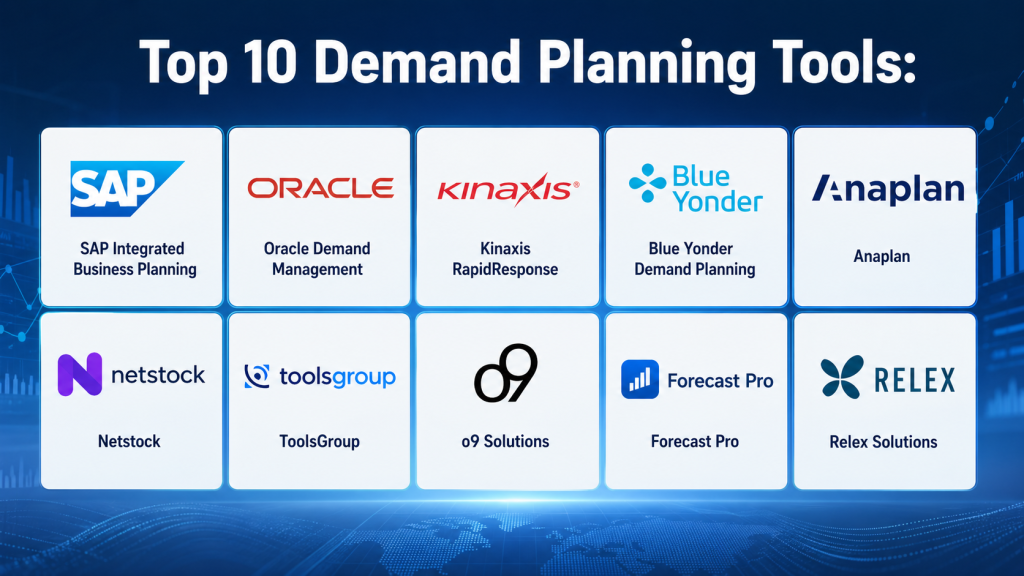
Top 10 Demand Planning Tools
#1 — SAP Integrated Business Planning
Short description:
SAP Integrated Business Planning is a comprehensive supply chain planning solution designed for large enterprises. It provides advanced forecasting, real-time analytics, and deep integration with SAP ecosystems. It is best suited for organizations managing complex global supply chains. The platform supports collaboration and long-term planning strategies.
Key Features
- AI-based demand forecasting
- Real-time analytics and dashboards
- Scenario planning capabilities
- Inventory optimization
- Supply chain collaboration tools
Pros
- Strong enterprise-grade capabilities
- Deep integration with ERP systems
Cons
- Complex implementation process
- Higher cost for smaller organizations
Platforms / Deployment
Web
Cloud
Security & Compliance
SSO, MFA, encryption
SOC 2, GDPR
Integrations & Ecosystem
SAP IBP integrates deeply with enterprise environments, making it suitable for large organizations with existing SAP infrastructure.
- SAP ERP
- Data platforms
- Supply chain systems
Support & Community
Enterprise-level support with strong documentation, onboarding assistance, and partner ecosystem.
#2 — Oracle Demand Management
Short description:
Oracle Demand Management offers AI-powered forecasting and demand sensing capabilities. It is built for enterprises looking to scale their planning processes with automation and real-time insights. The platform integrates seamlessly with Oracle Cloud applications. It is well-suited for organizations already invested in Oracle technologies.
Key Features
- Machine learning-based forecasting
- Demand sensing
- Scenario planning
- Real-time analytics
Pros
- Strong analytics capabilities
- Scalable for enterprise use
Cons
- Requires Oracle ecosystem for best results
- Implementation complexity
Platforms / Deployment
Web
Cloud
Security & Compliance
SSO, encryption
Integrations & Ecosystem
Oracle Demand Management works best within the Oracle ecosystem and integrates with multiple enterprise applications.
- Oracle Cloud ERP
- Supply chain tools
- Data systems
Support & Community
Enterprise-grade support with onboarding programs and training resources.
#3 — Kinaxis RapidResponse
Short description:
Kinaxis RapidResponse is a real-time supply chain planning platform that enables fast decision-making and scenario analysis. It is widely used in manufacturing and retail industries. The platform focuses on agility and responsiveness. It helps organizations adapt quickly to demand changes.
Key Features
- Real-time planning engine
- Scenario simulation
- Demand forecasting
- Supply chain visibility
Pros
- High-speed data processing
- Strong scenario planning capabilities
Cons
- Learning curve for new users
- Premium pricing
Platforms / Deployment
Web
Cloud
Security & Compliance
SSO, MFA
Integrations & Ecosystem
Kinaxis integrates with supply chain and ERP systems to provide end-to-end visibility.
- ERP systems
- Data tools
- Supply chain platforms
Support & Community
Strong enterprise support with training and implementation services.
#4 — Blue Yonder Demand Planning
Short description:
Blue Yonder offers AI-driven demand planning tools focused on retail and supply chain optimization. It helps businesses improve forecasting accuracy and manage inventory effectively. The platform leverages machine learning for predictive insights. It is widely used in retail and logistics sectors.
Key Features
- AI-powered forecasting
- Demand sensing
- Inventory optimization
- Analytics dashboards
Pros
- Strong AI capabilities
- Industry-specific solutions
Cons
- Complex setup
- High cost
Platforms / Deployment
Web
Cloud
Security & Compliance
Not publicly stated
Integrations & Ecosystem
Blue Yonder integrates with supply chain and retail systems for comprehensive planning.
- Retail platforms
- Supply chain tools
Support & Community
Enterprise-level support with implementation assistance.
#5 — Anaplan
Short description:
Anaplan is a connected planning platform that supports demand planning alongside financial and operational planning. It enables collaboration across departments and supports flexible modeling. It is suitable for mid-market and enterprise organizations. The platform focuses on scalability and cross-functional alignment.
Key Features
- Connected planning framework
- Scenario modeling
- Forecasting tools
- Collaboration features
Pros
- Flexible and scalable platform
- Strong collaboration capabilities
Cons
- Requires customization
- Pricing varies
Platforms / Deployment
Web
Cloud
Security & Compliance
SSO, encryption
Integrations & Ecosystem
Anaplan connects with multiple enterprise systems for unified planning workflows.
- ERP systems
- CRM tools
- Data platforms
Support & Community
Active user community and strong vendor support.
#6 — Netstock
Short description:
Netstock is an inventory and demand planning solution designed for small and mid-sized businesses. It provides easy-to-use forecasting and reporting tools. The platform focuses on simplicity and quick implementation. It is ideal for companies transitioning from spreadsheets.
Key Features
- Inventory optimization
- Demand forecasting
- Reporting tools
- Alerts and recommendations
Pros
- Easy to use
- Quick deployment
Cons
- Limited advanced features
- Smaller ecosystem
Platforms / Deployment
Web
Cloud
Security & Compliance
Not publicly stated
Integrations & Ecosystem
Netstock integrates with ERP systems to enhance inventory and demand planning.
- ERP tools
- Data systems
Support & Community
Strong support for SMB customers with onboarding assistance.
#7 — ToolsGroup
Short description:
ToolsGroup provides AI-driven demand forecasting and inventory optimization solutions. It is designed for retail and distribution industries. The platform focuses on improving service levels and reducing inventory costs. It is suitable for complex supply chain environments.
Key Features
- AI-based forecasting
- Inventory optimization
- Demand sensing
- Analytics tools
Pros
- Accurate forecasting capabilities
- Industry-focused features
Cons
- Complex implementation
- Higher cost
Platforms / Deployment
Web
Cloud
Security & Compliance
Not publicly stated
Integrations & Ecosystem
ToolsGroup integrates with supply chain and enterprise systems for better planning.
- ERP systems
- Supply chain tools
Support & Community
Enterprise support with onboarding and training.
#8 — o9 Solutions
Short description:
o9 Solutions offers a digital planning platform that combines AI, analytics, and scenario modeling. It enables organizations to create intelligent supply chain strategies. The platform supports end-to-end planning processes. It is widely used by large enterprises.
Key Features
- AI-driven planning
- Scenario modeling
- Demand forecasting
- Advanced analytics
Pros
- Advanced AI capabilities
- Highly scalable
Cons
- Complex implementation
- Premium pricing
Platforms / Deployment
Web
Cloud
Security & Compliance
Not publicly stated
Integrations & Ecosystem
o9 integrates with enterprise systems to deliver unified planning experiences.
- ERP systems
- Data platforms
Support & Community
Enterprise-level support with implementation guidance.
#9 — Forecast Pro
Short description:
Forecast Pro is a statistical forecasting solution designed for demand planning. It offers easy-to-use tools and accurate predictions. It is suitable for small to mid-sized businesses. The platform focuses on simplicity and efficiency.
Key Features
- Statistical forecasting
- Data visualization
- Reporting tools
Pros
- Simple interface
- Accurate forecasting
Cons
- Limited AI capabilities
- Smaller ecosystem
Platforms / Deployment
Web / Desktop
Security & Compliance
Not publicly stated
Integrations & Ecosystem
Forecast Pro integrates with data tools to support forecasting workflows.
- Data systems
Support & Community
Moderate support with documentation.
#10 — Relex Solutions
Short description:
Relex Solutions provides demand planning and supply chain optimization tools for retail and distribution industries. It focuses on improving forecasting accuracy and inventory efficiency. The platform supports real-time analytics. It is designed for large-scale retail operations.
Key Features
- Demand forecasting
- Inventory optimization
- Analytics dashboards
Pros
- Strong retail focus
- Advanced analytics
Cons
- Implementation effort
- Cost considerations
Platforms / Deployment
Web
Cloud
Security & Compliance
Not publicly stated
Integrations & Ecosystem
Relex integrates with retail and supply chain systems for optimized planning.
- Retail platforms
- Supply chain tools
Support & Community
Enterprise support with onboarding services.
Comparison Table
| Tool Name | Best For | Platform(s) Supported | Deployment | Standout Feature | Public Rating |
|---|---|---|---|---|---|
| SAP IBP | Enterprise | Web | Cloud | Deep ERP integration | N/A |
| Oracle Demand Management | Enterprise | Web | Cloud | AI forecasting | N/A |
| Kinaxis RapidResponse | Enterprise | Web | Cloud | Real-time planning | N/A |
| Blue Yonder | Retail | Web | Cloud | AI demand sensing | N/A |
| Anaplan | Mid-market | Web | Cloud | Connected planning | N/A |
| Netstock | SMB | Web | Cloud | Inventory optimization | N/A |
| ToolsGroup | Enterprise | Web | Cloud | AI forecasting | N/A |
| o9 Solutions | Enterprise | Web | Cloud | Digital planning platform | N/A |
| Forecast Pro | SMB | Web/Desktop | Varies | Statistical forecasting | N/A |
| Relex Solutions | Retail | Web | Cloud | Retail optimization | N/A |
Evaluation & Scoring of Demand Planning Tools
| Tool Name | Core | Ease | Integrations | Security | Performance | Support | Value | Weighted Total |
|---|---|---|---|---|---|---|---|---|
| SAP IBP | 9 | 7 | 9 | 9 | 9 | 9 | 7 | 8.5 |
| Oracle | 9 | 7 | 9 | 8 | 9 | 9 | 7 | 8.4 |
| Kinaxis | 8 | 8 | 8 | 8 | 9 | 9 | 7 | 8.3 |
| Blue Yonder | 9 | 7 | 8 | 8 | 9 | 9 | 7 | 8.3 |
| Anaplan | 8 | 8 | 8 | 8 | 8 | 8 | 7 | 8.0 |
| Netstock | 7 | 9 | 7 | 7 | 7 | 7 | 8 | 7.6 |
| ToolsGroup | 8 | 7 | 8 | 7 | 8 | 8 | 7 | 7.9 |
| o9 Solutions | 9 | 7 | 8 | 8 | 9 | 9 | 7 | 8.4 |
| Forecast Pro | 7 | 9 | 6 | 6 | 7 | 7 | 8 | 7.4 |
| Relex | 8 | 7 | 7 | 7 | 8 | 8 | 7 | 7.8 |
How to interpret scores:
These scores are comparative and designed to help you shortlist tools. Higher scores indicate stronger overall performance across weighted categories. Enterprise tools often score higher in features and scalability, while SMB tools perform better in ease of use and cost efficiency. Always align scoring with your business priorities and use cases before making a decision.
Which Demand Planning Tool Is Right for You?
Solo / Freelancer
Forecast Pro or Netstock are suitable for simple forecasting needs with minimal complexity and lower cost.
SMB
Netstock and Anaplan provide a good balance of usability, affordability, and essential planning features.
Mid-Market
Anaplan and Kinaxis offer scalability, collaboration, and more advanced planning capabilities.
Enterprise
SAP IBP, Oracle Demand Management, and o9 Solutions are ideal for large organizations with complex supply chains.
Budget vs Premium
Budget-friendly options include Netstock and Forecast Pro, while premium enterprise solutions include SAP and Oracle platforms.
Feature Depth vs Ease of Use
SAP IBP offers deep functionality, while Netstock and Forecast Pro provide simpler, user-friendly experiences.
Integrations & Scalability
SAP, Oracle, and o9 Solutions lead in integration capabilities and scalability across systems.
Security & Compliance Needs
Enterprise platforms like SAP and Oracle provide stronger security and compliance features compared to SMB tools.
Frequently Asked Questions
1. What is a demand planning tool and why is it important?
A demand planning tool helps businesses forecast future product demand using data and analytics. It improves inventory management, reduces stockouts, and supports better decision-making. These tools are essential for aligning supply with customer needs. Without them, businesses risk inefficiencies and lost revenue.
2. How do demand planning tools improve forecasting accuracy?
They use historical data, statistical models, and AI algorithms to identify patterns and trends. This allows businesses to predict demand more accurately than manual methods. Advanced tools also incorporate real-time data. This leads to more responsive and dynamic planning.
3. Are demand planning tools suitable for small businesses?
Yes, many tools are designed specifically for small and mid-sized businesses. Solutions like Netstock and Forecast Pro offer simple interfaces and lower costs. They help smaller companies transition from spreadsheets. However, advanced enterprise tools may be unnecessary for small teams.
4. What is the difference between demand planning and inventory management?
Demand planning focuses on forecasting future demand, while inventory management deals with stock levels and movement. Both are closely related and often integrated. Demand planning informs inventory decisions. Together, they optimize supply chain performance.
5. Can demand planning tools integrate with ERP systems?
Most modern demand planning tools offer integration with ERP systems. This ensures data consistency and improves workflow efficiency. Integration allows seamless sharing of sales, inventory, and financial data. It is a critical factor when selecting a tool.
6. How long does it take to implement a demand planning tool?
Implementation time varies depending on the tool and company size. SMB solutions can be deployed within weeks. Enterprise platforms may take several months. Proper planning and data preparation can speed up the process significantly.
7. What industries benefit most from demand planning tools?
Retail, manufacturing, distribution, and eCommerce industries benefit the most. These sectors deal with fluctuating demand and large inventories. Demand planning helps them stay competitive. It also improves customer satisfaction and operational efficiency.
8. Do these tools support real-time demand updates?
Many modern tools offer real-time or near real-time demand sensing. They use live data inputs from sales and market signals. This helps businesses react quickly to changes. Real-time insights are especially valuable in dynamic markets.
9. What are common challenges when using demand planning tools?
Common challenges include poor data quality, integration complexity, and user adoption issues. Organizations may also face resistance to change. Proper training and clean data are essential for success. Choosing the right tool for your needs also reduces challenges.
10. Can companies switch demand planning tools easily?
Switching is possible but requires careful planning. Data migration, system integration, and employee training are key steps. Businesses should evaluate compatibility before switching. Running a pilot phase can reduce risks during transition.
Conclusion
Demand planning tools have become essential for businesses looking to improve forecasting accuracy, optimize inventory, and streamline supply chain operations. As markets become more dynamic and customer expectations continue to evolve, relying on manual or outdated planning methods is no longer sustainable. The tools covered in this guide offer a wide range of capabilities, from simple statistical forecasting solutions to advanced AI-driven enterprise platforms. However, the right choice depends on your organization’s size, complexity, and operational goals. Smaller businesses may benefit from easy-to-use and cost-effective tools, while enterprises require scalable and integrated platforms. To make the best decision, companies should evaluate their current processes, shortlist a few tools, and conduct pilot testing before full implementation. This approach ensures better alignment with business needs and maximizes long-term value.
