Introduction
Supply Chain Control Tower Platforms are centralized software systems that provide end-to-end visibility, real-time monitoring, and decision intelligence across the entire supply chain. They act as a “command center” that integrates data from procurement, manufacturing, logistics, and distribution into a single unified dashboard.
In today’s complex global supply chains, disruptions like delays, shortages, and demand fluctuations are common. Control towers help organizations detect these issues early, predict impacts, and respond proactively using analytics and automation.
Common use cases include:
- End-to-end supply chain visibility
- Inventory and order tracking
- Disruption detection and response
- Supplier and logistics coordination
- Performance monitoring and analytics
What buyers should evaluate:
- Real-time visibility capabilities
- Predictive analytics and AI features
- Integration with ERP, TMS, and WMS
- Scalability across global operations
- Collaboration and workflow automation
- Security and compliance
- Data accuracy and governance
- Ease of implementation
Best for: Large enterprises, global supply chain teams, manufacturers, retailers, and logistics providers managing multi-tier supply chains.
Not ideal for: Small businesses with simple supply chains or minimal operational complexity.
Key Trends in Supply Chain Control Tower Platforms
- AI-driven predictive and prescriptive analytics
- Real-time end-to-end visibility across supply networks
- Cloud-native and API-first architectures
- Digital twin modeling for supply chain simulation
- Autonomous execution and workflow automation
- Integration with IoT, weather, and external data feeds
- Sustainability and carbon footprint tracking
- Hyper-collaboration across partners and suppliers
How We Selected These Tools
- Market leadership and adoption across industries
- Depth of visibility, analytics, and orchestration capabilities
- Integration ecosystem with enterprise systems
- Reliability and scalability across global supply chains
- Security and compliance posture
- Usability for planners and operations teams
- Innovation in AI and automation
- Fit across SMB, mid-market, and enterprise use cases
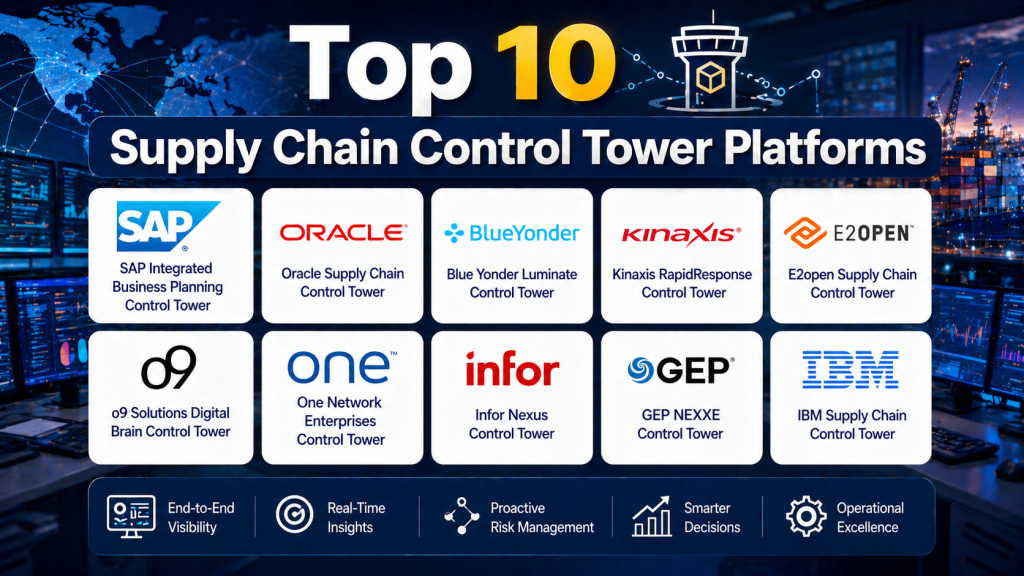
Top 10 Supply Chain Control Tower Platforms Tools
1 — SAP Integrated Business Planning Control Tower
Short description: SAP IBP Control Tower provides end-to-end supply chain visibility and planning capabilities. It integrates planning, forecasting, and analytics into one platform. It is widely used by large enterprises. It supports real-time insights. It is ideal for complex global supply chains.
Key Features
- End-to-end visibility
- Demand and supply planning
- Real-time analytics
- Scenario simulation
- KPI monitoring
Pros
- Strong enterprise integration
- Comprehensive planning capabilities
Cons
- Complex implementation
- High cost
Platforms / Deployment
Web — Cloud
Security & Compliance
Enterprise-grade controls
Integrations & Ecosystem
Integrates with SAP ERP and enterprise systems
- SAP S/4HANA
- Logistics systems
- APIs
Support & Community
Strong global ecosystem
2 — Oracle Supply Chain Control Tower
Short description: Oracle Control Tower provides real-time monitoring, analytics, and coordination across supply chain operations. It helps detect disruptions early. It supports automation and decision-making. It is suitable for large enterprises. It enhances operational efficiency.
Key Features
- Real-time monitoring
- Predictive analytics
- Collaboration tools
- Risk detection
- Reporting
Pros
- Strong analytics
- Scalable
Cons
- Requires Oracle ecosystem
- Complex setup
Platforms / Deployment
Web — Cloud
Security & Compliance
Not publicly stated
Integrations & Ecosystem
Integration with Oracle SCM suite
Support & Community
Enterprise support
3 — Blue Yonder Luminate Control Tower
Short description: Blue Yonder Luminate offers advanced visibility and orchestration capabilities. It combines AI and machine learning for predictive insights. The platform supports real-time decision-making. It is ideal for large supply chains. It enhances agility and responsiveness.
Key Features
- AI-driven insights
- Real-time visibility
- Supply chain orchestration
- Scenario planning
- Analytics
Pros
- Advanced AI capabilities
- Strong orchestration
Cons
- Premium pricing
- Complex deployment
Platforms / Deployment
Web — Cloud
Security & Compliance
Not publicly stated
Integrations & Ecosystem
Supports enterprise integrations
Support & Community
Enterprise support
4 — Kinaxis RapidResponse Control Tower
Short description: Kinaxis RapidResponse provides real-time supply chain visibility and planning capabilities. It enables concurrent planning across functions. The platform supports fast decision-making. It is suitable for global enterprises. It improves agility.
Key Features
- Concurrent planning
- Real-time analytics
- Scenario modeling
- Risk management
- Collaboration
Pros
- Fast decision-making
- Strong planning capabilities
Cons
- Learning curve
- Premium pricing
Platforms / Deployment
Web — Cloud
Security & Compliance
Not publicly stated
Integrations & Ecosystem
Integrates with ERP and planning systems
Support & Community
Strong support
5 — E2open Supply Chain Control Tower
Short description: E2open provides end-to-end supply chain visibility and collaboration tools. It connects suppliers, logistics providers, and customers. The platform supports real-time tracking and analytics. It is suitable for global networks. It enhances coordination.
Key Features
- Multi-enterprise visibility
- Real-time tracking
- Collaboration tools
- Analytics
- Risk management
Pros
- Strong partner network
- Good visibility
Cons
- Integration complexity
- Requires onboarding
Platforms / Deployment
Web — Cloud
Security & Compliance
Not publicly stated
Integrations & Ecosystem
Integration with supply chain partners
Support & Community
Enterprise support
6 — o9 Solutions Digital Brain Control Tower
Short description: o9 Control Tower provides AI-driven planning and execution capabilities. It enables real-time visibility and decision intelligence. The platform supports predictive and prescriptive analytics. It is suitable for enterprises. It improves supply chain agility.
Key Features
- AI-driven planning
- Real-time visibility
- Decision intelligence
- Scenario simulation
- Collaboration
Pros
- Strong AI capabilities
- Flexible platform
Cons
- Complex implementation
- Premium pricing
Platforms / Deployment
Web — Cloud
Security & Compliance
Not publicly stated
Integrations & Ecosystem
Supports enterprise integrations
Support & Community
Enterprise support
7 — One Network Enterprises Control Tower
Short description: One Network Enterprises offers a real-time supply chain network platform. It provides visibility and collaboration across partners. The platform supports multi-tier supply chains. It is suitable for complex ecosystems. It improves coordination.
Key Features
- Multi-tier visibility
- Real-time collaboration
- Analytics
- Workflow automation
- Reporting
Pros
- Strong collaboration
- Network-based approach
Cons
- Complex onboarding
- Requires ecosystem participation
Platforms / Deployment
Web — Cloud
Security & Compliance
Not publicly stated
Integrations & Ecosystem
Extensive partner network integrations
Support & Community
Enterprise support
8 — Infor Nexus Control Tower
Short description: Infor Nexus provides supply chain visibility and collaboration tools. It connects buyers, suppliers, and logistics providers. The platform supports real-time tracking and analytics. It is suitable for global supply chains. It enhances transparency.
Key Features
- Supply chain visibility
- Collaboration tools
- Real-time tracking
- Analytics
- Reporting
Pros
- Strong network
- Good visibility
Cons
- Limited advanced AI
- Integration effort
Platforms / Deployment
Web — Cloud
Security & Compliance
Not publicly stated
Integrations & Ecosystem
Integration with ERP and logistics systems
Support & Community
Standard support
9 — GEP NEXXE Control Tower
Short description: GEP NEXXE is a unified supply chain platform offering visibility, orchestration, and analytics. It supports procurement and logistics operations. The platform provides real-time insights. It is suitable for enterprises. It enhances efficiency.
Key Features
- Supply chain visibility
- Procurement integration
- Analytics
- Collaboration
- Reporting
Pros
- Unified platform
- Strong analytics
Cons
- Enterprise-focused
- Learning curve
Platforms / Deployment
Web — Cloud
Security & Compliance
Not publicly stated
Integrations & Ecosystem
Supports enterprise integrations
Support & Community
Enterprise support
10 — IBM Supply Chain Control Tower
Short description: IBM Control Tower provides AI-driven visibility and risk management capabilities. It integrates data across supply chain systems. The platform supports real-time insights and decision-making. It is suitable for large enterprises. It enhances resilience.
Key Features
- AI-driven analytics
- Risk management
- Real-time monitoring
- Collaboration
- Reporting
Pros
- Strong AI capabilities
- Reliable platform
Cons
- Complex implementation
- Premium pricing
Platforms / Deployment
Web — Cloud
Security & Compliance
Enterprise-grade controls
Integrations & Ecosystem
Integration with IBM and third-party systems
Support & Community
Enterprise support
Comparison Table
| Tool | Best For | Platforms | Deployment | Standout Feature | Public Rating |
|---|---|---|---|---|---|
| SAP IBP | Enterprise planning | Web | Cloud | End-to-end planning | N/A |
| Oracle | Enterprise SCM | Web | Cloud | Predictive analytics | N/A |
| Blue Yonder | AI-driven supply chains | Web | Cloud | AI orchestration | N/A |
| Kinaxis | Concurrent planning | Web | Cloud | Real-time planning | N/A |
| E2open | Multi-enterprise networks | Web | Cloud | Collaboration | N/A |
| o9 | AI planning | Web | Cloud | Decision intelligence | N/A |
| One Network | Multi-tier supply chains | Web | Cloud | Network visibility | N/A |
| Infor Nexus | Supplier collaboration | Web | Cloud | Transparency | N/A |
| GEP NEXXE | Procurement integration | Web | Cloud | Unified platform | N/A |
| IBM | AI and risk management | Web | Cloud | Risk analytics | N/A |
Evaluation & Scoring of Supply Chain Control Tower Platforms
| Tool | Core | Ease | Integrations | Security | Performance | Support | Value | Weighted Total |
|---|---|---|---|---|---|---|---|---|
| SAP IBP | 9 | 7 | 10 | 9 | 9 | 9 | 7 | 8.8 |
| Oracle | 9 | 7 | 9 | 8 | 9 | 9 | 7 | 8.5 |
| Blue Yonder | 9 | 7 | 9 | 8 | 9 | 9 | 7 | 8.5 |
| Kinaxis | 9 | 8 | 8 | 8 | 9 | 9 | 7 | 8.6 |
| E2open | 8 | 7 | 9 | 7 | 8 | 8 | 7 | 8.0 |
| o9 | 9 | 7 | 9 | 8 | 9 | 8 | 7 | 8.5 |
| One Network | 8 | 7 | 8 | 7 | 8 | 8 | 7 | 7.8 |
| Infor Nexus | 8 | 7 | 8 | 7 | 8 | 8 | 7 | 7.8 |
| GEP NEXXE | 8 | 7 | 8 | 7 | 8 | 8 | 7 | 7.8 |
| IBM | 9 | 6 | 9 | 9 | 9 | 9 | 7 | 8.6 |
How to interpret scores:
These scores are comparative and reflect relative strengths across visibility, analytics, and scalability. Enterprise platforms score higher due to strong integrations and AI capabilities. Mid-tier tools offer balanced usability and performance. Smaller platforms may provide value but lack advanced orchestration. Always align scoring with your supply chain complexity and scale.
Which Supply Chain Control Tower Platform Is Right for You
Solo / Small Business
Lightweight visibility tools or ERP dashboards are often sufficient.
SMB
Infor Nexus and GEP NEXXE offer balanced features and usability.
Mid-Market
E2open and One Network provide strong collaboration and visibility.
Enterprise
SAP IBP, Oracle, Kinaxis, and Blue Yonder are ideal for global operations.
Budget vs Premium
Budget tools focus on visibility, premium platforms provide AI-driven orchestration.
Feature Depth vs Ease of Use
Advanced tools offer deeper insights but require training.
Integrations & Scalability
Choose platforms with strong ERP and partner integrations.
Security & Compliance Needs
Enterprises should prioritize platforms with strong data governance.
Frequently Asked Questions
1. What is a supply chain control tower
It is a centralized platform that provides real-time visibility across the supply chain. It integrates data from multiple systems. It helps organizations monitor and manage operations efficiently.
2. Why is it important
Supply chains are complex and prone to disruptions. Control towers help detect issues early. They improve coordination and decision-making. They enhance efficiency.
3. What are the key features
Key features include real-time visibility, analytics, and collaboration. Predictive insights help proactive decision-making. Automation improves efficiency.
4. How do control towers work
They collect data from multiple sources like ERP systems, sensors, and logistics platforms. This data is analyzed and displayed in dashboards.
5. Are these platforms cloud-based
Most modern platforms are cloud-based. This improves scalability and accessibility. It enables real-time collaboration.
6. How do they improve efficiency
They provide real-time insights and alerts. They help reduce delays and optimize operations. They improve resource utilization.
7. Can small businesses use them
Yes, but simplified solutions are often better. Full control towers are more suited for complex operations.
8. What are common mistakes when choosing tools
Ignoring integration needs is a mistake. Choosing only based on cost can cause issues. Not testing the platform is risky.
9. Do they support predictive analytics
Yes, most platforms include predictive and prescriptive analytics. This helps anticipate disruptions.
10. Can they scale with business growth
Yes, modern platforms are highly scalable. They support global supply chains and evolving operations.
Conclusion
Supply Chain Control Tower Platforms have become essential for organizations managing complex, global supply chains by providing real-time visibility, predictive analytics, and coordinated decision-making across the entire network. These platforms transform fragmented data into actionable insights, enabling businesses to detect disruptions early, respond faster, and optimize operations at scale. As supply chains become more dynamic and interconnected, adopting a control tower is no longer optional but a strategic necessity. From enterprise solutions like SAP IBP and Oracle to AI-driven platforms like o9 and Blue Yonder, each tool offers unique strengths depending on business needs. The right choice depends on factors such as integration requirements, scalability, and operational complexity. There is no universal best solution, and organizations should evaluate their priorities carefully before selecting a platform. A practical next step is to shortlist two or three platforms, validate integration with existing systems, and run a pilot implementation to test real-world performance. This approach ensures the selected platform aligns with your operational workflows and delivers measurable value.
