Introduction
Logistics Visibility Platforms are software systems that provide real-time tracking, monitoring, and predictive insights across the supply chain. These platforms aggregate data from carriers, GPS devices, IoT sensors, and enterprise systems to give businesses a unified view of shipments across all transportation modes.
In modern logistics, delays, disruptions, and lack of transparency can significantly impact operations and customer satisfaction. Visibility platforms solve this by enabling proactive decision-making, improving coordination, and reducing costs through predictive analytics and automation.
Common use cases include:
- Real-time shipment tracking across road, rail, air, and ocean
- Predictive ETA and delay alerts
- Carrier performance monitoring
- Exception and disruption management
- Supply chain analytics and reporting
What buyers should evaluate:
- Real-time tracking accuracy
- Predictive analytics and ETA reliability
- Integration with TMS, ERP, and carriers
- Multi-modal visibility capabilities
- Scalability and global coverage
- Automation and alerts
- Security and data governance
- Ease of implementation
Best for: Logistics teams, supply chain managers, 3PL providers, and enterprises managing complex global shipments.
Not ideal for: Small businesses with minimal logistics complexity or basic tracking needs.
Key Trends in Logistics Visibility Platforms
- AI-driven predictive ETAs and disruption alerts
- End-to-end multimodal visibility across global networks
- Integration with IoT sensors and telematics systems
- Supply chain digital twins and simulation models
- Automation of exception management workflows
- Cloud-native and API-first platforms
- Sustainability tracking and carbon analytics
- Real-time collaboration between shippers and carriers
How We Selected These Tools
- Market leadership and adoption across global supply chains
- Strength of real-time tracking and predictive capabilities
- Integration ecosystem with carriers and enterprise systems
- Reliability and scalability across transport modes
- Security and compliance capabilities
- Usability for logistics teams
- Innovation in AI and analytics
- Customer fit across SMB to enterprise
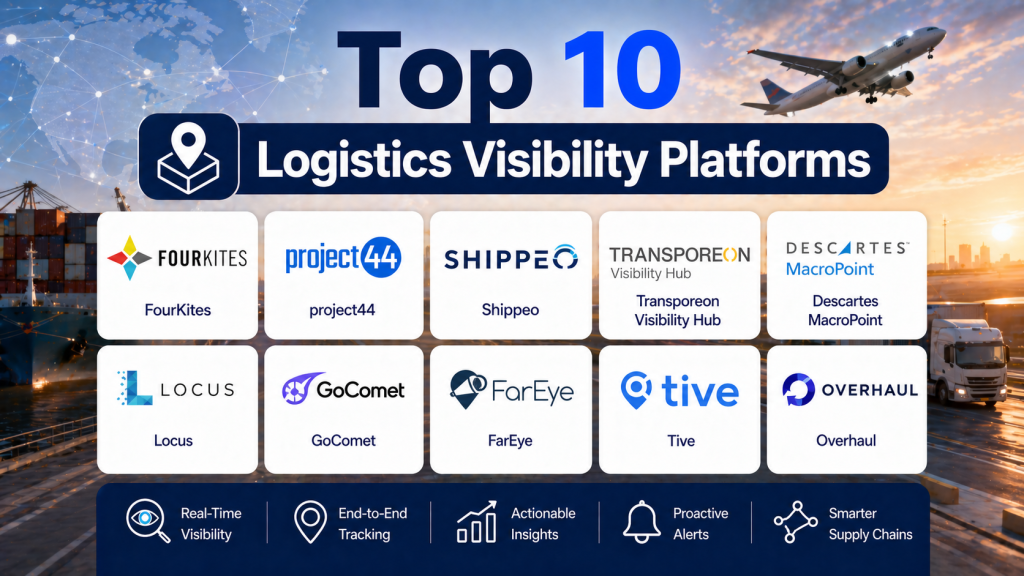
Top 10 Logistics Visibility Platforms Tools
1 — FourKites
Short description: FourKites is a leading supply chain visibility platform providing real-time tracking and predictive analytics. It enables end-to-end shipment visibility across all modes. The platform supports proactive decision-making. It is widely used by global enterprises. It focuses on reducing delays and improving efficiency.
Key Features
- Real-time multimodal tracking
- Predictive ETAs
- Exception management
- Digital twin visibility
- Performance analytics
Pros
- Strong global network
- Advanced analytics
Cons
- Premium pricing
- Complex implementation
Platforms / Deployment
Web — Cloud
Security & Compliance
Not publicly stated
Integrations & Ecosystem
Integrates with ERP, TMS, and carriers
- SAP
- Oracle
- Carrier APIs
Support & Community
Enterprise-level support
2 — project44
Short description: project44 is a supply chain visibility platform offering real-time tracking and AI-driven insights. It connects shippers and carriers through a unified platform. It provides actionable intelligence for logistics decisions. It is widely used by global enterprises. It focuses on data accuracy and predictive analytics.
Key Features
- Real-time shipment visibility
- Predictive analytics
- AI-driven insights
- Carrier connectivity
- Custom dashboards
Pros
- Strong data network
- Advanced analytics
Cons
- Requires integration effort
- Enterprise pricing
Platforms / Deployment
Web — Cloud
Security & Compliance
Not publicly stated
Integrations & Ecosystem
Extensive integrations with TMS and ERP systems
Support & Community
Strong enterprise support
3 — Shippeo
Short description: Shippeo provides real-time and predictive supply chain visibility across all transport modes. It offers highly accurate ETAs and disruption alerts. The platform integrates with thousands of systems. It is suitable for global logistics operations. It improves efficiency and planning.
Key Features
- Real-time tracking
- Predictive ETA
- Disruption alerts
- KPI analytics
- Multi-modal visibility
Pros
- High ETA accuracy
- Strong integration network
Cons
- Requires quality data
- Premium pricing
Platforms / Deployment
Web — Cloud
Security & Compliance
Not publicly stated
Integrations & Ecosystem
Integrates with TMS, ERP, and telematics systems
Support & Community
Good support
4 — Transporeon Visibility Hub
Short description: Transporeon Visibility Hub provides real-time tracking and collaboration tools for logistics networks. It enables precise ETA predictions and route optimization. The platform supports multi-modal logistics. It improves transparency and coordination. It is widely used in Europe and globally.
Key Features
- Real-time tracking
- Predictive ETA
- Route optimization
- Collaboration tools
- Analytics
Pros
- Strong collaboration
- High visibility accuracy
Cons
- Integration complexity
- Premium pricing
Platforms / Deployment
Web — Cloud
Security & Compliance
Not publicly stated
Integrations & Ecosystem
Integration with logistics and telematics systems
Support & Community
Enterprise support
5 — Descartes MacroPoint
Short description: MacroPoint provides real-time freight visibility and tracking for logistics providers. It aggregates data from carriers and telematics devices. The platform supports predictive analytics. It is suitable for 3PL and logistics companies. It improves transparency and efficiency.
Key Features
- Freight tracking
- Predictive analytics
- Automated notifications
- Exception management
- Reporting
Pros
- Strong carrier integrations
- Reliable tracking
Cons
- Limited advanced analytics
- Requires setup
Platforms / Deployment
Web — Cloud
Security & Compliance
Not publicly stated
Integrations & Ecosystem
Carrier and telematics integrations
Support & Community
Standard support
6 — Locus
Short description: Locus is a logistics optimization platform with visibility capabilities for tracking shipments and optimizing routes. It focuses on last-mile delivery and real-time tracking. The platform supports analytics and automation. It is suitable for logistics companies. It improves efficiency.
Key Features
- Real-time tracking
- Route optimization
- Analytics
- Delivery management
- Reporting
Pros
- Strong last-mile optimization
- User-friendly
Cons
- Limited global coverage
- Smaller ecosystem
Platforms / Deployment
Web — Cloud
Security & Compliance
Not publicly stated
Integrations & Ecosystem
API integrations available
Support & Community
Standard support
7 — GoComet
Short description: GoComet is a supply chain visibility platform combining tracking, freight procurement, and analytics. It provides real-time insights and cost optimization tools. The platform is suitable for global logistics operations. It improves transparency and efficiency.
Key Features
- Real-time tracking
- Freight analytics
- Cost optimization
- Reporting
- Integration
Pros
- Cost-focused insights
- Easy to use
Cons
- Limited enterprise depth
- Smaller ecosystem
Platforms / Deployment
Web — Cloud
Security & Compliance
Not publicly stated
Integrations & Ecosystem
Supports integration with logistics systems
Support & Community
Standard support
8 — FarEye
Short description: FarEye is a logistics platform focused on last-mile delivery and real-time visibility. It provides route optimization and delivery tracking. The platform supports automation and analytics. It is suitable for logistics providers. It improves delivery efficiency.
Key Features
- Real-time tracking
- Route optimization
- Delivery scheduling
- Analytics
- Automation
Pros
- Strong last-mile capabilities
- Real-time updates
Cons
- Limited global reach
- Smaller ecosystem
Platforms / Deployment
Web — Cloud
Security & Compliance
Not publicly stated
Integrations & Ecosystem
Integration with enterprise systems
Support & Community
Standard support
9 — Tive
Short description: Tive provides shipment visibility using IoT-enabled tracking devices and software. It offers real-time tracking and condition monitoring. The platform is suitable for high-value shipments. It improves security and transparency. It supports analytics.
Key Features
- IoT tracking
- Real-time visibility
- Condition monitoring
- Alerts
- Reporting
Pros
- Strong hardware integration
- High accuracy
Cons
- Requires devices
- Higher cost
Platforms / Deployment
Web — Cloud
Security & Compliance
Not publicly stated
Integrations & Ecosystem
Integration with IoT and logistics systems
Support & Community
Standard support
10 — Overhaul
Short description: Overhaul is a visibility and risk management platform for logistics operations. It provides real-time tracking and predictive risk analytics. The platform helps manage disruptions and security risks. It is suitable for enterprises. It improves operational resilience.
Key Features
- Real-time tracking
- Risk analytics
- Incident management
- Alerts
- Reporting
Pros
- Strong risk management
- Predictive insights
Cons
- Enterprise-focused
- Complex setup
Platforms / Deployment
Web — Cloud
Security & Compliance
Not publicly stated
Integrations & Ecosystem
Integration with telematics and logistics systems
Support & Community
Enterprise support
Comparison Table
| Tool | Best For | Platforms | Deployment | Standout Feature | Public Rating |
|---|---|---|---|---|---|
| FourKites | Enterprise logistics | Web | Cloud | End-to-end visibility | N/A |
| project44 | Global supply chains | Web | Cloud | AI insights | N/A |
| Shippeo | Predictive tracking | Web | Cloud | ETA accuracy | N/A |
| Transporeon | Collaboration | Web | Cloud | Visibility hub | N/A |
| MacroPoint | Freight tracking | Web | Cloud | Carrier integrations | N/A |
| Locus | Last-mile delivery | Web | Cloud | Route optimization | N/A |
| GoComet | Cost optimization | Web | Cloud | Freight analytics | N/A |
| FarEye | Delivery tracking | Web | Cloud | Last-mile visibility | N/A |
| Tive | IoT tracking | Web | Cloud | Condition monitoring | N/A |
| Overhaul | Risk management | Web | Cloud | Risk analytics | N/A |
Evaluation & Scoring of Logistics Visibility Platforms
| Tool | Core | Ease | Integrations | Security | Performance | Support | Value | Weighted Total |
|---|---|---|---|---|---|---|---|---|
| FourKites | 9 | 7 | 9 | 8 | 9 | 9 | 7 | 8.4 |
| project44 | 9 | 7 | 10 | 8 | 9 | 9 | 7 | 8.5 |
| Shippeo | 8 | 8 | 9 | 7 | 8 | 8 | 7 | 8.1 |
| Transporeon | 8 | 7 | 9 | 7 | 8 | 8 | 7 | 8.0 |
| MacroPoint | 8 | 7 | 8 | 7 | 8 | 8 | 7 | 7.8 |
| Locus | 7 | 8 | 7 | 6 | 7 | 7 | 8 | 7.4 |
| GoComet | 7 | 8 | 7 | 6 | 7 | 7 | 8 | 7.4 |
| FarEye | 7 | 8 | 7 | 6 | 7 | 7 | 8 | 7.4 |
| Tive | 7 | 7 | 6 | 7 | 8 | 7 | 7 | 7.2 |
| Overhaul | 8 | 6 | 8 | 8 | 8 | 8 | 7 | 7.9 |
These scores are comparative and reflect how each platform performs across critical logistics capabilities. Enterprise tools score higher due to strong integrations and scalability, while mid-tier tools balance usability and value. Smaller platforms often excel in ease of use but may lack advanced features. Always align scoring with your operational complexity and scale.
Which Logistics Visibility Platform Is Right for You
Solo / Small Business
GoComet and Locus are easier to deploy and cost-effective.
SMB
Shippeo and FarEye provide strong tracking and analytics without heavy complexity.
Mid-Market
Transporeon and MacroPoint offer balanced features and integrations.
Enterprise
FourKites and project44 are ideal for large global supply chains.
Budget vs Premium
Budget tools focus on core tracking, premium platforms offer AI-driven insights and automation.
Feature Depth vs Ease of Use
Advanced tools provide deeper analytics but require onboarding and training.
Integrations & Scalability
Choose platforms with strong TMS and ERP integrations for long-term growth.
Security & Compliance Needs
Enterprises should prioritize platforms with strong risk management and data protection.
Frequently Asked Questions
1. What are logistics visibility platforms
They are systems that track shipments in real time. They provide data on location, status, and ETA. They improve supply chain transparency. They help businesses make better decisions.
2. Why are they important
They reduce delays and improve coordination. They help companies respond to disruptions quickly. They improve customer experience. They reduce operational costs.
3. How do these platforms work
They collect data from GPS, IoT devices, and carriers. They combine this data into a single dashboard. Predictive analytics improve accuracy.
4. Are these platforms cloud-based
Most modern platforms are cloud-based. This enables scalability and real-time access. It improves collaboration across teams.
5. Can small businesses use these platforms
Yes, many tools offer scalable solutions. Smaller businesses can start with basic features. They can expand as they grow.
6. Do they support multi-modal logistics
Yes, most platforms support road, rail, ocean, and air tracking. This ensures complete visibility.
7. What are common mistakes when choosing tools
Ignoring integration needs is a mistake. Choosing only based on price can cause issues. Not testing the platform is risky.
8. How do these tools improve efficiency
They automate tracking and alerts. They provide predictive insights. They optimize routes and operations.
9. Can these platforms scale
Yes, they are designed to scale with business growth. They support global operations.
10. How long does implementation take
Implementation depends on integrations and complexity. Cloud platforms deploy faster than legacy systems.
Conclusion
Logistics Visibility Platforms have become essential for modern supply chains by enabling real-time tracking, predictive insights, and proactive decision-making. These platforms transform fragmented logistics data into actionable intelligence, helping organizations reduce delays, improve efficiency, and enhance customer satisfaction. As supply chains grow more complex and globalized, the ability to see and respond to disruptions in real time is no longer optional but a competitive necessity.Different platforms cater to different needs, from enterprise-grade solutions like FourKites and project44 to more flexible tools like Locus and GoComet. The best choice depends on your scale, integration requirements, and operational complexity. There is no universal solution, and organizations should evaluate their priorities carefully before making a decision.
