Introduction
Facility Management Software is a digital system that helps organizations manage buildings, assets, maintenance operations, and workplace services in a centralized way. It connects maintenance workflows, asset tracking, space usage, and work order automation into one platform so teams can operate more efficiently.
These tools are widely used in corporate offices, manufacturing plants, hospitals, schools, and real estate portfolios where managing multiple facilities manually becomes complex and costly. Modern platforms are now cloud based, mobile enabled, and powered by automation and IoT for real time visibility.
At the core, many of these systems follow CMMS principles, helping organizations plan preventive maintenance, reduce downtime, and extend asset life.
Real World Use Cases
- A manufacturing plant tracking machine breakdowns and scheduling preventive maintenance
- A hospital managing equipment uptime and safety inspections
- A corporate office optimizing workspace utilization and maintenance requests
- A real estate company managing multiple buildings and tenant facilities
- An airport tracking critical infrastructure assets and service operations
Key Evaluation Criteria
- Work order management efficiency
- Asset lifecycle tracking capability
- Preventive maintenance automation
- Ease of use for technicians and managers
- Integration with ERP, IoT, and workplace systems
- Real time reporting and dashboards
- Scalability across multiple locations
- Mobile accessibility for field teams
- Security and access control
- Cost efficiency and long term value
Key Trends in Facility Management Software
- AI based predictive maintenance to reduce breakdowns
- IoT sensors for real time equipment monitoring
- Smart building automation and energy optimization
- Cloud first platforms replacing legacy systems
- Mobile first work order execution
- Integration with ERP and HR systems
- ESG and sustainability tracking requirements
- Digital twin models for facility simulation
- Automated compliance and audit reporting
- Data driven real estate optimization decisions
How We Selected These Tools
- Strong adoption in enterprise and industrial environments
- Complete maintenance and asset lifecycle coverage
- Reliable performance under large scale operations
- Integration with ERP, IoT, and CMMS ecosystems
- Ease of deployment and usability
- Scalability for multi site operations
- Strong analytics and reporting capabilities
- Vendor maturity and support quality
- Automation and AI readiness
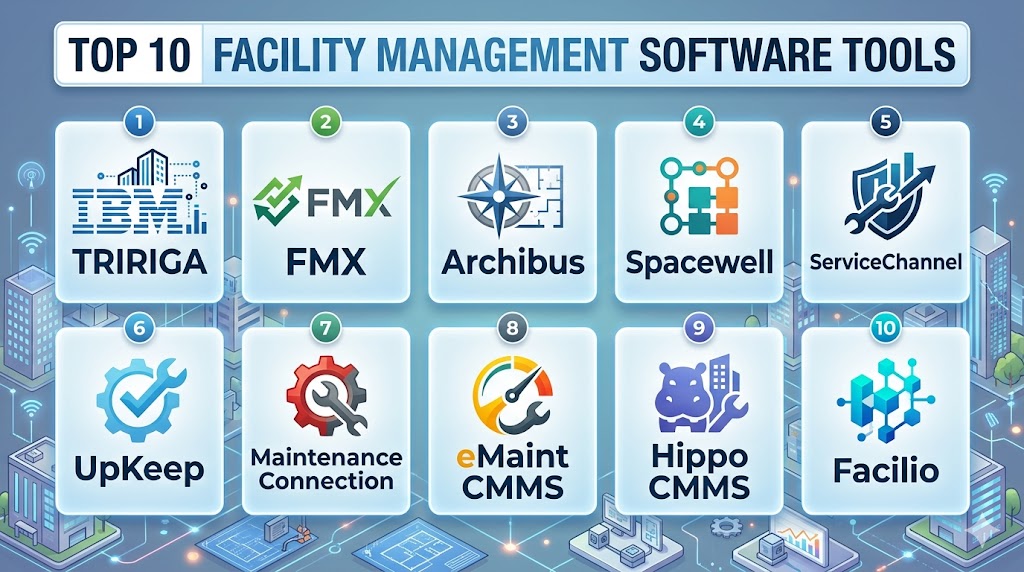
Top 10 Facility Management Software Tools
#1 — IBM TRIRIGA
Short description:
IBM TRIRIGA is an enterprise level facility and real estate management platform designed for large organizations. It helps manage assets, maintenance, and space planning in a unified system. It is widely used in complex enterprise environments.
Key Features
- Real estate lifecycle management
- Space optimization and planning
- Asset tracking and maintenance
- Energy management
- Compliance and reporting
Pros
- Highly scalable enterprise platform
- Strong analytics capabilities
- Deep integration potential
Cons
- Complex implementation process
- High cost of ownership
- Requires training
Platforms or Deployment
Web, Cloud, Hybrid
Security and Compliance
Enterprise grade security features
Not publicly stated certifications
Integrations and Ecosystem
- ERP systems
- IoT platforms
- Enterprise asset systems
Support and Community
Enterprise level support
#2 — FMX
Short description:
FMX is a simple facility management system designed for maintenance tracking, work orders, and scheduling. It is widely used in schools and small to mid sized organizations. It focuses on ease of use and quick deployment.
Key Features
- Work order management
- Preventive maintenance scheduling
- Asset tracking
- Calendar based scheduling
- Reporting dashboards
Pros
- Very easy to use
- Fast implementation
- Cost effective
Cons
- Limited enterprise depth
- Basic customization options
- Smaller ecosystem
Platforms or Deployment
Web, Cloud
Security and Compliance
Not publicly stated
Integrations and Ecosystem
- Calendar tools
- Maintenance systems APIs
Support and Community
Strong SMB support
#3 — Archibus
Short description:
Archibus is a comprehensive facility and workplace management platform used for space planning, maintenance, and asset tracking. It is widely adopted in enterprise real estate operations.
Key Features
- Space and workplace planning
- Maintenance management
- Asset lifecycle tracking
- Compliance reporting
- Facility analytics
Pros
- Highly feature rich platform
- Strong enterprise scalability
- Advanced analytics
Cons
- Complex setup and configuration
- Requires training
- Higher cost structure
Platforms or Deployment
Web, Cloud, On premise
Security and Compliance
Not publicly stated
Integrations and Ecosystem
- ERP systems
- BIM tools
- Enterprise APIs
Support and Community
Enterprise support available
#4 — Spacewell
Short description:
Spacewell is a smart facility management platform that uses IoT and analytics to optimize building operations. It provides real time insights into occupancy, energy usage, and maintenance needs.
Key Features
- IoT based occupancy tracking
- Predictive maintenance
- Space optimization
- Energy monitoring
- Analytics dashboards
Pros
- Strong IoT integration
- Advanced analytics
- Modern architecture
Cons
- Complex implementation
- Higher cost
- Requires technical expertise
Platforms or Deployment
Cloud, Hybrid
Security and Compliance
Not publicly stated
Integrations and Ecosystem
- IoT sensors
- Workplace systems
- API based integrations
Support and Community
Enterprise level support
#5 — ServiceChannel
Short description:
ServiceChannel is a facilities maintenance platform focused on vendor management and service execution across multiple locations. It is widely used in retail and enterprise operations.
Key Features
- Vendor management
- Work order tracking
- Maintenance scheduling
- Performance monitoring
- Cost control
Pros
- Strong vendor network
- Multi location support
- Reliable execution
Cons
- Pricing varies
- Learning curve
- Limited customization
Platforms or Deployment
Web, Cloud
Security and Compliance
Not publicly stated
Integrations and Ecosystem
- ERP systems
- Procurement tools
- API integrations
Support and Community
Enterprise support
#6 — UpKeep
Short description:
UpKeep is a mobile first maintenance management platform designed for technicians and field teams. It simplifies work orders, asset tracking, and preventive maintenance.
Key Features
- Mobile work order management
- Asset tracking
- Preventive maintenance
- Inventory tracking
- Reporting tools
Pros
- Easy mobile usage
- Fast deployment
- User friendly
Cons
- Limited enterprise features
- Basic analytics
- Smaller ecosystem
Platforms or Deployment
Web, Mobile, Cloud
Security and Compliance
Not publicly stated
Integrations and Ecosystem
- ERP systems
- IoT platforms
- APIs
Support and Community
Good SMB support
#7 — Maintenance Connection
Short description:
Maintenance Connection is a CMMS based facility management platform focused on maintenance optimization and asset lifecycle tracking. It is widely used in industrial environments.
Key Features
- Work order management
- Preventive maintenance
- Asset tracking
- Inventory control
- Reporting analytics
Pros
- Strong CMMS foundation
- Reliable performance
- Scalable
Cons
- Complex interface
- Requires training
- Learning curve
Platforms or Deployment
Web, Cloud
Security and Compliance
Not publicly stated
Integrations and Ecosystem
- ERP systems
- Maintenance tools
- APIs
Support and Community
Enterprise support
#8 — eMaint CMMS
Short description:
eMaint CMMS is a cloud based maintenance management platform that helps organizations automate maintenance workflows and improve asset performance.
Key Features
- Work order automation
- Preventive maintenance scheduling
- Asset lifecycle management
- Mobile access
- Reporting dashboards
Pros
- Strong CMMS capabilities
- Cloud based flexibility
- Custom workflows
Cons
- Setup complexity
- Pricing variations
- Training required
Platforms or Deployment
Web, Cloud
Security and Compliance
Not publicly stated
Integrations and Ecosystem
- ERP systems
- IoT systems
- API integrations
Support and Community
Enterprise support
#9 — Hippo CMMS
Short description:
Hippo CMMS is a simple and easy to use maintenance management system designed for small and mid sized organizations. It focuses on quick setup and usability.
Key Features
- Work order management
- Preventive maintenance
- Asset tracking
- Scheduling system
- Reporting tools
Pros
- Very easy to use
- Quick setup
- Affordable
Cons
- Limited advanced features
- Smaller ecosystem
- Basic analytics
Platforms or Deployment
Web, Cloud
Security and Compliance
Not publicly stated
Integrations and Ecosystem
- API integrations
- Maintenance tools
Support and Community
Good SMB support
#10 — Facilio
Short description:
Facilio is an AI driven facility management platform designed for real time operations and predictive maintenance. It helps organizations improve efficiency using data driven insights.
Key Features
- AI powered maintenance insights
- Real time asset monitoring
- IoT integration
- Energy management
- Centralized operations
Pros
- Advanced AI capabilities
- Strong analytics
- Modern architecture
Cons
- Complex setup
- Higher cost
- Requires training
Platforms or Deployment
Web, Cloud
Security and Compliance
Not publicly stated
Integrations and Ecosystem
- IoT devices
- ERP systems
- API integrations
Support and Community
Enterprise level support
Comparison Table
| Tool Name | Best For | Deployment | Standout Feature | Ease of Use | Enterprise Fit |
|---|---|---|---|---|---|
| IBM TRIRIGA | Large enterprises | Cloud Hybrid | Lifecycle management | Low | Very High |
| FMX | SMB facilities | Cloud | Simplicity | High | Medium |
| Archibus | Real estate enterprises | Cloud On premise | Space planning | Medium | Very High |
| Spacewell | Smart buildings | Cloud Hybrid | IoT integration | Medium | High |
| ServiceChannel | Multi location operations | Cloud | Vendor management | Medium | High |
| UpKeep | Field maintenance teams | Cloud Mobile | Mobile CMMS | High | Medium |
| Maintenance Connection | Industrial CMMS | Cloud | Asset lifecycle | Medium | High |
| eMaint | Maintenance automation | Cloud | Work order system | Medium | High |
| Hippo CMMS | Small businesses | Cloud | Ease of use | Very High | Medium |
| Facilio | Smart enterprises | Cloud | AI insights | Medium | Very High |
Evaluation & Scoring
| Tool Name | Core | Ease | Integrations | Security | Performance | Support | Value | Total |
|---|---|---|---|---|---|---|---|---|
| IBM TRIRIGA | 10 | 6 | 9 | 9 | 10 | 8 | 6 | 8.5 |
| FMX | 8 | 9 | 7 | 6 | 8 | 7 | 9 | 7.9 |
| Archibus | 9 | 7 | 8 | 8 | 9 | 8 | 7 | 8.2 |
| Spacewell | 9 | 7 | 9 | 8 | 9 | 8 | 7 | 8.3 |
| ServiceChannel | 9 | 8 | 9 | 8 | 9 | 8 | 7 | 8.4 |
| UpKeep | 8 | 9 | 8 | 6 | 8 | 7 | 9 | 8.0 |
| Maintenance Connection | 9 | 7 | 8 | 8 | 8 | 8 | 7 | 8.1 |
| eMaint | 9 | 7 | 8 | 8 | 8 | 8 | 7 | 8.1 |
| Hippo CMMS | 7 | 9 | 7 | 6 | 7 | 7 | 9 | 7.8 |
| Facilio | 9 | 7 | 9 | 8 | 9 | 8 | 7 | 8.3 |
Frequently Asked Questions
1. What is facility management software
Facility management software is a system that helps organizations manage buildings, assets, and maintenance operations in one platform. It improves efficiency and reduces manual work.
2. What industries use it
It is used in real estate, manufacturing, healthcare, education, and corporate offices. Any organization with physical assets can use it.
3. What is CMMS
CMMS stands for computerized maintenance management system. It focuses on maintenance scheduling, work orders, and asset tracking.
4. Can it reduce costs
Yes, it reduces maintenance costs by preventing breakdowns and improving asset efficiency.
5. Is it cloud based
Most modern tools are cloud based, allowing real time access and updates from anywhere.
6. Does it support mobile use
Yes, many platforms offer mobile apps for technicians and managers.
7. Can it track assets
Yes, it tracks asset lifecycle, maintenance history, and performance data.
8. Is it suitable for small businesses
Yes, simpler tools like FMX and Hippo CMMS are ideal for SMBs.
9. Does it integrate with ERP systems
Yes, most tools integrate with ERP, IoT, and enterprise systems.
10. What is the main benefit
The main benefit is improved operational efficiency through centralized maintenance and asset management.
Conclusion
Facility Management Software is essential for modern organizations that manage multiple assets, buildings, and maintenance operations. It helps reduce downtime, improve efficiency, and optimize costs through automation and real time insights. From enterprise platforms like IBM TRIRIGA and Facilio to simple tools like FMX and Hippo CMMS, each solution serves different business needs. Choosing the right tool depends on scale, complexity, and integration requirements. A well implemented facility management system enables smarter operations, better planning, and long term asset efficiency.
