Introduction
Reverse ETL tools are modern data integration solutions that move data from centralized data warehouses back into operational systems such as CRM platforms, marketing tools, support systems, and internal business applications. Unlike traditional ETL processes that focus on bringing data into warehouses, Reverse ETL ensures that clean, transformed data is activated across business workflows.
In today’s data-driven ecosystem, storing data is not enough. Teams need actionable insights directly inside the tools they use daily. Reverse ETL platforms enable this by syncing warehouse data into operational tools, helping teams automate workflows, personalize customer experiences, and make better decisions. Modern tools now include real-time syncing, automation, and AI-driven data activation capabilities.
Real-world use cases:
- Syncing customer data into CRM systems
- Powering personalized marketing campaigns
- Enabling product analytics inside business tools
- Automating sales workflows with enriched data
- Delivering real-time insights to operational teams
What buyers should evaluate:
- Supported data warehouses such as Snowflake, BigQuery, Redshift
- Destination integrations such as CRM and SaaS tools
- Data sync frequency including batch and real-time
- Transformation and modeling capabilities
- Data governance and security controls
- Ease of use and user interface
- API and extensibility
- Monitoring and error handling
- Scalability across datasets
- Pricing model and flexibility
Best for: Data teams, growth teams, marketing teams, RevOps teams, and organizations using modern data warehouses
Not ideal for: Organizations without structured data pipelines or centralized data storage
Key Trends in Reverse ETL Tools
- Real-time and event-driven data synchronization
- AI-powered segmentation and automation
- Deep integration with SaaS and business tools
- No-code and low-code data workflows
- Expansion into operational analytics
- Stronger data governance and compliance features
- Warehouse-first architecture adoption
- API-first design for flexibility
- Embedded analytics in operational tools
- Automation-driven data activation
How We Selected These Tools Methodology
- Market adoption and industry reputation
- Breadth of warehouse and destination integrations
- Reliability and performance of data syncing
- Ease of use for technical and non-technical teams
- Automation and workflow capabilities
- Data governance and security features
- Scalability for large datasets
- Vendor innovation and roadmap strength
- Support quality and documentation
- Suitability for SMBs and enterprises
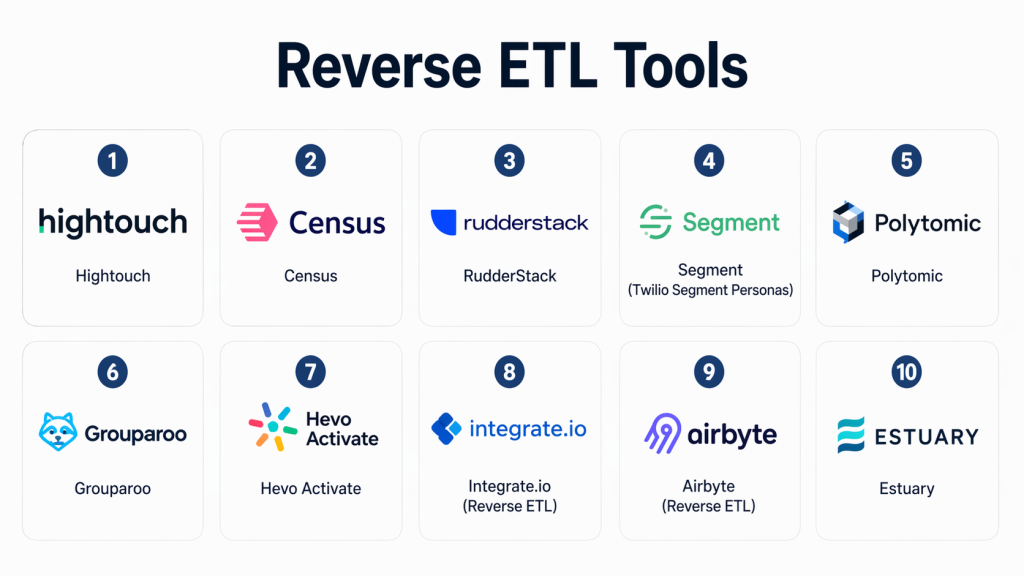
Top 10 Reverse ETL Tools
#1 — Hightouch
Short description:
Hightouch is a leading Reverse ETL platform designed to sync data from warehouses into business tools. It supports a wide range of integrations. It offers real-time data syncing. It enables workflow automation. It scales efficiently for large organizations. It is widely adopted in modern data stacks.
Key Features
- Warehouse integrations
- Real-time syncing
- Workflow automation
- Data modeling
- Monitoring and alerts
Pros
- Easy to use interface
- Strong integration ecosystem
- Highly scalable
Cons
- Premium pricing
- Limited deep customization
Platforms / Deployment
- Cloud
Security & Compliance
- RBAC
- Compliance Not publicly stated
Integrations & Ecosystem
Hightouch connects with CRMs, marketing platforms, and analytics tools, enabling seamless data activation across business systems.
- CRM platforms
- Marketing tools
- APIs and custom integrations
Support & Community
Strong enterprise support with detailed documentation and growing community adoption.
#2 — Census
Short description:
Census focuses on operationalizing warehouse data by syncing it into business tools. It provides reliable scheduling and automation. It supports multiple destinations. It ensures consistent data pipelines. It scales well for enterprise use. It is known for stability and ease of setup.
Key Features
- Data synchronization
- Automated workflows
- Scheduling
- Integration support
- Monitoring
Pros
- Reliable performance
- Easy setup
- Scalable architecture
Cons
- Cost considerations
- Limited advanced features
Platforms / Deployment
- Cloud
Security & Compliance
- RBAC
- Compliance Not publicly stated
Integrations & Ecosystem
Census integrates with major SaaS tools and data platforms, enabling smooth data delivery across business systems.
- CRM systems
- SaaS applications
- APIs
Support & Community
Good documentation and enterprise-grade support.
#3 — RudderStack
Short description:
RudderStack combines Reverse ETL with event streaming capabilities. It enables real-time data activation. It supports both cloud and self-hosted deployment. It integrates with modern data stacks. It is highly flexible. It is suitable for teams needing control over data pipelines.
Key Features
- Event streaming
- Data syncing
- Integration capabilities
- Automation workflows
- Analytics
Pros
- Open-source option available
- Highly flexible
- Scalable
Cons
- Complex setup
- Learning curve
Platforms / Deployment
- Cloud / Self-hosted
Security & Compliance
- RBAC
- Compliance Not publicly stated
Integrations & Ecosystem
RudderStack supports integrations across analytics tools and SaaS applications for real-time data activation.
- Data warehouses
- SaaS tools
- APIs
Support & Community
Active open-source community with enterprise support options.
#4 — Segment Personas
Short description:
Segment Personas enables Reverse ETL by activating customer data across marketing and analytics platforms. It supports segmentation and automation. It integrates with many SaaS tools. It scales effectively for enterprises. It provides strong customer insights.
Key Features
- Customer data activation
- Segmentation
- Integration
- Analytics
- Automation
Pros
- Strong ecosystem
- Reliable performance
- Enterprise-ready
Cons
- Expensive
- Complex configuration
Platforms / Deployment
- Cloud
Security & Compliance
- RBAC
- Compliance Not publicly stated
Integrations & Ecosystem
Segment integrates with a wide range of tools for marketing, analytics, and customer data management.
- Marketing platforms
- Analytics tools
- APIs
Support & Community
Strong enterprise support and ecosystem maturity.
#5 — Polytomic
Short description:
Polytomic is designed for real-time data activation with bi-directional syncing. It integrates with CRM systems and SaaS platforms. It provides fast performance. It supports automation. It scales for growing businesses. It is ideal for operational teams.
Key Features
- Real-time syncing
- Bi-directional data flow
- Integration support
- Automation
- Monitoring
Pros
- Fast data syncing
- Flexible usage
- Scalable
Cons
- Smaller ecosystem
- Limited advanced features
Platforms / Deployment
- Cloud
Security & Compliance
- RBAC
- Compliance Not publicly stated
Integrations & Ecosystem
Polytomic connects with CRM and SaaS tools to enable operational data usage.
- CRM systems
- SaaS applications
- APIs
Support & Community
Growing platform with improving documentation.
#6 — Grouparoo
Short description:
Grouparoo is an open-source Reverse ETL tool designed for developers. It enables data syncing and segmentation. It supports automation workflows. It is flexible and customizable. It works well for smaller teams. It is cost-effective.
Key Features
- Open-source flexibility
- Data syncing
- Segmentation
- Integration
- Automation
Pros
- Free and open-source
- Developer-friendly
- Flexible
Cons
- Requires setup
- Limited enterprise features
Platforms / Deployment
- Cloud / Self-hosted
Security & Compliance
- Not publicly stated
Integrations & Ecosystem
Grouparoo integrates with common business tools and APIs for flexible deployment.
- CRM tools
- APIs
Support & Community
Active open-source community support.
#7 — Hevo Activate
Short description:
Hevo Activate provides Reverse ETL capabilities with strong automation and scheduling. It integrates with warehouses and SaaS tools. It offers reliable syncing. It is easy to use. It scales well for SMBs and enterprises.
Key Features
- Data syncing
- Automation
- Scheduling
- Integration
- Monitoring
Pros
- Easy to use
- Reliable
- Scalable
Cons
- Limited advanced features
- Pricing considerations
Platforms / Deployment
- Cloud
Security & Compliance
- RBAC
- Compliance Not publicly stated
Integrations & Ecosystem
Hevo supports integrations with multiple SaaS tools and data warehouses.
- CRM systems
- Marketing tools
- APIs
Support & Community
Good support and documentation.
#8 — Integrate.io
Short description:
Integrate.io provides Reverse ETL along with strong data pipeline capabilities. It supports automation and integration workflows. It offers scalability for enterprises. It provides reliable performance. It is suitable for complex environments.
Key Features
- Data pipelines
- Automation
- Integration
- Monitoring
- Analytics
Pros
- Flexible workflows
- Scalable
- Reliable
Cons
- Complex interface
- Cost
Platforms / Deployment
- Cloud
Security & Compliance
- RBAC
- Compliance Not publicly stated
Integrations & Ecosystem
Integrate.io supports connections with business tools and APIs for data activation.
- CRM tools
- APIs
Support & Community
Enterprise-level support available.
#9 — Airbyte
Short description:
Airbyte provides Reverse ETL capabilities with open-source flexibility. It supports custom connectors and integrations. It is scalable. It enables automation. It is suitable for technical teams needing customization.
Key Features
- Open-source platform
- Data integration
- Automation
- API support
- Custom connectors
Pros
- Highly customizable
- Scalable
- Flexible
Cons
- Requires technical expertise
- Learning curve
Platforms / Deployment
- Cloud / Self-hosted
Security & Compliance
- Not publicly stated
Integrations & Ecosystem
Airbyte offers a wide range of connectors for flexible data workflows.
- Data warehouses
- APIs
Support & Community
Strong open-source community.
#10 — Estuary
Short description:
Estuary provides real-time data pipelines with Reverse ETL capabilities. It focuses on streaming data integration. It integrates with modern data stacks. It is scalable. It provides strong performance for real-time use cases.
Key Features
- Real-time streaming
- Data syncing
- Integration
- Automation
- Monitoring
Pros
- Real-time capabilities
- Scalable
- Flexible
Cons
- Emerging platform
- Limited ecosystem
Platforms / Deployment
- Cloud
Security & Compliance
- Not publicly stated
Integrations & Ecosystem
Estuary integrates with modern platforms for real-time data movement.
- Data platforms
- APIs
Support & Community
Growing ecosystem with evolving support.
Comparison Table
| Tool | Best For | Platform | Deployment | Standout Feature | Rating |
|---|---|---|---|---|---|
| Hightouch | Enterprise | Cloud | Cloud | Real-time sync | N/A |
| Census | Enterprise | Cloud | Cloud | Reliability | N/A |
| RudderStack | DevOps | Multi | Hybrid | Event streaming | N/A |
| Segment | Enterprise | Cloud | Cloud | CDP integration | N/A |
| Polytomic | Mid-market | Cloud | Cloud | Bi-directional sync | N/A |
| Grouparoo | Developers | Multi | Hybrid | Open-source | N/A |
| Hevo | SMB | Cloud | Cloud | Simplicity | N/A |
| Integrate.io | Enterprise | Cloud | Cloud | Data pipelines | N/A |
| Airbyte | Developers | Multi | Hybrid | Custom connectors | N/A |
| Estuary | Emerging | Cloud | Cloud | Real-time streaming | N/A |
Evaluation & Scoring of Reverse ETL Tools
| Tool | Core | Ease | Integration | Security | Performance | Support | Value | Weighted Total |
|---|---|---|---|---|---|---|---|---|
| Hightouch | 10 | 9 | 9 | 9 | 9 | 9 | 8 | 9.1 |
| Census | 9 | 9 | 9 | 9 | 9 | 9 | 8 | 9.0 |
| RudderStack | 9 | 7 | 9 | 9 | 9 | 8 | 8 | 8.7 |
| Segment | 10 | 8 | 10 | 9 | 9 | 9 | 7 | 9.0 |
| Polytomic | 8 | 8 | 8 | 8 | 9 | 8 | 8 | 8.2 |
| Grouparoo | 8 | 7 | 8 | 8 | 8 | 7 | 9 | 8.1 |
| Hevo | 8 | 9 | 8 | 8 | 8 | 8 | 9 | 8.4 |
| Integrate.io | 9 | 7 | 8 | 9 | 9 | 8 | 7 | 8.3 |
| Airbyte | 9 | 7 | 9 | 8 | 8 | 7 | 9 | 8.3 |
| Estuary | 8 | 7 | 8 | 8 | 9 | 7 | 8 | 8.0 |
Scoring is based on a comparative model across features, usability, integrations, and value. A higher score indicates stronger overall capability. However, the best tool depends on specific use cases. Enterprises may prioritize integrations, while smaller teams may prioritize ease of use and cost.
Which Reverse ETL Tool Is Right for You
Solo / Freelancer
- Grouparoo is suitable due to flexibility and cost efficiency
SMB
- Hevo Activate offers ease of use and reliable performance
Mid-Market
- Polytomic provides strong real-time capabilities
Enterprise
- Hightouch, Census, and Segment offer scalability and advanced features
Budget vs Premium
- Budget option is Grouparoo
- Premium option is Hightouch
Feature Depth vs Ease of Use
- Easy to use option is Census
- Advanced option is RudderStack
Integrations & Scalability
- Segment provides strong integration ecosystem
Security & Compliance Needs
- Hightouch offers strong enterprise-grade capabilities
Frequently Asked Questions
1. What is Reverse ETL
Reverse ETL is a process that moves data from a warehouse into operational tools. It helps teams use data in real workflows. It bridges analytics and operations. It improves decision-making across teams.
2. Why is Reverse ETL important
It enables businesses to activate data instead of just storing it. Teams can use real-time insights. It improves operational efficiency. It helps drive better business outcomes.
3. How does Reverse ETL work
It extracts data from warehouses and syncs it into SaaS tools. It uses APIs and connectors. It automates data pipelines. It ensures consistent data flow.
4. Who should use Reverse ETL tools
Data teams, marketing teams, and sales teams benefit from these tools. Organizations with centralized data systems benefit most. It helps operationalize data effectively.
5. Are Reverse ETL tools scalable
Yes, they are built for large datasets and cloud environments. They scale with business growth. They support real-time and batch processing. This ensures reliability.
6. Do Reverse ETL tools integrate with other tools
Yes, they integrate with CRMs, marketing tools, and SaaS applications. This creates a connected data ecosystem. Integration improves workflows and efficiency.
7. Are Reverse ETL tools secure
Most tools include access controls and encryption. They ensure safe data transfer. Proper configuration enhances security. They reduce data risks.
8. Are Reverse ETL tools difficult to implement
Some tools are easy to use with no-code interfaces. Others require technical expertise. Proper setup ensures success. Planning is important.
9. What are alternatives to Reverse ETL
Alternatives include traditional ETL and data integration tools. However, they focus on data ingestion. Reverse ETL focuses on data activation. It complements these tools.
10. Are Reverse ETL tools expensive
Pricing varies by features and usage. Some tools offer free options. Enterprise tools are more expensive. Investment depends on business needs.
Conclusion
Reverse ETL tools have become a critical part of the modern data stack, enabling organizations to activate data stored in warehouses and deliver it directly into business workflows. Instead of keeping insights locked in analytics systems, these tools ensure that data reaches the teams who need it most, driving faster decisions and improved efficiency across sales, marketing, and operations. Choosing the right Reverse ETL platform depends on your organization’s size, technical maturity, and integration requirements. Enterprise teams may benefit from platforms like Hightouch or Census, while smaller teams can leverage flexible or open-source options such as Grouparoo or Airbyte. The best approach is to shortlist a few tools, run pilot implementations, and validate how well they integrate with your existing data stack and workflows before making a final decision.
