Introduction
Digital marketing has evolved from a simple mix of organic search and banner ads into a sprawling, multi-channel ecosystem. Today, marketing teams juggle dozens of campaigns, multiple content formats, hyper-targeted social media channels, technical SEO requirements, and complex marketing automation sequences.
Yet, as channel complexity increases, internal efficiency often plummets. Marketing teams find themselves trapped in endless email chains, disjointed spreadsheets, missed deadlines, and siloed communication. These operational inefficiencies stall campaign launches, dilute brand messaging, and waste valuable budget.
To scale effectively, businesses must transition from reactive tasks to a proactive, structured digital marketing workflow. A smarter workflow brings order to chaos, automates repetitive operations, aligns cross-functional teams, and ensures that every piece of content or ad spend drives measurable business value.
In this comprehensive guide, you will learn how to design, execute, and optimize a high-performance digital marketing workflow using modern strategies, proven frameworks, and platforms like WizBrand.
What Is a Digital Marketing Workflow?
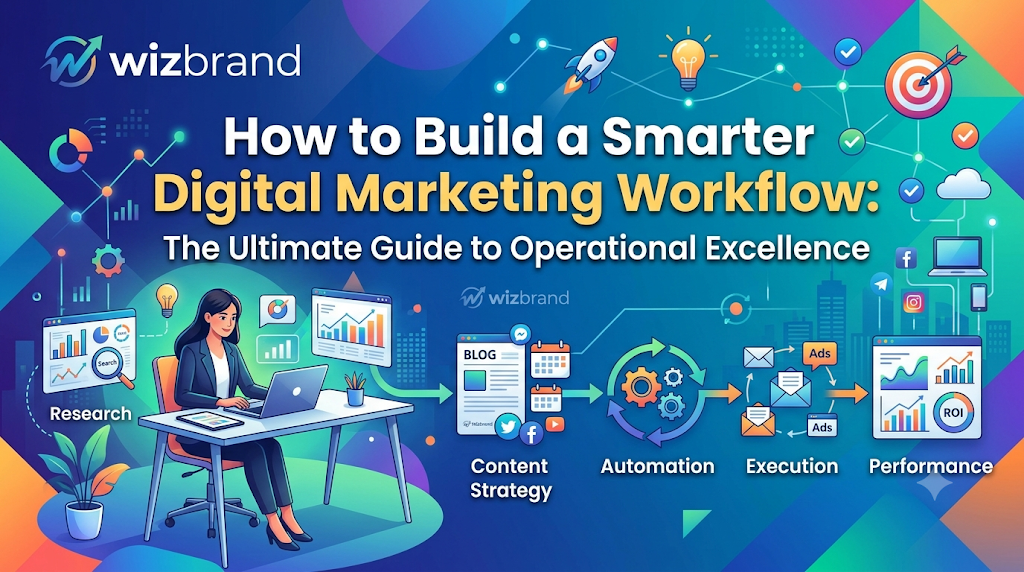
A digital marketing workflow is a structured, repeatable sequence of tasks, steps, and approvals required to move a marketing initiative from ideation to final execution and analysis. It defines who does what, when they do it, and what tools or resources are needed at each stage.
When optimized, a digital marketing workflow acts as the operational heartbeat of your marketing department. It bridges the gap between high-level strategy and daily execution, transforming ambiguous marketing goals into clear, accountable milestones.
Why Traditional Marketing Workflows Fail
Many organizations still rely on legacy processes—such as email threads, desktop spreadsheets, and disjointed point solutions—to manage modern campaigns. This approach leads to inevitable failures:
- Siloed Communication: Content creators, SEO specialists, and paid media managers operate in isolation, leading to disjointed customer journeys.
- Lack of Visibility: Managers have no real-time insight into project bottlenecks or task ownership.
- Manual Bottlenecks: Approvals stall because they rely on manual pinging rather than automated triggers.
- Inconsistent Quality: Without Standard Operating Procedures (SOPs), brand voice, formatting, and SEO optimization checks are frequently skipped.
Characteristics of a Smarter Marketing Workflow
A smarter marketing workflow moves beyond basic task management into true digital marketing operations excellence. Its defining traits include:
- End-to-End Transparency: Every team member knows project status, deadlines, and responsibilities at a glance.
- Seamless Automation: Repetitive administrative and scheduling tasks are handled by automated triggers.
- Built-in SEO Integration: Search engine optimization is treated as a foundational element of content creation, not an afterthought.
- Data-Driven Feedback Loops: Performance data feeds directly back into planning phases to refine future iterations.
Common Workflow Bottlenecks
Identifying where friction occurs is the first step toward optimization. Typical marketing bottlenecks include:
- Content Review Delays: Content waiting in personal email inboxes for editorial sign-off.
- Asset Disorganization: Designers and copywriters storing files across local drives instead of centralized drives.
- Misaligned Objectives: Sales and marketing teams targeting different buyer personas due to poor communication.
- Late SEO Audits: Discovering technical optimization issues only after a website page has been published.
Aligning Marketing Goals and Team Responsibilities
A successful workflow starts with strategic alignment. Business owners and marketing managers must connect overarching revenue goals directly to daily team output.
- Define Core KPIs: Establish clear metrics such as organic traffic growth, lead conversion rates, and customer acquisition cost (CAC).
- Map Accountability: Use RACI matrices (Responsible, Accountable, Consulted, Informed) to eliminate ambiguity over who owns specific deliverables.
Creating Standard Operating Procedures (SOPs)
Consistency drives scalability. Standard Operating Procedures (SOPs) document the exact steps required to execute recurring tasks, ensuring high quality regardless of who performs the work.
- Document Everything: Create concise step-by-step guides for blog publishing, email newsletter creation, and social media scheduling.
- Store Centrally: Keep SOPs accessible within a centralized workflow management platform like WizBrand so team members can reference them instantly.
Content Planning and Editorial Workflow
Content remains the anchor of digital marketing, but erratic publishing schedules kill organic momentum. An effective editorial workflow governs content from conception to distribution:
- Ideation & Research: Gathering data-driven content topics based on keyword research and audience pain points.
- Drafting & Review: Writing copy while adhering to brand guidelines and SEO best practices.
- Editorial Polish: Checking readability, tone, and factual accuracy.
- Publishing & Promotion: Deploying content across web and social channels simultaneously.
SEO Workflow Integration
SEO cannot be bolted on at the last minute; it must be embedded directly into the content workflow management process.
- Keyword Mapping: Assign primary and secondary keywords before drafting begins.
- On-Page Optimization Checks: Ensure meta descriptions, title tags, heading structures, and internal links are optimized prior to publication.
- Rank Tracking: Monitor how newly published assets perform over time to identify required updates.
Social Media Workflow Management
Managing multiple social channels requires disciplined scheduling and rapid asset coordination.
- Calendar Synchronization: Maintain a master social calendar that coordinates with blog and email campaigns.
- Visual Asset Batching: Create and approve graphics in batches to maintain a steady cadence of posts.
- Engagement Tracking: Route incoming comments and customer queries through a unified social monitoring queue.
Campaign Planning and Execution
Complex multi-channel campaigns require synchronized execution across paid ads, email marketing, content marketing, and social media.
- Timeline Mapping: Use Gantt charts or visual timelines to map dependencies between ad creation, landing page development, and email broadcast dates.
- Cross-Channel Synergy: Ensure visual assets and messaging remain consistent whether a user encounters the brand on LinkedIn, Google Search, or an email newsletter.
Marketing Automation and Workflow Efficiency
According to industry benchmarks, marketing automation significantly reduces operational overhead. Utilizing marketing workflow automation eliminates manual data entry, lead routing delays, and scheduling errors.
- Lead Nurturing Sequences: Automatically trigger onboarding emails based on user actions.
- Task Assignment Triggers: Automatically assign proofreading tasks as soon as a writer marks a draft as complete.
Team Collaboration and Communication
Effective marketing team collaboration breaks down departmental silos.
- Unified Workspace: Keep conversations, file attachments, and feedback threads tied directly to specific tasks rather than scattered across chat apps.
- Transparent Updates: Daily stand-ups and dashboard overviews keep remote and hybrid teams synchronized.
Approval Processes and Quality Control
Unclear review chains cause frustrating project delays. A smart workflow establishes strict approval gates:
- Single Point of Review: Assign specific approvers for legal, branding, and executive sign-offs.
- Version Control: Prevent team members from working on outdated file drafts by using centralized cloud repositories.
Performance Tracking and Reporting
You cannot optimize what you do not measure. A complete marketing workflow includes regular performance reporting checkpoints.
- Automated Dashboards: Aggregate traffic, conversion, and ROI metrics into real-time reporting views.
- Weekly Reviews: Analyze which campaigns exceeded benchmarks and adjust underperforming workflows accordingly.
Continuous Workflow Optimization
Workflows are living systems that require regular tuning. Conduct quarterly operational audits to identify new bottlenecks, integrate emerging tools, and prune redundant approval layers.
Future of AI-Driven Marketing Workflows
The integration of Artificial Intelligence into digital marketing operations is redefining efficiency. AI now assists in predictive content scheduling, automated keyword clustering, smart audience segmentation, and real-time performance forecasting, allowing marketing teams to focus on high-level strategy and creative execution.
Practical Workflow Examples
1. Content Production Workflow
- Idea Generation: SEO specialist identifies keyword opportunity and inputs topic into WizBrand.
- Assignment: Content manager assigns brief, target keyword, and word count to staff writer.
- Drafting: Writer creates content in the centralized editor adhering to SEO guidelines.
- Review & SEO Audit: Editor checks quality and runs automated SEO checks.
- Publishing: Content is approved and scheduled for live deployment.
2. SEO Campaign Workflow
- Audit & Discovery: Run technical site audit to identify crawling or indexing errors.
- Keyword Research: Cluster keywords by search intent and business value.
- Content Optimization: Update existing underperforming landing pages with targeted semantic terms.
- Backlink Acquisition: Coordinate outreach campaigns with content promotion efforts.
- Rank Tracking: Monitor visibility shifts weekly.
Comprehensive Comparison Tables
Traditional Workflow vs. Smarter Workflow
| Feature | Traditional Workflow | Smarter Workflow |
|---|---|---|
| Task Tracking | Spreadsheets & Sticky Notes | Centralized Digital Platform |
| Communication | Fragmented Emails & Chat Apps | Contextual Task Comments |
| SEO Integration | Post-Publishing Fixes | Built-in from Ideation |
| Approvals | Manual Follow-ups | Automated Routing & Gates |
| Visibility | Low (Siloed Departments) | High (Real-Time Dashboards) |
Manual Processes vs. Automated Processes
| Operation | Manual Approach | Automated Approach |
|---|---|---|
| Task Assignment | Emailing team members individually | Automatic assignment via status triggers |
| Lead Nurturing | Manually sending follow-up emails | Triggered multi-step email sequences |
| Reporting | Manual spreadsheet compilation | Real-time automated dashboards |
| Notifications | Asking for updates in meetings | Instant system status alerts |
Step-by-Step Framework to Build a Smarter Digital Marketing Workflow
Step 1: Define Marketing Objectives
- Purpose: Establish clear direction and ensure all team efforts support broader business goals.
- Best Practices: Use SMART goals (Specific, Measurable, Achievable, Relevant, Time-bound).
- Tools Involved: Strategy documents, goal-setting templates.
- Expected Business Impact: Aligned team focus and higher return on marketing investment.
Step 2: Map Your Workflow
- Purpose: Visualize every stage of campaign production from start to finish.
- Best Practices: Involve team members who execute the work to uncover hidden steps.
- Tools Involved: Process mapping software, whiteboard tools.
- Expected Business Impact: Elimination of redundant steps and reduced project friction.
Step 3: Assign Roles and Ownership
- Purpose: Eliminate confusion over accountability.
- Best Practices: Ensure every task has one clear owner and clearly defined secondary reviewers.
- Tools Involved: RACI matrix, team directory.
- Expected Business Impact: Faster execution and eliminated finger-pointing.
Step 4: Centralize Content Management
- Purpose: Keep all collateral, copy, and media organized in one secure location.
- Best Practices: Implement strict naming conventions and folder structures.
- Tools Involved: Cloud storage, WizBrand content repository.
- Expected Business Impact: Zero time wasted searching for lost files.
Step 5: Automate Repetitive Tasks
- Purpose: Free team members from manual administrative chores.
- Best Practices: Automate status updates, notification alerts, and recurring task creation.
- Tools Involved: Workflow automation engines, WizBrand automation rules.
- Expected Business Impact: Up to 30% increase in daily team productivity.
Step 6: Integrate SEO into Every Stage
- Purpose: Ensure maximum organic reach for all digital assets.
- Best Practices: Make SEO checks mandatory before any content moves to the publishing stage.
- Tools Involved: SEO audit tools, keyword research databases.
- Expected Business Impact: Consistent organic traffic growth and higher search visibility.
Step 7: Improve Collaboration
- Purpose: Connect disparate teams into a cohesive unit.
- Best Practices: Keep all project discussions inside task cards rather than private chats.
- Tools Involved: Collaborative work management platforms.
- Expected Business Impact: Reduced miscommunication and stronger cross-channel campaigns.
Step 8: Track Performance
- Purpose: Monitor output velocity and campaign results.
- Best Practices: Review core metrics weekly against predefined targets.
- Tools Involved: Analytics platforms, reporting dashboards.
- Expected Business Impact: Rapid identification of failing campaigns and swift reallocation of resources.
Step 9: Optimize Continuously
- Purpose: Refine workflows over time based on real operational data.
- Best Practices: Hold monthly retrospective meetings to address recurring roadblocks.
- Tools Involved: Process audit checklists.
- Expected Business Impact: Long-term operational agility and scalable growth.
Essential Components of a Smarter Marketing Workflow
- Task Management: Clear boards and lists displaying active deliverables, deadlines, and priorities.
- Workflow Automation: Rules that trigger automated actions based on task status changes.
- Content Collaboration: Shared workspaces for real-time writing, editing, and asset sharing.
- SEO Coordination: Integrated tools that evaluate keyword density, metadata, and readability.
- Campaign Visibility: High-level calendars and Gantt charts showing all active initiatives.
- Analytics Integration: Centralized data feeds connecting operational output to traffic and revenue results.
- Reporting Dashboards: Customizable executive views showcasing team productivity and campaign ROI.
- Team Accountability: Transparent activity logs ensuring clear ownership of every milestone.
How WizBrand Helps Businesses Build Smarter Marketing Workflows
Scaling a digital marketing operation requires more than scattered tools; it demands an integrated environment designed specifically for marketing success. WizBrand provides a robust platform that streamlines digital marketing operations from end to end:
- Centralized Workflow Management: Bring planning, execution, and review into a single, intuitive workspace.
- Team Collaboration: Enable copywriters, designers, and SEO specialists to collaborate seamlessly without leaving the platform.
- Task Tracking: Monitor task progress with visual Kanban boards and timeline views.
- Content Coordination: Manage editorial calendars and content pipelines with absolute clarity.
- SEO Workflow Support: Integrate search optimization checks directly into your content publishing pipeline.
- Campaign Management: Coordinate multi-channel marketing efforts efficiently across teams.
- Performance Monitoring: Track execution speed and campaign metrics through centralized reporting.
- Productivity Optimization: Eliminate administrative friction and manual tracking to maximize team output.
Why Businesses Choose WizBrand
- Better Marketing Organization: Transform chaotic schedules into structured, predictable publishing pipelines.
- Faster Campaign Execution: Reduce time-to-market with streamlined approvals and automated task routing.
- Improved Collaboration: Connect cross-functional teams to ensure cohesive brand messaging.
- Workflow Transparency: Give leaders real-time visibility into project health and team workloads.
- Reduced Manual Work: Automate repetitive administrative duties to free up creative bandwidth.
- Higher Marketing Efficiency: Do more with existing resources by eliminating operational bottlenecks.
- Scalable Growth Support: Support growing marketing departments and agencies without adding operational chaos.
Digital Marketing Workflow Checklist
Use this actionable checklist to evaluate and upgrade your marketing operations today:
- [ ] Workflow Documentation: All core marketing processes are documented in accessible SOPs.
- [ ] Task Ownership: Every campaign task has a single assigned owner and defined deadline.
- [ ] Content Planning: An editorial calendar is established at least one month in advance.
- [ ] SEO Integration: Mandatory SEO checks are embedded into the content review stage.
- [ ] Automation Enabled: Routine notifications and task transitions are fully automated.
- [ ] Collaboration Standardized: Team discussions occur within task management cards, not private emails.
- [ ] Reporting Active: Performance dashboards are configured and reviewed weekly.
- [ ] Continuous Optimization: Quarterly workflow reviews are scheduled to address team feedback.
Frequently Asked Questions (FAQs)
What is a digital marketing workflow?
A digital marketing workflow is a structured, repeatable sequence of steps, tasks, and approvals that guides a marketing initiative from initial idea to execution, publishing, and analysis.
How does marketing automation improve workflow efficiency?
Marketing automation eliminates manual, repetitive tasks—such as sending reminder notifications, assigning follow-up tasks, and triggering email sequences—allowing teams to focus on strategy and creative execution.
What is the best way to optimize a lagging marketing workflow?
Begin by mapping your current processes to identify bottlenecks, establish clear standard operating procedures (SOPs), assign strict ownership to tasks, and centralize operations on a platform like WizBrand.
Why is SEO integration important in a marketing workflow?
Integrating SEO from the ideation stage ensures that all content is optimized for search engines and user intent before publication, preventing the need for costly post-launch rewrites.
How does WizBrand improve team collaboration for marketing agencies?
WizBrand provides a centralized workspace where cross-functional team members can share files, track task statuses, review content, and manage SEO campaigns collaboratively in real time.
What are the key components of an editorial content workflow?
A strong editorial workflow includes keyword research, brief creation, drafting, editorial review, SEO optimization check, final approval, and scheduled multi-channel distribution.
How often should a digital marketing workflow be reviewed?
Workflows should be evaluated quarterly during team retrospective meetings to identify emerging bottlenecks, incorporate new tools, and refine operational procedures.
Can small businesses benefit from marketing workflow management platforms?
Yes. Workflow platforms help small businesses and startups scale their marketing efforts efficiently without requiring larger teams, by reducing administrative overhead and human error.
What is the difference between a traditional and a smarter marketing workflow?
Traditional workflows rely on scattered spreadsheets, manual emails, and siloed communication, whereas smarter workflows utilize centralized platforms, automated routing, and real-time analytics.
How do Standard Operating Procedures (SOPs) impact marketing quality?
SOPs provide step-by-step instructions for recurring tasks, ensuring consistent brand voice, formatting standards, and quality control across all published materials.
What role does AI play in modern marketing workflows?
AI enhances workflows by automating predictive content scheduling, audience segmentation, keyword clustering, and performance forecasting.
How does WizBrand support campaign management?
WizBrand offers robust task tracking, cross-functional collaboration tools, and centralized content coordination to ensure multi-channel marketing campaigns execute smoothly on schedule.
Conclusion
Building a smarter digital marketing workflow is no longer optional; it is a fundamental requirement for businesses striving to compete in a crowded digital landscape. By replacing fragmented spreadsheets and reactive communication with structured SOPs, built-in SEO coordination, and intelligent automation, businesses can eliminate bottlenecks and dramatically boost productivity.
Empower your team to focus on what matters most: creating impactful campaigns that drive real growth. Centralize your operations, automate repetitive tasks, and elevate your marketing performance today by partnering with WizBrand.
