Introduction
IC (Integrated Circuit) Design & Verification tools are specialized Electronic Design Automation (EDA) software used to design, simulate, validate, and verify semiconductor chips. These tools support workflows from RTL (Register Transfer Level) design to physical layout, ensuring chips function correctly before fabrication.
With the growing complexity of chips used in AI, automotive systems, consumer electronics, and high-performance computing, IC design tools have become mission-critical. Errors at the silicon stage are extremely costly, making robust verification and simulation essential in modern chip development.
Common real-world use cases:
- Digital and analog IC design
- RTL design and synthesis
- Functional and formal verification
- Timing and power analysis
- Physical design and layout
What buyers should evaluate:
- RTL design and synthesis capabilities
- Verification methodologies (UVM, formal verification)
- Simulation performance and accuracy
- Scalability for large chip designs
- Integration across design stages
- Support for advanced semiconductor nodes
- Automation and AI-assisted design
- Deployment flexibility (cloud vs on-premise)
- Debugging and visualization tools
Best for: Semiconductor companies, chip designers, VLSI engineers, ASIC/FPGA teams, and R&D organizations.
Not ideal for: General software developers, small teams without hardware focus, or users not involved in chip-level design.
Key Trends in IC Design & Verification Tools
- AI-driven chip design automation: Accelerating layout, synthesis, and verification workflows
- Shift-left verification: Early-stage validation to reduce costly errors
- Cloud-based EDA environments: Scalable compute for large simulations
- Hardware-software co-design: Integrated system-level modeling
- Advanced node support: Tools optimized for cutting-edge semiconductor processes
- Formal verification adoption: Increased use for ensuring correctness
- High-performance simulation: Leveraging parallel computing and HPC
- Reusable IP ecosystems: Faster design cycles using pre-built components
- Security-aware chip design: Addressing hardware-level vulnerabilities
- Automation of verification workflows: Reduced manual effort
How We Selected These Tools (Methodology)
- Industry adoption and leadership in semiconductor design
- Coverage across RTL, synthesis, simulation, and verification
- Performance in handling large-scale chip designs
- Integration with full EDA ecosystems
- Availability of advanced verification methodologies
- Vendor ecosystem strength and support
- Flexibility across deployment models
- Documentation, training, and community support
- Innovation in AI and automation
- Suitability across different enterprise scales
Top 10 IC Design & Verification Tools
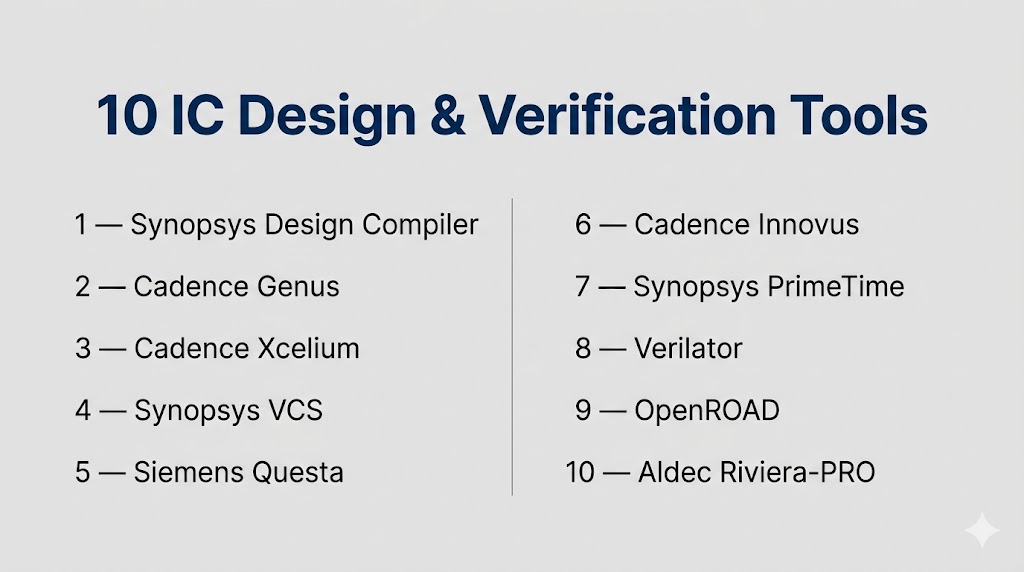
#1 — Synopsys Design Compiler
Short description: A leading synthesis tool used for converting RTL designs into optimized gate-level implementations.
Key Features
- RTL synthesis
- Timing and power optimization
- Support for advanced nodes
- High scalability
- Integration with verification tools
- Constraint-driven optimization
Pros
- Industry standard
- High-performance synthesis
Cons
- Expensive
- Requires expertise
Platforms / Deployment
Linux
Self-hosted
Security & Compliance
Not publicly stated
Integrations & Ecosystem
Synopsys tools integrate across the full chip design lifecycle.
- Verification tools
- Physical design tools
- APIs
- Semiconductor workflows
Support & Community
Enterprise-level support with strong documentation.
#2 — Cadence Genus
Short description: A modern synthesis solution offering high performance and advanced optimization for digital IC design.
Key Features
- RTL synthesis
- Multi-threaded optimization
- Power-aware design
- Integration with physical design
- High scalability
Pros
- Efficient performance
- Strong Cadence ecosystem
Cons
- Complex setup
- High cost
Platforms / Deployment
Linux
Self-hosted
Security & Compliance
Not publicly stated
Integrations & Ecosystem
- Cadence ecosystem
- Verification tools
- APIs
- IC design workflows
Support & Community
Strong enterprise support.
#3 — Cadence Xcelium
Short description: High-performance simulation platform for digital and mixed-signal verification.
Key Features
- Fast simulation engine
- Mixed-signal simulation
- Debugging tools
- Scalable architecture
- UVM support
Pros
- High simulation speed
- Strong verification capabilities
Cons
- Expensive
- Learning curve
Platforms / Deployment
Linux
Self-hosted
Security & Compliance
Not publicly stated
Integrations & Ecosystem
- Cadence verification suite
- Debug tools
- APIs
- Simulation workflows
Support & Community
Enterprise-grade support.
#4 — Synopsys VCS
Short description: A widely used simulation tool for functional verification of digital designs.
Key Features
- High-speed simulation
- UVM support
- Debugging capabilities
- Coverage analysis
- Scalable performance
Pros
- Industry adoption
- Reliable performance
Cons
- Cost
- Complexity
Platforms / Deployment
Linux
Self-hosted
Security & Compliance
Not publicly stated
Integrations & Ecosystem
- Synopsys ecosystem
- Verification tools
- APIs
- Debug tools
Support & Community
Strong enterprise support.
#5 — Siemens Questa
Short description: A comprehensive verification platform for functional, formal, and simulation-based verification.
Key Features
- Functional verification
- Formal verification
- Simulation
- Coverage analysis
- Debugging tools
Pros
- Comprehensive verification
- Strong reliability
Cons
- Learning curve
- Licensing cost
Platforms / Deployment
Windows / Linux
Self-hosted
Security & Compliance
Not publicly stated
Integrations & Ecosystem
- Siemens EDA ecosystem
- Verification tools
- APIs
- Debug workflows
Support & Community
Strong enterprise support.
#6 — Cadence Innovus
Short description: A physical design platform for place-and-route and chip implementation.
Key Features
- Place-and-route
- Timing optimization
- Power optimization
- Advanced node support
- Physical verification
Pros
- High performance
- Scalable
Cons
- Complex
- Expensive
Platforms / Deployment
Linux
Self-hosted
Security & Compliance
Not publicly stated
Integrations & Ecosystem
- Cadence ecosystem
- Physical design tools
- APIs
- IC workflows
Support & Community
Enterprise-level support.
#7 — Synopsys PrimeTime
Short description: Industry-standard tool for static timing analysis and sign-off.
Key Features
- Static timing analysis
- Sign-off validation
- Power analysis
- High accuracy
- Integration with synthesis tools
Pros
- High accuracy
- Industry standard
Cons
- Expensive
- Specialized use
Platforms / Deployment
Linux
Self-hosted
Security & Compliance
Not publicly stated
Integrations & Ecosystem
- Synopsys ecosystem
- Design tools
- APIs
- IC workflows
Support & Community
Strong enterprise support.
#8 — Verilator
Short description: An open-source tool for fast simulation of digital designs.
Key Features
- High-speed simulation
- Open-source
- SystemVerilog support
- Integration with C++
- Lightweight
Pros
- Free
- Fast
Cons
- Limited features vs enterprise tools
- No full UVM support
Platforms / Deployment
Linux / macOS
Self-hosted
Security & Compliance
Not publicly stated
Integrations & Ecosystem
- Open-source ecosystem
- APIs
- Simulation tools
- Developer workflows
Support & Community
Active open-source community.
#9 — OpenROAD
Short description: Open-source tool for automated physical design of digital chips.
Key Features
- Automated place-and-route
- Open-source
- Scalable workflows
- Integration with open PDKs
- Chip design automation
Pros
- Free
- Growing ecosystem
Cons
- Still evolving
- Limited enterprise support
Platforms / Deployment
Linux
Self-hosted
Security & Compliance
Not publicly stated
Integrations & Ecosystem
- Open-source tools
- APIs
- Semiconductor workflows
- Research ecosystem
Support & Community
Academic and community-driven support.
#10 — Aldec Riviera-PRO
Short description: A simulation and verification platform for FPGA and ASIC designs.
Key Features
- HDL simulation
- Debugging tools
- Coverage analysis
- FPGA verification
- Mixed-language support
Pros
- Flexible
- Good FPGA support
Cons
- Smaller ecosystem
- Less adoption than top vendors
Platforms / Deployment
Windows / Linux
Self-hosted
Security & Compliance
Not publicly stated
Integrations & Ecosystem
- FPGA tools
- APIs
- Simulation workflows
- Debug tools
Support & Community
Moderate community and vendor support.
Comparison Table (Top 10)
| Tool Name | Best For | Platform(s) Supported | Deployment | Standout Feature | Public Rating |
|---|---|---|---|---|---|
| Synopsys Design Compiler | RTL synthesis | Linux | Self-hosted | Industry standard | N/A |
| Cadence Genus | Synthesis | Linux | Self-hosted | Optimization | N/A |
| Cadence Xcelium | Simulation | Linux | Self-hosted | High speed | N/A |
| Synopsys VCS | Verification | Linux | Self-hosted | UVM support | N/A |
| Siemens Questa | Verification | Windows, Linux | Self-hosted | Formal verification | N/A |
| Cadence Innovus | Physical design | Linux | Self-hosted | Place & route | N/A |
| Synopsys PrimeTime | Timing analysis | Linux | Self-hosted | Sign-off accuracy | N/A |
| Verilator | Open-source simulation | Linux, macOS | Self-hosted | Speed | N/A |
| OpenROAD | Open-source PnR | Linux | Self-hosted | Automation | N/A |
| Riviera-PRO | FPGA simulation | Windows, Linux | Self-hosted | Flexibility | N/A |
Evaluation & Scoring of IC Design & Verification Tools
| Tool Name | Core (25%) | Ease (15%) | Integrations (15%) | Security (10%) | Performance (10%) | Support (10%) | Value (15%) | Weighted Total |
|---|---|---|---|---|---|---|---|---|
| Synopsys DC | 10 | 5 | 9 | 7 | 10 | 9 | 5 | 8.10 |
| Cadence Genus | 9 | 6 | 9 | 7 | 9 | 9 | 6 | 8.00 |
| Xcelium | 9 | 6 | 9 | 7 | 10 | 9 | 6 | 8.15 |
| VCS | 9 | 6 | 9 | 7 | 10 | 9 | 6 | 8.15 |
| Questa | 9 | 6 | 9 | 7 | 9 | 9 | 6 | 8.00 |
| Innovus | 10 | 5 | 9 | 7 | 10 | 9 | 5 | 8.10 |
| PrimeTime | 10 | 5 | 9 | 7 | 10 | 9 | 5 | 8.10 |
| Verilator | 7 | 7 | 6 | 5 | 8 | 7 | 10 | 7.35 |
| OpenROAD | 7 | 6 | 6 | 5 | 7 | 6 | 10 | 7.00 |
| Riviera | 8 | 7 | 7 | 6 | 8 | 7 | 7 | 7.45 |
How to interpret scores:
- Enterprise tools dominate in performance and features
- Open-source tools provide high value but limited support
- Ease of use is generally lower across IC tools
- Scores are comparative, not absolute
- Choose based on workflow fit and scale
Which IC Design & Verification Tool Is Right for You?
Solo / Freelancer
- Best: Verilator, OpenROAD
SMB
- Best: Riviera-PRO
Mid-Market
- Best: Questa, Xcelium
Enterprise
- Best: Synopsys, Cadence tools
Budget vs Premium
- Budget: Verilator, OpenROAD
- Premium: Synopsys, Cadence
Feature Depth vs Ease of Use
- Deep: Synopsys, Cadence
- Easier: Riviera
Integrations & Scalability
- Best: Synopsys, Siemens
Security & Compliance Needs
- Enterprise tools recommended
Frequently Asked Questions (FAQs)
What are IC design tools?
They are software used to design and verify semiconductor chips.
Are these tools expensive?
Yes, enterprise tools are costly.
Can beginners use them?
They require strong technical knowledge.
What languages are used?
Verilog and VHDL are common.
Is simulation necessary?
Yes, it prevents costly errors.
What is verification?
Ensuring the chip behaves correctly.
Are open-source tools useful?
Yes, for learning and small projects.
Can I run them on cloud?
Some workflows support cloud deployment.
How long to learn?
Several months to years.
What industries use them?
Semiconductors, AI hardware, automotive.
Conclusion
IC Design & Verification tools are critical for building modern semiconductor devices. While enterprise tools like Synopsys and Cadence dominate the industry, open-source tools provide accessible entry points.
