Introduction
Mechanical design software refers to digital tools used by engineers and designers to create, simulate, and optimize mechanical components and systems. These tools typically include CAD (Computer-Aided Design), CAE (Computer-Aided Engineering), and sometimes CAM (Computer-Aided Manufacturing) capabilities, allowing teams to design everything from simple parts to complex assemblies.
Today, mechanical design software plays a critical role in product development across industries such as automotive, aerospace, manufacturing, and consumer electronics. With increasing product complexity and shorter development cycles, these tools help teams reduce errors, accelerate innovation, and improve overall design quality.
Common real-world use cases:
- Designing mechanical parts and assemblies
- Product prototyping and validation
- Simulation and stress analysis (FEA integration)
- Manufacturing planning and CNC workflows
- Reverse engineering and design optimization
What buyers should evaluate:
- Ease of use and learning curve
- CAD modeling capabilities (parametric, direct modeling)
- Simulation and analysis features
- Integration with FEA, CAM, and PLM tools
- Cloud vs on-premise deployment
- Collaboration and version control
- Performance and scalability
- Cost and licensing flexibility
- Customization and API support
Best for: Mechanical engineers, product designers, manufacturing teams, startups building hardware products, and enterprise engineering teams.
Not ideal for: Non-technical users, teams needing only 2D drafting, or projects that don’t require complex 3D modeling and simulation.
Key Trends in Mechanical Design Software
- Cloud-based CAD platforms: Increasing shift to browser-based design tools
- AI-assisted design: Automated geometry generation and optimization
- Generative design workflows: Software suggesting optimal designs based on constraints
- Real-time collaboration: Multiple users working on the same model simultaneously
- Integration with FEA tools: Seamless simulation-driven design
- Digital twin adoption: Linking design with real-world performance data
- Low-code customization: Easier automation without deep programming
- Subscription pricing models: Reduced upfront costs
- Cross-platform compatibility: Work across devices and operating systems
- Stronger data security controls: Enterprise-grade governance and access management
How We Selected These Tools (Methodology)
- Strong industry adoption and brand recognition
- Comprehensive CAD and design capabilities
- Availability of simulation and manufacturing features
- Integration with engineering ecosystems
- Performance and reliability in large assemblies
- Flexibility for different user segments (SMB to enterprise)
- Availability of cloud and desktop deployment
- Vendor support, training, and documentation
- Customization and extensibility
- Overall value for cost
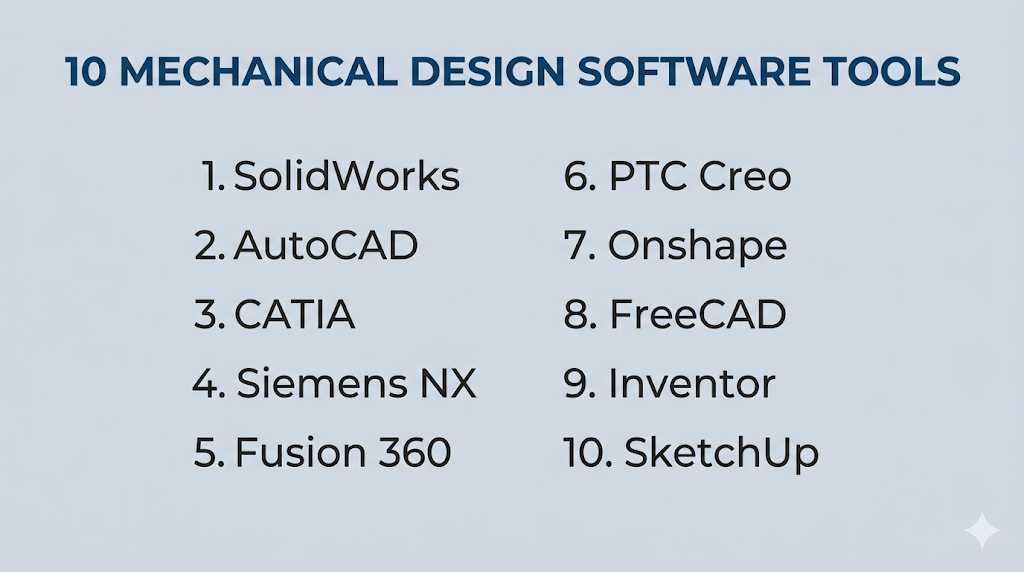
Top 10 Mechanical Design Software Tools
#1 — SolidWorks
Short description: One of the most widely used CAD tools for mechanical design, ideal for engineers and product designers.
Key Features
- Parametric 3D modeling
- Assembly design
- Integrated simulation tools
- Sheet metal and weldment design
- Rendering and visualization
- Extensive library support
Pros
- User-friendly interface
- Strong industry adoption
Cons
- Windows-only
- Licensing cost
Platforms / Deployment
Windows
Self-hosted
Security & Compliance
Not publicly stated
Integrations & Ecosystem
- PLM tools
- Simulation tools
- APIs
- CAD ecosystem
Support & Community
Large global community with extensive learning resources.
#2 — AutoCAD
Short description: A versatile CAD software widely used for both 2D drafting and 3D modeling.
Key Features
- 2D drafting and 3D modeling
- Customizable workflows
- Cloud storage integration
- Drawing automation
- Collaboration tools
Pros
- Industry standard
- Flexible use cases
Cons
- Not specialized for mechanical design
- Subscription cost
Platforms / Deployment
Windows / macOS
Cloud / Self-hosted
Security & Compliance
Not publicly stated
Integrations & Ecosystem
- Autodesk ecosystem
- APIs
- Cloud services
- Plugins
Support & Community
Strong documentation and user base.
#3 — CATIA
Short description: Advanced CAD software used in aerospace and automotive industries for complex product design.
Key Features
- Advanced surface modeling
- Large assembly management
- PLM integration
- Multi-disciplinary design
- High scalability
Pros
- Enterprise-grade capabilities
- Excellent for complex designs
Cons
- Expensive
- Steep learning curve
Platforms / Deployment
Windows
Cloud / Hybrid
Security & Compliance
Not publicly stated
Integrations & Ecosystem
- Dassault ecosystem
- PLM integration
- APIs
- Manufacturing tools
Support & Community
Enterprise-level support.
#4 — Siemens NX
Short description: A high-end integrated CAD, CAM, and CAE platform for advanced product development.
Key Features
- Integrated CAD/CAE/CAM
- Advanced simulation
- Generative design
- Digital twin capabilities
- Automation tools
Pros
- All-in-one platform
- Highly scalable
Cons
- Complex
- Expensive
Platforms / Deployment
Windows
Hybrid
Security & Compliance
Not publicly stated
Integrations & Ecosystem
- Siemens ecosystem
- PLM tools
- APIs
- Manufacturing systems
Support & Community
Strong enterprise support.
#5 — Fusion 360
Short description: Cloud-based CAD/CAM/CAE tool designed for startups and SMBs.
Key Features
- Cloud-based modeling
- Integrated simulation
- Generative design
- Collaboration tools
- CAM capabilities
Pros
- Easy to use
- Affordable
Cons
- Limited advanced features
- Internet dependency
Platforms / Deployment
Web / Windows / macOS
Cloud
Security & Compliance
Not publicly stated
Integrations & Ecosystem
- Autodesk ecosystem
- APIs
- Cloud collaboration
- CAD tools
Support & Community
Large and active community.
#6 — PTC Creo
Short description: A powerful parametric CAD tool known for robust modeling and simulation.
Key Features
- Parametric and direct modeling
- Simulation integration
- AR capabilities
- Additive manufacturing tools
- Advanced assemblies
Pros
- Strong modeling capabilities
- Enterprise-ready
Cons
- Learning curve
- Expensive
Platforms / Deployment
Windows
Self-hosted
Security & Compliance
Not publicly stated
Integrations & Ecosystem
- PLM tools
- APIs
- IoT integration
- CAD ecosystem
Support & Community
Strong enterprise support.
#7 — Onshape
Short description: A fully cloud-native CAD platform built for real-time collaboration.
Key Features
- Browser-based CAD
- Real-time collaboration
- Version control
- Parametric modeling
- Cloud storage
Pros
- No installation required
- Excellent collaboration
Cons
- Subscription-based
- Limited offline access
Platforms / Deployment
Web / iOS / Android
Cloud
Security & Compliance
Not publicly stated
Integrations & Ecosystem
- APIs
- Cloud integrations
- CAD tools
- Plugins
Support & Community
Growing community and documentation.
#8 — FreeCAD
Short description: An open-source parametric CAD tool suitable for hobbyists and engineers.
Key Features
- Parametric modeling
- Open-source
- Custom scripting
- Modular architecture
- Community extensions
Pros
- Free
- Flexible
Cons
- UI limitations
- Less polished
Platforms / Deployment
Windows / macOS / Linux
Self-hosted
Security & Compliance
Not publicly stated
Integrations & Ecosystem
- Open-source ecosystem
- Plugins
- Scripts
- APIs
Support & Community
Community-driven support.
#9 — Inventor
Short description: Autodesk’s mechanical design software focused on product engineering.
Key Features
- 3D mechanical design
- Simulation tools
- Sheet metal design
- Assembly modeling
- Automation
Pros
- Strong Autodesk integration
- Good for manufacturing
Cons
- Windows-only
- Subscription cost
Platforms / Deployment
Windows
Self-hosted
Security & Compliance
Not publicly stated
Integrations & Ecosystem
- Autodesk ecosystem
- APIs
- PLM tools
- CAD tools
Support & Community
Strong documentation and support.
#10 — SketchUp
Short description: A simple 3D modeling tool suitable for basic mechanical concepts and visualization.
Key Features
- Easy 3D modeling
- Web-based access
- Visualization tools
- Plugin support
- Fast learning curve
Pros
- Very easy to use
- Accessible
Cons
- Limited engineering capabilities
- Not suitable for complex design
Platforms / Deployment
Web / Windows / macOS
Cloud / Self-hosted
Security & Compliance
Not publicly stated
Integrations & Ecosystem
- Plugins
- APIs
- Visualization tools
- CAD integrations
Support & Community
Large community and tutorials.
Comparison Table (Top 10)
| Tool Name | Best For | Platform(s) Supported | Deployment | Standout Feature | Public Rating |
|---|---|---|---|---|---|
| SolidWorks | Product design | Windows | Self-hosted | Ease of use | N/A |
| AutoCAD | Drafting | Windows, macOS | Hybrid | Versatility | N/A |
| CATIA | Enterprise design | Windows | Hybrid | Advanced modeling | N/A |
| Siemens NX | Advanced engineering | Windows | Hybrid | CAD+CAE+CAM | N/A |
| Fusion 360 | SMB/startups | Web, Windows, macOS | Cloud | Cloud collaboration | N/A |
| PTC Creo | Enterprise CAD | Windows | Self-hosted | Parametric modeling | N/A |
| Onshape | Collaboration | Web, Mobile | Cloud | Real-time collaboration | N/A |
| FreeCAD | Open-source | All platforms | Self-hosted | Free | N/A |
| Inventor | Manufacturing | Windows | Self-hosted | Autodesk integration | N/A |
| SketchUp | Beginners | Web, Desktop | Hybrid | Simplicity | N/A |
Evaluation & Scoring of Mechanical Design Software
| Tool Name | Core (25%) | Ease (15%) | Integrations (15%) | Security (10%) | Performance (10%) | Support (10%) | Value (15%) | Weighted Total |
|---|---|---|---|---|---|---|---|---|
| SolidWorks | 9 | 9 | 8 | 6 | 8 | 9 | 7 | 8.15 |
| AutoCAD | 8 | 8 | 8 | 6 | 8 | 9 | 7 | 7.85 |
| CATIA | 10 | 5 | 9 | 7 | 9 | 9 | 5 | 7.95 |
| Siemens NX | 10 | 5 | 9 | 7 | 9 | 9 | 5 | 7.95 |
| Fusion 360 | 7 | 9 | 7 | 6 | 7 | 8 | 9 | 7.65 |
| Creo | 9 | 6 | 8 | 6 | 8 | 8 | 6 | 7.65 |
| Onshape | 7 | 9 | 8 | 6 | 7 | 8 | 8 | 7.70 |
| FreeCAD | 6 | 6 | 6 | 5 | 6 | 6 | 10 | 6.60 |
| Inventor | 8 | 8 | 8 | 6 | 8 | 8 | 7 | 7.75 |
| SketchUp | 6 | 10 | 6 | 5 | 6 | 7 | 8 | 6.95 |
Interpretation:
- Scores are comparative, not absolute
- Enterprise tools rank higher in features but lower in value
- Cloud tools rank higher in ease and collaboration
- Open-source tools rank highest in value but require effort
Which Mechanical Design Software Tool Is Right for You?
Solo / Freelancer
- Best: Fusion 360, SketchUp, FreeCAD
SMB
- Best: SolidWorks, Fusion 360
Mid-Market
- Best: Creo, Inventor
Enterprise
- Best: CATIA, Siemens NX
Budget vs Premium
- Budget: FreeCAD
- Premium: CATIA, Siemens NX
Feature Depth vs Ease of Use
- Deep: CATIA, NX
- Easy: Fusion 360, SketchUp
Integrations & Scalability
- Best: Siemens NX, SolidWorks
Security & Compliance Needs
- Enterprise tools preferred
Frequently Asked Questions (FAQs)
What is mechanical design software?
It is software used to create, simulate, and optimize mechanical components digitally.
Is CAD the same as mechanical design software?
CAD is a major part, but full tools also include simulation and manufacturing features.
How much does it cost?
Pricing varies from free tools to high-cost enterprise solutions.
Is cloud CAD safe?
Generally yes, but depends on vendor security practices.
Do I need high-end hardware?
Desktop tools require strong hardware; cloud tools reduce this need.
Can beginners use these tools?
Yes, especially tools like Fusion 360 and SketchUp.
What industries use this software?
Automotive, aerospace, manufacturing, and product design.
Can I integrate with FEA tools?
Yes, most modern tools support simulation integration.
Is open-source CAD good enough?
For basic use, yes. For enterprise needs, less so.
How long to learn?
Basic skills: weeks; advanced: months.
Conclusion
Mechanical design software is essential for modern product development, enabling teams to design, simulate, and optimize efficiently. From powerful enterprise platforms like CATIA and Siemens NX to accessible tools like Fusion 360 and FreeCAD, there is a solution for every level.
